7
5
7
download/literature/watchtower/1901-20.pdf
../literature/watchtower/1901/20/1901-20-5.html
(328-329)
ZION'S
WATCH
TOWER
ALL£GH£NY.
PA.
been
poured
out
upon
any
of
our
race
until
Pentecost.
It
in
divine
providence;
and
the
only
things
which
could
hinder
gll
e",
abo
a
",uggestlOn
re"'pectmg
the
breadth
of
character
of
us
from
feeling
patient
forbearance
and
kindly
sympathy
and
the
anclenb,
qUlte
in
contradictlOn
of
the
theory
of
evolution,
love
for
those
who
have
despitefully
used
and
persecuted
us,
\\
hich
\I
ould
claIm
that
at
that
early
period,
man
being
but
would
be
a
lack
of
the
spirit
of
the
Lord,
the
spirit
of
mercy,
sil;'!!ltly
above
the
monkey,
would
have
coarse
and
brutish
sen-
and
a
failure
to
see
properly
that
whatever
agencies
God
may
tllllenb.
use
in
our
spiritual
upbuilding
are
to
be
appreciated
and
sym-
'/""!'jlh
pr('al'1](,(1
a
gn'at
~('rmon
to
his
brethren
in
few
pathized
with;-whether
they
be
brethren
or
of
the
world
words
when
he
saId,
"God
did
send
me
before
you
to
preserve
Egyptians.
11
!l>"-hc
thus
0\
crruled
your
\\
lOng
cour;,e,
and
has
brought
Then
Joseph
explained
the
providence
of
God,
the
years
of
out
of
It
a
blessing.
He
gave
IllS
brethren
credIt
for
ability
to
plenty
and
the
years
of
famine,
and
how
God
had
been
super
IInd"I,LIlI"
"udl
t1llngs.
'lh,lt
the
Lord
oYerrul"d
their
course
vising
the
entire
matter,
and
that
this
was
his
means
of
pre
for
gaud,
dId
not
prove
that
their
course
was
a
good
?~
prop.er
serving
Abraham's
posterity,
('oneluding,
"So
now,
it
was
not
com
,I',
It
meldy
proved
th('
dIvine
power
and
the
dlvllle
WIS-
you
that
sent
me
hither,
but
God."
\Ve
are
not
to
!!;ive
credit
dum
an,1
til'
me
1'101
l"ell(,("
that
\1
as
over
Joseph
and
over
all
to
the
evil
agencies
through
which
we
have
receive(l
blessings,
the
hon"e
of
Jacub,
camUlI"
all
things,
evcn
the
enl
thlllg,
to
otherwise
we
might
soon
be
disposed
to
call
evil
goo(l,
but
we
I,
01
k
out
fur
gooJ,
aCC01(.l~lg
to
the
tIivme
plan.
How
great
are
to
give
full
credit
to
God,
because
that
which
was
intended
.~lId
h(l\\-
Lhting
a
1""'''''11
(',line
to
JO'leph's
brethren
through
to
be
evil,
and
which
wa'l
evil
of
itself.
divine
wisdom,
,,0
far
th"ll
('~\l(,l
]('nces,
and
through
this
IllS
short
sermon
\\
e
can-
above
the
earthly
plane,
was
able
to
overrule
for
our
good.
It
Hot
t"ll;
hut
there
is
a
great
les,on
here
for
all
of
God's
is
as
we
lcarn
the
lesson
of
Gods
inhercnt
good!l('"s-ns
we
pl
"I'k
toti.ly
alung
the
line
of
mercy
towar~
those
wl~o
del~b-
learn
to
respect
his
wi'ldom,
loY{'
and
power
that
our
faith
('J
atplv
"Ill
u"ain"t
us;
antI
abo
along
the
hne
of
notlllg,
dlS-
grows
stronger
and
stronger,
until
we
are
able
to
trust
the
Cl'lllll;g
and
~
etcrring
to
divllle
providence
in
connectiun
with
Lord,
not
only
in
things
which
we
can
see
are
working
out
for
a
Ill'
allan".
\Ye
ale
not
only
to
notc
divine
provldences,
but
our
good,
but
able
to
trust
him
also
in
rpspect
to
thin!!:R
which
'\l'
HI
e
to
gIve
cre,lit
for
them,
as
it
is
written,
"In
all
thy
seem
entirely
dark
and
out
of
which
apparently
no
good
can
\\.1.1"
(lcl.}lUl~/ed[Je
hun
"-PIOY.
3:6.
come;
thus
we
trust
him
where
we
cannot
trace
him.
And
.To,eph
could
have
pcrmittctI
his
expericnces
to
have
devel-
this
is
faith;
and
faith
is
a
gift
of
Go(1
in
that
it
i"
culti
OIJl'd
a
gleat
tIcal
of
pculOn.tl
pude.
He
mIght
have
reasoned
vated
to
acceptable
development
by
the
Lord's
glacious
prom
to
hilll"df,
as
some
would
have
reasoned,
that
he
was
merely
'ises,
rightly
received,
appreciated
and
acted
upon.
luck,}',
or
that
he
was
naturally
bnght,
attractive,
smart,
and
While
Joseph
had
patiently
waited
for
the
Lord's
time
to
that
tillS
\\
as
the
secret
of
his
success;
that
this
was
the
rea-
come,
and
for
twenty
years
had
not
seen
his
father's
face,
son
IllS
father
lovell
him
specially;
that
this
was
the
reason,
having
now
witnessed
the
fulfillment
of
his
fir"t
drpam,
the
\1
hen
"old
for
a
slave,
he
was
bought
by
a
good
master
in
af-
bowing
of
his
brother's
sheaves
to
his
sheaf,
he
realizpd
that
tl\lpEt
circumstances;
that
this
personal
bnlliancy
was
the
the
Lord's
time
had
about
come
for
him
aga
in
to
Sf'e
his
fath
cau"p
of
his
ri"e
in
Potiphar's
house
to
eminence;
that
the
er,
when
the
second
dream
would
be
fulfillc(],
And
whereas
he
sallie
effcctcd
his
rise
to
a
position
of
authority
in
the
prison;
was
all
patience
before,
now
he
was
all
energy
and
haste,
be
th.lt
IllS
kecnnc"s
of
intellcct
hatI
enablcd
him
to
interpret
the
cause
the
time
\yas
come,
and
so
he
said
to
IllR
hrcthren,
l!leams;
an,1
that
in
gellcl
al
he
stood
head
and
shoulders
"Haste
ye,
and
go
up
tv
my
father,
and
say
unto
him,
Thus
,lboY('
ether
men;
antI
that
others
realized
this,
antI
hence
saith
thy
son
.Joseph,
God
hath
made
me
lord
of
all
Egypt.
he
h'lll
come
by
his
exaltation
in
a
natural
way.
But
had
he
Come
down
unto
me;
tarry
not."
He
impressed
upon
his
thus
uf'en
heady
and
hIgh-minded,
and
self-conceited,
we
may
brethren
the
glories
of
his
position,
not
by
way
of
boast
or
he
Hire
that
It
woulll
haye
led
to
a
fall-that
GotI
would
not
pride,
but
by
way
of
assuring
them
of
his
authority
and
powpr
have
continuetI
to
bless,
prosper
and
advance
him.
'We
may
to
care
for
them,
and
so
that
they
might
fully
assurc
their
lJl'
SUll"
too,
that
had
hc
thus
developetI
a
spint
of
pride
and
father
Jacob
that
his
caution
might
not
hinder
him
from
tak
self-eonceit,
his
conduct
with
his
brethren
would
have
been
very
ing
advantage
of
the
goodly
land
of
Goshen,
now
put
at
their
difTplf'nt
from
\\hat
it
was.
He
would
have
been
crowing
disposal.
His
brethren
and
fathl'r
were
not
invited
to
come
01
pr
th"ll1,
and
mi~treating
them
in
order
to
convince
them
of
and
share
in
his
throne
and
regal
power,
but
were
inviterl
to
llh
pOI',
pr,
and
thus
woultI
have
shown
him"eIf
to
be
a
very
come
and
partake
of
all
the
blessings
flowing
therefrom.
.Tust
HIUdl
,maIler
man
than
hi"
proper
courSe
shows
him
to
have
so
during
the
Millennial
nge,
after
the
Christ,
Head
and
body,
IH'('n.
lIe
was
a
grent
mnn,
and
his
greatness
was
manifested,
represented
in
.Joseph
shnll
be
in
the
throne
of
glory
amI
of
not
mPlcly
in
his
financial
management
of
the
kingdom
of
power-in
the
heavenly
Father's
throne-when
the
'kingdom
1-:glpt,
hut
espccinlly
manIfested
in
his
reliance
upon
God,
his
of
God
shall
be
established
in
the
earth,
nIl
who
feel
a
faminl',
reali/ntion
that
thp
dIvine
promise
and
blessing,
through
his
a
hunger,
for
the
true
bread
of
heaven,
for
etl'rnnl
life,
will
great-grallllfather
Abraham,
his
grandfather,
Isaac,
and
his
be
invited
to
come
and
receive
abundantly
of
it.
None,
however,
fathpr,
,Tac-oh,
was
resting-
upon
him
in
some
manner,
and
that
of
the
earthly
class
will
be
invited
to
share
in
the
kingdom
l)('c-a
lI~e
of
tIllS
divine
favor
things
were
working
as
they
were.
honors,
for
the
kingdom
class
will
be
complete.
But
thev
will
be
invited
to
come
and
receive
the
blessings
of
the
kin'gdom,
The
spiritunl
seed
of
Abraham
may
draw
valuable
lessons
mental,
moral
and
physical,
health
nn(l
strength,
under
the
from
this
nnrrative.
If
it
was
appropriate
that
Joseph
should
favor
of
the
King
of
kings,
and
Lord
of
lords.
IH'kno\\'le,lge
the
Lora
as
the
giver
of
all
his
blessings.
which
The
parting
of
.Joseph
and
his
brethren
was
an
affecting
'\('1
f'
all
of
an
carthly
amI
tf'mporal
kind,
how
much
more
one;
they
now
understood
the
meaning
of
their
previous
ex
~h/)1I111
the
i'ipiritual
see
a
of
Abraham
acknowledge
the
spirit-
periences,
including
the
cup
found
in
Benjamin's
sack;
they
lIal
],]p~,ilJgs
r1'PPivf'll
at
the
Fathf'r's
hnnd,-and
recognize
in
saw
that
these
matters
all
were
leading
up
to
the
present
man
('\'('n'
TllPr('v
nnd
favor
opportunities
of
service;
that
it
is
the
ifestation
to
thl'm
of
the
love
and
sympathy
of
Joseph,
and
h,lll,1
of
pr()vi,lpnce.
f;nrC'ly
these
should
always
bl'
on
the
now,
as
expressing
his
special
love
for
Benjamin
he
kissed
him
n
It'l
L
to
rpa
li7p
nn(l
to
confess,-"lt
is
the
Lord's
doing,
and
first,
weeping
tears
of
joy
and
recognition,
and
then
did
to
it
I"
Tllarl'plous
in
our
PYP'l."
But
on
the
contrary,
we
are
all
the
other'l
similarly,
and
sent
them
on
their
way.
There
~()II
v
at
time"
to
fiml
soml'
of
God's
spiritual
children
inclined
is
power
in
affection,
in
love;
but
it
is
necessary
that
the
101'
t"
hC'
pnfff'd
up,
and
to
sppnk
of
God's
favor,
the
knowledge
of
ing
affection
be
manifested,
ere
that
power
can
be
felt.
A
n",
tJ
ut
1,
\11n('h
thf'v
hnve
rf'cdved
of
the
Lord,
as
though
it
difficulty
with
many
parents,
husbands,
wives,
children,
is
that
'\
('l'f'
'OI11dhin,g
of
tllPir
own
aphievement;
-as
though
some
they
do
not
manifest
all
the
affection
which
they
feel.
Pride
Ii00wr
\VPTe
(luc
thpm,
as
thp
inventors
of
the
divine
plan.
or
fear
or
some
other
thing
hinders,
restrains
them,
from
.\:!,Jin,
the
"piritual
Israf'lite
should
be
even
more
merci-
being
as
frank
with
each
other
as
they
should
be.
Joseph's
fill
than
,To~rph.
If
he
coulll
spe
that
the
persecutions
he
re-
example
here
is
worthy
of
emulation.
He
was
the
wronged
r"I\'p~.
from
hi"
brdllrf'n
ana
othcrs,
are
merely
incidents
of
one;
he
was
the
one
in
power;
he
was
the
one
who
should
di\
111('
providrncp-\\
hich
the
Lord
is
using
to
prepare
him
for
have
the
dignity,
and
he,
therefore,
was
the
one
who
could
best
('()]lIilli!'
hle,~ings
and
exaltation,
should
not
the
spiritual
Is-
afford
to
humble
himself,
and
to
kiss
and
make
an
ado
over
r,1<']lt"
t.11,e
hi"
dIsappOintments
as
(lod's
app01ntmcnts?
And
his
brethren.
Y'e
may
be
sure
that
they
appreciated
it;
that
~h/)uld
he
not"
ith
a
clparcr
r~'e
of
faith,
be
the
better
able
to
such
a
mnnifest
.ltion
of
affection
On
the
part
of
the
highly
H''''
that
many
of
hi~
spiritual
advancements
have
come
as
a
exalted
brother
touched
a
tender
spot
in
their
hearts,
and
I
(,~Il!t
of
ppr~(cutions
from
the
world
and
from
fal<;e
brethren?
doubtles'l
work£d
good
for
them
to
the
remainder
of
their
.\
nil
shoul'l
he
not,
like
.Jo"eph,
look
with
great
complacency
lives.
And
so
\'1'
may
find
it
with
our
friends
and
relativeR,
lIpon
a
II
thr"e
various
ai!'pncif's
which
God
has
been
pleased
to
that
a
manifestation
of
our
love
and
kind
feeling
toward
them
1'''('
in
«piritlllllly
uplifting-
him,
to
perfect
him
as
a
'new
will
not
only
be
reciprocated,
but
will
do
them
good;
and
prf'atllTl',"
an
hpir
of
Goll,
a
joint-heir
with
.Tesus
Christ,
his
that
our
affl'ction
rl'strained
of
expression
will
leave
an
icy
Lord"
JTp
sUfl,lv
"houl(!.
AmI
the
onlv
thing-s
which
can
hin-
roldnesR,
wllich
nothing
else
will
remove,
and
that
such
cold
dpr
11"
from
sf'l'ing
that
our
ndvancf'ment
is
of
the
Lord,
and
ne~s
will
affect
not
onlv
them
but
ourselves
also
unfavorably
not
of
ourselves,
will
be
a
lack
of
humility,
and
a
lack
of
trust
-sapping
all
of
life's
joy-springs,
[2894]
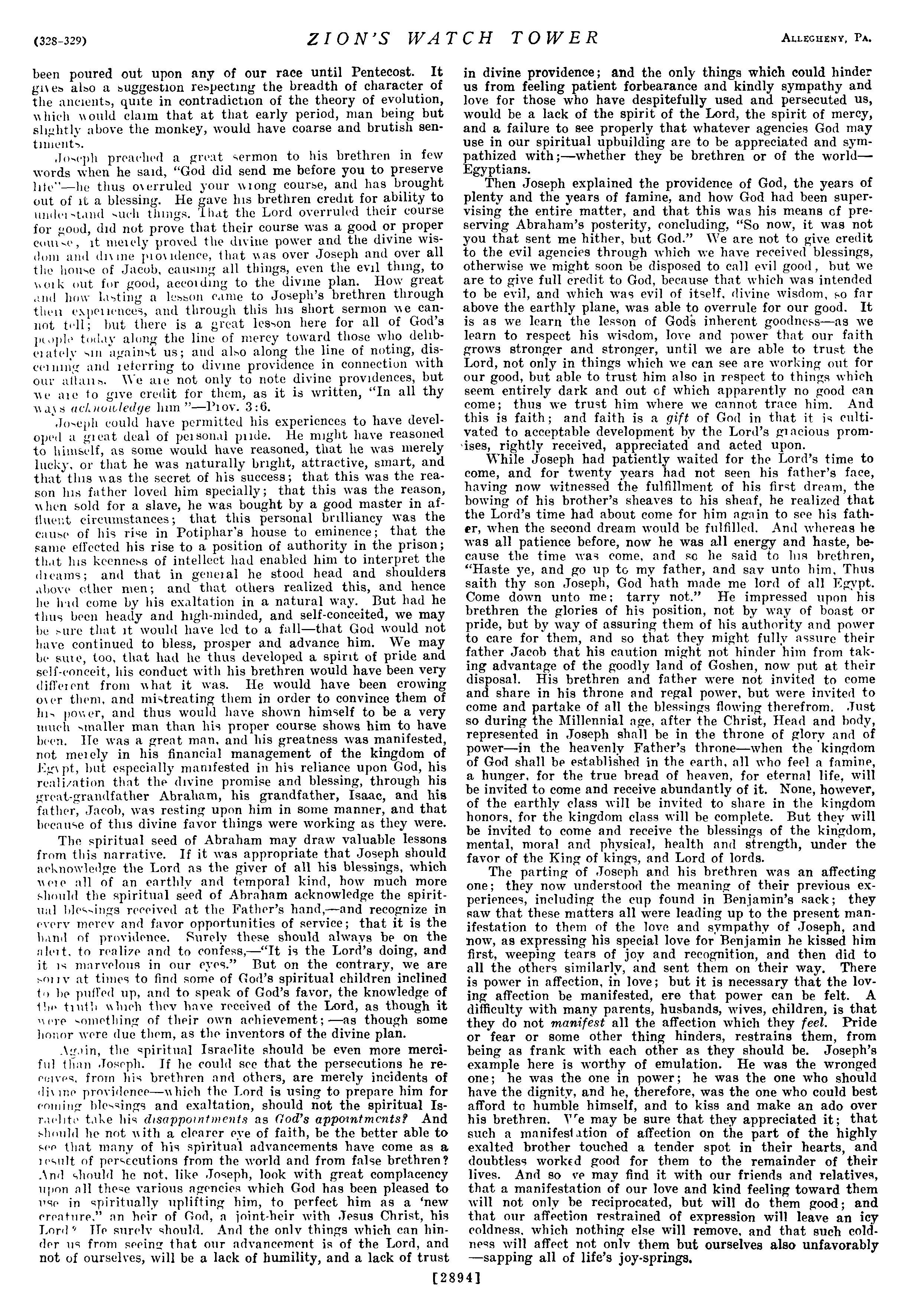
(328-329) been poured out upon any of our race until Pentecost. It gives also a suggestion respecting the breadth of character of the ancients, quite in contradiction of the theory of evolution, which would claim that at that early period, man being but shehtly above the monkey, would have coarse and brutish sentimients. Joseph preached a great sermon to his brethren in few words when he said, “God did send me before you to preserve lite"—he thus overruled your wrong course, and has brought out of 1t a blessing. He gave his brethren credit for ability to understand such things. ‘That the Lord overruled their course for goud, did not prove that their course was a good or proper cause, if merely proved the divine power and the divine wisdom and divine providence, that was over Joseph and over all the house of Jacob, causing all things, even the evil thing, to work out for good, according to the divine plan. How great and how lasting a lesson came to Joseph’s brethren through then experiences, and through this his short sermon we cannot tell; but there is a great lesson here for all of God’s poople today along the line of mercy toward those who deliberately sin against us; and also along the line of noting, disecuumeg and referring to divine providence in connection with our atlans. We aie not only to note divine providences, but we are to give credit for them, as it is written, “In all thy ways acknowledge him ”—PDroy. 3:6. Joseph could have permitted his expericnces to have developed a great deal of personal pide. He might have reasoned to himself, as some would have reasoned, that he was merely lucky, or that he was naturally bright, attractive, smart, and that this was the secret of his success; that this was the reason his father loved him specially; that this was the reason, when sold for a slave, he was bought by a good master in affluent circumstances; that this personal brilliancy was the cause of his rise in Potiphar’s house to eminence; that the same effected his rise to a position of authority in the prison; that lis keenness of intellect had enabled him to interpret the dreams; and that in general he stood head and shoulders above clher men; and that others realized this, and hence he had come by his exaltation in a natural way. But had he thus been heady and high-minded, and self-conceited, we may be sure that it would have led to a fall—that God would not have continued to bless, prosper and advance him. We may Le sure, too, that had he thus developed a spirit of pride and self-conceit, his conduct with his brethren would have been very different from what it was. He would have been crowing over them, and mistreating them in order to convince them of his power, and thus would have shown himself to be a very much smaller man than his proper course shows him to have been. Ie was a great man, and his greatness was manifested, not metely in his financial management of the kingdom of Ey, pt, but especially manifested in his reliance upon God, his realization that the divine promise and blessing, through his wrent-grandfather Abraham, his grandfather, Isaac, and his father, Jacob, was resting upon him in some manner, and that beenuse of this divine favor things were working as they were. The spiritual seed of Abraham may draw valuable lessons from this narrative. If it was appropriate that Joseph should acknowledge the Lord as the giver of all his blessings, which were all of an earthly and temporal kind, how much more should the spiritual seed of Abraham acknowledge the spiritual blessings received at the Father’s hand,—and recognize in every mereyv and favor opportunities of service; that it is the hand of providence, Surely these should always be on the alert, to realize and to confess,—“It is the Lord’s doing, and it 1s marvelous in our eyes.” But on the contrary, we are sorry at times to find some of God’s spiritual children inclined to be puffed up, and to speak of God’s favor, the knowledge of the tinth winch thev have received of the Lord, as though it were something of their own achievement ;—as though some honor were due them, as the inventors of the divine plan. Again, the spiritual Israclite should be even more merciful than Joseph. If he could see that the persecutions he reecives, from his brethren and others, are merely incidents of divine providence—which the Lord is using to prepare him for coming blessings and exaltation, should not the spiritual Israclite take his disappointments as God’s appointments? And shonld he not with a clearer eve of faith, be the better able to see that many of his spiritual advancements have come as a result of persecutions from the world and from false brethren? And should he not, like Joseph, look with great complacency upon all these various agencies which God has been pleased to vse in spiritually uplifting him, to perfect him as a ‘new creature.” an heir of God, a joint-heir with Jesus Christ, his Lord* Tle surely should. And the onlv things which can hinder us from seeing that our advancement is of the Lord, and not of ourselves, will be a lack of humility, and a lack of trust ZION’S WATCH TOWER ALLEGHENY, Pa, in divine providence; and the only things which could hinder us from feeling patient forbearance and kindly sympathy and love for those who have despitefully used and persecuted us, would be a lack of the spirit of the Lord, the spirit of mercy, and a failure to see properly that whatever agencies God may use in our spiritual upbuilding are to be appreciated and sympathized with;—whether they be brethren or of the world— Egyptians, Then Joseph explained the providence of God, the years of plenty and the years of famine, and how God had been supervising the entire matter, and that this was his means of preserving Abraham’s posterity, concluding, “So now, it was not you that sent me hither, but God.” We are not to give credit to the evil agencies through which we have received blessings, otherwise we might soon be disposed to call evil good, but we are to give full credit to God, because that which was intended to be evil, and which was evil of itself, divine wisdom, so far above the earthly plane, was able to overrule for our good. It is as we learn the lesson of Gods inherent goodness—as we learn to respect his wisdom, love and power that our faith grows stronger and stronger, until we are able to trust the Lord, not only in things which we can see are working out for our good, but able to trust him also in respect to things which seem entirely dark and out of which apparently no good can come; thus we trust him where we cannot trace him. And this is faith; and faith is a gift of God in that it is cultivated to acceptable development by the Lord’s miacious prom ‘ises, rightly received, appreciated and acted upon. While Joseph had patiently waited for the Lord’s time to come, and for twenty years had not seen his father’s face, having now witnessed the fulfillment of his first dream, the bowing of his brother’s sheaves to his sheaf, he realized that the Lord’s time had about come for him again to see his father, when the second dream would be fulfilled. And whereas he was all patience before, now he was all energy and haste, because the time was come, and so he said to Ins brethren, “Haste ye, and go up tc my father, and sav unto him, Thus saith thy son Joseph, God hath made me lord of all Egypt. Come down unto me; tarry not.” He impressed upon his brethren the glories of his position, not by way of boast or pride, but by way of assuring them of his authority and power to care for them, and so that they might fully assure their father Jacob that his caution might not hinder him from taking advantage of the goodly land of Goshen, now put at their disposal. His brethren and father were not invited to come and share in his throne and regal power, but were invited to come and partake of all the blessings flowing therefrom. Just so during the Millennial age, after the Christ, Head and body, represented in Joseph shall be in the throne of glory and of power—in the heavenly Father’s throne—when the kingdom of God shall be established jin the earth, all who feel a famine, a hunger, for the true bread of heaven, for eternal life, will be invited to come and receive abundantly of it. None, however, of the earthly class will be invited to share in the kingdom honors, for the kingdom class will be complete. But they will be invited to come and receive the blessings of the kingdom, mental, moral and phvsical, health and strength, under the favor of the King of kings, and Lord of lords. The parting of Joseph and his brethren was an affecting one; they now understood the meaning of their previous experiences, including the cup found in Benjamin’s sack; they saw that these matters all were leading up to the present manifestation to them of the love and sympathy of Joseph, and now, as expressing his special love for Benjamin he kissed him first, weeping tears of joy and recognition, and then did to all the others similarly, and sent them on their way. There is power in affection, in love; but it is necessary that the loving affection be manifested, ere that power can be felt. A difficulty with many parents, husbands, wives, children, is that they do not manifest all the affection which they feel. Pride or fear or some other thing hinders, restrains them, from being as frank with each other as they should be. Joseph’s example here is worthy of emulation. He was the wronged one; he was the one in power; he was the one who should have the dignity, and he, therefore, was the one who could best afford tc humble himself, and to kiss and make an ado over his brethren. V‘e may be sure that they appreciated it; that such a manifestation of affection on the part of the highly exalted brother touched a tender spot in their hearts, and doubtless worked good for them to the remainder of their lives. And so ve may find it with our friends and relatives, that a manifestation of our love and kind feeling toward them will not only be reciprocated, but will do them good; and that our affection restrained of expression will leave an icy coldness, which nothing else will remove, and that such coldness will affect not only them but ourselves also unfavorably —sapping all of life’s joy-springs. [2894]
Ez a honlap cookie-kat használ a honlap és a felhasználói élmény fejlesztésére. A honlap további használatával hozzájárulsz a cookie-k használatához. Ha további információt szeretnél, vagy ha nem szeretnél hozzájárulni a cookie-k használatához, kérünk, látogass el az
Adatvédelmi irányelvek
Használati feltételek
oldalra.


