16
13
16
download/literature/watchtower/1922-8.pdf
../literature/watchtower/1922/8/1922-8-13.html
THE
TRUE
REFORMATION
FORESHADOWED
HULDAH
THE
PROPHETESS
FINDING
THE
WORD
OF
THE
LORD
-
-
MAY
21-
2
CHRONICLES
34:
14-33
-
-
"Thy
trord
is
a
lamp
unto
my
teet,
and
a
light
unto
my
[iath."-Psalm
119:
105
KI]\"G
JOSIAH
THE
REFOR,lER
-
FINDING
THE
WORD
OF
THE
LORD
-
HULDAH
THE
PROPHETJ<:S&
-
THE
PRELIMINARY
REFORMA
TION
-
THE
TRUE
REFORMATION
-
THY
WORD
IS
A
LAMP.
the
people
ol'Ully
by
the
prrests,
who
ga\'e
it
fmm
memory.
It
is
not
&urprising,
therefore,
thnt
when
the
book
of
thfJ
law
was
found
by
the
jJl'le"t
Hilkmh
it
was
e"teemerl
a
treasure,
delivered
to
ShajJhan,
the
king's
secretary,
and
reau
in
the
king's
he,lring.
Its
uelineatiolls
of
the
law
of
Gou
incumbent
upon
his
people
I~rael
were
SO
dIfferent
from
what
the
people
hatl
been
taught
by
the
priests,
by
woru
of
mouth,
that
the
king
was
astonisherl
and
"lent
his
garment"
(an
expre&swn
of
uI"may),
N01'
could
we
expect
otherwise,
when
we
rememlJ~r
that
idolatry
had
flonl'lshed
to
a
considerable
extent
for
uYer
thl'ee
hnndretl
years,
with
only
occasional
reformations;
and
that
dnrmg
all
that
time
the
priests
and
Levites
who
had
III
any
degree
remllllled
faithful
to
the
Lord
were
without
~llPIJort
flom
the
people;
for
they
had
no
land
of
thell'
own,
and
were
largely
de
pendent
upon
the
tithes,
anrl
c()n~equently
rlurlllg
the
period
of
Idolatry
would
be
obliged
to
engage
con"ltlerably
in
secu
lar
emplo~'ment,
Heahzlllg
how
far
short
Israel
had
come
of
the
demands
of
the
law,
and
notlt1g'the
punishment,>
prescnbed
III
that
law
for
unfaithfulnef;f;,
the
klllg
was
greatly
troubled.
Ac
cordlIlgly
he
sent
several
of
his
court
officers
with
the
high
pI
iest
to
inquire
of
the
Lord,
through
fl
pruphet,
re'>jJecting
the
status
of
the
Cfl&e
llnd
respecting
what
"hould
be
done
by
Israel
to
escape
the
llulllshments
which
he
realized
justly
belonged
to
the
nation
under
the
conditions
of
that
law
covenant,
T
H
UID
reform,ltwn
III
a
reltgious
sense
consIsts
not
in
finlllt1g
sometillng
ne\\,
but
in
findlt1g
something
old;
not
III
the
de\
eloplllent
of
»ome
new
and
untried
hu
man
plan
for
human
s,ll\'atlOn,
but
III
the
rediscovery
of
the
plan
of
GOII.
III
the
restol'lltlOn
of
his
\VorlI
to
its
right
ful
place
in
the
hearts
of
tile
people;
and
this
is
illustrated
in
tile
e\
en
t"
of
toda~"s
les"on,
KlIlg
Jusinh,
\\hose
name
&Ignifies
Jeho'Uah
1mll
support,
wa'>
born
dunng
the
pPl'lod
of
his
grandfather
Manasseh's
refol'lnatwn
mu\'(~ment
Hnd
apparently
wa'>
of
godly
parent
m;e
011
hi'>
motller'"
f,lde.
Her
name,
Jeelirlah,
signifies
the
be!o!;ed
at
Jeho!
ah:
Hnd
her
mother's
name,
Adrah,
signifies
the
honorea
at
Jdwvah.
Parents
who
had
no
interest
III
the
\\
orsillp
of
.J
ehov.1h
wou1<l
not
thus
name
their
children,
and
\\
e
ma.v
:!»;;,ullle
that
the
earl~'
traming
of
King
Josiah
wa;,
of
the
!Je~
t.
.Joswh
came
to
the
throne
at
eight
~'ears
of
age.
His
si"leenth
yem'
datp'o
hI"
converSIOn,
the
date
at
which
the
c111Ol11cler
say":
"He
began
to
sec/,;
after
the
God
of
David,
his
father".
And
thiS
ul'lngs
to
our
attentIOn
a
fact
that
is
lost
sight
of
by
many;
VIZ.,
that
It
is
one
thing
to
be
"ell-born
and
\\
ell-dispo»ed
and
anothel'
thlllg
entirely
to
con'oecrate
the
heart
to
the
Lord;
and
this
latter
step
many
morally
inclined,
"good"
people,
neglect
to
take,
to
their
own
permanent
clI"atl\
:llItage.
It
IS
not
f,uttiClent
that
we
be
well-clI»posed,
moral.
It
is
nece&sary
that
we
become
the
Loa!'",
de\
otmg
our"elves
to
IllS
Will,
alld
then
seek
after
him
to
know
lll~
\nll
that
we
may
tl0
it
It
If,
onl~'
to
tho<;e
that
thus
rlraw
ncar
to
the
Lord
that
hIS
Ill'ombe
extends:
"Drn\\
neal'
unto
me,
and
I
WIll
uraw
near
unto
~'ou".
'l'he
re"ult
of
the
klJ1g's
thus
&eekIllg
the
Lord
culmlJ1atect
foul'
ye:lJs
laler
III
a
determIllation
to
u~e
hi"
influence
and
power
for
the
complete
overthrow
of
ilIolntry
throughout
the
kll1!;'clom;
and
the
next
&IX
years
of
hiS
rCI~n
were
de\
oted
to
thi<;
work.
How
well
the
work
was
'lone
the
SCl'lptures
bear
wltnef,'o:
"Like
unto
him
was
there
no
kmg
before
hun,
that
tUl'lled
to
the
Lord
with
all
hI'>
heart,
lIntl
\\
ith
all
IlIS
soul,
accordmg
to
all
the
law
of
Moses;
neIther
after
Imn
aro"e
there
any
like
him",
(2
Kings
23:
23)
Our
les:,on
"hows
the
ba"is
for
this
thorough-goIllg
re
formatIOn
whIch
I\:ing
.Josll1h
instItuted.
'rhe
pl'ophets
Jel'emiah
amI
Zephaninh
\\el'e
then
living
and
prophesying,
but
the
klfle:
for
~ome
reaf,on
sent
hIS
mef,"enger~
to
a
prophetes:-..
Hllidah,
tlau~hter-m-l:1\V
of
one
of
IllS
court
officers.
Why
the
klllg
pas&ecl
uy
two
prominent
prophets,
to
1l111ke
IIlqulry
at
the
mouth
of
one
otherwi&e
unknown
in
the
Scnpture
narrative,
\\e
can
onl~'
conjec
ture:
(1)
It
Illay
ha
\
e
been
that
of
a
woman
the
klllg
might
hope
to
receive
n
sotter
and
more
pencpflll
me»sage
than
from
n
man,
eSIJPr
ially
as
tIllS
woman,
through
her
ffltIJer-lI1-la\\,
wa'>
connedetl
wltll
11l~
own
court
and
would
therefore
be
tlI~po"prl
to
gl\'P
fl-;
l(llldl~'
II
mpf,~age
as
POSSI
ble.
(2)
Anothel'
;'lI~~"-;II"n
i~
thdt
.Tclellll,lh
flnrl
Zepha
niah
may
have
been
lIiJ~r'lIt
from
.Jelll&alem
on
preaching
tourf,.
and
tllll"
cOlllrl
flol
1)('
rea<lll~'
commlllllc,lted
with.
During
the
reipl
of
Klllg
Joslllh's
great-great-grandfath-
(3)
An
at!llItllln,1!
and
e\'en
more
fl)l'ceflll
~llggestion
is
er,
a
hundred
ye.ll's
111·enou,>.
the
wicked
King
Ahaz
had
that
Jerell1111h
11I1d
Zephanwh
hllrl
been
prophes~'ing
in
the
cau"ect
the
mall\l'ocnpts
of
the
law
to
be
lmrnerl,
prp~um-
name
of
the
Lord
Imbllf'ly,
fUI
etellin:;
the
In<l;':lllent
of
the
ably
all
of
them
HI)\\eVer,
III
God's
prOVidence,
perhaps
Lord
abont
to
come
upon
that
natIon,
an,l
that
their
preach-
With
the
cooperatIOn
of
some
of
the
faithfUl
priests,
one
ing
pi
obaiJly
had
somewhat
to
do
wIth
the
reformation
copy
of
the
law
\\as
bnried
under
a
pile
of
stone
and
rub-
which
Jo:,wh
had
lllaugul'l1ted.
'i'hinlon:;
favorably
of
his
bi~h
lt1
one
of
the
little
rooms
surrounding
the
court
of
the
own
reforms,
the
kll1g
<lollbtlpf,s
tlllHW:ht
their
11
1
'edictions
temple.
There
it
was
found
by
the
pnest
Hilkinh
III
the
unwarranted
and
extreme.
He
felt,
therefore,
that
he
knew
process
of
the
cleanlllg
up
and
re,>tonng
of
the
temple
ser-
what
an"wer
these
prophet,>
would
make
to
hiS
questIons,
vices
commanc1ed
by
Klllg
Josiah
III
connection
with
the
and
deSired
to
hear
through
»tlll
nnothel'
channel
which
he
reforms
he
instltutpd,
It
is
"uppo'>ed
that
the
book
which
might
hope
woulel
be
les"
&evere.
(4)
Bef,ides,
Jeremiah
was
found
was
the
book
of
Deuteronomy.
was
the
son
of
the
high
priest,
J'lilkiah
:
and
Zephaniah
WflS
Pre&umubly
this
wa'>
the
copy
of
the
law
which
Moses
the
king's
own
cousin.
The
klllg'S
desire,
therefore,
would
wrote
with
his
own
hand,
and
commanded
to
be
placed
in-
seem
to
be
to
obtain
an
out"irle
te"tllnony,
anel
as
favol'able
8ide
of
the
ark,
with
the
golden
pot
of
manna
and
Aaron's
as
possible,
AdditIOnally,
Jeremiah
was
compllmtively
a
rod
that
budded.
Quite
probably
the
ark,
as
the
most
sacred
young
man
at
tIll'>
time
-
it
being
at
least
thirty-five
~'ears
and
most
valuable
of
the
temple's
furniture,
had
been
se-
before
Zedekiah's
uownfall,
creted
at
the
time
the
temple
was
denuded
of
much
of
its
While
the
Scriptures
do
not
show
that
our
Lord
selected
golden
ornllmentations
to
pay
tnuute
to
invaders,
and
was
any
women
as
IllS
allo'>tles,
nor
that
they
were
ever
elected
now
discovered.
\\'e
are
to
remember
too,
that
books
were
as
elders
in
the
ChUl'ch,
nor
occupied
positIOns
as
pastors
few
in
that
day,
and
that
few
could
either
write
or
read
lind
evangelists,
yet
the
Scriptures
do
recognize
that
women
them,
and
that
the
law
of
Moses
was
communicated
to
are
pliglble
to
high
honors
in
the
Lord's'service,
They
sbow
125
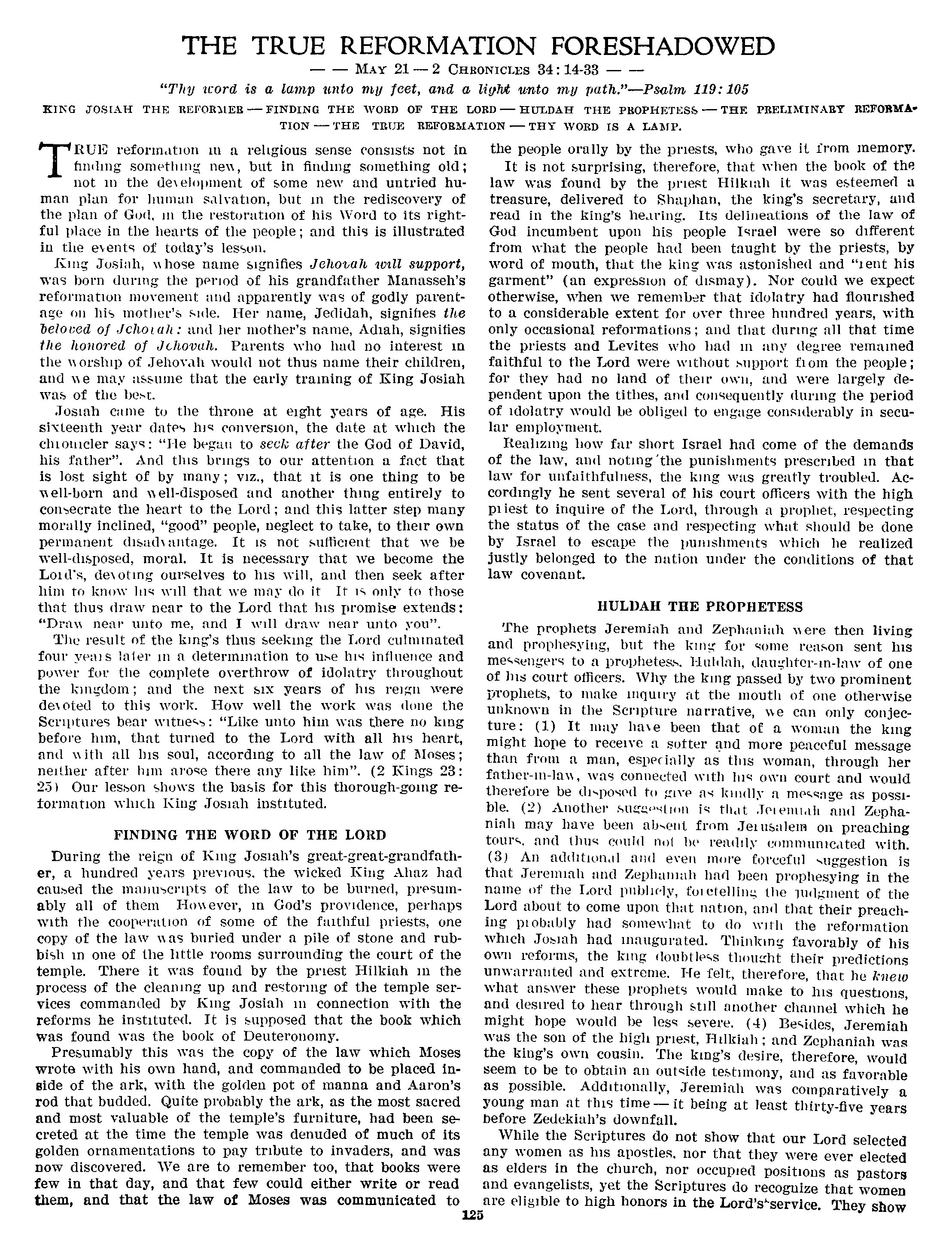
THE TRUE REFORMATION FORESHADOWED — — May 21—2 CuHronictes 34: 14-33 — — “Thy word is a lamp unto my feet, and a light unto my path.”—Psalm 119: 105 KING JOSIAH THE REFORMER —— FINDING THE WORD OF THE LORD— HULDAH THE PROPHETESS — THE PRELIMINARY REFORMA-> TION—-THE TRUE REFORMATION — THY WORD IS A LAMP. RUE reformation in a religious sense consists not in finding something new, but in finding something old; not in the development of some new and untried human plan for human salvation, but im the rediscovery of the plan of God, in the restoration of his Word to its rightful place in the hearts of the people; and this is illustrated in the events of today’s lesson. King Jusinh, whose name signifies Jehovah aill support, was born during the period of his grandfather Manasseh’s reformation muvement und apparently was of godly parentage on his mothev’s side. Her name, Jedidah, signifies the beloved of Jehovah: and her mother’s name, Adiah, signifies the honored of Jchovuh. Parents who had no interest in the worship of Jehovah would not thus name their children, and we may assume that the early traming of King Josiah was of the best. Josiah came to the throne at eight years of age. His sixteenth year dates his conversion, the date at which the chiouicler says: “He begun to sech after the God of David, his father”. And this brings to our attention a fact that is lost sight of by many; viz., that it is one thing to be well-born and well-disposed and another thing entirely to consecrate the heart to the Lord; and this latter step many morally inclined, “good” people, neglect to take, to their own permanent disadvantage. It 1s not sufficient that we be well-disposed, moral. It is necessary that we become the Loid’s, devoting ourselves to his will, and then seek after him to know Ins will that we may do it It 1S only to those that thus draw near to the Lord that his promise extends: “Draw near unto me, and I will draw near unto you’. The result of the king’s thus seeking the Lord culminated four vers later in a determination to use his influence and power for the complete overthrow of idolatry throughout the kingdom; and the next six years of his reign were devoted to this work. How well the work was done the Scriptures bear witness: “Like unto hin was there no king before him, that turned to the Lord with all his heart, and with all his soul, according to all the law of Moses; neither after him arose there any like him”. (2 Kings 23: 25) Our lesson shows the basis for this thorough-going retormation which Wing Josiah instituted. FINDING THE WORD OF THE LORD During the reign of King Josiah’s great-great-grandfather, a hundred years previous, the wicked King Ahaz had caused the manuseripts of the law to be burned, presumably all of them However, in God’s providence, perhaps with the cooperation of some of the fuithful priests, one copy of the law was buried under a pile of stone and rubbish in one of ihe httle rooms surrounding the court of the temple. There it was found by the priest Hilkinh in the process of the cleaning up and restoring of the temple services commanded by King Josiah in connection with the reforms he instituted. It is supposed that the book which was found was the book of Deuteronomy. Presumably this was the copy of the law which Moses wrote with his own hand, and commanded to be placed inside of the ark, with the golden pot of manna and Aaron’s rod that budded. Quite probably the ark, as the most sacred and most valuable of the temple’s furniture, had been se creted at the time the temple was denuded of much of its golden ornamentations to pay tribute to invaders, and was now discovered. We are to remember too, that books were few in that day, and that few could either write or read them, and that the law of Moses was communicated to the people orally by the priests, who gave it from memory. It is not surprising, therefore, that when the book of the law was found by the priest Hilkinh it was esteemed a treasure, delivered to Shaphan, the king’s secretary, and read in the king’s hearing. Its delineations of the law of God incumbent upon his people Israel were so different from what the people had been taught by the priests, by word of mouth, that the king was astonished and “1ent his garment” (an expression of dismay). Nor could we expect otherwise, when we remember that idolatry had flourished to a considerable extent for over three hundred years, with only occasional reformations; and that during all that time the priests and Levites who had in any degree remained faithful to the Lord were without support fiom the people; for they had no land of their own, and were largely dependent upon the tithes, and consequently during the period of idolatry would be obliged to engage considerably in secular employment, Realizing how far short Israel had come of the demands of the law, and noting ‘the punishments presersbed in that law for unfaithfulness, the king was greatly troubled. Accordingly he sent several of his court officers with the high pliest to inquire of the Lord, through a prophet, respecting the status of the case and respecting whut should be done by Israel to escape the punishments which he realized justly belonged to the nation under the conditions of that law covenant. HULDAH THE PROPHETESS The prophets Jeremiah and Zephaniah were then living and prophesying, but the king fur some reason sent his messengers to a prophetess, Huldah, daughter-in-law of one of his court officers. Why the king passed by two prominent prophets, to make inquiry at the mouth of one otherwise unknown in the Scripture narrative, we can only conjecture: (1) It may have been that of a womun the king might hope to receive a sotter and more peaccful message than from a man, especially as this woman, through her father-in-law, was connected with Ins own court and would therefore be disposed to give as kindly a message as possible. (2) Another suggestion is that Jeremiah and Zephaniah may have been absent from Jerusalem on preaching tours, and thus could not be readily communicated with. (8) An additional and even more forceful suggestion is that Jeremiah and Zephamuah had been prophesying in the naine of the Lord publicly, foretelling the judgment of the Lord about to come upon that nation, and that their preaching probably had somewhat to do with the reformation which Josiah had inaugurated. Thinking favorably of his own reforms, the king doubtless thought their predictions unwarranted and extreme. He felt, therefore, that he knew what answer these prophets would make to his questions, and desired to hear through still another channel which he might hope would be less severe. (4) Besides, Jeremiah wus the son of the high priest, Hilkiah: and Zephaniah was the king’s own cousin. The king’s desire, therefore, would seem to be to obtain an outside testimony, and as favorable as possible. Additionally, Jeremiah was coinparatively a young man at this time —it being at least thirty-five years before Zedekiah’s downfall. While the Scriptures do not show that our Lord selected any women as his apostles, nor that they were ever elected as elders in the church, nor occupied positions as pastors and evangelists, yet the Scriptures do recognize that women are eligible to high honors in the Lord’s‘service, They show 125
Ez a honlap cookie-kat használ a honlap és a felhasználói élmény fejlesztésére. A honlap további használatával hozzájárulsz a cookie-k használatához. Ha további információt szeretnél, vagy ha nem szeretnél hozzájárulni a cookie-k használatához, kérünk, látogass el az
Adatvédelmi irányelvek
Használati feltételek
oldalra.


