7
1
7
download/literature/watchtower/1903-11.pdf
watchtower/1903/11/1903-11-1
(159-163)
ZION'S
WATCH
TOWER
AI,LCGHBNY.
PA
and
joint-heir
in
the
kingdom;
and,
by
and
by,
the
establish·
ment
of
a
kingdom
for
the
blessing
and
enlightenment
of
all
the
families
of
the
earth.
No
novel,
no
plot
of
human
concoc
tion,
could
ever
equal
this
one.
It
is
the
Lord's
doing,
and
it
is
marvelous
in
our
eyes.
We
cannot
wonder
if
those
who
see
from
the
outside-who
do
not
see
the
strength
and
beauty
and
consistency
and
harmony
from
the
inside
standpoint
consider
that
we
who
see
matters
from
the
right
standpoint
are
too
much
enthused.
They
cannot
appreciate
the
fact
that
we
accept
gladly
the
privilege
of
self·sacrifice,
in
order
thereby
to
attest
our
love
and
devotion
to
the
Lord
and
to
be
accounted
worthy
a
share
with
him
as
members
of
his
church,
his
bride.
The
time
wiII
come,
and
it
is
not
far
distant
now,
when
man)'
who
are
now
highly
esteemed
amongst
men
for
their
wi~dom,
will
be
seen
to
have
been
foolish,
and
many
who
are
now
('steemed
fools
for
Christ's
sake
and
for
the
Gospel's
sake,
will
be
seen
to
have
been
truly
wise
in
choosing
the
heavenly
t1t1l1g"R
and
in
being
willing
to
surrender
the
earthly
things
for
the
atbinment
of
the
heavenly,
because
it
is
impossible
to
sen
('
God
and
Mammon.
The
Apostle's
answer
to
Festus
was
not
flattery,
but
Chris
tian
courtesy.
Festus
was
a
noble
man,
and
it
is
not
im
proper
to
speak
the
truth
in
reasonable
language,
and
to
give
a
merited
compliment.
"I
am
not
mad,
most
noble
Festus,
but
~peak
forth
words
of
truth
and
soberness."
So,
when
we
answer
the
world,
let
us
remember
the
difference
of
stand
point,
and
that
our
privilege
of
seeing
the
deep
things
of
God
is
the
re~ult
of
our
having
been
accepted
of
him
through
con
!:'ccration
and
obedience,
receiving
the
spirit
of
the
Anointed,
whereby
we
can
know
the
things
freely
given
unto
us
of
God.
The
Apostle
appealed
to
the
king
for
corroboration
of
the
thin:rs
he
declared,
evidently
well
assured
that
the
declaration
of
the
Gospel
had
created
so
much
commotion
amongst
the
Jews
that
the
king
had
heard
thereof
repeatedly.
The
thing
was
not
done
in
a
corner
j
it
was
a
public
matter
of
general
knowledge,
and
had
Festus
been
living
in
the
country
he
would
not
question
the
facts.
The
Apostle
appealed
to
Agrippa
in
a
most
earnest
and
dignified
tone.
"King
Agrippa,
believest
thou
the
prophets
~
I
know
that
thou
believest."
The
intimation
is
that
the
Apos
tle
had
in
this
discourse
set
forth
the
fulfilment
of
the
proph
ecies
so
fully,
so
explicitly,
that
anyone
believing
them
to
be
inspired
could
not
doubt
that
Jesus
was
the
Messiah.
This
led
to
the
notable
words
of
Agrippa,
"Almost
thou
persuadest
me
to
be
a
Christian."
The
New
Testament
revisers
evidently
considered
this
lan
guage
ironical,
but
it
does
not
so
seem
to
us.
The
Apostle's
rejoinder
seems
to
contradict
that
thought,
"I
would
that
thou
wert
not
only
almost
but
altogether
such
as
I
am-except
these
bonds."
It
is
presumed
upon
reasonable
grounds
t.hat,
althou~h
Agrippa
did
not
become
a
Christian,
this
knowl
edge
of
the
principle~
underlying
Christianity
remained
with
him
and
influenced
him
during
the
remainder
of
his
life.
His
tory
tells
us
that
in
the
subsequent
persecutions
that
arosE'
in
connection
with
the
trouble
coming
upon
the
Jewish
nation
Agrippa
received
and
kindly
entreated
the
Christians
who
fled
to
him
for
protection.
How
many
there
are
in
Christian
lands
who
have
heard
the
Go!'pel
message
more
or
less
distinctly,
and
have
been
"almost
persuaded"
to
lay
hold
of
the
grace
of
God,
but
neg
lect
opportunities
of
action
and
have
lost
the
appreciation
of
the
privilege.
These,
like
Agrippa,
will
have
comparatively
bmall
conception
of
the
wonderful
things
they
came
so
near
to
gra~ping
and
yet
missed.
When
they
shall
come
forth
from
the
grave
and
enjoy
the
great
privileges
of
the
Milll'n
nial
kingdom
it
will
amaze
them
to
know
what
great
oppor
tunities
they
had
to
become
members
of
the
little
flock,
the
Lord's
associates
on
the
throne.
VOL.
XXIV
ALLEGHENY,
PA.,
JUNE
1,
1903
THE
EDITOR
ON
HIS
EUROPEAN
JOURNEY
No.
11
U.
S.
M.
S.
"NEW
YORK."
a
space.
to
do
more
than
sound
one
chord
on
our
precious
G
reC'ting'l
to
"the
Children
of
the
Morning"-of
the
Dawn
Harp
(the
Bible).
Committing
results
to
the
Lord,
I
pointed
--of
the
Light:-
out
the
great
Covenant
promise
which
our
heavenly
Father
On
bo:ml
the
Steamship
"~ew
York"
I
am
nearing
Great
gave
to
Abraham
and
hIS
seed:
that
it
was,
"In
thy
seed
shall
Bribll1
antI
the
dear
brethren
there
whom
I
know
bv
corre-
all
the
families
of
the
earth
be
blessed;"
that
the
natural
seerl,
..
ponrlence
and
so
dearly
love,
and
whom
I
hope
soon
to
greet
Isaac
and
Jacob
and
the
nation
of
Israel,
held
fast
the
promise
pQI',onallv.
Nevertheless,
all
the
dear
readers
of
the
\VATCH
but
never
inherited
it;
that
the
true
seed
only
began
to
come
TOWEa
are
before
my
mental
vision,
and
I
take
this
opportunity
in
the
person
of
the
Lord
Jesus:
that
the
true
church,
the
for
l'pnding
you
a
message
of
love
and
fellowship.
It
is
a
true
members
of
the
body
of
Christ,
are
members
of
this
s('\!Tce
of
great
pleasure
and
encouragement
to
me
to
realize
"seed"
and
heirs
according
to
that
original
promi'le
which
has
th?t
your
love
and
prayers
are
with
me
on
my
journey;
and
not
yet
had
its
fulfilment.
but
awaits
the
completion
of
the
I
w('ll
know
that
every
feature
of
my
experiences
will
be
of
seed-the
completion
of
"the
church
which
is
his
body."
"If
intC'rC'~t
to
you.
ye
be
Christ's
then
are
ye
Abraham's
seed,
and
heirs
accord-
.Tust
a
w'eek
ago
(on
April
14th)
I
bade
farewell
to
a
goodly
ing
to
the
promise."-Gal.
3:29.
company
of
the
church
at
the
railway
depot
in
Pittsburgh.
Briefly
noting
that
this
is
the
Christian's
hope
of
our
text,
On
the
previous
Sunday
I
said
"Goodbye"
to
the
church
at
and
that
it
is
still
unfulfilled,
we
saw
that
it
is
still
to
be
Allegheny
as
a
whole,
shaking
hands
with
about
300
person-
striven
for
by
all
who
would
make
their
calling
and
election
:.<
11)';
but
I
was
cheered.
nevertheless,
by
the
final
parting
at
sure;
and
that
in
the
light
of
this
promise
and
hope
all
true
the
train.
Ne:\t
mornin~
I
was
met
at
New
York
depot
by
Christians
should
recognize
present
e"periences,
trials,
etc.,
rC'prC'sentativl's
of
the
churches
of
N('w
York.
Brooklyn,
Yonk-
as
so
much
of
their
education
in
the
school
of
Christ,-in
('1
'I
••
Tersl'y
City,
Perth
Amboy
and
Philadelphia.
who
saw
me
preparation
for
their
work
in
the
coming
age-the
work
of
on
hoard
my
steamer
and
tarried
until
the
starting
of
the
blessing
the
families
of
earth
during
the
promised
Millennial
Y<'~'lC'l.-thC'n
from
the
pier
wav('d
me
their
love
and
good
Kin~dom.
wishcs
as
they
assured
me
previously
that
I
had
their
pray-
Only
five
of
the
passengers
have
had
either
interest
or
('r~.
curiosity
sufficient
to
lead
them
to
converse
with
me
on
the
I
was
not
so
vain
as
to
accept
these
love-tokens
as
personal
subject,-and
only
two
of
these
with
earnestness;
but
if
two
trihutes;
but
received
them,
on
the
contrar;v,
as
expressions
of
or
even
one
should
ultimately
develop
as
a
ripe
grain
of
dC'votion
to
the
Lord
and
appreciation
of
his
truth,
with
which
"wheat"
how
glad
and
thankful
we
would
be.
So
far
as
I
in
his
providence
I
had
become
associated
as
a
servant;-a
min-
can
ascertain,
about
one-half
of
the
passengers
are
professing
i~tC'r
of
the
Lord.
a
mini'lter
of
his
Word,
a
minister
of
his
peo-
Christians,
and
about
two-thirds
of
these
Episcopalians-of
pIp.
All
may
he
sure
that
my
heart
fully
reciprocated
the
kind
whom
not
one
has
seemed
interested.
Of
the
two
manifesting
wishC''l
and
blessing
accepted
from
these
dear
friends,
who
in
a
interest
one
is
a
Baptist.
the
other
a
Methodist.
A
Baptist
~till
larger
sense
reprC'sented
to
me
all
of
the
d.ear
WATCH
minister
aboard
declared
himself
an
evolutionist
and
in
full
TOWER
readers
of
America
who
rejoice
to
seud
me,
with
their
sympathy
with
''higher
criticism"-denying
tlmt
the
Lord
vrawrs
and
love.
as
their
repre'lentatives
for
a
few
weeks
to
bought
us.
\Vhen
pre'lsed
with
Rcripture
he
denied
the
author
tho'll'
of
like
precious
faith
in
Europe.
itv
of
Paul
and
the
other
apostles,
and
claimed
to
hold
to
the
Our
steamer
has
had
a
quiet
voyage,
and
in
many
ways
I
life
and
words
of
.Tesus
only.
When
confronted
with
our
Lord's
h'lYl'
heen
"kl'pt"
hy
divine
providence-so
that
I
have
had
no
own
words
to
the
l'ffl'ct
that
he
rame
to
"give
his
life
a
ransom
sl'asickness
since
the
first
two
days
out,
and
was
able
to
respond
for
manv"
he
avoiill'd
further
disrussion.
to
the
invitation
of
our
captain
to
aS'list
in
conducting
the
More
and
morl'
it
becomes
evident
that
we
are
in
the
great
Il~ual
Sunday
morning
serviees
of
the
vl''l"el-incluiling
an
trial-day
of
the
Christian
faith,
and
that
it
is
not
so
much
nildrl'ss
of
about
thirty
minutes
on
the
hope
that
is
the
anchor
3.
'1ul'stion
of
Who
will
fall?
as
of
"Who
shall
be
able
to
stand'"
to
our
souls,
both
sure
and
stl'adfnst.-Hl'b.
6:Jll.
(Rev.
6:17)
The
prophet
ileclared.
"A
thousand
shall
fall
at
I
had
no
reason
to
hope
that
among
the
pas'lengers
would
thv
side"
(Psa.
91
:7),
and
so
we
find
it.
So
far
from
~Iory-
be
many
with
"an
ear
to
hear
j"
nor
could
I
expect,
in
'10
brief
ing
in
the
evidences
that
mmy
are
falling
from
tllil
fundamental
[3198]
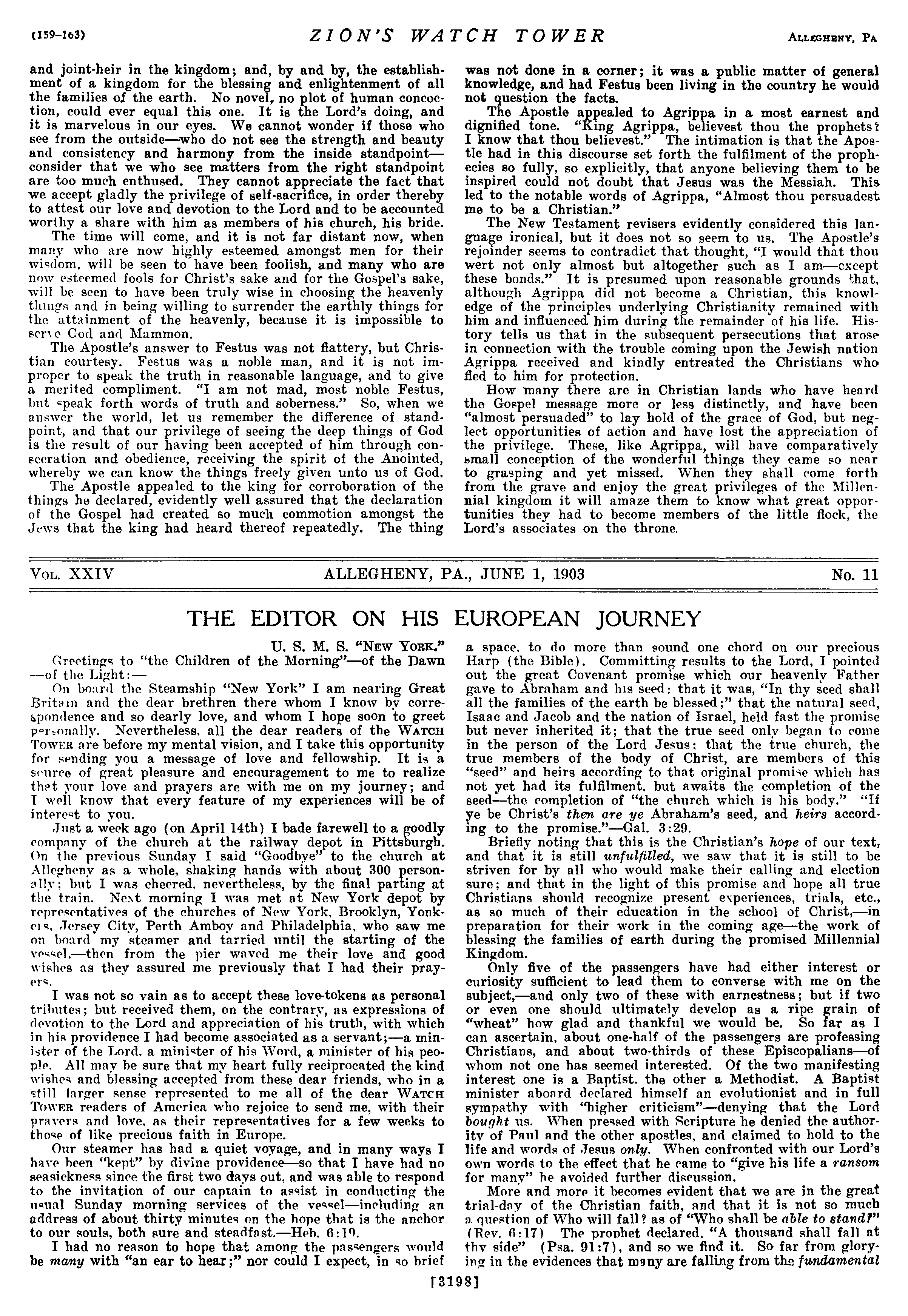
(159-163) and joint-heir in the kingdom; and, by and by, the establishment of a kingdom for the blessing and enlightenment of all the families of the earth. No novel, no plot of human concoction, could ever equal this one. It is the Lord’s doing, and it is marvelous in our eyes. We cannot wonder if those who see from the outside—who do not see the strength and beauty and consistency and harmony from the inside standpoint— consider that we who see matters from the right standpoint are too much enthused. They cannot appreciate the fact that we accept gladly the privilege of self-sacrifice, in order thereby to attest our love and devotion to the Lord and to be accounted worthy a share with him as members of his church, his bride. The time will come, and it is not far distant now, when many who are now highly esteemed amongst men for their wisdom, will be seen to have been foolish, and many who are now esteemed fools for Christ’s sake and for the Gospel’s sake, will be seen to have been truly wise in choosing the heavenly things and in being willing to surrender the earthly things for the attainment of the heavenly, because it is impossible to scrve God and Mammon. Tle Apostle’s answer to Festus was not flattery, but Christian courtesy. Festus was a noble man, and it is not improper to speak the truth in reasonable language, and to give a merited compliment. “I am not mad, most noble Festus, but speak forth words of truth and soberness.” So, when we answer the world, let us remember the difference of standpoint, and that our privilege of seeing the deep things of God 1s the result of our having been accepted of him through coneccration and obedience, receiving the spirit of the Anointed, whereby we can know the things freely given unto us of God, The Apostle appealed to the king for corroboration of the things he declared, evidently well assured that the declaration of the Gospel had created so much commotion amongst the Jews that the king had heard thereof repeatedly. The thing ZION’S WATCH TOWER ALLecHeny, Pa was not done in a corner; it was a public matter of general knowledge, and had Festus been living in the country he would not question the facts. The Apostle appealed to Agrippa in a most earnest and dignified tone. “King Agrippa, believest thou the prophets? I know that thou believest.” The intimation is that the Apostle had in this discourse set forth the fulfilment of the prophecies so fully, so explicitly, that anyone believing them to be inspired could not doubt that Jesus was the Messiah. This led to the notable words of Agrippa, “Almost thou persuadest me to be a Christian.” The New Testament revisers evidently considered this language ironical, but it does not so seem to us. The Apostle’s rejoinder seems to contradict that thought, “I would that thou wert not only almost but altogether such as I am—cxcept these bonds.” It is presumed upon reasonable grounds that, although Agrippa did not become a Christian, this knowledge of the principles underlying Christianity remained with him and influenced him during the remainder of his life. History tells us that in the subsequent persecutions that arose in connection with the trouble coming upon the Jewish nation Agrippa received and kindly entreated the Christians who fled to him for protection. How many there are in Christian lands who have heard the Gospel message more or less distinctly, and have been “almost persuaded” to lay hold of the grace of God, but neglect opportunities of action and have lost the appreciation of the privilege. These, like Agrippa, will have comparatively small conception of the wonderful things they came so near to grasping and yet missed. When they shall come forth from the grave and enjoy the great privileges of the Millennial kingdom it will amaze them to know what great opportunities they had to become members of the little flock, the Lord’s associates on the throne, VoL. XXIV ALLEGHENY, PA., JUNE 1, 1903 No. 11 THE EDITOR ON HIS EUROPEAN JOURNEY U. 8. M. S. “NEw York.” Grectings to “the Children of the Morning”—of the Dawn —of the Light:— On board the Steamship “New York” I am nearing Great Britain and the dear brethren there whom I know by correspondence and so dearly love, and whom I hope soon to greet personally. Nevertheless, all the dear readers of the WaTcH TOWER are before my mental vision, and I take this opportunity for sending you a message of love and fellowship. It is a scurce of great pleasure and encouragement to me to realize thet your love and prayers are with me on my journey; and T well know that every feature of my experiences will be of interest to you. Just a week ago (on April 14th) I bade farewell to a goodly company of the church at the railway depot in Pittsburgh. On the previous Sunday I said “Goodbye” to the church at Allegheny as a whole, shaking hands with about 300 personally; but I was cheered, nevertheless, by the final parting at the train. Nest morning I was met at New York depot by representatives of the churches of New York, Brooklyn, Yonkers, Jersey City, Perth Amboy and Philadelphia, who saw me on board my steamer and tarried until the starting of the vessel,—then from the pier waved me their love and good wishes as they assured me previously that I had their prayers, I was not so vain as to accept these love-tokens as personal tributes; but received them, on the contrary, as expressions of devotion to the Lord and appreciation of his truth, with which in his providence I had become associated as a servant;—a minister of the Lord, a minister of his Word, a minister of his people. All may be sure that my heart fully reciprocated the kind wishes and blessing accepted from these dear friends, who in a still larger sense represented to me all of the dear WatcH Tower readers of America who rejoice to send me, with their prayers and love. as their representatives for a few weeks to those of like precious faith in Europe. Our steamer has had a quiet voyage, and in many ways I have heen “kept” by divine providence—so that I have had no seasickness since the first two davs out, and was able to respond to the invitation of our captain to assist in conducting the usual Sunday morning services of the vessel—including an address of about thirty minutes on the hope that is the anchor to our souls, both sure and steadfast.—Heb. 6:19. I had no reason to hope that among the passengers would be many with “an ear to hear;” nor could I expect, in so brief a space, to do more than sound one chord on our precious Harp (the Bible). Committing results to the Lord, I pointed out the great Covenant promise which our heavenly Father gave to Abraham and his seed: that it was, “In thy seed shall all the families of the earth be blessed ;” that the natural seed, Isaac and Jacob and the nation of Israel, held fast the promise but never inherited it; that the true seed only began to come in the person of the Lord Jesus: that the true church, the true members of the body of Christ, are members of this “seed” and heirs according to that original promise which has not yet had its fulfilment, but awaits the completion of the seed—the completion of “the church which is his body.” “If ye be Christ’s then are ye Abraham’s seed, and heirs according to the promise.”—Gal. 3:29. Briefly noting that this is the Christian’s hope of our text, and that it is still unfulfilled, we saw that it is still to be striven for by all who would make their calling and election sure; and that in the light of this promise and hope all true Christians should recognize present experiences, trials, etc., as so much of their education in the school of Christ,—in preparation for their work in the coming age—the work of blessing the families of earth during the promised Millennial Kingdom. Only five of the passengers have had either interest or curiosity sufficient to lead them to converse with me on the subject,—and only two of these with earnestness; but if two or even one should ultimately develop as a ripe grain of “wheat” how glad and thankful we would be. So far as I ean ascertain, about one-half of the passengers are professing Christians, and about two-thirds of these Episcopalians—of whom not one has seemed interested. Of the two manifesting interest one is a Baptist, the other a Methodist. A Baptist minister aboard declared himself an evolutionist and in full sympathy with “higher criticism”’—denying that the Lord bought us. When pressed with Scripture he denied the authority of Pau] and the other apostles, and claimed to hold to the life and words of Jesus only. When confronted with our Lord’s own words to the effect that he came to “give his life a ransom for many” he avoided further discussion. More and more it becomes evident that we are in the great trial-day of the Christian faith, and that it is not so much a. question of Who will fall? as of “Who shall be able to stand?” (Rev. 6:17) The prophet declared, “A thousand shall fall at thy side’ (Psa. 91:7), and so we find it. So far from glorying in the evidences that many are falling from the fundamental [3198]
Pentru a vă îmbunătăți experiența pe site-ul nostru, folosim cookies și tehnologii similare. Unele cookies sunt esențiale pentru funcționalitatea de bază a site-ului nostru și nu pot fi refuzate. Puteți alege să acceptați sau să refuzați cookies suplimentare. Vrem să vă asigurăm că aceste date nu vor fi vândute sau utilizate în scopuri de marketing. Puteți ajusta preferințele dvs. în orice moment accesând Setările de Confidențialitate din subsolul paginii. Pentru mai multe informații, vă rugăm să consultați
Politica de Confidențialitate
Condiții de utilizare
.


