7
1
7
download/literature/watchtower/1903-5.pdf
watchtower/1903/5/1903-5-1
VOL.
XXIV
ALLEGHENY,
PA.,
MARCH
1,
1903
No.5
GOD'S
SUPERVISION
OF
HIS
SAINTS
"The
steps
of
a
good
man
are
ordered
of
the
Lord,
ana
h6
delighteth.
i1lo
h48
way.
TluJugh.
he
stumble,
he
shall
Mt
be
uttf1t"UI
OfUt
aown;
for
the
Lortl
upholdeth.
him
with,
MS
hand."-Psalm
37
:23,
24.
Calvinism
has
its
good
features
as
well
as
its
bad
ones.
that
if
there
is
a
God
he
is
so
concerned
and
occupit,d
in
his
Its
institutions
meant
the
reaction
of
noble
Christian
minds
own
personal
affairs
and
in
the
affairs
of
other
beings
in
other
against
a
false
doctrine.
The
fact
that
these
reactionists
went
worlds,
that
the
hundreds
of
millions
upon
this
planet
are
in
to
an
extreme
should
not
condemn
them
utterly,
nOr
nullify
his
sight
and
estimation
but
as
so
many
mites
would
be
in
the
good
features
of
their
teachings.
It
is
customary
for
the
man's
estimation.
These
are
little
inclined
to
think
that
all
pendulum
of
thought
to
swing
from
one
extreme
to
another,
the
steps
of
a
good
man
are
ordered
of
the
Lord.
passing
the
central
point
of
absolute
truth.
Indeed,
we
have
As
Calvin's
day
was
a
time
of
reaction
from
a
wrong
every
reason
to
believe
that
this
is
a
part
of
the
adversary's
thought
toward
a
right
one
in
this
particular,
so,
today
marks
method
in
blinding
the
minds
of
those
who
are
seeking
truth.
another
crisis.
Weare
living
in
the
time
of
reaction
against
He
would
It>ad
as
far
away
from
absolute
truth
.as
possible,
the
right
thought
on
this
subject,
and
in
favor
of
the
wrong
either
in
one
direction
or
the
other
in
every
reaction
or
re-
thought.
In
early
times
in
all
the
theological
seminaries,
as
form;
therefore,
he
seems
to
have
taken
an
interest
to
the
ex-
well
as
in
the
great
colleges
and
universities
of
Christendom,
tent
of
helping
the
reformers
to
an
opposite
extreme.
the
teachings
were
distinctly
adverse
to
the
sentiment
of
our
During
the
"dark
ages"
the
central
thought
of
our
text
text,
and
at
very
most
allow
that
mankind
as
a
whole
is
pos
was
lost
sight
of-the
thought
of
God's
care
for
each
and
for
sibly
under
some
kind
of
divine
supervision
and
care;
though
all
of
his
consecrated
people.
The
thought
inculcated
and
the
sentiment
seems
to
be
that
God
knows
and
cares
much
less
generally
held
was
to
the
contrary
of
this;
viz.,
that
the
aver-
for
the
poor
groaning
creation
than
did
its
theologians,
pub
age
man,
even
though
a
consecrated
believer,
is
too
insignifi-
licists
and
reformers.
cant
for
divine
attention;
that
God
had
given
over
to
the
care
There
is
a
reason
for
all
this,
to
be
sure.
The
wheels
in
of
the
Pope
and
the
clergy
the
souls
of
his
people.
To
EO
great
the
divine
plan
are
so
large,
and
the
hands
on
the
divine
clock
an
extent
did
this
teaching
prevail
that
the
people
subject
move
so
slowly
that
the
natural
man
perceives
no
movement
thereto
did
not
think
of
Jehovah
as
their
shepherd;
nor
even
-fails
to
realize
that
God
is
working
all
things
according
to
of
Jesus
as
hts
appointed
representative
shepherd;
and
did
not
the
counsel
of
his
own
will.
Lacking
the
instruction
of
the
think
of
approaching
these
in
prayer,
nor
of
having
their
di-
divine
Word;
worldly
wisdom
sees
not
the
purpose
of
the
vine
oversight
and
direction
in
their
affairs.
On
the
contrary,
permission
of
"the
present
evil
world;"
nor
how
the
lessons
if
they
had
sins
to
be
repented
of,
they
were
to
go
to
the
and
experiences
which
it
is
giving
to
all
mankind
will
eventu
priest,
make
confession,
and
secure
absolution.
Had
they
re-
ally
work
out
a
great
bressing,
as
part
of
man's
needed
instruc
quests
to
make,
they
were
to
ask
the
priest;
or
in
prayer
to
tion;
to
be
followed
by
his
instruction
in
righteousness
in
the
approach
some
dead
saint,
requesting
his
mediation
with
some
Millennial
age,
soon
to
be
ushered
in.
Wordly
wisdom
sees
of
the
dead
apostles
or
with
Mary,
the
mother
of
Jesus,
that
not
the
object
for
which
the
church
is
now
called
out
from
they,
in
turn,
might
mediate
with
the
Son
Jesus,
that
he,
in
amongst
the
world
and
shaped
and
fitted
and
polished,
by
turn,
might
mediate
with
the
Father,
and
that
thus
they
might
trials
and
difficulties
and
contact
with
evil,
for
the
glorious
be
brought
to
the
attention
of
Jehovah
and
possibly
get
some
work
of
the
future,-of
blessing
all
the
families
of
the
earth.
fragmentary
blessing
as
a
crumb
from
the
table.
And
not
seeing
these
things,-not
seeing
the
object
of
the
per-
The
reaction
of
Reformation
times
was
against
all
this
mission
of
evil,
not
seeing
why
God
has
delayed
the
binding
sort
of
thing,
and
the
central
teaching
of
Calvinism
was
that
of
Satan,
the
overthrow
of
his
power
and
the
release
of
the
God
has
a
direct
interest
in
all
those
who,
through
the
merit
bonds
of
superstition
and
blindness
with
which
he
has
en
of
Jesus,
become
his
children
through
faith
and
consecration.
slaved
the
masses,
it
concludes
that
God
is
indifferent,
and
It
is
difficult
to
estimate
how
great
has
been
the
blessing
that
that
all
the
provisions
and
arrangements
for
social
uplift
de
ha,>
come
to
the
Lord's
people
through
the
revival
of
this
doc-
pend
upon
the
wisdom
and
the
benevolence
of
men.
trine
of
the
primitive
church.
We
must
ever
feel
grateful
to
How
thankful
should
be
our
hearts,
as
we
realize
the
di
John
Calvin
and
his
coadjutors
for
the
service
they
rendered
vine
favor
which
has
rescued
us
from
this
blindness
which
to
the
household
of
faith
in
this
particular,-even
though
we
is
upon
the
world,
and
particularly
upon
the
great
and
world
mm;t,
at
the
same
time,
thoroughly
repudiate
that
feature
of
ly-wise
of
Christendom!
The
knowledge
granted
us
of
the
their
teachings
which
passed
to
the
extreme
of
declaring
that
plan
of
the
ages
saves
us,
not
only
from
the
bondage
of
priest
as
God
had
foreknown
an
elect
church,
the
special
and
happy
craft
and
superstition
of
the
"dark
ages,"
but
it
saves
us
also
object
of
his
care
during
this
Gospel
age,
and
to
be
exalted
from
the
evolutionary
unbelief
which
is
now
sweeping
over
ultimately
to
the
heavenly
state,
he
had,
on
the
other
hand,
Christendom,
and
robbing
all
who
have
not
the
light
of
the
predetermined
the
torture
of
all
the
remainder
of
the
race,
and
present
truth
of
their
joy
in
the
Lord,
their
peace,
their
confi
had
made
ample
provision
therefor.
God
permitted
(we
may
dence,
their
trust
in
him.
even
say,
used)
Calvin
and
his
associates
in
the
presentation
We
thank
God
for
the
ability
to
grasp
this
blessed
proonise
of
an
important
truth,
while
at
the
same
time
he
permitted
of
our
text
(and
scores
of
others
of
similar
import)
and
to
them
to
attach
to
it
this
awful,
blasphe'II1ous,
God-dishonoring
rejoice
in
them,
strong
in
the
Lord
and
in
the
power
of
his
teaching
respecting
the
non-elect.
We
thank
God
that,
in
his
might;
saying,
"If
God
be
for
us
who
can
be
against
us
[to
providence,
we
live
in
the
time
when
it
is
due
that
his
gracious
any
avail]?"
If
God
so
loved
us
while
we
were
yet
sinners,
purposes
toward
the
non-elect
should
be
clearly
seen,
and
his
much
more
does
he
love
us
now
that
we
are
his
people.
(Rom.
character
freed
from
the
evil
aspersions
of
such
a
theory.
5
:8,
9)
He
who
has
begun
a
good
work
in
us
is
both
able
Papacy's
conception
of
the
insignificance
of
man,
even
and
willing
to
complete
it
unto
the
day
of
Jesus
Christ.
(Phil.
though
a
good
man
in
the
Lord's
sight,
is
much
nearer
to
the
1:6)
Since
we
are
the
Lord's,
and
have
these
various
assur
"iew
of
the
natural,
worldly
man,
than
is
the
thought
that
ances
of
his
Word,
"We
know
that
all
things
work
together
for
all
the
steps
of
a
good
man
are
ordered
of
the
Lord.
The
good
to
them
that
love
God;
to
them
who
are
the
called
[ones]
natural
man
finds
it
difficult
to
believe
in
a
God
at
all;
as
according
to
his
purpose."-Rom.
8:28.
he
looks
about
the
universe
his
first
th(:mght
of
its
immensity
Let
us
not,
however,
apply
our
text
carelessly;
let
us
note
and
intricacies,
and
of
the
greatness
of
the
one
who
created
carefully
that
it
does
not
apply
to
all
mankind,
hut
to
the
all
these
things
is
speedily
oftset
by
the
suggestion
that
pos-
"good."
The
thought
here
is
evidently
in
harmony
with
the
sibly
there
is
no
God
;-po'lsibly
there
are
"laws
of
nature"
statements
elsewhere,
to
the
effect
that
God's
care
is
over
the
which
form
themselves
and
which
operate
themselves,
and
un-
righteous,
as
when
we
read,
"The
Lord
knoweth
the
way
of
der
which
all
things
are
and
shall
ever
be.
He
is
encouraged
the
righteous,
but
the
way
of
the
ungodly
shall
perish."
(Psa.
in
this
line
of
doubt
by
the
views
of
some,
known
as
Scientists,
1:6)
"The
Lord
knoweth
them
that
are
his."
(2
Tim.
2:
19)
Evolutionists
and
Higher
Critics.
Though
none
of
these
have
Looking
about
us
in
the
world
we
inquire:
Who,
then,
are
the
temerity
to
declare
point-blank
that
there
is
no
God
but
the
righteous
1
who
are
so
good
as
to
be
properly
called
God's
nature,
they,
almost
without
exception,
MOW
that
this
is
the
people?
Hearkening
for
direction
from
the
Word
of
the
Lord
leaning
of
their
minds,
the
tendency
of
their
thought.
They
we
hear
the
answer,
"There
is
none
good,
save
one,
that
is
have
not
yet
discovered
any
form
of
life
which
has
not
in
s(}me
God;"
and,
"There
is
none
righteous,
no,
not
one."
These
tea
sense
or
degree
been
transmitted
from
BOme
other
living
thing.
timonies
of
the
Word
fully
correspond
to
our
own
findings;
They
are
looking
for
this,
however-earnestly
looking
for
it
for
in
ourselves,
a8
well
as
in
others,
we
find
imperfection;
and
expecting
it,
a.nd
quite
ready,
if
they
can
find
it,
to
unrighteousness.
But
how
can
these
testimonies
of
the
Scrip
claim
that
all
life,
all
being,
is
the
result
of
a
law
of
evolu-
ture
be
reconciled
1-taat
there
are
none
righteous,
none
good
tion,
and
needed
no
interference
by
a
Creator,
even
at
the
be·
of
all
the
Adamic
race,
and
yet
that
God
declares
that
all
the
ginning.
From
this
standpoint,
and
especially
backed
up
by
steps
of
a
good
man,
all
the
ways
of
the
righteous,
are
under
the
high
authorities
of
our
day,
scientific
and
religious,
the
his
supervision
1
We
answer
that
the
Scriptures
explain
how
natural
man
feels
skeptical
aoout
a
God
at
all,
and
ooncludes
these
statements
are
in
full
accord;
th&t
there
is
a
clase
of
[3155]
(67-68)
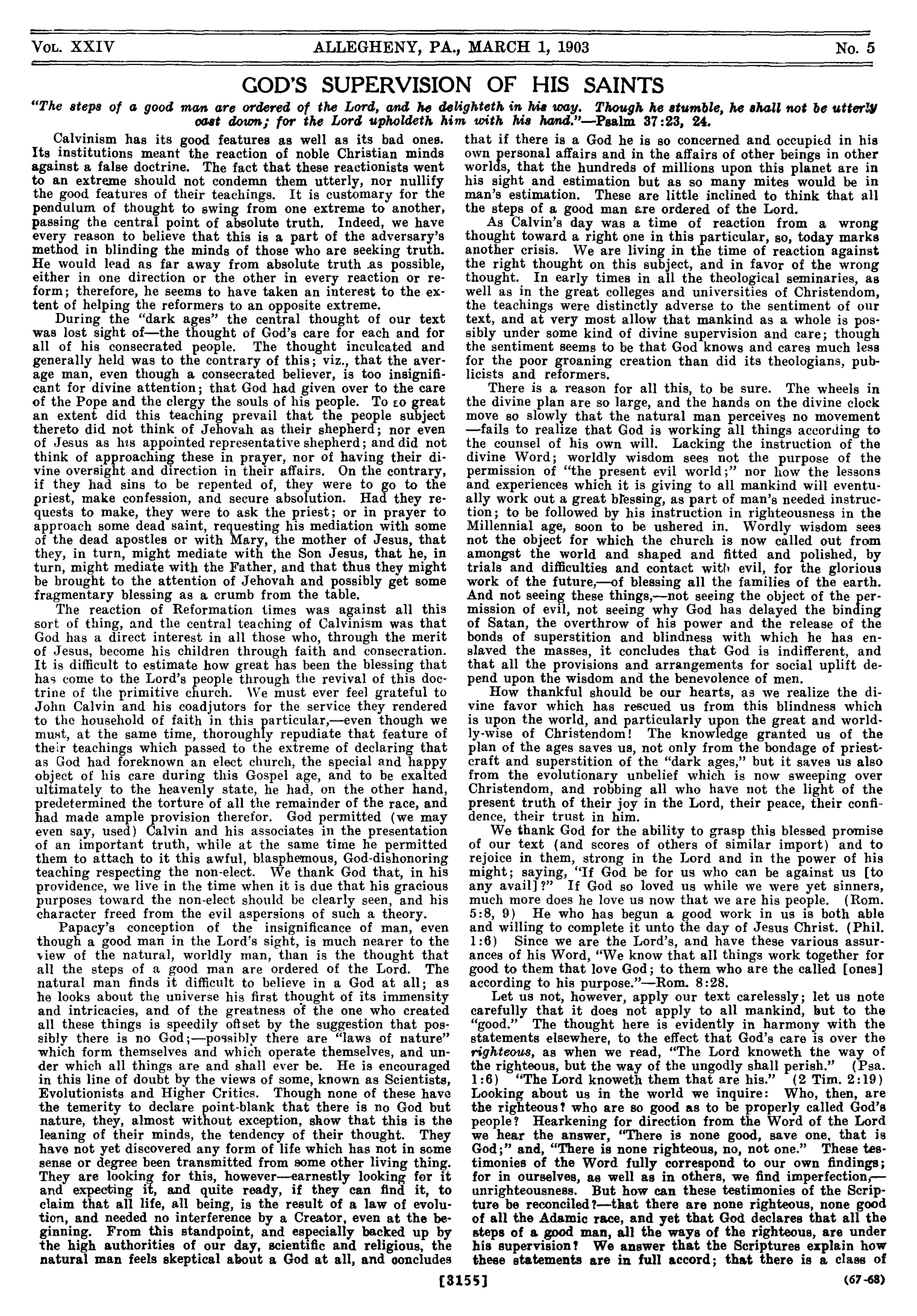
VoL. XXIV ALLEGHENY, PA., MARCH 1, 1903 No. 5 GOD’S SUPERVISION OF HIS SAINTS “The ateps of a good man are ordered of the Lord, and he delighteth in hie way. Though he stumble, he shall not be utterly cast down; for the Lord upholdeth him with his hand.”—Pgalm 37:23, 24. Calvinism has its good features as well as its bad ones. Its institutions meant the reaction of noble Christian minds against a false doctrine. The fact that these reactionists went to an extreme should not condemn them utterly, nor nullify the good features of their teachings. It is customary for the pendulum of thought to swing from one extreme to another, passing the central point of absolute truth. Indeed, we have every reason to believe that this is a part of the adversary’s method in blinding the minds of those who are seeking truth. He would lead as far away from absolute truth as possible, either in one direction or the other in every reaction or reform; therefore, he seems to have taken an interest to the extent of helping the reformers to an opposite extreme. During the “dark ages” the central thought of our text was lost sight of—the thought of God’s care for each and for all of his consecrated people. The thought inculcated and generally held was to the contrary of this; viz., that the average man, even though a consecrated believer, is too insignifieant for divine attention; that God had given over to the care of the Pope and the clergy the souls of his people. To co great an extent did this teaching prevail that the people subject thereto did not think of Jehovah as their shepherd; nor even of Jesus as hts appointed representative shepherd; and did not think of approaching these in prayer, nor of having their divine oversight and direction in their affairs. On the contrary, if they had sins to be repented of, they were to go to the priest, make confession, and secure absolution. Had they requests to make, they were to ask the priest; or in prayer to approach some dead saint, requesting his mediation with some of the dead apostles or with Mary, the mother of Jesus, that they, in turn, might mediate with the Son Jesus, that he, in turn, might mediate with the Father, and that thus they might be brought to the attention of Jehovah and possibly get some fragmentary blessing as a crumb from the table. The reaction of Reformation times was against all this sort of thing, and the central teaching of Calvinism was that God has a direct interest in all those who, through the merit of Jesus, become his children through faith and consecration. It is difficult to estimate how great has been the blessing that has come to the Lord’s people through the revival of this doctrine of the primitive church. We must ever feel grateful to John Calvin and his coadjutors for the service they rendered to the household of faith in this particular,—even though we must, at the same time, thoroughly repudiate that feature of their teachings which passed to the extreme of declaring that as God had foreknown an elect church, the special and happy object of his care during this Gospel age, and to be exalted ultimately to the heavenly state, he had, on the other hand, predetermined the torture of all the remainder of the race, and had made ample provision therefor. God permitted (we may even say, used) Calvin and his associates in the presentation of an important truth, while at the same time he permitted them to attach to it this awful, blasphemous, God-dishonoring teaching respecting the non-elect. We thank God that, in his providence, we live in the time when it is due that his gracious purposes toward the non-elect should be clearly seen, and his character freed from the evil aspersions of such a theory. Papacy’s conception of the insignificance of man, even though a good man in the Lord’s sight, is much nearer to the view of the natural, worldly man, than is the thought that all the steps of a good man are ordered of the Lord. The natural man finds it difficult to believe in a God at all; as he looks about the universe his first thought of its immensity and intricacies, and of the greatness of the one who created all these things is speedily oftset by the suggestion that possibly there is no God;—possibly there are “laws of nature” which form themselves and which operate themselves, and under which all things are and shall ever be. He is encouraged in this line of doubt by the views of some, known as Scientists, Evolutionists and Higher Critics. Though none of these have the temerity to declare point-blank that there is no God but nature, they, almost without exception, show that this is the leaning of their minds, the tendency of their thought. They have not yet discovered any form of life which has not in some sense or degree been transmitted from some other living thing. They are looking for this, however—earnestly looking for it and expecting it, and quite ready, if they can find it, to claim that all life, all being, is the result of a law of evolution, and needed no interference by a Creator, even at the beginning. From this standpoint, and especially backed up by the high authorities of our day, acientific and religious, the natural man feels skeptical about a God at all, and concludes {3155] that if there is a God he is so concerned and occupied in his own personal affairs and in the affairs of other beings in other worlds, that the hundreds of millions upon this planet are in his sight and estimation but as so many mites would be in man’s estimation, These are little inclined to think that all the steps of a good man are ordered of the Lord. As Calvin’s day was a time of reaction from a wrong thought toward a right one in this particular, so, today marks another crisis. We are living in the time of reaction against the right thought on this subject, and in favor of the wrong thought. In early times in all the theological seminaries, as well as in the great colleges and universities of Christendom, the teachings were distinctly adverse to the sentiment of our text, and at very most allow that mankind as a whole is possibly under some kind of divine supervision and care; though the sentiment seems to be that God knows and cares much less for the poor groaning creation than did its theologians, publicists and reformers, There is a reason for all this, to be sure. The wheels in the divine plan are so large, and the hands on the divine clock move so slowly that the natural man perceives no movement —fails to realize that God is working all things according to the counsel of his own will. Lacking the instruction of the divine Word; worldly wisdom sees not the purpose of the permission of “the present evil world;” nor how the lessons and experiences which it is giving to all mankind will eventually work out a great blessing, as part of man’s needed instruction; to be followed by his instruction in righteousness in the Millennial age, soon to be ushered in. Wordly wisdom sees not the object for which the church is now called out from amongst the world and shaped and fitted and polished, by trials and difficulties and contact with evil, for the glorious work of the future,—of blessing all the families of the earth. And not seeing these things,—not seeing the object of the permission of evil, not seeing why God has delayed the binding of Satan, the overthrow of his power and the release of the bonds of superstition and blindness with which he has enslaved the masses, it concludes that God is indifferent, and that all the provisions and arrangements for social uplift depend upon the wisdom and the benevolence of men. How thankful should be our hearts, as we realize the divine favor which has rescued us from this blindness which is upon the world, and particularly upon the great and worldly-wise of Christendom! The knowledge granted us of the plan of the ages saves us, not only from the bondage of priestcraft and superstition of the “dark ages,” but it saves us also from the evolutionary unbelief which is now sweeping over Christendom, and robbing all who have not the light of the present truth of their joy in the Lord, their peace, their confidence, their trust in him. We thank God for the ability to grasp this blessed promise of our text (and scores of others of similar import) and to rejoice in them, strong in the Lord and in the power of his might; saying, “If God be for us who can be against us [to any avail]?” If God so loved us while we were yet sinners, much more does he love us now that we are his people. (Rom. 5:8, 9) He who has begun a good work in us is both able and willing to complete it unto the day of Jesus Christ. (Phil. 1:6) Since we are the Lord’s, and have these various assurances of his Word, “We know that all things work together for good to them that love God; to them who are the called [ones] according to his purpose.”—Rom. 8:28. Let us not, however, apply our text carelessly; let us note carefully that it does not apply to all mankind, but to the “good.” The thought here is evidently in harmony with the statements elsewhere, to the effect that God’s care is over the righteous, as when we read, “The Lord knoweth the way of the righteous, but the way of the ungodly shall perish.” (Psa. 1:6) “The Lord knoweth them that are his.” (2 Tim. 2:19) Looking about us in the world we inquire: Who, then, are the righteous? who are so good as to be properly called God’s people? Hearkening for direction from the Word of the Lord we hear the answer, “There is none good, save one, that is God ;” and, “There is none righteous, no, not one.” These testimonies of the Word fully correspond to our own findings; for in ourselves, as well as in others, we find imperfection,— unrighteousness. But how can these testimonies of the Scripture be reconciled ?—-that there are none righteous, none good of all the Adamic race, and yet that God declares that all the steps of a good man, all the ways of the righteous, are under his supervision? We answer that the Scriptures explain how these statements are in full accord; that there is a class of (67 -68)
Pentru a vă îmbunătăți experiența pe site-ul nostru, folosim cookies și tehnologii similare. Unele cookies sunt esențiale pentru funcționalitatea de bază a site-ului nostru și nu pot fi refuzate. Puteți alege să acceptați sau să refuzați cookies suplimentare. Vrem să vă asigurăm că aceste date nu vor fi vândute sau utilizate în scopuri de marketing. Puteți ajusta preferințele dvs. în orice moment accesând Setările de Confidențialitate din subsolul paginii. Pentru mai multe informații, vă rugăm să consultați
Politica de Confidențialitate
Condiții de utilizare
.


