8
1
8
download/literature/watchtower/1907-16.pdf
watchtower/1907/16/1907-16-1
INTERESTING
QUESTION
ANSWERED
"For
he
that
be,"
The
soul
that
sinneth
it
shall
die."
We
see,
then,
that
nothing
of
the
man,
nothing
of
the
being,
is
exempted
from
the
penalty,
and
so
long
as
the
man
lay
under
the
penalty
he
could
have
no
right
to
life
to
all
eternity.
There
is
no
provision
for
a
second
life
except
through
a
redemption
accomplished
by
our
Lord
Jesus-the
work
being
finished
at
Calvary,
and
subsequently
accepted
of
the
Father,
and
his
acceptance
manifested
by
the
outpouring
of
the
holy
Spirit
at
Pentecost.
But
God
did
not
deal
with
the
man
to
acq~it
him.
God
merely
passes
the
man
as
a
purchased
P?S
seSSIon
over
to
1
ne
care
of
his
Redeemer,
J
esus,-J
ustlc('
giving
to
Jesus
a
full
title
to
the
man,
and
all
the
rights.
etc.,
which
he
ever
enjoyed.
You
will
perceive
-that
this
gives
the
man
no
rights
ot
his
own,
but
commits
all
things
to
the
Son.
We
must
there
fore
inquire
of
the
Son
how
he
proposes
to
deal
with
the
purchased
possession.
Briefly
we
understand
the
testimony
of
the
Word
to
be
that
the
Son,
during
the
Millennial
age,
will
judge
the
world
by,
through
and
in
conjunction
with
his
elect
church,
and
that
all
shall
have
the
opportunity
of
coming
up
to
human
perfection
under
the
chastisements
and
disciplines
of
the
Millennial
age,
and
that
failing
to
improve
these
blessed
opportunities
they
will
be
cut
off
in
the
second
death.
Some
of
the
Scriptures
bearing
upon
the
subject
would
seem
to
imply
punishment
for
misdeeds
of
the
present
life-but
we
believe
only
for
such
misdeeds
as
were
committed
against
some
dp,gree
of
light,
or
against
some
of
the
childr('n
of
light.
Those
who
had
no
knowledge
whatever
of
the
divine
arrangement
in
Christ
could
have
no
responsibility
in
the
sense
of
meriting
special
punishment,
because
they
were
under
the
original
condemnation,
and
their
personal
responsibility
under
the
New
Covenant
could
only
begin
when
they
came
to
some
degree
of
knowledge
respecting
it.
However,
we
can
readily
see
that
to
whatever
extent
any
violate
the
laws
of
Jl'l.ture,
they
degrade
themselves;
and
that
every
step
downward
in
the
present
life,
will
require
effort
to
retrace
it
during
the
M
1'
lennial
age.
AN
Question.-Please
explain
Romans
6:
7:
IS
dead
is
freed
from
sm."
Answer.-The
Apostle
is
not
here
speaking
of
original
sin-the
transgression
which
brought
the
death
penalty
upon
the
race:
he
is
addressing
those
who
had
passed
from
death
unto
life
through
Christ,
and
who
now,
at
the
time
of
his
writing,
were
new
creatures
in
Christ
Jesus.
He
is
repre
senting
sin
as
the
great
taskmaster
which
previously
held
them
in
slavery
to
wickedness,
and
he
exhorts
them
now
to
consider
tlremEelves
as
though
they
had
gotten
free
from
that
slavery
to
the
taskmaster
in
as
full
and
complete
a
sense
as
a
slave
would
be
free
from
his
master
if
he
died.
You
will
notice
this
thought
running
through
the
discourse
of
this
chapter,
as
for
instance
in
verses
12,
14,
16,
17,
18,
and
this
is
explained
to
be
figurative
language
in
verse
19.
It
will
be
noticed
that
this
is
not
a
question
of
sin
having
dominion
over
the
new
creature,
but
a
question
of
sin
still
having
dominion
over
the
flesh,
the
earthen
vessel.
Carrying
on
the
same
argument,
the
Apostle
says
(8:10),
"If
Christ
be
in
you
the
body
is
dead
because
of
sin,
but
the
spirit
is
alive
because
of
righteousness."
Then
he
exhorts
that
it
be
not
satisfactory
to
us
merely
to
count
our
bodies
dead
to
sin,
so
that
we
will
not
permit
them
to
serve
ein,
but
that
the
new
mind
in
us
shall
take
control
and
actuate
these
mortal
bodies,
and
make
of
them
servants
of
the
new
mind,
~ervants
of
righteousness,
servants
of
Christ.
He
assures
liS
that
the
spirit
of
God
which
was
powerful
enough
to
raise
our
Lord
Jesus
actually
from
the
dead
is
powerful
enough,
if
we
lay
hold
of
it
properly,
to
permit
such
d.
quick.
ening
of
our
mortal
bodies
to
newness
of
life.
Man
can
pay
his
penalty
in
death;
but
when
the
penalty
has
been
inflicted
to
the
full
there
is
nothing
of
man
left:
hence
it
means
his
utter
and
everlasting
destruction.
To
suppose
anything
left
after
the
penalty
had
been
inflicted,
would
be
to
suppose
some
part
of
him
that
had
not
been
condemned;
but
we
know
that
the
language
of
Genesis
is,
"Thou
shalt
surely
die,"
and
that
the
law
was
stated
to
VOL.
XXVIII
ALLEGHENY,
P
A.,
AUGUST
15,
1907
No.
16
VIEWS
FROM
THE
WATCH
TOWER
THE
MISSIONARY
WITHOUT
THE
HALO
"The
recruit
reaches
the
field
in
a
state
of
spiritual
ex-
The
American
conception
of
a
missionary
is
"a
man
altation.
He
has
renounced
home,
friends,
country,
and
with
a
book,
going
out
among
the
natives,
preaching,
preach·
worldly
prospects,
in
order
to
prearh
the
Gospel
to
tho
ing,
always
and
everywhere
prearhing,
'as
a
dying
marl
to
heathen.
Fully
expectant
of
hardships
and
self-denial
and
dying
men.'"
So
says
Mr.
William
T.
Ellis,
who
is
at
possible
martyrdom,
he
has
nerved
l1imself
to
the
worst.
present
engaged
in
looking
at
the
transplanted
preacher
His
first
shock
comes
when
he
finds
a
wplcome
awaiting
with
unemotional
eyes.
His
present
field
of
observation
is
him
in
a
comfortable
American
hO'lJle,
possibly
better
than
China,
which,
he
says,
"furnishes
the
greatest
variety
C1f
the
one
he
has
left.
He
100J{s
about
in
vain
for
the
crosses
missionaries."
This
prevalent
idea
is
a
misconception,
we
that
he
has
strengthened
his
sho'llders
to
bear.
Then,
in-
'lre
told,
for
"there
is
probably
~s
little
of
accosting
way-
stead
of
life
on
the
qui
vive
for
the
conversion
of
the
farers
in
China
on
the
subject
vi
religion
as
there
is
in
heathen,
he
finds
existence
quite
a
hum-drum
matter.
He
America."
The
missionary
is
a
man
not
different
from
discovers
that
he
is
not
to
preach
to
crowds
or
to
converse
those
who
preach
at
home
except
as,
in
the
minds
of
his
by
the
wayside
upon
salva.tion,
or
to
teach
the
ignorant
or
supporters,
a
kind
of
religious
romanticism
has
invested
to
heal
the
sick;
two
solid
years
must
be
devoted
to
the
him
with
a
halo.
"The
man
or
woman
who
engages
in
for-
deadening
duty
of
learning
the
language.
Not
romance,
eign
missionary
work,"
says
Mr.
Ellis
(in
the
New
York
but
routine,
such
as
schoolboys
know.
is
his
lot.
There
is
Tribune,
May
26),
"is
commonly
regarded
as
a
person
of
no
glamour
about
mastering
Chinese
characters
and
Chinese
peculiar
sanctity,
chivalry,
devotion,
sacrifice,
and
courage."
pronunciation;
it
is
all
grind,
grind,
grind,
until
the
poor
The
"real"
missionary
is
d~3cribed
ill
these
words:
student
wonders
whether,
after
all,
missionary
work
is
worth
"Occasionally
I
have
met
a
missionary,
usually
young
while.
and
second-rate,
who
takes
himself
quite
as
seriously
as
hie
"During
these
first
years,
which
plane
off
the
corners
friends
at
horne
take
him,
and
who,
weH
aware
that
he
is
of
the
soul's
enterprise
and
initiative,
the
new
missionary
one
of
the
noble
army
of
martyr
spirits,
goes
about
wear-
becomes
adapted
to
his
environment;
the
heathen
are
no
ing
his
halo
with
all
the
self-consciousness
of
a
girl
with
a
longer
a
novelty;
they
are
everywhere-in
his
kitchen,
in
new
easter
hat.
his
study,
in
every
highway
and
byway.
He
meets
them
"Mo~t
missionaries,
on
the
other
hand,
feel
foolish
be-
whichever
way
he
turns.
Soon
the
missionary
discovers
cause
of
the
false
attitude
in
which
they
are
placed
by
that
the
heathen
half
a
world
awa.y
are
far
more
interest-
their
idealizing
admirers
at
home.
Some
of
them
have
used
ing
than
the
heathen
swarming
about
him
on
every
hand.
In
quite
un
missionary
forcibleness
of
speech
on
this
point.
this
latter
fact
is
a
depressing
power
difficult
to
define
or
de·
They
say
that
they
are
neither
extraordinary
saints
nor
scribe,
but
tremendously
real
in
experience.
The
atmos-
heroes,
and
that
they
are
not
living
lives
of
physical
hard-
ph
ere
of
a
heathen
land
seems
to
steal
a
man's
enthusiasm.
ship
and
sacrifice;
those
who
really
have
hardships
say
It
reins
the
war-horse,
chafing
at
the
bit,
down
to
the
dog-
nothing
about
them.
That,
in
reality,
they
do
not
corre-
trot
of
the
livery
hack.
eo
the
ordinary
missionary
finds
spond
to
the
image
of
themselves
ever
being
held
up
in
himself
plodding
along
established
lines
and
living
not
at
sermons,
speeches,
and
articles
no
one
knows
quite
so
well
all
the
life
he
expected
to
live
when
he
sailed
from
his
as
themselves.
If
permitted
to
speak
frankly,
they
woulJ
native
shores.
say,
as
many
have
said
to
me,
that
t.hey
have
fewer
mate-
"My
own
judgment
has
affirmerl
the
critidsm
made
to
rial
discomforts
than
the
average
home
missionary
or
coun-
me
in
numerous
specific
cases
that
the
dwellings
of
the
try
pastor."
missionaries
aTe
entirely
too
sumptuous
for
persons
of
thei
r
The
missionary
himself
may
have
shared
the
romantic
vocation.
Rightly
or
wrongly,
the
church
and
the
world
views
of
the
horne
people
before
he
entered
upon
the
work
associate
the
idea
of
sacrifice
with
the
missionary's
calling;
of
the
foreign
field;
but
Mr.
Ellis
shows
how
his
change
of
the
natives,
too,
quickly
come
to
see
the
apparent
discrep-
view
comes
about
through
perfectly
natural
causes.
Thus:
limy
between
the
preaching
of
self-denial
and
the
practise
[4041]
(239-
2
43)
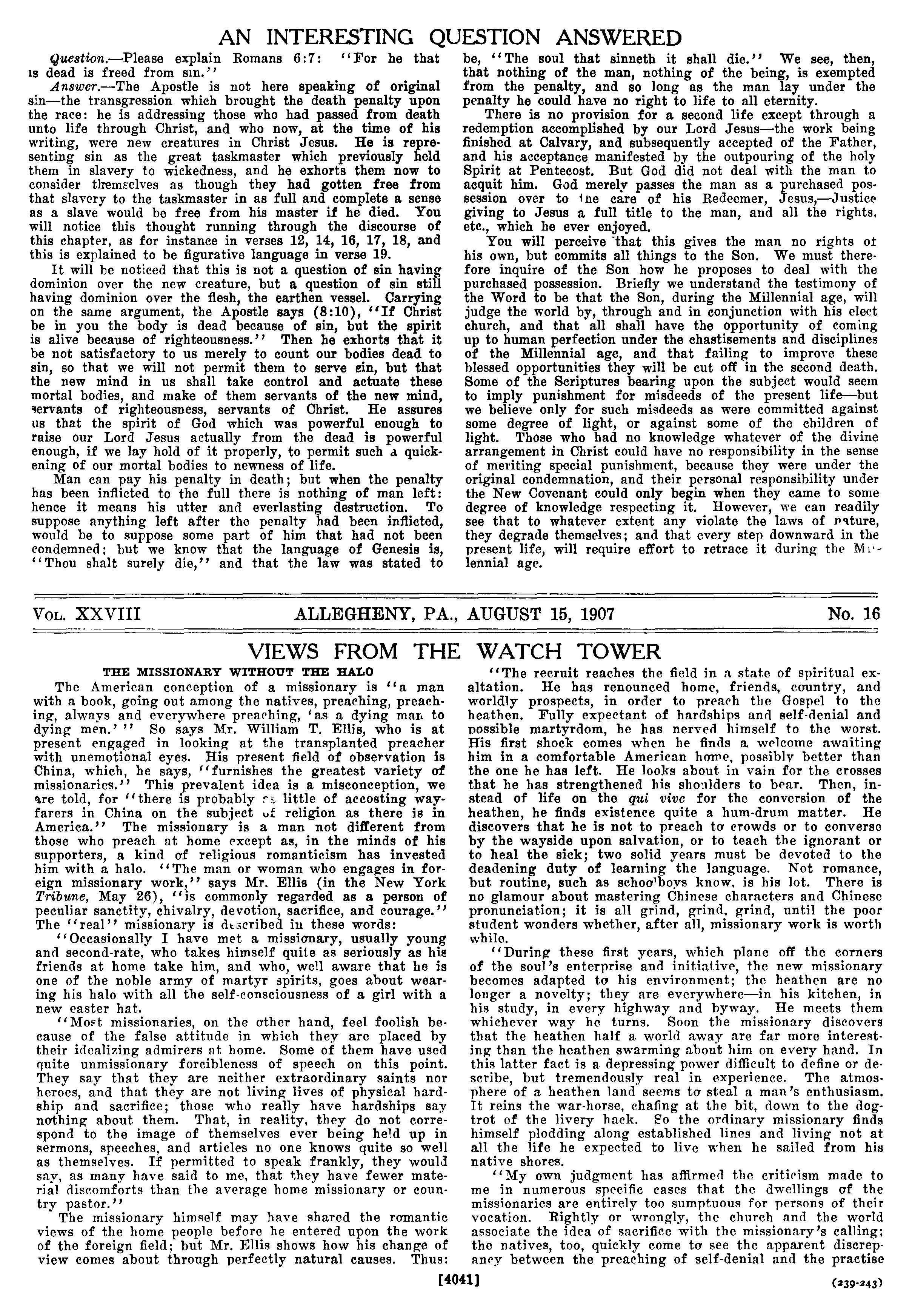
AN INTERESTING QUESTION ANSWERED Question Please explain Romans 6:7: ‘‘For he that 1s dead is freed from sin.’’ Answer—The Apostle is not here speaking of original in—the transgression which brought the death penalty upon the race: he is addressing those who had passed from death unto life through Christ, and who now, at the time of his writing, were new creatures in Christ Jesus. He is representing sin as the great taskmaster which previously held them in slavery to wickedness, and he exhorts them now to consider themselves as though they had gotten free from that slavery to the taskmaster in as full and complete a sense as a slave would be free from his master if he died. You will notice this thought running through the discourse of this chapter, as for instance in verses 12, 14, 16, 17, 18, and this is explained to be figurative language in verse 19. It will be noticed that this is not a question of sin having dominion over the new creature, but a question of sin still having dominion over the flesh, the earthen vessel. Carrying on the same argument, the Apostle says (8:10), ‘‘If Christ be in you the body is dead because of sin, but the spirit is alive because of righteousness.’? Then he exhorts that it be not satisfactory to us merely to count our bodies dead to sin, so that we will not permit them to serve ein, but that the new mind in us shall take control and actuate these mortal bodies, and make of them servants of the new mind, servants of righteousness, servants of Christ. He assures us that the spirit of God which was powerful enough to raise our Lord Jesus actually from the dead is powerful enough, if we lay hold of it properly, to permit such a quickening of our mortal bodies to newness of life. Man can pay his penalty in death; but when the penalty has been inflicted to the full there is nothing of man left: hence it means his utter and everlasting destruction. To suppose anything left after the penalty had been inflicted, would be to suppose some part of him that had not been condemned; but we know that the language of Genesis is, ‘‘Thou shalt surely die,’’ and that the law was stated to Vou. XXVIII be, ‘‘The soul that sinneth it shall die.’’ We see, then, that nothing of the man, nothing of the being, is exempted from the penalty, and so Jong as the man lay under the penalty he could have no right to life to all eternity. There is no provision for a second life except through a redemption accomplished by our Lord Jesus—the work being finished at Calvary, and subsequently accepted of the Father, and his acceptance manifested by the outpouring of the holy Spirit at Pentecost. But God did not deal with the man to acquit him. God merely passes the man as a purchased possession over to the care of his Redeemer, Jesus,—Justice giving to Jesus a full title to the man, and all the rights, etc., which he ever enjoyed. You will perceive that this gives the man no rights ot his own, but commits all things to the Son. We must therefore inquire of the Son how he proposes to deal with the purchased possession. Briefly we understand the testimony of the Word to be that the Son, during the Millennial age, will judge the world by, through and in conjunction with his elect church, and that all shall have the opportunity of coming up to human perfection under the chastisements and disciplines of the Millennial age, and that failing to improve these blessed opportunities they will be cut off in the second death. Some of the Scriptures bearing upon the subject would seem to imply punishment for misdeeds of the present life—but we believe only for such misdeeds as were committed against some degree of light, or against some of the children of light. Those who had no knowledge whatever of the divine arrangement in Christ could have no responsibility in the sense of meriting special punishment, because they were under the original condemnation, and their personal responsibility under the New Covenant could only begin when they came to some degree of knowledge respecting it. However, we can readily see that to whatever extent any violate the laws of pature, they degrade themselves; and that every step downward in the present life, will require effort to retrace it during the Mui'lennial age. ALLEGHENY, PA., AUGUST 15, 1907 No. 16 VIEWS FROM THE WATCH TOWER THE MISSIONARY WITHOUT THE HALO The American conception of a missionary is ‘‘a man with a book, going out among the natives, preaching, preaching, always and everywhere preaching, ‘as a dying man to dying men.’’’ So says Mr. William T. Ellis, who is at present engaged in looking at the transplanted preacher with unemotional eyes. His present field of observation is China, which, he says, ‘‘furnishes the greatest variety of missionaries.’’ This prevalent idea is a misconception, we are told, for ‘‘there is probably cs little of accosting wayfarers in China on the subject uf religion as there is in America.’’? The missionary is a man not different from those who preach at home except as, in the minds of his supporters, a kind of religious romanticism has invested him with a halo. ‘‘The man or woman who engages in foreign missionary work,’’ says Mr. Ellis (in the New York Tribune, May 26), ‘‘is commonly regarded as a person of peculiar sanctity, chivalry, devotion, sacrifice, and courage.’’ The ‘‘real’’ missionary is deseribed in these words: ‘*Oecasionally J have met a missionary, usually young and second-rate, who takes himself quite as seriously as his friends at home take him, and who, well aware that he is one of the noble army of martyr spirits, goes about wearing his halo with all the self-consciousness of a girl with a new easter hat. ‘¢Most missionaries, on the other hand, feel foolish because of the false attitude in which they are placed by their idealizing admirers at home. Some of them have used quite unmissionary forcibleness of speech on this point. They say that they are neither extraordinary saints nor heroes, and that they are not living lives of physical hardship and sacrifice; those who really have hardships say nothing about them. That, in reality, they do not correspond to the image of themselves ever being held up in sermons, speeches, and articles no one knows quite so well as themselves. If permitted to speak frankly, they would say, as many have said to me, that they have fewer material discomforts than the average home missionary or country pastor.’’ The missionary himself may have shared the romantic views of the home people before he entered upon the work of the foreign field; but Mr. Ellis shows how his change of view comes about through perfectly natural causes. Thus: [4041] ‘“‘Phe recruit reaches the field in a state of spiritual exaltation. He has renounced home, friends, country, and worldly prospects, in order to preach the Gospel to the heathen. Fully expectant of hardships and self-denial and possible martyrdom, he has nerved himself to the worst. His first shock comes when he finds a welcome awaiting him in a comfortable American home, possibly better than the one he has left. He looks about in vain for the crosses that he has strengthened his shoulders to bear. Then, instead of life on the qui vive for the conversion of the heathen, he finds existence quite a hum-drum matter. He discovers that he is not to preach to crowds or to converse by the wayside upon salvation, or to teach the ignorant or to heal the sick; two solid years must be devoted to the deadening duty of learning the language. Not romance, but routine, such as schoo’boys know, is his lot. There is no glamour about mastering Chinese characters and Chinese pronunciation; it is all grind, grind, grind, until the poor student wonders whether, after all, missionary work is worth while, ‘‘During these first years, which plane off the corners of the soul’s enterprise and initiative, the new missionary becomes adapted to his environment; the heathen are no longer a novelty; they are everywhere—in his kitchen, in his study, in every highway and byway. He meets them whichever way he turns. Soon the missionary discovers that the heathen half a world away are far more intcresting than the heathen swarming about him on every hand. In this latter fact is a depressing power difficult to define or desctibe, but tremendously real in experience. The atmosphere of a heathen land seems to steal a man’s enthusiasm. It reins the war-horse, chafing at the bit, down to the dogtrot of the livery hack. fo the ordinary missionary finds himself plodding along established lines and living not at all the life he expected to live when he sailed from his native shores. ‘‘My own judgment has affirmed the criticism made to me in numerous specific cases that the dwellings of the missionaries are entirely too sumptuous for persons of their vocation. Rightly or wrongly, the church and the world associate the idea of sacrifice with the missionary’s calling; the natives, too, quickly come to see the apparent discrepancy between the preaching of self-denial and the practise (239-243)
Pentru a vă îmbunătăți experiența pe site-ul nostru, folosim cookies și tehnologii similare. Unele cookies sunt esențiale pentru funcționalitatea de bază a site-ului nostru și nu pot fi refuzate. Puteți alege să acceptați sau să refuzați cookies suplimentare. Vrem să vă asigurăm că aceste date nu vor fi vândute sau utilizate în scopuri de marketing. Puteți ajusta preferințele dvs. în orice moment accesând Setările de Confidențialitate din subsolul paginii. Pentru mai multe informații, vă rugăm să consultați
Politica de Confidențialitate
Condiții de utilizare
.


