8
1
8
download/literature/watchtower/1908-14.pdf
watchtower/1908/14/1908-14-1
ZION'S
WATCH
TOWER
ALLEGHENY,
PA.
-Horeb.
This
was
the
same
mount
from
which
the
Law
kingdoms
of
this
world:
(a)
The
winds
(wars)
now
held
Covenant
was
delivered
at
the
hands
of
Moses.
Paul
shows
back,
show
that
the
overthrow
of
present
institutions
will
not
that
this
represents
the
heavenly
kingdom.
(Heb.
12:18-25.)
take
place
until
after
the
Elijah
class
has
reached
the
Mount
The
parable
of
the
virgins
shows
that
only
those
who
appre-
of
God-actually
changed.
However,
the
elements
are
being
date
present
truth
enter
into
the
marriage
since
1874.
They
prepared
for
the
conflict
before
them.
(b)
Earthquake
(social
must
appreciate
the
"Presence."
disorder)
next
follows.
(c)
Anarchy
is
the
fire
that
com-
The
forty
days'
and
forty
nights'
journey
(a
day
for
a
pletes
the
work.
God
was
not
in
them
in
the
sense
that
they
year,
as
in
IJrevious
type
of
1260
days)
gives
the
length
of
were
not
of
divine
institution;
nevertheless
they
were
over-
the
journey
(time)
from
the
beginning
of
the
awakening
by
ruled
to
accomplish
his
purposes.
(d)
"The
still
small
voice"
"that
servant,"
angel,
in
1874,
untl1
the
last
member
of
the
(God's
Word)
which
now
speaks
only
to
the
listening
ear
(he
Elijah
class
&hall
have
reached
the
kingl!om
(Mount
of
God,
that
hath
an
"ear
to
hear")
will
then
speak
with
authority
Heb.
12:
22)
"in
l
by]
the
strength
of
that
food
"-present
in
the
kingdom,
saying,
"Peace,
be
still."
Verse
13-It
truth.
Then
we
shall
meet
our
Lord
and
see
him
as
he
is.
seems
that
the
type
here
changes
to
teach
lessons
regarding
The
sub&equent
manifestation
of
power
shm,s,
as
you
have
our
present
privileges
and
responsibilities.
toll!
us,
the
three
features
of
the
oyerthrow
of
the
present
Yours
in
the
One
Hope,
C.
E.
FOWLER.
-
-
-
-
-
-
-
-
OUR
LORD'S
LAST
DAYS
CONNECTED
BIBLE
READING
WHICH
ACCOUNTS
FOR
EVERY
DAY
AND
NIGHT
OF
THE
LORD'S
LIFE,
FROM
THE
9TH
TO
THE
16TH
OF
NISAN,
PROVIi\G
THAT
HIS
DEATH
TOOK
PLACE
ON
THE
AFTERNOON
OF
FRIDAY,
THE
14TH.
BY
C.
J.
WOODWORTH
Oth
Nisan,
6.00
P.~I.
Saturday
to
6.00
P.M:.
Sunday:
John
12:
1.
'
'Then
Jesus,
six
days
before
the
passover,
came
to
Bethany."
This
accounts
for
Sunday
afternoon.
10th
Nisan,
6.00
P.M.
Sunday
to
6.00
P.M.
Monday:
John
12
:2-11.
Mar;r
hreaks
the
alabaster
box.
Sunday
night.
John
12
:12-15
and
Mark
11
:1-10.
Tl'iumphal
entry.
Monday
forenoon.
11th
Nisan,
6.00
P.M.
Mon(lay
to
6.00
P.M.
Tuesday:
Mark
11
:11.
Lodged
at
Bethany.
Monday
night.
Mark
11
:12-18.
Cursing
the
fig
tree;
cleansing
the
tem
ple.
Tuesday
forenoon.
12th
Nisan,
6.00
P.M.
'l'uesday
to
6.00
P.M.
Wednesday:
Mark
1J:
J
9.
Lodged
out
of
the
city.
Tuesday
night.
Mark
11
:20;
13
::17.
Many
para
hIes
delivered.
Wednes
day
forenoon
and
afternoon.
13th
Nisan,
6.00
P.M
Wednesllay
to
6.00
P.M.
Thursday:
Mark
14:
1-11.
One
of
the
bYO
days
before
the
passover,
beginning
on
Wedncsday
night.
Mark
14:
12-16.
'l'he
apostles
make
arrangements
for
the
last
supper,
Thm'sday,
daytime.
14th
Nisan,
6.00
P.M.
Thursday
to
6.00
P.M.
Friday,
the
day
hefore
the
Jewish
passover,
callell
the"
Day
of
Prepara
tion:
"
Mark
14
:17-65.
Last
supper,
Gethsemane,
trial
before
high
priest,
Thursday
night.
Mark
15:
1-34
and
Luke
23
:44-52.
Trial
before
Pilate,
crucifixion,
body
laid
in
tomb,
Friday
forenoon
and
after
noon.
Luke
23
:54.
Here
it
is
distinctly
stated
that
the
death
of
Christ
took
place
on
the
"Day
of
Preparation."
This
day
is
reckoned
as
the
first
day
and
night
which
Christ
spent
in
the
tomb.
15th
Nisan,
6.00
P.M.
Friday
to
6.00
P.M.
Saturday,
Jewish
passover
Sabbath:
Luke
23
:54
and
John
19
:42.
The
Jewish
Sabbath
begins
just
as
the
"Day
of
Preparation"
closes,
at
6:
00
P.M.
Friday
night.
Matt.
27:
62.
The
chief
priests
ask
Pilate
to
place
a
guard
about
the
tomb,
Saturday
morning.
This
day
is
reckoned
as
the
second
day
and
night
which
Christ
spent
in
the
tomb.
16th
Nisan,
6.00
P.M.
Saturday
to
6.00
P.M.
Sunday,
First
day
of
week:
Matt.
27:
66.
Watch
set
over
tomb
throughout
Saturday
night.
Matt.
28:1,
Mark
16:1,
2,
Luke
24:1
and
John
20:1.
The
women
come
to
the
tomb
early
on
Sunday
morning
and
find
the
Lord
is
risen.
This
day
is
reckoned
as
the
third
day
and
night
which
Christ
spent
in
the
tomb.
VOL.
XXIX
ALLEGHENY,
P
A.,
AUGUST
1,
1908
No.
15
-~-~-----.-===========================
"IF
GOD
BE
FOR
US
WHO
CAN
BE
AGAINST
US?'"
Romans
8:31.
"Vhat
wonderful
thoughts
these
words
arouse!
God
for
us!
God
on
our
side!
It
means
almighty
wisdom
enlisted
in
our
interest,
almighty
power
exerted
on
our
behalf,
almighty
love
and
infinite
goodness
watching
over
us
and
caring
for
and
helping
us.
What
immeasnral,le
lengths
and
breadths,
heights
[md
depths
of
infinite
grace
are
here
so
forcibly
and
so
con
cisrly
set
hefore
the
min<1!
But
we
notice
a
limitation:
The
Apostle's
suggestion
is
not
that
God
is
for
everyone,
hut
for"
1IS."
To
whom
does
he
refer
by
this
word
"us
"I
"
Is
It
possihle
that
divine
lovE'
anll
energy.
,\isdom
and
power
are
not
being
exertell
on
behalf
of
the
world,
but
only
on
behalf
of
the
church
in
this
present
time~
Christian
prople
are
divitled
in
their
opinion
respecting
this
matter.
Our
MC'thodist
friends
and
generally
Uniyersali9ts
and
Unitarians
hold
that
God
is
not
for
118,
the
church,
spe
cially;
but
that
he
is
for
everybody,
everywhere.
'rhey
hold
that
he
is
today
trying
to
save
cvcryhody,
and
that
he
has
been
so
trying
for
tLe
past
six
thousand
years.
They
must
of
course
admit,
when
making
such
a
claim,
that
thus
far
the
divine
plan
has
failed
of
success
for
six
thousand
years;
be
cause
men
are
not
saved
and
only
a
small
proportion
have
yet
had
the
necessary
opportunity
for
salvation;
namely,
a
knowledge
of
the
only"
name
given
under
heaven
or
amongst
men
whereby
we
must
be
saved."
They
must
realize
that
the
logic
of
facts
is
against
their
contention
and
against
all
hope
that
by
present
methods
and
arrangements
the
world
would
ever
be
converted;
for
they
are
aware
that
while
it
is
claimed
in
a
general
way
that
nearly
a
million
heathen
have
been
converted
during
the
la9t
century
(and
it
is
safe
to
say
that
a
very
large
proportion
of
these
are
not
so
thoroughly
converted
as
might
be
desired;
that
comparatively
few
of
them
could
be
termed
"saints'
'),
yet,
during
the
same
time
it
is
estimated
tl:at
the
numbers
of
the
heathen
have
increased,
in
a
natural
way,
to
the
enormous
sum
of
two
hundred
millions.
How
long
woulll
it
require
at
this
rate,
at
this
ratio
of
conver·
s:on,
one
million
converts
to
two
hundred
million
births,
to
com-ert
the
world!
All
can
see
that
such
hopes
are
quite
illog.
ical.
Nevertheless,
we
can
sympathize
with
and
greatly
appre
ciate
the
warmth
of
heart
on
the
part
of
many
of
these
whose
theology
we
now
criticise.
Many
of
them-at
least
the
found
ers
of
the
systems-were
forced
to
such
conclusions,
namely,
that
God
IS
doing
the
best
he
can
do
for
the
world,
in
opposi
tion
to
the
doctrine
of
election
and
foreordination,
as
it
has
heretofore
been
misunderstood.
On
the
other
hand,
the
great
majority
of
Christian
people,
namely,
the
various
branches
of
the
Presbyterian,
the
Episco
pal,
the
Lutheran,
the
Baptist
and
the
Congregationalist
churcheR
deny
the
theory
that
God
has
been
trying
to
save
the
world
for
the
past
six
thousand
years
and
has
failed
of
his
purpose.
They
hold,
to
the
contrary,
that
his
purpose
has
been
to
select
or
elect
out
of
the
world
a
church
and
that
this
work
of
election
has
been
progressing
and
will
finally
be
consum
mated;
and
that
thus
God's
Word
through
the
prophets
shall
he
fulfilled,
"My
Word
that
goeth
forth
out
of
my
mouth
shall
not
return
unto
me
void;
but
it
shall
accomplish
that
1chich
I
please,
and
it
shall
prosper
in
the
thing
whereto
I
sent
it."
(Isa.
55:11.)
They
hold
that,
since
all
of
God's
purposes
shall
be
accomplished,
it
cannot
have
been
his
pur·
pose
either
to
convert
the
world
or
to
bring
every
creature
to
a
knowledge
of
Christ
during
the
past
six
thousand
years;
be
eause
neither
thing
has
been
accomplished,
therefore
neither
thing-s
could
have
been
purposed.
We
were
about
to
say
that
we
agree
with
the
last
men·
tioned
numerous
families
of
Christians
in
reference
to
the
doctrine
of
election;
but
we
cannot
make
so
broad
a
state·
[4212]
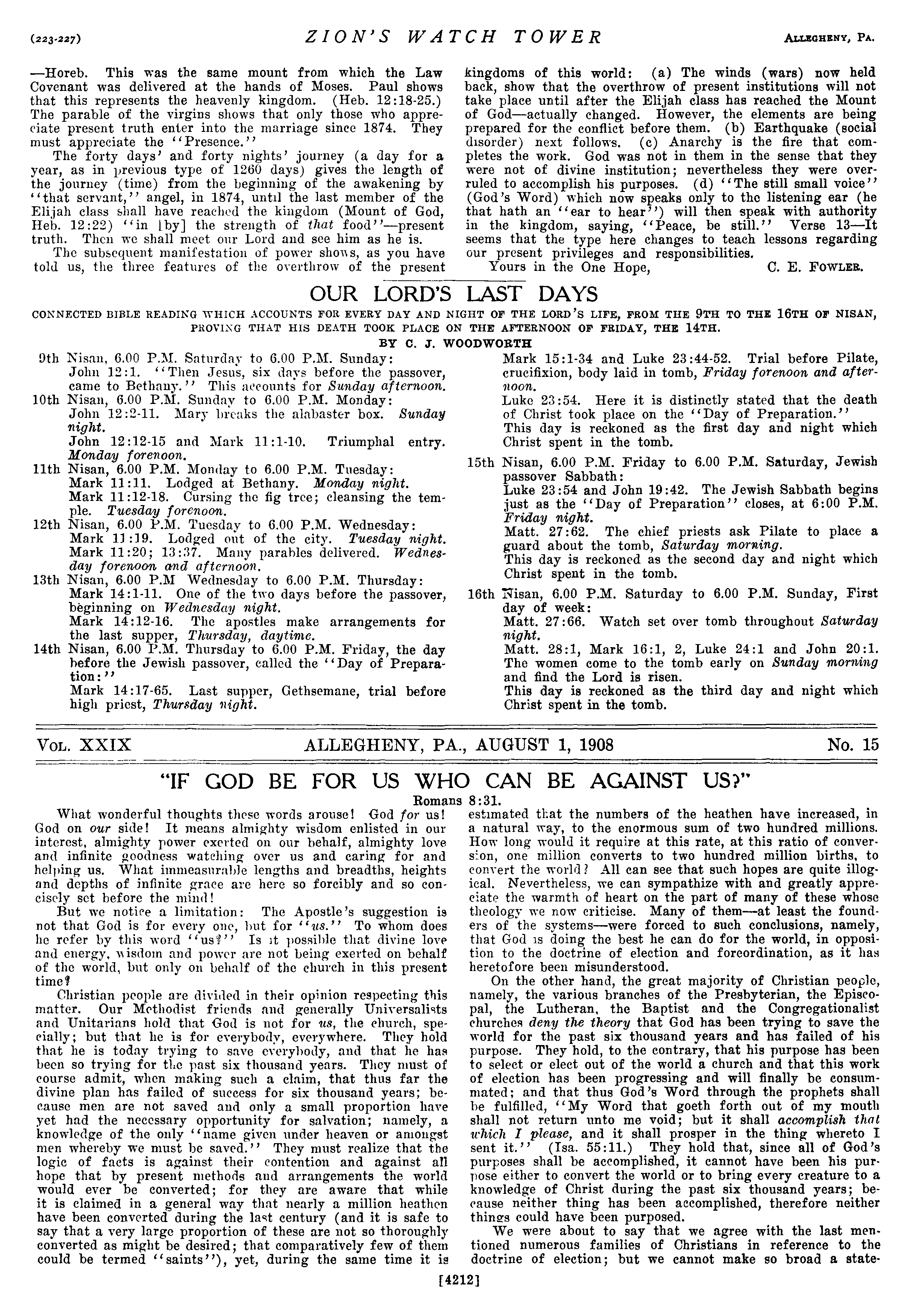
(223-227) —Horeb. This was the same mount from which the Law Covenant was delivered at the hands of Moses. Paul shows that this represents the heavenly kingdom. (Heb. 12:18-25.) The parable of the virgins shows that only those who appreciate present truth enter into the marriage since 1874. They must appreciate the ‘‘Presence.’’ The forty days’ and forty nights’ journey (a day for a year, as in previous type of 1260 days) gives the length of the journey (time) from the beginning of the awakening by ‘‘that servant,’’ angel, in 1874, until the last member of the Elijah class shall have reached the kingdom (Mount of God, Heb. 12:22) ‘‘in |by] the strength of that food’’—present truth. Then we shall meet our Lord and see him as he is. The subsequent manifestation of power shows, as you have told us, the three features of the overthrow of the present ZION’S WATCH TOWER ALLEGHENY, Pa. kingdoms of this world: (a) The winds (wars) now held back, show that the overthrow of present institutions will not take place until after the Elijah class has reached the Mount of God—actually changed. However, the elements are being prepared for the conflict before them. (b) Earthquake (social disorder) next follows. (¢) Anarchy is the fire that completes the work. God was not in them in the sense that they were not of divine institution; nevertheless they were overruled to accomplish his purposes. (d) ‘‘The still small voice’’ (God’s Word) which now speaks only to the listening ear (he that hath an ‘‘ear to hear’’) will then speak with authority in the kingdom, saying, ‘‘Peace, be still.’’ Verse 13—It seems that the type here changes to teach lessons regarding cur present privileges and responsibilities. Yours in the One Hope, C. E, Fow er, LAST DAYS CONNECTED BIBLE READING WHICH ACCOUNTS FOR EVERY DAY AND NIGHT OF THE LORD’S LIFE, FROM THE 9TH TO THE 16TH OF NISAN, PROVING THAT HIS DEATH TOOK PLACE ON THE AFTERNOON OF FRIDAY, THE 14TH. BY C. J. WOODWORTH OUR LORD’S Oth Nisan, 6.00 P.M. Saturday to 6.00 P.M. Sunday: John 12:1, ‘‘Then Jesus, six days before the passover, came to Bethany.’’ This accounts for Sunday afternoon, Nisan, 6.00 P.M. Sunday to 6.00 P.M. Monday: John 12:2-11. Mary breaks the alabaster box. night, John 12:12-15 and Mark 11:1-10. Monday forenoon, Nisan, 6.00 P.M. Monday to 6.00 P.M. Tuesday: 10th Sunday Triumphal entry. 11th Mark 11:11. Lodged at Bethany. Monday night. Mark 11:12-18. Cursing the fig tree; cleansing the temple. Tuesday forenoon, 12th Nisan, 6.00 P.M. Tuesday to 6.00 P.M. Wednesday: Mark 11:19. Lodged ont of the city. Tuesday night. Mark 11:20; 13:37. Many parables delivered. Wednesday forenoon and afternoon, 13th Nisan, 6.00 P.M Wednesday to 6.00 P.M. Thursday: Mark 14:1-11. One of the two days before the passover, beginning on Wednesday night. Mark 14:12-16. The apostles make arrangements for the last supper, Thursday, daytime. Nisan, 6.00 P.M. Thursday to 6.00 P.M. Friday, the day hefore the Jewish passover, called the ‘‘Day of Preparation: Mark 14:17-65. Last supper, Gethsemane, trial before high priest, Thursday night. 14th Mark 15:1-34 and Luke 23:44-52. Trial before Pilate, crucifixion, body laid in tomb, Friday forenoon and afternoon, Luke 23:54. Here it is distinctly stated that the death of Christ took place on the ‘‘Day of Preparation.’’ This day is reckoned as the first day and night which Christ spent in the tomb. Nisan, 6.00 P.M. Friday to 6.00 P.M. Saturday, Jewish passover Sabbath: Luke 23:54 and John 19:42. The Jewish Sabbath begins just as the ‘‘Day of Preparation’’ closes, at 6:00 P.M. Friday night. Matt. 27:62. The chief priests ask Pilate to place a guard about the tomb, Saturday morning. This day is reckoned as the second day and night which Christ spent in the tomb. 16th Wisan, 6.00 P.M. Saturday to 6.00 P.M. Sunday, First day of week: Matt. 27:66. night, Matt. 28:1, Mark 16:1, 2, Luke 24:1 and John 20:1. The women come to the tomb early on Sunday morning and find the Lord is risen. This day is reckoned as the third day and night which Christ spent in the tomb. 15th Watch set over tomb throughout Saturday Vou. X XIX ALLEGHENY, PA., AUGUST 1, 1908 No. 15 “IF GOD BE FOR US WHO CAN BE AGAINST US?” Romans 8:31. What wonderful thoughts these words arouse! God for us! God on our side! It means almighty wisdom enlisted in our interest, almighty power exerted on our behalf, almighty love and infinite goodness watching over us and caring for and helping us. What immeasurable lengths and breadths, heights and depths of infinite grace are here so forcibly and so conciscly sct before the mind! But we notice a limitation: The Apostle’s suggestion is not that God is for every one, but for ‘‘us.’’ To whom does he refer by this word ‘‘us?’’ Is it possible that divine love and energy, wisdom and power are not being exerted on behalf of the world, but only on behalf of the church in this present time? Christian people are divided in their opinion respecting this matter. Our Mcthodist friends and generally Universalists and Unitarians hold that God is not for us, the ehurch, speelally; but that he is for everybody, everywhere. They hold that he is today trying to save everybody, and that he has been so trying for tlhe past six thousand years. They must of course admit, when making such a claim, that thus far the divine plan has failed of success for six thousand years; because men are not saved and only a small proportion have yet had the necessary opportunity for salvation; namely, a knowledge of the only ‘‘name given under heaven or amongst men whereby we must be saved.’’?’ They must realize that the logie of facts is against their contention and against all hope that by present methods and arrangements the world would ever be converted; for they are aware that while it is claimed in a general way that nearly a million heathen have been converted during the last century (and it is safe to say that a very large proportion of these are not so thoroughly converted as might be desired; that comparatively few of them could be termed ‘‘saints’’), yet, during the same time it is estimated that the numbers of the heathen have increased, in a natural way, to the enormous sum of two hundred millions. How long would it require at this rate, at this ratio of conversion, one million converts to two hundred million births, to convert the world? All can see that such hopes are quite illogical, Nevertheless, we can sympathize with and greatly appreciate the warmth of heart on the part of many of these whose theology we now criticise. Many of them—-at least the founders of the systems—were forced to such conclusions, namely, that God 1s doing the best he can do for the world, in opposition to the doctrine of election and foreordination, as it has heretofore been misunderstood. On the other hand, the great majority of Christian people, namely, the various branches of the Presbyterian, the Episcopal, the Lutheran, the Baptist and the Congregationalist churches deny the theory that God has been trying to save the world for the past six thousand years and has failed of his purpose. They hold, to the contrary, that his purpose has been to select or elect out of the world a church and that this work of election has been progressing and will finally be econsummated; and that thus God’s Word through the prophets shall be fulfilled, ‘‘My Word that goeth forth out of my mouth shall not return unto me void; but it shall accomplish that which I please, and it shall prosper in the thing whereto I sent it.’? (Isa. 55:11.) They hold that, since all of God’s purposes shall be accomplished, it cannot have been his purpose either to convert the world or to bring every creature to a knowledge of Christ during the past six thousand years; because neither thing has been accomplished, therefore neither things could have been purposed. We were about to say that we agree with the last mentioned numerous families of Christians in reference to the doctrine of election; but we cannot make so broad a state [4212]
Pentru a vă îmbunătăți experiența pe site-ul nostru, folosim cookies și tehnologii similare. Unele cookies sunt esențiale pentru funcționalitatea de bază a site-ului nostru și nu pot fi refuzate. Puteți alege să acceptați sau să refuzați cookies suplimentare. Vrem să vă asigurăm că aceste date nu vor fi vândute sau utilizate în scopuri de marketing. Puteți ajusta preferințele dvs. în orice moment accesând Setările de Confidențialitate din subsolul paginii. Pentru mai multe informații, vă rugăm să consultați
Politica de Confidențialitate
Condiții de utilizare
.


