8
1
8
download/literature/watchtower/1910-14.pdf
watchtower/1910/14/1910-14-1
Tnv
1,
1910
THE
WATCH
TOWER
1220
-2?i)
pould
do
the
mira('les
whidl
he
doeth
unless
God
be
with
him"
in
some
spe('ial
manner.
"WHOM
SAY
YE
THAT
I
AM"
Our
Lord
first
inquired
respeding
the
general
opinion
of
the
people
l'on('l'rning
himself.
He
did
this,
not
because
of
his
own
ignorance,
but
that
he
might
draw
out
the
thoughts
of
his
oliseiples.
They
replied
that
some
thought
he
was
John
thl'
,aptist;
others
supposed
he
was
one
of
the
prophets.
The
ideas
f
the
heatflen
were
gradually
making
inroads
upon
the
Jews.
'he
doctrine
of
reinparnation,
wholly
unspriptural,
is
suggested
n
these
answers.
All
the
answers,
of
course,
were
wrong,
for
.he
prophets
were
all
dead
and
could
not
reappear
until
thc
resurrection.
Then
our
Lord
pointedly
put
the
question
to
his
('hosen
followers:
"\Vhom
do
ye
say
that
I
2.m?"
The
cour
ageous
St.
Peter
promptly
answl'red
as
spokesman
for
the
whole
l·ompany.
"Thou
art
the
Christ
(Messiah),
the
Son
of
the
liv
ing
God."
This
was
the
very
answer
designed
to
be
brought
forth.
It
was
the
truth,
but
our
Lord
hesitated
to
present
it,
bel'ause
it
would
better
come
from
the
disciples
themseh-es
and
then
have
his
endorspment.
His
answer
to
St.
Peter
was,
"Blessed
art
thou,
Simon
Bar-jona,
for
flesh
and
blood
hath
not
revealed
it
unto
thep,
but
my
Father
which
is
in
heaven."
It
was
not
that
St.
PetH
I;ad
pxperienped
a
spedal
vision
or
revelation,
but
slll'h
a
gn·at
spiritual
fal't
as
was
then
under
('onsideration.
poull!
hp
lluly
apprepiaterl
only
by
those
who
were
specially
favored
of
the
Father.
Indeed,
it
is
evident
that
the
same
prinpiple
still
opprates,
for
we
read,
"No
man
pan
come
unto
mp,
expept
the
Father
which
sent
me
draw
him."
Our
primar.v
l!rawing
anll
r·alling
is
of
tlw
Father
up
to
the
time
whl'n
WP
appept
his
graep
in
Christ
anll
make
our
consecration
to
llo
his
will
and
rerl'ive
the
spirit
of
adoption
into
his
family
as
GOll'S
ddldrpn;
Wl'
are
tll('n
put
into
the
sehool
of
Christ
to
Iparn
of
him.
Let
us
ll'arn
the
Ipsson
that
the
spepial
blessini!s
always
comp.
not
only
from
believing
in
Christ,
hut
also
from
l'onfl'ssing
him
to
and
before
others.
ST.
PETER--THE
ROCK--THE
KEYS
According
to
the
Greek.
OUr
Lord
replied
to
Peter,
"Thou
art
a
stone.
and
upon
this
ropk
will
I
build
my
churph."
The
rOl'k
upon
which
the
Churph
is
built
is
this
confession
which
St.
Petl'r
madr.
St.
Peter
himself
was
not
the
rock.
but
he
was
one
of
the
living
stones
built
by
faith
upou
the
rock
of
truth.
It
was
this
same
Apostle
who
so
heautifully
explained
the
whole
mattpr,
assuring
us
that
all
l'onspcrate,l
bplievers
are
"living
,tOIlI'S"
ill
thp
tplllplp
of
Uod.
who,p
foulldntion
anll
rap-stone
is
Christ.
in
whom
,~'e
are
huilllpd
together
through
the
operation
of
the
hol,v
Spirit.--l
Pet.
2:
-1-7.
TIll'
exprpssion,
"Upon
this
ro(,k
I
will
huild
my
churdl
amI
thl'
gates
of
hpll
(halll'~)
shall
not
prl'vail
against
it."
is
one
that
i~
mUl·h
misunllprstoolI.
Till'
gates
of
hp1l
are
not
gates
to
some
pla('p
of
torture.
nor
l2atps
to
purgator~'.
Thpy
arl'o
in
thp
Grppk,
"gatp..;
of
harll's,"
and
hade,.;
~ignifie~
a
statp
or
pon
IIition
of
llpath.
'1'hp
passage
might
well
hp
translatpd.
"The
gatps
of
till'
grave
,hall
not
prp,'ail
against
it."
That
is
to
~a:r.
C'hri,t
,JpSIlS
invites
the
('Illlrph
to
die
with
him.
to
share
in
hi,
sacrific(',
in
his
dpath.
and
while.
apparently,
thp
gates
of
hades
have
preyailcrl
against
the
pllllrph.
again~t
Gall's
peoplp,
for
more
than
pightel'n
(,pnturips.
nevertheless,
WI'
haye
tIl('
assur
aJj('e
that
thpy
shall
not
forever
prevail.
The
J\fastpr's
assur
anl'l'
is
that
hv
his
dpatll
Il('
ha,.;
I)cpome
Lonl
of
all
a11l}
lUIS
the
kpys
of
,Il'ath'
awl
l:adps.
Up
has
tIl('
right
to
0pl'n
hadp,.;,
thp
tomh,
and
to
pall
forth
all
who
hayp
gone
down
into
it.
Ill'
assurl's
us
that
hp
will
do
this.
a..;
Ill'
says,
".\ll
that
arp
in
thr,ir
graye,
shall
hpar
tlll'
voil'e
of
tlw
~on'
of
wan
amI
shall
r'onH'
forth."
XpnrtllPlp,s.
for
all
tll('sp
r·pntllrie,.;
it
has
J'('quirpil
faith
to
hpli,'y('
t!Jat,
hy
Ih'inl',
with
Christ.
llis
foll()\\'l'rs
,h',11
ypt
iJYl'
with
hilll--Iha't
Sh:llll1g'
with
him
in
hi,.;
dl':lth
Ih,·y
shall
\'Pt
share
with
him
in
his
r~surredion
to
the
glnn-
and
t~
the
hOl'lOr
atta"hing
to
the
lli,'ine
naturp.
Ro.
thpn.
'our
Lonl's
,"ords
mean
that
thPTp
will
he
a
rpsurredion
from
thp
grayp.
and
sincp
tlIP
l'hul'I'h
is
to
1)('
"a
kind
of
first-fruits
unto
00,1
of
his
prpa
hIres"
(.Tas,
1:1R;
TI(','.
l--l'--l),
her
rp,urrl'etion
mp:1ns.
indio
redl.".
thl'
uplifting
of
mankind.
tIl('
0ppllillg
of
Ihp
i!ran
til
pvpr."
memlH'r
IIf
HIP
human
hmil.".
The
giYillg
of
the
"keys"
of
the
kingdom
to
i::lt.
Peter
has
no
refel'l'llce
to
lo('ks
allli
bars
of
heaven
over
whi('h
St.
Peter
is
the
cu,.;todian.
Thp
church
in
the
present
time
is
the
king
dOIll
of
heaypn
ill
its
IH'pIJ<Hatory
of
pmhryotie
statp.
:lIld
~t.
Peter
was
privilegell
to
do
thp
opelling
work
to
thp
Gospel
chur('h.
He
opened
the
door
to
thp
.Tews
at
Ppnte('ost.
whpn,
as
the
mouthpIece
of
the
Lon},
11('
proclaimell
the
meaning
of
the
l'entel'ostal
hlpssing
and
till'
hopes
thpn
open
to
e,'pry
Jpw
('oming
indiyirluaHy
into
mpmhpr,hip
in
Christ.
Ill'
u,ed
thp
8('('oml
"key"
to
0lll'n
the
,.;amp
kingdom
privileg('s
to
the
(lPII'
till'S,
in
that
when
the
llup
time
pame
for
C'orn.'lius,
the
fir~t
(jpntile
convert,
to
be
rppeinll,
Nt.
Peter
dill
the
work.
D."
preaching
to
Cornelius
the
Gospel
all']
baptizing
him
into
Christ
he
threw
open
the
door
to
the
Gpntllps.
as
our
Lord
foretolll
in
til('
words
of
this
lesson.
f-it.
]'pter's
commission
th:1t
whatever
thing,
he
shoul,l
hinll
on
parth
should
he
bound
in
he:1ypn
amI
what
thing,.;
he
shoulll
loose
on
earth
should
be
loosed
in
IH'ayen,
is
thp
samp
that
was
given
to
the
othpr
Apostlps.
(Rpp
Matt.
I
R:
I
H)
It
dol'S
nllt
mean,
of
poursI',
that
the
Lord
has
turnell
matters
OY('J'
to
i"t.
Peter
and
made
him
Lord
of
heaypn
and
parth,
nor
that
any
or
all
of
the
Apostles
were
so
honorp,].
It
simply
means
this:
God
purposes
to
use
his
Apostles
and
to
SO
holll
up
thpir
hands.
in
all
their
affairs,
that
thp
wholp
ehurdl
may
han
ponfidpn('e
in
thpm,
and
m:1Y
rp('ognize
their
tpa('hings
as
of
God.
If
they
deplared
that
certain
of
thp
pommandment,.;
ullllpr
the
Jewish
law
wpre
not
him}ing
upon
Christians,
WI'
must
know
that
their
~tatenl('nts
were
true.
alii}
that,
similarly,
in
hpaypn,
thp
rPlpase
or
changp
i,
re('ognizpr].
AmI
if
thp."
hounll
(,pl'tain
dol'tri!]('s
and
teachings.
we
must
know
that
those
an'
hound
an,1
firml."
established
in
l1l'aven.
In
other
wonls.
we
nm,t
repognize
thp
Apostlps
as
GOll'S
inerrant
mouthpipcps.
Thp
time
for
thp
pro('laiming
of
.Tpsus
a~
the
l\]pssiah
di,1
not
('omp
until
aftpr
his
rIpath
and
rpsurrection.
InllePll,
his
TI]pssiahship
properly
llates
from
his
rpslllTl'ption.
He
<1esirp,1
his
disciplps
to
re('ognizp
him
propprl.".
and
hp
pxplainpd
to
thpm
alJout
his
approaching
Ilpnth
an,}
rpslllTel'tion.
hut
he
did
not
wish
them
to
proclaim
this
to
the
worl,1
until
thC'
rIue
tinll'.
St.
Peter,
perhaps
elated
with
tllp
Lonl's
l'Omml'llllation
of
his
pre
vious
speech.
undprtook
now
the
rolC'
of
tpapher
to
the
onp
whom
he
had
iust
arkuowledged
as
thp
J\fpssiah.
In
this
hI'
prrer].
It
was
in
sympathy
that
hp
nrged
that
thp
l\fastpr
should
not
think
of
any
steps
whidl
woul,1
Iparl
to
<1path,
but
shoul<1
think
rather
of
pl'o,pprity
:1nd
parthly
favor.
~'pt
our
Lonl',.;
l'l'proof
was
pointe'l.
He
said;
lOU
arp
Ill."
ndv,·rs:I1'.".
Pl'h·r.
whpn
YOU
thus
~ncak
to
mp.
You
woulll
tll11s
p!lll
..
a\,or
to
,liss!Hlll
..
'nIl'
from
d~ing
m."
Fathpr's
"'ill.
to
hilHler
lllP
from
llrinkillg
thp
eup
whi('h
IllV
Fatlll'r
h:1s
pourpd
for
mp;
your
('01l1lspl
is
that
ponnnon
to
thp
world
:11111
lIot
of
Ood.
Rimilarlv.
thl'
followprs
of
.Tpsu,.;
sonwtinl('s
npl',1
to
rpsist
thl'ir
friC'nrI"s,
who
tIm,
otfpr
r'oulIsPl
"onlr:1rv
to
thp
lli,'illp
will
all,1
'YOi'll
amI
Prm'idl'npp.
Thp,p
~houl,}
'not
hp
pnl'ourng'l'll
nor
tlwir
advicp
followl'rl.
Thev
nl"'d
l'ol'l'pl'tion
from
thl·ir
fl'l
low-di':l'ipl(·~.
a,.;
did
~t
1'pI,'r,'
The
wonls
of
PC'tl'r
furnishp<1
till'
l\fast<'r
an
opportullity
for
calling
tlj('
at!pntion
of
his
followprs
to
Ihp
tprlllS
of
,Ii"l'iplp·
ship.
Not
olll~'
must
tIl('
l\]ast
..
r
him,plf
sutfpr.
hllt
all
of
hi~
followf'TS
likp\\,i,p.
This
poursp
was
proYi,lpll
for
(·vPI'.v
onp.
an<1
wlloe\'(>r
would
flpC'
from
it
wOll]ll
losp
till'
pjPl'll:tl
lifp
hoppll
for.
"~11Oevcr
W0111d
takl'
up
his
l'ross
an,1
follow
thp
'!\Tnstn
to
rJp;lth
woulrl
tllf'rPllV
m:l1.;:p
surp
of
llis
shnl'l'
in
l'lpl'nal
lifp
on
thC'
II(>avpnl."
planp.'
His
rlis('iplps
harl
aln·ndy
pll'dgl'<1
thpir
l'arthlv
li"I·s.
an,1
for
thpm
to
witllholll
thpm
for
worldly
:1dvall
tagp.
\\'ould
ml'an
that
tlH'V
would
I08p
thpir
soul"
th;·ir
lin·s.
Thi·;
is
110t.
tnlp
of
thp
\\'01'1<1
in
gpnpral,
lout
mprply
of
th
..
(,1111J'(·11.
p:dlp,}
to
hp
of
thp
pler·t.
ro."al
prip,tlloo,1.
Ill'
thpn
a"surplI
thl'lll
of
his
sl'l'onll
pominl!.
and
that
hp
woulll
pomp
in
IhC'
12101'."
of
tIl('
Fnthpr
amI
with
his
:1ngpls
(mps~l'nl!prs)--not
agaill
as
a
man--as
11
sal'rif1l·p.
At
t.h
..
timp
of
his
sC'('oml
coming
Ill"
W011111
rcward
p,'prv
onp
of
his
follow('l's
a""ordill[!
to
thp
faithflllnpss
of
paph.
Hp
('onl'1mlpll
this
refrrpnl'p
t.o
'tIll'
r·oming
kin!!dolll
hy
th,·
assuranl'p
that
somp
of
tllPl1l
would
hayp
an
r",ular
dl'lJlonsir:di"n
of
hi~
r'om
ill!!
powl'r
:1nll
;!Iol'~'
lodorp
thp~,
wonld
dil'.
This
WP
will
con·
sirll'r
in
our
npxt
sturl.".
YOL.
XXXI
Xn.1.1
--_._----~---------~-------------
---------_.
--
-
--
-
-------
-
------
---
FOREIGN
TOUR
REPORT
SECTION
IV.
At
thC'
F:,}inhmgh
railwa."
station
WI'
W('J'P
ml't
h."
a
rldl'
gation
of
frienrls:
indppd
somp
camp
tl1
Dnndpl'
to
mpet
us.
\Ve
had
a
very
pnio~'ahll'
spason.
Brothpr
,John
Ed;!ar.
1\f.
D
..
addrpssed
thp
Rrlillhurgh
frienrls
in
tllf'
forpnoon
on
thp
"Ran
som
anrl
i-lin-Offpring."
'Ye
wpre
not
privilegpd
to
hpar
the
arldrp"".
hut,
through
othprs
I"arnl'rl
that
it
was
hoth
interest
ill(!'
an'}
instrul'tivp.
In
thp
aftprnoon
we
addressC'd
the
inter
I's'jl',l.
n
hout
]
--lO.
awl
pnrlpavored
to
point
ont
how
thp
chnrC'h
pntrrs
illto
cownant
rC'lationship
with
Uod.
not
through
thp
work
of
a
mpdiator.
hut
by
"saprifice."
\Ve
pointed
out
that
the
world
through
thp
l\Tillpllnium
will
have
the
grC'at
Mpdia-
[464:1]
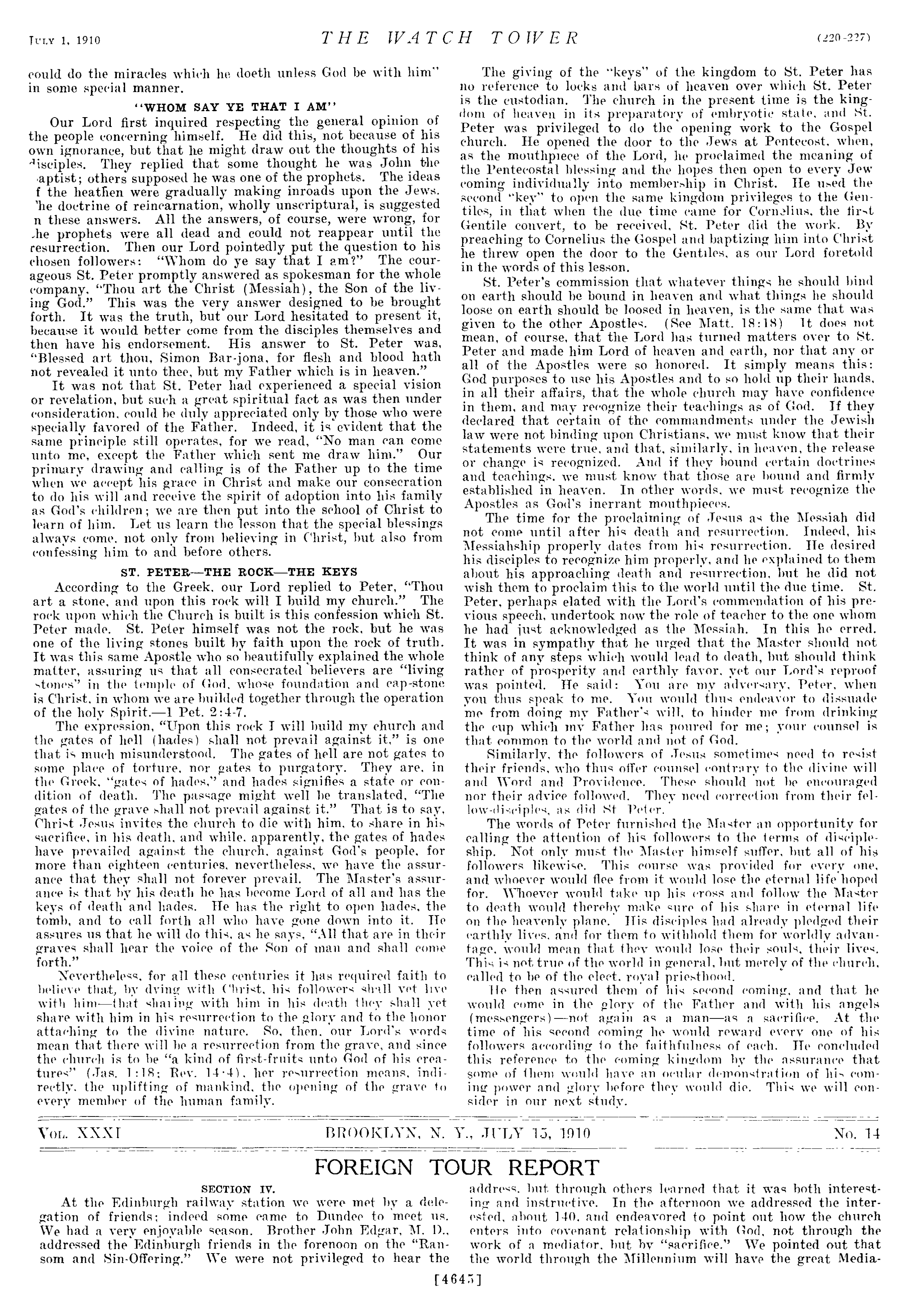
Tury 1, 1910 THE could do the miracles which he doeth unless God be with him” in some special manner. ‘“‘WHOM SAY YE THAT I AM” Our Lord first inquired respecting the general opinion of the people concerning himself. He did this, not because of his own ignorance, but that he might draw out the thoughts of his disciples. They replied that some thought he was John the aptist; others supposed he was one of the prophets. The ideas f the heathen were gradually making inroads upon the Jews. ‘he doctrine of reincarnation, wholly unscriptural, is suggested n these answers. All the answers, of course, were wrong, for -he prophets were all dead and could not reappear until the resurrection. Then our Lord pointedly put the question to his chosen followers: “Whom do ye say that I am?” The courageous St. Peter promptly answered as spokesman for the whole company. “Thou art the Christ (Messiah), the Son of the living God.” This was the very answer designed to be brought forth. It was the truth, but our Lord hesitated to present it, because it would better come from the disciples themselves and then have his endorsement. His answer to St. Peter was, “Blessed art thou, Simon Bar-jona, for flesh and blood hath not revealed it unto thee, but my Father which is in heaven.” It was not that St. Peter had experienced a special vision or revelation, but such a great spiritual fact as was then under consideration, could he duly appreciated only by those who were specially favored of the Father. Indeed, it is evident that the same principle still operates, for we read, “No man can come unto me, except the Father which sent me draw him.” Our primary drawing and calling is of the Father up to the time when we accept his grace in Christ and make our consecration to do his will and receive the spirit of adoption into his family as God's children; we are then put into the school of Christ to learn of him. Tet us learn the lesson that the special blessings always come, not only from believing in Christ, but also from confessing him to and before others. ST. PETER—THE ROCK—THE KEYS According to the Greek, our Lord replied to Peter, “Thou art a stone, and upon this rock will I build my church.” The rock upon which the Church is built is this confession which St. Peter made, St. Peter himself was not the rock, but he was one of the living stones built hy faith upon the rock of truth. It was this same Apostle who so heautifully explained the whole matter, assuring us that all consecrated believers are “living stones” in the temple of God, whose foundation and cap-stone is Christ. in whom we are builded together through the operation of the holy Spirit.—1 Pet. 2:4-7, The expression, “Upon this rock T will build my church and the gates of hell (hades) shall not prevail against it.” is one that is much misunderstood, The gates of hell are not gates to some place of torture, nor gates to purgatory. They are, in the Greek, “cates of hades,” and hades signifies a state or condition of death. The passage might well be translated, “The gates of the grave shall not prevail against it.” That is to say, Christ Jesus invites the church to die with him, to share in his sacrifice, in his death, and while. apparently, the gates of hades have prevailed against the church, against God's people. for more than eighteen centuries, nevertheless, we have the assurance that they shall not forever prevail. The Master's assurance is that by his death he has heeome Lerd of all and has the keys of death and hades. He has the right to open hades, the tomb, and to call forth all who have gone down into it. Tle assures us that he will do this. as he says, “AN that are in their graves shall hear the voice of the Son of man and shall come forth.” Nevertheless, for all these centuries it has required faith to believe that, by dying with Christ, his followers shall vet live with him—that sharing with him in his death they shall vet share with him in his resurrection to the glory and to the honor attaching to the divine nature. So, then. our Lord’s words mean that there will he a resurrection from the grave, and since the church is to be “a kind of first-fruits unto God of his ereatures” (Jas, 1:18; Rev. 14:4). her resurrection means, indirectly. the uplifting of mankind, the opening of the grave to every member of the human family. WATCH TOWER (220-227) The giving of the “keys” of the kingdom to St. Peter has no reference to locks and bars of heaven over which St. Peter is the custodian. The church in the present time is the kingdom of heaven in its preparatory of embryotie state, and St. Peter was privileged to do the opening work to the Gospel church. He opened the door to the Jews at Pentecost. when, as the mouthpiece of the Lord, he proclaimed the meaning of the Pentecostal blessing and the hopes then open to every Jew coming individually into membership in Christ. He used the second “key” to open the same kingdom privileges to the Gentiles, in that when the due time came for Cornelius, the first Gentile convert, to be received, St. Peter did the work. By preaching to Cornelius the Gospel and baptizing him into Christ he threw open the door to the Gentiles, as our Lord foretold in the words of this lesson. St. Peter’s commission that whatever things he should bind on earth should be bound in heaven and what things he should loose on earth should be loosed in heaven, is the same that was given to the other Apostles. (See Matt. 18:18) It does not mean, of course, that the Lord has turned matters over to Nt. Peter and made him Lord of heaven and earth, nor that any or all of the Apostles were so honored. It simply means this: God purposes to use his Apostles and to so hold up their hands, in all their affairs, that the whole chureh may have confidence in them, and may recognize their teachings as of God. If they declared that certain of the commandments under the Jewish law were not binding upon Christians, we must know that their statements were true, and that, similarly, in heaven, the release or change is recognized. And if they hound certain doctrines and teachings. we must know that those are bound and firmly established in heaven. In other words. we must recognize the Apostles as God's inerrant mouthpieces. The time for the proclaiming of Jesus as the Messiah did not come until after his death and resurrection. Indeed, his Messiahship properly dates from his resurrection. He desired his disciples to recognize him properly. and he explained to them about his approaching death and resurrection, but he did not wish them to proclaim this to the world until the due time. St. Peter, perhaps elated with the Lord’s commendation of his previous speech, undertook now the role of teacher to the one whom he had just acknowledged as the Messiah. In this he erred. It was in sympathy that he urged that the Master should not think of any steps which would lead to death, but should think rather of prosperity and carthly favor, yet our Lord’s reproof was pointed. He said: You are my adversary, Peter, when you thus speak to me. You would thus endeavor to dissuade me from doing my Father's will, to hinder me from drinking the cup which my Father has poured for me; your counsel] is that common to the world and not of God, Similarly, the followers of Jesus sometimes need to resist their friends, who thus offer counsel contrary to the divine will and Word and Providence. These should not he encouraged nor their advice followed. They need correction from their fellow-disciples, as did St Peter, The words of Peter furnished the Master an opportunity for calling the attention of his followers to the terms of discipleship. Not only must the Master himself suffer, but all of his followers likewise. This course was provided for every one, and whoever would flee from it would lose the eternal Hfe hoped for. Whoever would take up his cross and follow the Master to death would therehy make sure of his share in eternal life on the heavenly plane. Tlis disciples had already pledged their carthly lives. and for them to withhold them for worldly advantage. would mean that they would Jose their souls, their lives, This is not true of the world in general, hut merely of the chureh, called to be of the elect. royal priesthood. He then assured them of his second coming, and that he would come in the elory of the Father and with his angels (messengers)—not again as a man—as a sacrifice. At the time of his second coming he would reward every one of his followers according to the faithfulness of each. Tle coneluded this reference to the coming kingdom hy the assurance that some of them weuld have an ocular demonstration of his coming power and glory hefore they would die. This we will consider in our next study. Von. xX XXI : SECTION IV. At the Edinburgh railway station we were met by a deleeation of friends; indeed some came to Dundee to meet us, We had a very enjovable season. Brother John Edgar, M. D., addressed the Edinburgh friends in the forenoon on the “Ransom and NSin-Offering.’ We were not privileged to hear the BROOKLYN, N.Y. JULY 13, 1910 — “FOREIGN TOUR REPORT No. 14 address. but through others learned that it was both interesting and instructive. In the afternoon we addressed the interested, about 140. and endeavored to point out how the church enters into covenant relationship with God, not through the work of a mediator, but by “sacrifice.” We pointed out that the world through the Millennium will have the great Media [4645]
Pentru a vă îmbunătăți experiența pe site-ul nostru, folosim cookies și tehnologii similare. Unele cookies sunt esențiale pentru funcționalitatea de bază a site-ului nostru și nu pot fi refuzate. Puteți alege să acceptați sau să refuzați cookies suplimentare. Vrem să vă asigurăm că aceste date nu vor fi vândute sau utilizate în scopuri de marketing. Puteți ajusta preferințele dvs. în orice moment accesând Setările de Confidențialitate din subsolul paginii. Pentru mai multe informații, vă rugăm să consultați
Politica de Confidențialitate
Condiții de utilizare
.


