9
1
9
download/literature/watchtower/1910-6.pdf
watchtower/1910/6/1910-6-1
VOL.
XXXI
BROOKLYN,
N.
Y.,
MARCH
15,
1010
No.6
A
LAYMAN
ON
THE
"NEW
THEOLOGY"
lA
STRIKING
AND
AULJ<:
REVIEW
OF
DR.
ELIOT'S
VIEWS.]
wonld
chew
off
its
own
fingers;
a
cat,
or
eVen
a
child,
woulll
walk
into
the
fire
before
intellect
lUlll
taught
bim
his
danger;
and
so
on
to
the
ellll
of
the
chapter.
"Perhaps
one
might
think
that
because
this
lecture
was
de
livered
at
Harvard
it
is
too
extreme
a
statenwnt
of
the
New
Theology.
But
the
New
Theology
is
world-wide.
For
many
of
its
disciples
it
has
no
God
(except
as
the
soul
of
the
uni
verse
may
be
a.
God,
if
one
can
grasp
that
idea),
no
inspired
Bible,
no
heaven-sent
Savior
of
the
world;
its
fundamental
principle,
if
I
have
been
able
to
make
it
out,
is
the
absolute
and
positive
negation
of
any
supernatural
power
whatever
in
the
past,
present
or
future,
with
all
that
that
implies.
And
as
far
as
its
professors
and
votaries
have
come
under
my
ob
servation,
it
is,
in
this
fundamental
principle,
pretty
much
the
same
at
Harvard,
Union,
Yale,
Chicago;
very
much
the
same
among
Episcopalians,
Methodists
and
Baptists
as
it
is
among
Unitarians
and
Congregationalists;
and
it
seems
to
have
won
a
large
majority
of
the
young
clergy
of
the
Protes
tant
Churches
in
this
section.
Thcre
are
minor
differences,
of
course;
Dr.
Eliot's
position
is
the
llllvancerl
logical
position,
towards
which
all
the
others
are
tending,
but
which
not
all
have
yet
reached.
Some
men,
moreover,
are
entirely
subject
to
the
influence
of
the
new
theologv;
others
are
influenced
partly
by
the
new
and
partly
hy'
the
old
in
all
stages
of
progress,
but
in
general
acquiring
a
little
more
of
the
new
leaven
and
losing
a
little
more
of
the
old
each
year.
"\Vell,
this
is
rather
a
long
It'ttpr
on
theology
from
one
who
i8
not
a
theologian.
:My
interest
is
not
wholly,
perhaps
not
chiefly,
theological;
it
is
rather
practical
and
sociological.
I
have
long
been
convinced
that
the
church
could
not
adopt
Dar
winism
without
being
killed
by
it,
anel
the
New
Theology
is
largely
the
effect
of
Darwinism
on
the
church.
"We
all
know
that
there
is
a
sort
of
elective
affinity
be
tween
unbridled
democracy
and
atheistic
Rocialism.
By
un
bridled
democracy,
I
mean
the
kind
which
gives
to
the
Sea
Island
negro
the
sallle
political
weight
as
to
his
former
mas
tel';
which
gives
to
the
half-pauper,
half-vicious
denizens
of
the
slum
distriets
of
our
great
citic8
the
same
voting
power
as
the
independent
househol(ler
or
businrss
man
possessrs;
ayl'.
which
giye
them
more,
since
ns
they
are
mOl'r
numprous.
thry
who
pay
no
direct
taxes
are
alloweel,
in
effpct.
to
levy
them
on
those
who
do.
by
elpding
aldl'rmen
and
other
officers
as
worthless
as
themselves-the
sort
of
drmocracv
whirh
reallv
believes
the
olel
maxim,
"Vox
populi.
I'OX
Dei."
This
may
st'em
like
political
heresy
to
many,
hut
wl1en
the
new
thpolog:v
shall
have
destroyed
the
common
man's
helirf
in
God,
thl'
fepl
ing
of
moral
obligation
to
him
ana
to
our
fellows,
as
his
chil
oren
(as
it
will
do
if
it
is
not
vigoronsly
opposcd),
and
when
the
:Marxian
missionaries
shall
Iw
ve
malle
as
mncll
progrpss
in
teaching
their
gospel
of
robbery
to
the
negroes
of
tl1r
South
and
the
poorer
classes
of
our
cities
afl
tIH''y
have
already
ma,le
on
the
Continent,
and
art'
making
in
I~on(lon,
Wt'
shall
begin
to
appreciate
what
sort
of
a
Vox
Dei
the
Vox
populi
of
a
god
less
people
can
be.
This
affinity
betwpt'n
extreme
democracy
and
atheistic
socialism
haf!
long
bet'n
strikinglv
manifl'..;tl'a
Oil
the
Continent;
it
begins
to
be
seen
in
England
an(l
AnlPriea.
The
North
of
Germany,
I
am
told,
is
so
far
won
by
atheistic
and
Marxian
socialism-the
so-called
Socinl
Democracy-that
the
existing
order
if!
chiefly
maintainen.
in
the
Germ~n
Em
pire
by
the
Catholic
South,
the
country
districts,
and
the
well·
drillp(]
bayonet.
"And
to
me,
one
of
the
most
interesting
thing~
in
connp./'
tion
with
the
so-callen.
npw
theolog-'y
is
the
fact
that
so
many
of
its
disciples
are
showing
as
much
affinity
for
militant
so
cialism
as
the
atheism
of
the
Continent
shows,
awl
for
the
same
reasons.
Thi~,
of
course,
is
not
true
of
all
its
'lisciples
or
teachers-is
emphatically
not
true
of
Dr.
Eliot-but
it
seems
to
be
a
tendency
of
the
system.
"Christianity
teaches
that
man
is
inclincd
to
sin;
that
Ius
natural
impubes
are
often
ba'l;
that
he
needs
human
govern
ment
as
well
a,
divine
guidance;
"The
powers
that
he
arc
oJ'([ained
of
Uo'!.'
The
majority
of
the
followers
of
:Mar.,
and
many
of
the
professor.,
of
the
New
Theology
alike
Jeny
the
existence
of
00(1
(in
the
sense
in
which
Utp
church
has
heretofore
understood
tltat
existence),
an,[
the
tl'n,lency
of
Illan
to
sin;
they
say
that
man's
natural
impul..;('s
are
good
and
for
the
most
part
teach
that
salvation
lies
in
the
destruc-
also,
the
miHunrlerstanding
of
the
mission
tion
of
poverty
anu
misery.
Christianity
tpaches
brotherly
3!Hl
and
400.
The
most
ol'llinary
intellect
love,
but
forbids
robbery
and
even
covetousnpss.
Marxian
so-
if
there
were
no
pain
in
the
world,
a
baby
eialism
pretends
to
advance
brotherly
love,
but
its
maxim
is
[4581]
(99
111(1)
The
following
from
The
Religious
Herald
contains
consider
able
truth
and
is
well
worth
the
reading
as
bearing
on
mat
ters
seen
from
TIlE
\VATCII
TOWER:-
"You
h:1
ve
probably
scen
in
the
papers
references
to
the
definition
of
the
new
theology
given
by
Dr.
Eliot,
president
emeritus
of
Harvard
College,
and
for
thirty-five
years
the
first
citizen
of
MasS'lchusetts,
if
not
of
New
England.
But
second
hand
newspaper
accounts
are
apt
to
be
inaccurate;
I
thought
you
might
like
to
see
the
original,
and
accordingly
am
enclos
ing
a
copy
of
the
Harvard
Theological
Review,
under
separate
cover,
containing
his
lecture.
"Dr.
Eliot
has
been
much
criticised,
but
for
my
part
I
ad
mire
his
courage
and
honesty.
Now,
as
always,
he
speaks
the
truth
as
he
spes
it.
without
fear
or
favor.
Too
many
of
the
advocates
of
the
new
theology
pursue
the
policy
which
a
:'\fethodist
minister
in
a
neighboring
parish
explained
to
me;
they
pxpress
their
views
freely
at
ministers'
meetings,
but
have
a
tacit
undcrstanding
not
to
mention
them
to
the
pews.
And
this
resppet
for
the
tender
feclings
of
the
superstitious
ones
(
!)
who
occupy
the
prws
is,
aftpr
all,
not
impolitic;
for
if
the
new
thpology
wcre
understood
by
the
average
layman,
he
would
find
it
so
hard
to
distinguish
from
the
old
atheism
that,
ac·
cording
to
his
temper,
he
would
stay
at
home
and
save
his
1ll00H'Y,
or
would
try
to
get
a
new
pastor
installed.
"The
Methollist
clrrgyman
I
mention
tells
me
that
a
great
llIajority
of
the
younger
ministers
of
that
church,
in
this
]Mrt
of
the
country,
nre
bclievers
in
the
new
theoloO'y.
A
ma
jority
of
thp
Prot~sbnt
ministers
that
I
know
her;abouts
ad
here
to
it,
il]('luding
mo..;t
of
the
younger
m€n.
"You
will
sec
th:1t
Dr.
Eliot's
lecture
consists
of
two
parts.
The
first,
which
is
negative,
is
practically
undistinguishable,
so
far
as
I
can
see,
from
ancient
athei"m.
In
fact,
the
new
theology,
as
I
understand
it,
in
its
adyanced
form,
has
less
belief
.in
a
Go,[
(consi,[ered
as
a
personality,
with
conscience
an,l
wIll),
who
preaterl
the
universe
and
the
livinrr
creatures
in
it,
than
Davil[
Hume,
Edward
Gibbon,
Thomas
Payne,
Vol
taire.
allll
.T
.
.T.
Rousspau
had.
.
"As
to
the
positive
part
of
thE'
new
theology-well,
I
shall
Wish
to
know
what
YOU
think
of
it.
"It
is
P,t,y
for
u;e
to
understand
this
state
of
mind
of
the
atheist,
a~llthtic,
OJ'
matel:ialist,
and
in
this
age
So
many
of
the
foremost
Intell~ets.
espeCIally
on
the
Continent,
deny
all
evi
dpnce
of
the
c:\:lstence
of
God,
that
I
am
not
surprised
to
learn
that
any
man
holds
such
views.
But
to
deny
positively,
on
the
one
hand,
all
those
conceptions
of
the
Creator
thnt
seem
nat
ural
to,
man,
an,l
then.
without
adhpring
to
the
logic
of
atheism,
ngno"tIcism
or
lIIa/eralism,
to
set
up
the
hazv,
and
to
mv
mind
illogical
vic\\'
of
God
which
is
presented
in'
this
~ew
theology;
hardly
seems
normal,
nor
does
it
seem
as
if
it
could
ever
acquire
llJan~'
panlPst
followers
among
the
common
ppople.
It
seems
to
me
to
bear
strOI\CT
internal
evirlence
of
its
oriCTin
in
the
study
of
the
skepticn!
professor
of
theology,
and
to'\ave,
if
I
1lJ~~:
usc
t?e.
cxpression,
a
pprhaps
uncomciow,
but
yet
hypo
cnbcal
ongtn.
Of
course,
when
I
say
this,
I
do
not
at
all
refer
to
Dr.
Eliot.
"But
I"t
us
pnt
onrs~IYes
for
a
moment
in
the
place
of
the
mnn
who
h~lS
been
ordamed
to
the
Chri5tian
ministry,
who
has
lost
faIth
allli
lacks
the
courage
to
turn
his
back
on
his
palling
and
his
friends,
to
confess
himself
a
failure
and
to
I)('gin
lifp
~nelV.
To.
"uch
:"
one
the
new
theology'
appeals
strongly;
It
saH's
hiS
consistency;
it
sayes
his
salary;
it
san's
him
from
the
humiliatiiln
that
open
apostasy
wouid
in
volve.
Skpptip"
cum
manly
f"cl
niorp
or
less
di"like
of
an
ex
[Jiie;t:
the
faithful
consider
him
an
apostate.
But
by
em
braCing
t.he
so-called
new
theology,
he
holds
hi5
pastorate
or
Ip"turps~lp
and
wins
reputation
as
being
learned,
liberal
and
progressive.
"Whatever
the
cause
may
be,
the
so-callerl
npw
theology
spcms
to
be
dominant
in
most
Protestant
tllPolocrical
semina
rips
in
Oprmuny,
Englanrl
and
the
northern
part
~f
the
United
~tates,
or
wherc
not
dominant,
to
be
rapidly
increasing
its
in
tI
uenpe.
.
"You
will
note
in
Dr.
Eliot's
lecture
that
in
denying
the
pXIs/pncp
of
a
comcious
p('l'sonal
(Jo,l
(as
distin
cruished
from
the
Cod
II
ho
is
the
stnn
of
all
living
souls,
humabn
and
brute,
good,
ba,l
ancl
iilll
itrerpnt
alike),
lIe
denies
all
hope
of
a
future
life.
"How
CUI
iou..;,
of
pain
on
pagl's
ought
to
see
that
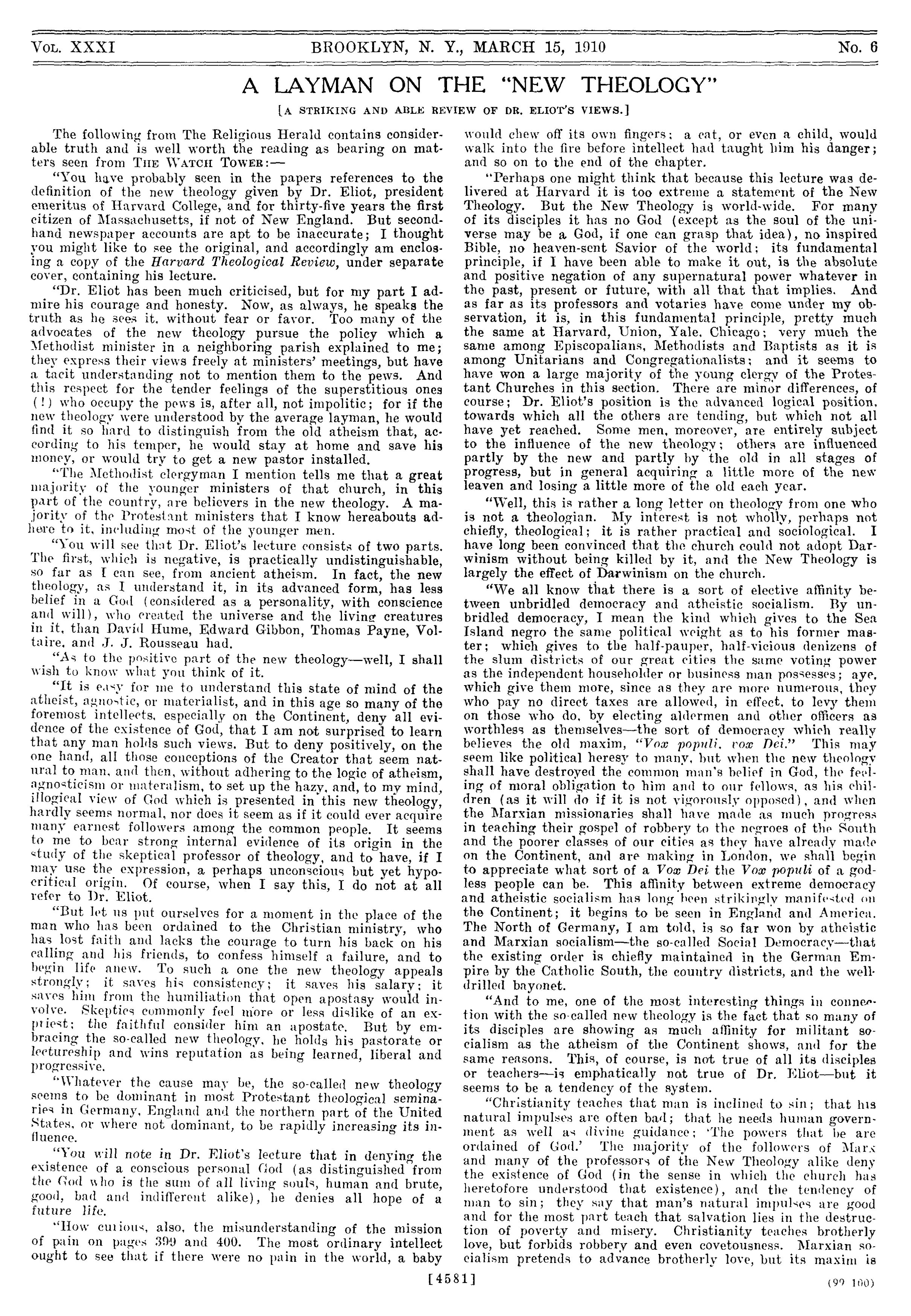
Vou. XXXI BROOKLYN, N. Y¥., MARCH 15, 1910 No. 6 ~———— A LAYMAN ON THE “NEW THEOLOGY” {A STRIKING AND ABLE REVIEW OF DR, ELIOT’S VIEWS. ] The following from The Religious Herald contains considerable truth and is well worth the reading as bearing on matters seen from Tne WatcH TowER:— “You have probably seen in the papers references to the definition of the new theology given by Dr. Eliot, president emeritus of Harvard College, and for thirty-five years the first citizen of Massachusetts, if not of New England. But secondhand newspaper accounts are apt to be inaccurate; I thought you might like to see the original, and accordingly am enclosing a copy of the Harvard Theological Review, under separate cover, containing his lecture. “Dr. Eliot has been much criticised, but for my part I admire his courage and honesty. Now, as always, he speaks the truth as he sees it, without fear or favor. Too many of the advocates of the new theology pursue the policy which a Methodist minister in a neighboring parish explained to me; they express their views freely at ministers’ meetings, but have a tacit understanding not to mention them to the pews. And this respect for the tender feelings of the superstitious ones (!) who oecupy the pews is, after all, not impolitic; for if the new theology were understood by the average layman, he would find it so hard to distinguish from the old atheism that, according to his temper, he would stay at home and save his money, or would try to get a new pastor installed, “The Methodist clergyman I mention tells me that a great majority of the younger ministers of that church, in this part of the country, are believers in the new theology. A majority of the Protestant ministers that I know hereabouts adhere to it, including most of the younger men. “You will see that Dr. Eliot’s lecture consists of two parts. The first, which is negative, is practically undistinguishable, so far as [ can see, from ancient atheism. In fact, the new theology, as I understand it, in its advanced form, has less belief in a God (considered as a personality, with conscience and will), who created the universe and the living creatures in it, than David Hume, Edward Gibbon, Thomas Payne, Voltaire, and J. J. Rousseau had. _ “As to the positive part of the new theology—well, I shall wish to know what you think of it. “Tt is easy for me to understand this state of mind of the atheist, agnostic, or materialist, and in this age so many of the foremost intellects, especially on the Continent, deny all evidence of the existence of God, that I am not surprised to learn that any man holds such views. But to deny positively, on the one hand, all those conceptions of the Creator that seem natural to man, and then, without adhering to the logic of atheism, agnosticism or materalism, to set up the hazy, and, to my mind, illogical view of God which is presented in this new theology, hardly seems normal, nor does it seem as if it could ever acquire many earnest followers among the common people. It seems to me to bear strong internal evidence of its origin in the study of the skeptical professor of theology, and to have, if I may use the expression, a perhaps unconscious but yet hypocritical origin. Of course, when I say this, I do not at all refer to Dr. Eliot. “But let ug put ourselves for a moment in the place of the man who has been ordained to the Christian ministry, who has lost faith and lacks the courage to turn his back on his calling and his friends, to confess himself a failure, and to begin life anew. To such a one the new theology appeals strongly; it saves his consistency; it saves his salary; it saves him from the humiliation that open apostasy would involve. Skeptics commonly feel more or less dislike of an expriest; the faithful consider him an apostate. But by embracing the so-called new theology, he holds his pastorate or lectureship and wins reputation as being learned, liberal and progressive, “Whatever the cause may be, the so-called new theology seems to be dominant in most Protestant theological seminaries in Germany, England and the northern part of the United States, or where not dominant, to be rapidly increasing its influence. “You will note in Dr. Flict’s lecture that in denying the existence of a conscious personal God (as distinguished from the God who is the sum of all living souls, human and brute, good, bad and indifferent alike), he denies all hope of a future life, “Wow curious, also, the misunderstanding of the mission of pain on pages 399 and 400. The most ordinary intellect ought to see that if there were no pain in the world, a baby [4581] would chew off its own fingers: a cat, or even a child, would walk into the fire before intellect had taught him his danger; and so on to the end of the chapter. “Perhaps one might think that because this lecture was delivered at Harvard it is too extreme a statement of the New Theology. But the New Theology is world-wide. For many of its disciples it has no God (except as the soul of the universe may be a God, if one can grasp that idea), no inspired Bible, no heaven-sent Savior of the world; its fundamental principle, if I have been able to make it out, is the absolute and positive negation of any supernatural power whatever in the past, present or future, with all that that implies. And as far as its professors and votaries have come under my observation, it is, in this fundamental principle, pretty much the same at Harvard, Union, Yale, Chicago; very much the same among Episcopalians, Methodists and Baptists as it is among Unitarians and Congregationalists; and it seems to have won a large majority of the young clergy of the Protestant Churches in this section. There are minor differences, of course; Dr. Eliot’s position is the advanced logical position, towards which all the others are tending, but which not all have yet reached. Some men, moreover, are entirely subject to the influence of the new theology; others are influenced partly by the new and partly by the old in all stages of progress, but in general acquiring a little more of the new leaven and losing a little more of the old each year. “Well, this is rather a long letter on theology from one who is not a theologian. My interest is not wholly, perhaps not chiefly, theological; it is rather practical and sociological. I have long been convinced that the church could not adopt Darwinism without being killed by it, and the New Theology is largely the effect of Darwinism on the church. “We all know that there is a sort of elective affinity between unbridled democracy and atheistic socialism. By unbridled democracy, I mean the kind which gives to the Sea Island negro the same political weight as to his former master; which gives to the half-pauper, half-vicious denizens of the slum districts of our great cities the same voting power as the independent householder or business man possesses; aye, which give them more, since as they are more numerous, they who pay no direct taxes are allowed, in effect, to levy them on those who do, by electing aldermen and other officers as worthless as themselves—the sort of democracy which really believes the old maxim, “Vow populi, vow Dei”? This may seem like political heresy to many, but when the new theology shall have destroyed the common man’s belief in God, the feeling of moral obligation to him and to our fellows, a3 his children (as it will do if it is not vigorously opposed), and when the Marxian missionaries shal} have made ag much progress in teaching their gospel of robbery to the negroes of the South and the poorer classes of our cities as they have already made on the Continent, and are making in London, we shall begin to appreciate what sort of a Vow Dei the Vow populi of a godless people can be. This affinity between extreme democracy and atheistic socialism has long heen strikingly manifested on the Continent; it begins to be seen in England and America. The North of Germany, I am told, is so far won by atheistic and Marxian socialism—the so-called Social Democracy—that the existing order is chiefly maintained in the German Empire by the Catholic South, the country districts, and the well drilled bayonet. “And to me, one of the most interesting things in connertion with the so-called new theology is the fact that so many of its disciples are showing as much affinity for militant socialism as the atheism of the Continent shows, and for the same reasons. This, of course, is not true of all its disciples or teachers—is emphatically not true of Dr. Eliot—but it seems to be a tendency of the system. “Christianity teaches that man is inclined to sin; that his natural impulses are often bad; that he needs human government as well as divine guidance; ‘The powers that be are ordained of God.’ The majority of the followers of Marx and many of the professors of the New Theology alike deny the existence of God (in the sense in which the church has heretofore understood that existence), and the tendency of man to sin; they say that man’s natural impulses are yood and for the most part teach that salvation lies in the destruetion of poverty and misery. Christianity teaches brotherly love, but forbids robbery and even covetousness. Marxian socialism pretends to advance brotherly love, but its maxim is (99 100)
Pentru a vă îmbunătăți experiența pe site-ul nostru, folosim cookies și tehnologii similare. Unele cookies sunt esențiale pentru funcționalitatea de bază a site-ului nostru și nu pot fi refuzate. Puteți alege să acceptați sau să refuzați cookies suplimentare. Vrem să vă asigurăm că aceste date nu vor fi vândute sau utilizate în scopuri de marketing. Puteți ajusta preferințele dvs. în orice moment accesând Setările de Confidențialitate din subsolul paginii. Pentru mai multe informații, vă rugăm să consultați
Politica de Confidențialitate
Condiții de utilizare
.


