8
1
8
download/literature/watchtower/1910-9.pdf
watchtower/1910/9/1910-9-1
--~
-----~---~-----================-=--'-=-=-=======---===
YOLo
XXXI
BROOKLYN,
N.
Y.,
MAY
1,
1910
COUNTING
THE
BLOOD
COMMON
1'\0.
fJ
thf'
Lord
(l47-14R)
"Of
how
much
sorer
punishment
suppose
ye
shall
he
be
thought
worthy
who
hath
trodden
under
foot
the
Son
of
God,
amd
hath
counted
the
blood
of
the
Covenant
wherewith
he
teas
sanctified,
an
unholy
thing
[a
common
thing]
and
hath
done
despite
to
the
spirit
of
favor."-Hebrews
10:29.
The
Apostle
is
here
evidently
contrasting
Moses
and
his
Philippians,
I
count
all
things
as
los~
that
I
might
win
Christ;
law
with
the
Antitypieal
MORes
and
the
greater
law.
Anyone
that
I
might
have
fellowship
in
his
suffering;
that
I
J!light
~
who
despised
the
law
of
Moses,
the
arrangement
made
and
es-
baptized
into
his
death;
Rharc
hiR
"cup"
of
suffenng;
RO
tablished
through
the
typical
Law
Covenant,
was
condemnpd
Rhould
WI'.
Paul
counte,l
pYerv
other
intpreRt
and
considera-
to
death,
a
sentence
from
which
he
is
to
be
released
through
tion
as
of
no
value
in
compari;on
with
this
great
privilpge
of
the
mprit
of
Christ.
Since
that
condemnation
was
merely
of
a
the
Go~pel
age,
which
is
acco]"(led
us.
temporal
character
this
docs
not
affect
his
eternal
interests.
Now,
if
we
should
ever
lose
sight
of
this
wonderful
privi-
It
is
pvident
that
there
is
a
difference
between
these
two
lege,
if
WP
should
ever
comp
to
the
pl~ce
.where
we
fail
.to-
ap-
condemnations-that
if
anyone
should
come
under
the
con-
prpciate
the
fact
that
\Ye
h~Lve
bpen
l.n:'lted
t~
share
~n
Ol~r
denmation
of
the
Antitypical
Moses
his
punishment
would
be
Lord's
"cup,"
have
hepn
invited
to
partIclpatc
WIth
hnn
In
thIS
even
more
severe.
This
severer,
or
"sorer
punishment,"
we
un-
blood
of
the
Npw
Covenant.
thi~
bloOlI
which
iR
to
ratify,
to
dprstancl
to
be
the
"second
dpath"-utter
annihilation.
If
any
seal
the
New
Covenant,
it
would
be
doing
,lpspite
to
all
thpRe
onp
dpspises
thp
law
of
God,
in
any
particular,
afl
expressed
privileges
and
favors
which
han'
l)('cn
Rpecially
givcn
to
us.
through
Christ
and
the
New
Covenant
arrangement,
he
will
hut
newr
given
to
an.Y
otllPr
people
in
thp
worM
and
never
be
worthy
of
thp
second
death.
This
principle,
we
see,
will
ap-
will
be
giYen
again,
a
grpat
privilcge
npver
o~prp,l.
to
the
an-
ply
all
through
the
Millennial
age,
in
the
sense
that
any
an,l
gels.
but
offered
only
to
the
Lonl
,Tcsus
C'hrJRt
lllmRelf.
and
pvery
one
who.
after
being
brought
to
a
knowledge
of
the
pro-
tho~e
who
would
haYe
his
Rpirit
during
thiR
age.
visions
and
favors
that
GOlI
has
brought
to
him
through
Christ,
If,
then,
we
lose
our
apprpciation
of
that
"cup"
and
.say
Rhall
thpn
treat
the
matter
lightly
and
fail
to
rpciprocate
such
that
it
is
only
an
onlinary
thing,
onl~'
Ruch
.a~
nIl
nommal
lovc.
fa
il
to
bc
obpdient
to
thiR
arrangement
for
his
relief.
will
ChriRtians
have
thonght
it
to
bp:
only
tnrmng
a
way
from
be
counted
unworthy
of
receiving
any
nwre
fayor
of
God
and
sin
and
tryinO'
to
lin'
an
upri'Tht
life:
it
is
not
a
speCIal
sac-
wiII
go
into
the
Recond
death.
Evidently,
howeyer,
the
Apo.stle
rifice:
it
'is
~ot
a
partiripati;n
in
the
bloo~1
.of
l'hri~t
at
~ll,
is
not
hpre
conRillering
what
will
happen
at
the
end
of
the
nor
,h'inking
of
his
",·up."
then
Wf'
an'
d,·~P],.111g
aJlllre.l(',·t111g
Millennial
age,
and
\ye
merely
mention
it
incidentally
to
show
all
tl1f'
privileges
that
Wf're
offf'rp,l
to
u~
RJ.lec~ally,
above
thoge
the
wide
scol)('
of
thp
comparison
between
l\Iosps
amI
Christ.
offered
to
any
otlwr
people.
It
woul,l
slg-mfy.
that
we
harl
The
AJlo~tle
is
not
applying
this
text,
however,
to
the
worI,l,
'lespised
the
whole
arrangf'ment
and
that
ROI.net.lll~g
wa~
wrong
but
to
the
church.
All
the
context
shows
that
he
i~
addre~sing
with
our
hearts-providing,
howe\'f'r.
\\'e
rhd
I~
IJ.!tenhona~I:y,
the
church.
those
who
haYe
been
begotten
of
the
holy
f'pirit,
willingly,
knowingly.
after
wp
hall
~een
that
thlR
IR
the
pnvI-
those
who~p
sins
ha\'e
]JPen
conred
by
the
imputation
of
lege
of
sacrificf'.
after
we
hall
kn~wn
~hat
wp
were
.accpptpd
Christ's
righteousneRfl
anrl
who.
in
the
Rtrength
of
that
cover-
as
members
of
ChriRt.
to
"suffer
WIth
hnll,
that
WP
mIght
also
ing.
are
ju~tifif'd.
have
prp,~ente,l
their
bodie~
living
sacrifices.
reign
with
him."
For
what
pm'pose
do
we
thus
make
consecration?
It
iR
in
For
all
such
as
lllwe
eypr
had
this
clparer
knowlpdge
a
JIll
anRwer
to
our
Lord's
invitation
to
drink
of
his
"cup";
to
be
appreciation,
to
turn
away
is
to
reject
t.his
"hlood
of
the
coYt'-
baptizell
into
his
lleath:
to
suffer
with
him
as
nWlllbers
nant."
and
to
do
de~Jlite
to
it.
antI
to
fall
to
usp
thp
Jln\'lle.gp~
of
hi~
bOlly.
that
\Y('
nHl~'
reign
with
him
and
be
his
members
offprecl.
In
undertaking
to
u~e
these
privilegp~
they
had
first,
on
the
plane
of
glory.
lllpmbers
of
the
Rpiritual
I~rael.
the
of
necessity,
to
make
the
sacrifice
of
thp
earthl~'
nature.
It
~piritual
seed
of
Abraham.
for
the
great
work
of
bleflsing
nat-
thcrefore
f~llowfl
that
th('\"f'
is
nothing
left
for
thpm.
for
they
ural
Israel
and
throllg-h
natural
Israel.
all
the
familip~
of
the
have
seorned
the
new
nature
and
the
Lord's
proYiRions
which
p~U'th.
are
obtainable
only
through
participation
in
thp
sacrificp
of
~o.
then,
the
Apostlp,
in
bring-ing
this
mattp!,
to
our
attf'n-
Christ.
No
opportunity
for
rf'Rtitution
i~
lcft
!hpm.
Hencl'
tion.
i~
diRclls~ing
the
chureh
anrl
what
wiII
happPIl
if
any
of
the
only
thinO'
for
thpm
iR
that
which
is
appropnate
for
those
u~-not
anv
of
us
who
havp
merely
turned
from
sin.
and
have
who
II;spisfO
""aOll's
arrangpmellt
after
the.v
have
oncp
under-
J'f'alize,l
th~t
Christ
iR
the
great
Atoner
for
0111'
sins-no.
but
Rtood
it.
and
that
is
the
~cco'1ll1
,lpath.
those
of
UR
who
han'
been
justified
through
faith
in
his
blood
The
"Rorer
puni~hment"
nH'ntioned
by
thc
ApoRtlp
(H;b.
an,l
haw
been
sanctified-those
of
us
who
should
then
fall
10:20)
is
the
"Rin
nnto
death."
Are
we
compc·tent
to
pomt
a,\'a:~.
out
who
havp
(lOlnnlittPll
that
sin?
For
onr
own
part
\,'e
\Ye
rcmember
that
on
the
night
of
our
Lonl's
institution
of
would
prefer
not
to
l'xercise
jIHlgment
in
tlw
matte,r,
b~lt
the
la~t
Rupper,
the
samp
night
in
which
he
wa~
betra~·ed.
nlPJ'elv
to
say
that
such
ju,lgment
is
for
the
Loni.
\\
I'
WIll
whf'n
hc
took
thf'
cup
hc
sai,l,
"This
cup
is
m~-
blood
of
the
.
,
.
h
1
I'
.
I
t
not
make
any
dpeision
until
we
sec
t
I'
,on
s
.lu'
gTIlf'n
.
Xe\\'
Cm'puant,
\\'hich
is
shed
for
manv
for
the
remission
o
f
·
If
~inR."
{io,l's
intention
regarding-
thifl
bioo'l,
as
the
blood
that
Thc
Apostlp
sayR
that
we
arl'
not
.to
judgl'
one
anot~er.
.
\\'ill
seal
the
New
Covenant,
is
that
it
~honld
be
efficacious
to
for
in~tance,
vou
shoul,l
Ray.
1
belIeve
that
.Te~us
lhed
anll
the
remission
of
all
the
sins
of
Adam
and
hiR
children.
This
that
he
iR
ou~
Rf'deen1f'r,
but
1
have
lo~t
that
idpa
which
I
was
thc
purpoRP.
the
object
for
which
our
LoJ'(l'~
hlood
wafl
once
had
of
our
]wing
invitpd
to
becomf'
dead
with
him:
to
sherI.
"This
i~
mv
blood."
not
your
blood.
It
is
the
blood
or
share
with
him
in
hiR
~uffering
at
the
present
time
an,l
later
lifp
that
I
am
gh:ing.
that
I
consecrated
when
I
was
begotten,
the
glory
that
shall
follow-shou1<l
we
then
say
to
you
..
Oh.
and
that
I
am
to
rf'hnquish
today
npon
the
cross
(for
it
was
VOlt
have
committed
the
Rin
unto
death;
you
have
dpspI~pd
then
thp
same
da~'
or
part
of
the
same
da~-
in
which
he
wa~
the
blood
of
the
covenant
wherewith
you
havp
I)('en
Ranctified,
r·rucifiecl).
This
\\'hieh
is
mine
today-the
blood
that
will
ancl
thereforp
having-
no
restitution
privilege~
to
go
back
to,
,eal
the
Xew
Connant
between
{iod
~11(1
men-I
invite
vou
you
have
pr;ctically
gone
unto
the
spcond.
,lenth
condition?
to
participate
in.
"Drink
ye
all
of
it."
AlI
of
~'ou
drink
of
\Ve
answer,
:No.
\\'1'
,10
not
ullflerstand
that
It
would
be
for
us
it
and
drink
all
of
it.
Lpave
non('.
The
il1\'itation
to
parti-
to
judge
you
or
to
decide
re~pecting
~-ou.
because
we
do
n?t
('ipate
in
this
blood.
this
cup,
is
neyer
to
be
ginn
to
any
other
kn~\V
to
what
extent
your
previous
deelarations
Wf'rc
true.
~\
I'
peoplp
or
('las~
hut
you-~'ou
who
are
specially
('aIled
for
thi'i
do
not
know
that
yOU
evpr
understood
what
you
were
domg
'purpose.
Xot
onl~-
you
Apostle~
to
whom
I
Rpeak.
but
all
when
you
thought
that
you
had
made
a
full
con~ecration.
Per-
thosf'
who
shall
belicyf'
on
me
through
your
word.
and
who
haps
you
did
not
underfltand
YO~Jrself.
There~or:.
Wf'
prefer
similarly
~hall
make
thi'i
conspcration
and
undertakp
to
be
to
say
that
since
we
are
not
sure
m
the
matter
It
I~
not
for
us
baptizeci
into
my
rleath.
1
inyite
to
drink
of
m.v
e
u
p
.
·
]
1
t
tl
S
.
t
to
judge.
However,
we
are
to
reme~)(':
\V
1a
.
11'
•
en~,
urI's
The
Apo~tle
asks
con('erning
this
cup
of
which
we
par-
say
in
this
connection,
"The
Lord
WIll
11Hlge
hIS
people.
If,
ticipate
in
the
commnnion,
"Is
it
not
the
participation
of
thf'
therefore.
we
should
see
that,
aft!'r
you
had
reiected
the
blood
blood
of
Christ"'!
(I
Cor.
10:I<i)
We
answer.
Yes.
Is
not
t'fi
I
.
11
the
blood
of
Christ
tIll'
blood
of
the
Nf'w
Covenant?
Arp
we
of
the
Covenant
by
which
you
haye
been
sanc
I
pr
or
specla
y
set
apart
as
a
sacrifice,
a~
a
member.
of
the
body,.God
had
not.
thereforf',
participating
in
thp
blood
of
the
Kew
Covpnant?
hd
III
ht
f
In
thl'
participation,
thcrf'fore.
in
that
bloorl.
by
thp
inyitation
turncd
you
asi,le
apparl'ntly
amI
had
WIt
rawn
a
Ig
rom
of
our
Lord,
are
\\'p
not
sharprs
in
hi~
"enp"
an,l
alI
that
pf'r-
you
an,1
IUlll
thrust
you
out
of
hiR
fayor.
to
the
cxtent
that
we
bins
to
it?
Yes.
\\'hat
,lops
this
mean
to
ns?
A
great
,lcal.
~'olll,l
spe
this.
we
w~ulrl
bp
jn~tifiell
in
saying
to
onrsplves
,tt
\Ve
Rhonl,l
be
Yen"
thankful
for
thp
great
priyilege
Wf'
ha\'e
least.
whether
we
mentione,l
it
to
another
or
not,
that
the
bcl'n
acconlf'(l
to
sharp
in
his
"cup."
to
bp
"baptiz(,ll
into
his
Lorrl
was
dl'aling
with
yon.
.
death."
A~
tlIP
Apostle
Panl
declares
in
the
third
chapter
of
\\'1'
cannot
imagine
that
if
anyone
wOllM
reJect
\'---58
[46051
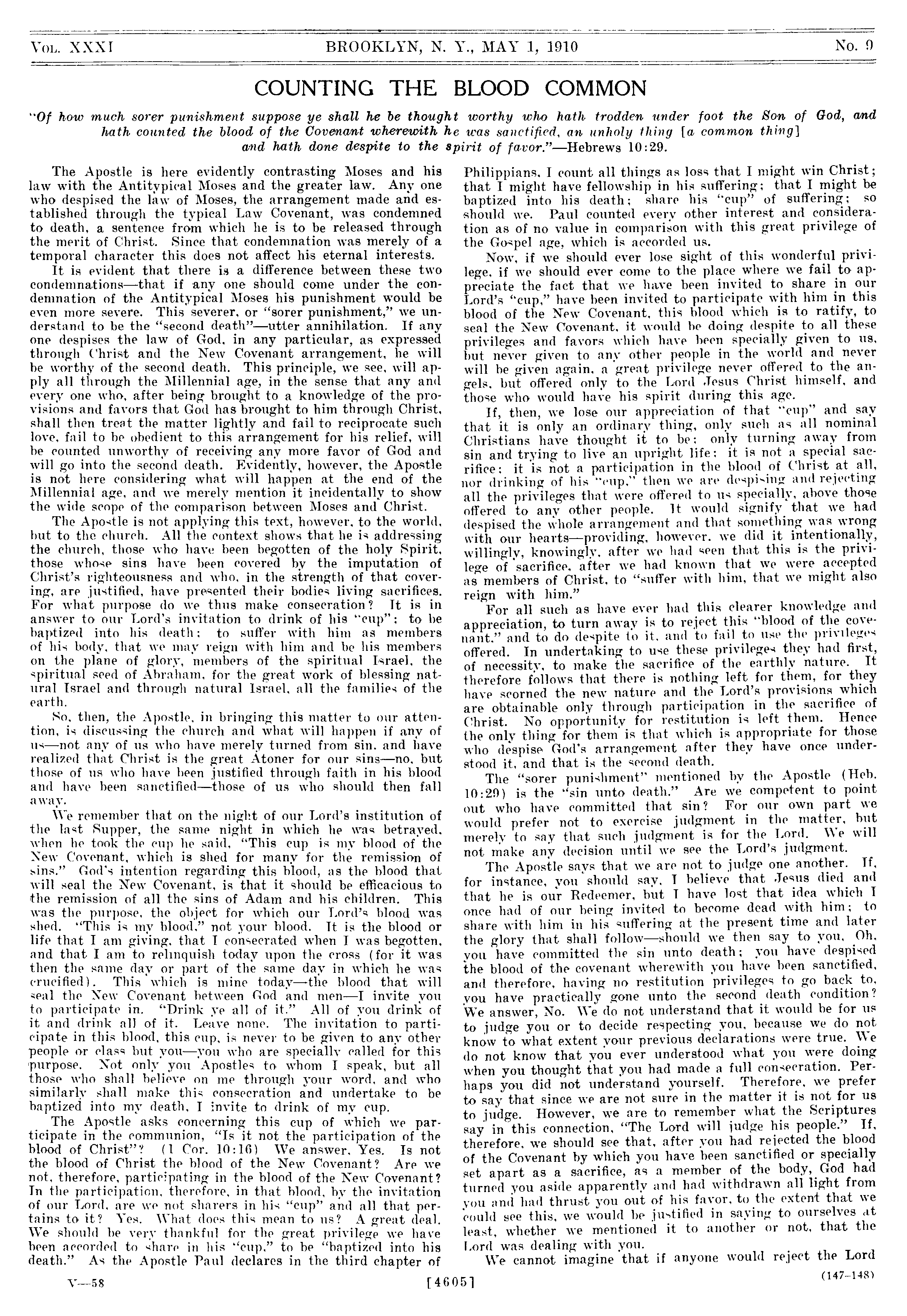
Vou. XXXI BROOKLYN, N. Y., MAY 1, 1910 No. 9 COUNTING THE BLOOD COMMON “Of how much sorer punishment suppose ye shall he be thought worthy who hath trodden under foot the Son of God, and hath counted the blood of the Covenant wherewith he was sanctified, an unholy thing [a common thing] and hath done despite to the spirit of favor.”—Hebrews 10:29. The Apostle is here evidently contrasting Moses and his law with the Antitypical Moses and the greater law. Any one who despised the law of Moses, the arrangement made and established through the typical Law Covenant, was condemned to death, a sentence from which he is to be released through the merit of Christ. Since that condemnation was merely of a temporal character this does not affect his eterna] interests. It is evident that there is a difference between these two condemnations—that if any one should come under the condemnation of the Antitypical Moses his punishment would be even more severe. This severer, or “sorer punishment,” we understand to be the “second death”’—utter annihilation. If any one despises the law of God. in any particular, as expressed through Christ and the New Covenant arrangement, he will be worthy of the second death. This principle, we see, will apply all through the Millennial age, in the sense that any and every one who, after being brought to a knowledge of the provisions and favors that God has brought to him through Christ, shall then treat the matter lightly and fail to reciprocate such love, fail to be obedient to this arrangement for his relief, will be counted unworthy of receiving any more favor of God and will go into the second death. Evidently, however, the Apostle is not here considering what will happen at the end of the Millennial age, and we merely mention it incidentally to show the wide scope of the comparison between Moses and Christ. The Apostle is not applying this text, however, to the world, but to the church. All the context shows that he is addressing the church, those who have been begotten of the holy Spirit, those whose sins have been covered by the imputation of Christ’s righteousness and who, in the strength of that covering, are justified, have presented their bodies living sacrifices. For what purpose do we thus make consecration? It is in answer to our Lord’s invitation to drink of his “cup”: to be baptized into his death: to suffer with him as members of his body, that we may reign with him and be his members on the plane of glory, members of the spiritual Israel, the spiritual seed of Abraham, for the great work of blessing natural Israel and through natural Israel, all the families of the earth. So, then, the Apostle, in bringing this matter to our attention, is discussing the church and what will happen if any of us—not any of us who have merely turned from sin. and have realized that Christ is the great Atoner for our sins—no, but those of us who have heen justified through faith in his blood and have been sanctified—those of us who should then fall away. We remember that on the night of our Lord’s institution of the last Supper, the same night in which he was betrayed. when he took the cup he said, “This cup is my blood of the New Covenant, which is shed for many for the remission of sins.” God's intention regarding this blood, as the blood that will seal the New Covenant, is that it should be efficacious to the remission of all the sins of Adam and his children. This was the purpose, the object for which our Lord’s blood was shed. ‘This is my blood.” not your blood. It is the blood or life that I am giving, that I consecrated when J was begotten, and that I am to relinquish today upon the cross (for it was then the same day or part of the same day in which he was crucified). This which is mine today—the blood that will seal the New Covenant hetween God and men—TI invite vou to partictpate in. “Drink ve all of it.” All of vou drink of it and drink al] of it. Leave none. The invitation to participate in this blood, this cup, is never to be given to any other people or class but you—vou who are specially called for this purpose. Not only you Apostles to whom I speak, but all those who shall believe on me through your word, and who similarly shall make this consecration and undertake to be baptized into my death, I invite to drink of my cup. The Apostle asks concerning this cup of which we participate in the communion, “Is it not the participation of the blood of Christ”? (1 Cor. 10:16) We answer. Yes, Is not the blood of Christ the blood of the New Covenant? Are we not, therefore, participating in the blood of the New Covenant? Tn the participation, therefore, in that blood, by the invitation of our Lord. are we not sharers in his “eup” and all that pertains to it? Yes. What does this mean to us? <A great deal, We should be very thankful for the great privilege we have been accorded to share in his “cup.” to be “baptized into his death.” As the Apostle Paul declares in the third chapter of V—-58 [4605] Philippians. I count all things as loss that I might win Christ; that I might have fellowship in his suffering; that I might be baptized into his death; share his “cup” of suffering; so should we. Paul counted every other interest and consideration as of no value in comparison with this great privilege of the Gospel age, which is accorded us. Now, if we should ever lose sight of this wonderful privilege. if we should ever come to the place where we fail to appreciate the fact that we have been invited to share in our Lord’s “eup,” have been invited to participate with him in this blood of the New Covenant, this blood which is to ratify, to seal the New Covenant, it would be doing despite to all these privileges and favors which have been specially given to us, but never given to any other people in the world and never will be given again, a great privilege never offered to the angels. but offered only to the Lord Jesus Christ himself, and those who would have his spirit during this age. If, then, we lose our appreciation of that “eup” and say that it is only an ordinary thing, only such as all nominal Christians have thought it to be: only turning away from gin and trying to live an upright life: it is not a special sacrifice: it is not a participation in the blood of Christ at all, nor drinking of his “eup.” then we are despising and rejecting all the privileges that were offered to us specially, ahove those offered to any other people. Jt would signify that we had despised the whole arrangement and that something was wrong with our hearts—providing, however. we did it intentionally, willingly, knowingly, after we had seen that this is the privileve of sacrifice, after we had known that we were accepted as members of Christ, to “suffer with him, that we might also reign with him.” For all such as have ever had this clearer knowledge and appreciation, to turn away is to reject this “blood of the covenant.” and to do despite to it, and to fail to use the privileges offered. In undertaking to use these privileges they had first, of necessity, to make the sacrifice of the earthly nature. It therefore follows that there is nothing left for them, for they have scorned the new nature and the Lord’s provisions which are obtainable only through participation in the sacrifice of Christ. No opportunity for restitution is left them. Hence the only thing for them is that which is appropriate for those who despise God's arrangement after they have once understood it, and that is the second death, The “sorer punishment” mentioned by the Apostle (Heb. 10:29) is the “sin unto death.’ Are we competent to point out who have committed that sin? For our own part we would prefer not to exercise judgment in the matter, but merely to say that such judgment is for the Lord. We will not make any decision until we see the Lord’s judgment. The Apostle says that we are not to judge one another. Tf, for instance, you should say, T believe that Jesus died and that he is our Redeemer, but T have Jost that idea which T once had of our being invited to become dead with him; to share with him in his suffering at the present time and later the glory that shall follow—should we then say to you, Oh. you have committed the sin unto death; you have despised the blood of the covenant wherewith you have been sanctified, and therefore, having no restitution privileges to go back to. you have practically gone unto the second death condition? We answer, No. We do not understand that it would be for us to judge you or to decide respecting you, because we do not know to what extent vour previous declarations were true. We do not know that vou ever understood what you were doing when you thought that you had made a full consecration. Perhaps you did not understand yourself. Therefore, we prefer to say that since we are not sure in the matter it is not for us to judge. However, we are to remember what the Seriptures say in this connection, “The Lord will judge his people.” Tf, therefore, we should sce that, after you had rejected the blood of the Covenant by which you have been sanctified or specially set apart as a sacrifice, as a member of the body, God had turned you aside apparently and had withdrawn all light from you and had thrust you out of his favor, to the extent that we could see this, we would be justified in saving to ourselves at least, whether we mentioned it to another or not, that the Lord was dealing with you. ; We cannot imagine that if anyone would reject the Lord (147-148)
Pentru a vă îmbunătăți experiența pe site-ul nostru, folosim cookies și tehnologii similare. Unele cookies sunt esențiale pentru funcționalitatea de bază a site-ului nostru și nu pot fi refuzate. Puteți alege să acceptați sau să refuzați cookies suplimentare. Vrem să vă asigurăm că aceste date nu vor fi vândute sau utilizate în scopuri de marketing. Puteți ajusta preferințele dvs. în orice moment accesând Setările de Confidențialitate din subsolul paginii. Pentru mai multe informații, vă rugăm să consultați
Politica de Confidențialitate
Condiții de utilizare
.


