8
1
8
download/literature/watchtower/1911-14.pdf
watchtower/1911/14/1911-14-1
THE
WATCH
TOWER
BROOKLYN.
N.
Y.
reply
to
my
question
as
to
his
right
to
do
so
was
instructive,
as
throwing
light
upon
an
incident
in
the
life
of
our
Lord,
as
to
which
SQme
difficulty
has
been
felt.
"In
the
early
spring,
when
the
first
leaves
appear,
an
im
mense
numher
of
small
figs
are
produced,
which
do
not
ripen,
but
fall
from
the
branches,
crude
and
immature,
to
the
ground.
To
these
we
fino
a
reference
in
Hev.
6:
13.
The
true
crop
is
not
produced
till
later
in
the
year.
This
first
crude,
'un
timely'
growth,
though
of
no
commercial
value,
is
yl't
plucked
and
eaten
by
the
peasantry,
sometimcs
with
a
pinch
of
salt,
sometimes
with
bread.
Like
the
wild
fruit
of
our
hedgerows
it
is
free
to
all
passersby.
It
was
just
at
this
early
season,
hefore
the
feast
of
the
Passover,
that
our
Lord
and
his
dis
ciples,
having
walked
from
Bethany,
'hungered.'
Seeing
ll.
fig
tree
'afar
off
having
leaves'
they
sought
fruit,
but
found
none.
Seeing
leaves
they
had
a
right
to
expect
fruit.
Find·
ing
fruit
they
would
have
had
right
to
pluck
it,
'for
the
time
of
figs
,vas
not
yet
'-the
true
and
valuable
crop
was
not
yen
produced.
This
incident
he
turned
into
a
solemn
lesson
of
warning
to
the
Jews,
etc.,
etc."
Yours
humbly
in
him
and
his
serdce,
WILLIAM
SMITH.
A
DONATION
OF
MIRACLE
WHEAT
Brothel'
Bohnpt
writes
us
that
he
has
gra,lually
accumu
late,l
a
nop
of
miracle
wheat
from
the
few
grains
he
ob
tain(',1
u.s
a
start.
He
prefers
that
thp
first
opportunity
for
ohtaining
this
wheat
shall
go
to
THE
WATCH
TOWER
readers.
lIe
will
HPII
it
for
$1
per
pound,
inelmiing
postage,
anti
give
the
entire
procee,ls
to
our
~oriety.
All
onlers
for
this
wheat
should
Ill'
a,I,1res~(',I,
'\Ilracle
\Vheat
Bohnet,
17
Hicl{s
street,
Brooklyn,
.:\.
Y.
TIll;;
will
keel'
mail
on
this
subject
separate
from
his
persOlJal
ma.il
and
from
ours.
Broth('r
Bohnet
promises
to
be
reatly
to
ship
this
wheat
hy
August
1.
He
says
miracle
wheat
should
be
sowed
one
fourth
as
thick
as
common
wheat.
Ordinarily
it
should
pro
ouce
from
ten
to
fifteen
times
as
much
proportionately
to
the
amOllllt
.'OWI1.
To
save
keeping
accollnt,
1I10ney
should
accompany
the
Orller.
WATCH
TOWER
readers
will
have
the
pr"fer"nce
up
to
August
15,
aft"r
,,'hidl
of(lers
will
be
at·
tentled
to
in,liscriminatel:,',
,;0
long
as
the
suppl:,'
hol,ls
out.
'I'his
wheat
shoul,l
be
sown
in
the
fall.
BRITISH
VISITS
OF
BROTHER
FRANK
DRAPER
Nottingham,
Eng.,
July
23,
23;
Hucknall,
Eng.,
July
24;
Bolsover,
Eng.,
July
25;
East
Kirkhy,
Eng.,
July
26;
Sheffield,
Eng.,
July
27,
28;
Bl'arlford,
Eng.,
July
29,
:W;
Dewsbury,
Eng.,
July
31;
Otley,
Eng.,
Aug.
1,
2;
Grimshy,
Eng.,
Aug.
3;
Eston,
Eng.,
Aug.
4;
Middlesboro,
Eng.,
Aug.
5,
6;
Bedlington,
Eng.,
Aug.
7.
=
=
=
=
=
=
=
=
=
=
=
=
=
=
=
=
=
=
=
=
=
=
=
=
=
=
=
.
:
:
.
-
_
-
-
-
-
YOLo
XXXII
BROOKLYN,
N.
Y.,
JULY
1,
1911
VIEWS
FROM
THE
WATCH
TOWER
No.
13
UNREST
IN
EUROPE
The
following'
"Unitcd
Press"
report
from
London
seems
to
give
a
very
moderate
view
of
the
Old
World's
affairs:-
"After
an
undisputed
reign
of
more
than
1,000
years,
the
European
'ruling
classes'
are
beginning
to
realize
that
the
pxistence
of
their
order
is
threatened
eVf'rywhere.
Not
even
the
French
Revolution
itself-hitherto
perhaps
the
most
re
markahle
social
upheaval
in
the
world's
history-was
so
sig
nificant
as
the
present
movement
of
the
masses
against
the
classes.
"Curiously
enough,
it
is
in
England,
with
all
its
con
servative
traditions
anc1
the
freest
government
in
Europe,
that
the
feeling
is
strongest.
To
a
great
<>xtent
this
is
due
to
the
fact
that
in
Great
Britain
the
upper
classes
and
the
landed
interests
hn.ve
always
heen
praf'tically
identical.
And
the
land-hungcr
which
has
!Jeen
increasing'
among
the
English
masses
for
forty
years
past
has
intensified
popular
hostility
againRt
those
representatives
of
th8
upper
classes
(which
sub
stantially
means
all
of
them)
who
have
selfishly
monopolized
the
land
for
their
O1m
pleasures.
"Recpnt
advanced
legi,;lation,
tending
toward
the
breaking
up
of
the
great
landed
estates,
has
made
matters
wors<>,
too,
instead
of
hetter.
The
people
who
"'ant
land
are
angrier
than
they
were
hpfore,
hecaURe
they
have
Recured
only
a
part
of
what
they
consider
their
due,
while
the
landed
aristocracy
is
furious
over
having
had
to
relinquish
even
a
fraction
of
its
possessions.
"The
change
that
has
eome
over
rural
England
in
the
past
threc
decadf's,
is,
in
fact,
nothing
short
of
marvelous.
In
the
old
days,
if
a
villager
failed
to
doff
his
hat
to
the
parson
or
th8
squire,
or
if
his
wife
omitted
a
reverential
courtesy
to
them,
it
was
a
foregonp
cOlJl'lusion
that
that
couple
would
he
driven
from
the
village
forthwith,
or
that
at
any
rate,
if
they
remained,
thrir
lives
,,'auld
he
made
intolerable.
To
(lay,
even
in
cases
wh<>rp
the
farm
lahorer
retains
an
outward
appearance
of
r<>sp<>ct
for
those
ahov<>
him,
he
looks
on
the
latter
as
his
natural
en<>mies,
and
n<>ver
misses
a
chance
of
voting
against
thpm
at
the
polls.
More
than
this,
he
has
rpached
a
point
where
he
not
only
disput<>s
the
aristocracy's
title
to
monopolize
the
land
which
he
thinks
should
he
his
own,
hut
refuses
to
acknowledge
its
superiority
over
him
in
any
form.
"In
the
towns,
of
course,
where
radicalism
has
long
h<>en
rampant,
the
ruling'
classes
have
heen
haten
for
a
much
greater
length
of
time
than
in
the
country.
But
wherl'as
they
were
merely
hated
nfty
years
ago.
their
very
right
to
exiRt
is
now
disputed.
Popular
education
ann
popular
newspapers
have
heen
mainly
responsible
for
the
growth
of
this
fe<>ling.
The
average
mechanic
WllO
has
to
work
hard
for
small
wages,
denies
the
right
of
another
to
live
in
inleness
upon
what
obis
father
left
him.
Thr
present-nay
British
workmen's
creed
is
that
everyone
in
the
world
ought
to
start
equal.
"To
a
large
extent,
the
growth
of
this
sentiment
has
been
at
the
hottom
of
recent
labor
trouhles
in
England.
Com
plaints
have
been
made
everywhere
that
the
lallOr
unionists
have
refused
to
obey
their
own
chief's
orders
and
have
thus
precipitated
useless
strikes.
But
this
is
only
partly
true.
Leav
ing
out
the
fact
that
most
of
the
labor
leaders
belong
to
a
passing
generation,
and
are
not
in
as
close
touch
as
they
should
be
with
the
rank-and·file,
there
is
quite
a
different
reason
for
the
men's
unmanageahility.
And
this
reason
is
that
the
feeling
of
unrest
and
discontent
is
so
rife
as
to
render
the
masses
of
workmen
anxious
to
defy
rathpr
than
to
treat
with
their
employers.
Just
as
the
village
laborer
regards
the
sf(uire,
so
the
city
mechanic
regards
the
capitalist.
Both
country
squire
and
city
capitalist
represent
the
ruling
classes
to
the
man
who
works.
THE
SPREAD
OF
SOCIALISM
,
'Generally
throughout
Europe,
the
growth
of
Socialism
is
held
accountable
by
the
aristocracy
for
the
masses'
dis·
content.
"In
England,
for
instance,
it
is
the
Tories'
custom
to
refer
to
any
man
of
progressive
political
ideas
as
a
'Socialist.'
They
use
the
word
as
a
term
of
reproach,
but
the
truth
is
that
it
is
really
not
the
right
word
to
use
as
the
Tories
use
it.
'Advanced
radicalism'
would
he
more
accurately
descriptive.
Not
many
English
workmen
admit
that
they
are
Socialists
and
not
many
of
them
are.
"In
Germany
they
do
admit-assent
it
in
fact.
And
the
spread
of
Socialism
in
the
Fatherland
is
making
the
old
aristocracy
shake
in
its
shoes.
Noone
there
would
be
surprised
by
a
Socialist
victory
at
any
election
and
when
the
Socialists
secure
control
of
the
Reichstag
the
aristoeracy's-and
the
monarchy's-days
are
numhered.
German
Socialists,
like
the
English,
are
advanced
Radicals.
Their
idea
is
less
the
rule
of
Socialism
than
an
evening-up
of
conditions-with
perhaps
a
not
entirely
unnatural
desire,
on
the
part
of
some
of
them,
for
revenge
upon
the
privileged
classes
who
have
oppressed
them
so
long.
"In
Austria-Hungary
an
identical
proeess
is
at
work.
The
dear-food
riots-the
revolt
against
the
excessive
cost
of
living
-are
the
first
expreisions
of
the
popular
oemand.
Exploited,
generation
after
generation
by
the
greedy
rich,
the
masses
have
lost
their
patience
at
last.
"The
strained
industrial
situation
in
France
is
due
to
the
same
cause.
In
France,
however,
the
rehellion
is
not
against
an
aristocracy,
hut
against
the
ring
of
capitalists
which
runs
the
government
alJn
every
thing
else
in
the
repuhlic.
As
the
memhers
of
this
ring
grow
richer,
the
poor-and
the
middle
classes-grow
poorer
every
day.
Concessions
in
one
par
ticular
trade
will
do
no
good
in
France.
What
is
needed
is
a
change
in
the
entire
economic
system.
"Russia
is
no
better
off.
The
revolutionary
movement
there
is
and
always
hal!!
heen
an
attempt
to
I
pull'
the
system
of
feudal
tyranny
which
grinds
the
people
into
the
dirt.
Unlike
his
fellows
elsewhere
throughout
Europe,
the
r48441
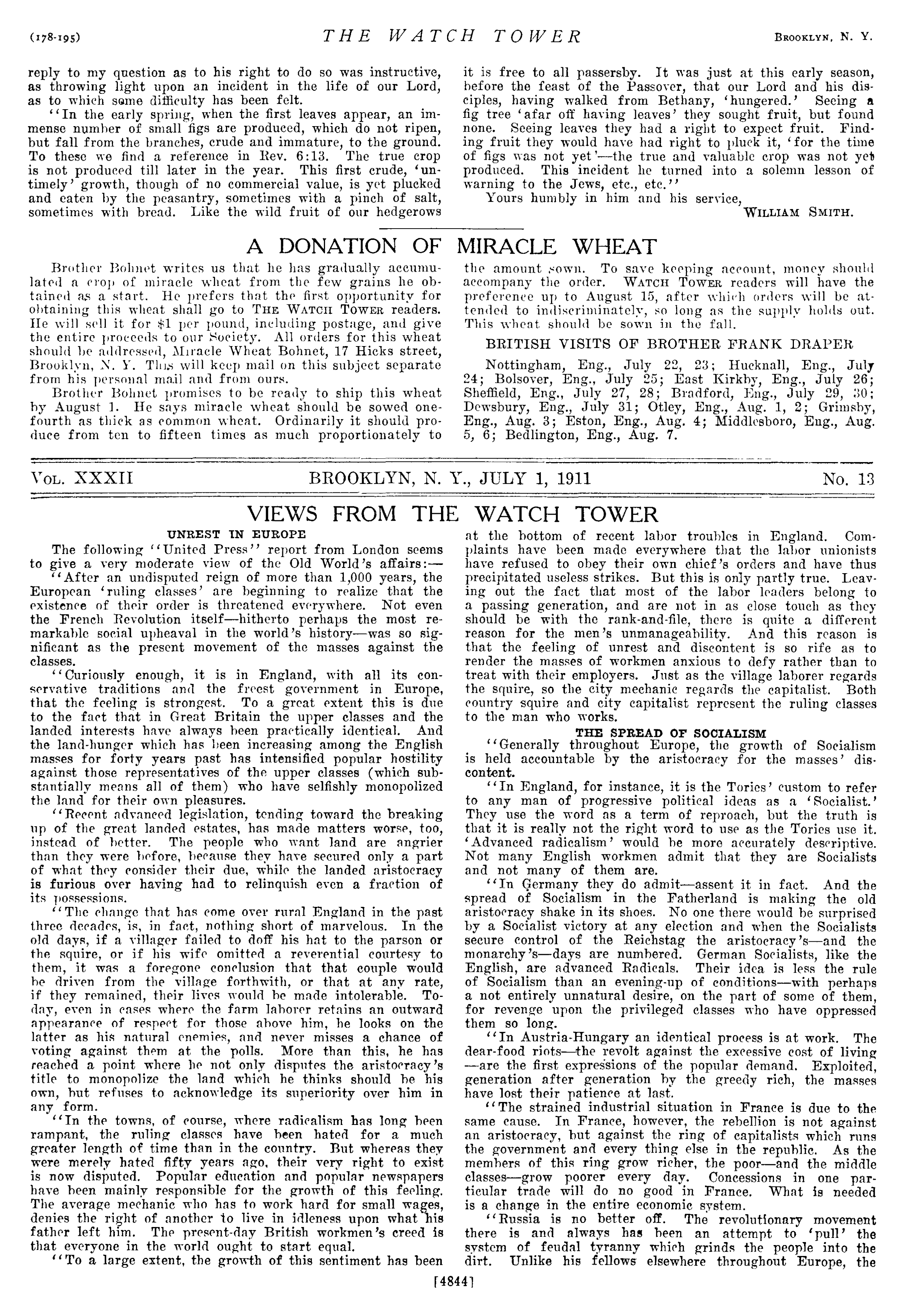
(178-195) reply to my question as to his right to do so was instructive, as throwing light upon an incident in the life of our Lord, as to which seme difficulty has been felt. “Tn the early spring, when the first leaves appear, an immense number of small figs are produced, which do not ripen, but fall from the branches, crude and immature, to the ground. To these we find a reference in Rev. 6:13. The true crop is not produced till later in the year. This first crude, ‘untimely’ growth, though of no commercial value, is yet plucked and eaten by the peasantry, sometimes with a pinch of salt, sometimes with bread. Like the wild fruit of our hedgerows A DONATION OF Brother Bohnet writes us that he has gradually accumulated a crop of miracle wheat from the few grains he obtained as a start. He prefers that the first opportunity for obtaining this wheat shall go to THz Watcn Tower readers. He will sell it for $1 per pound, including postage, and give the entire proceeds to our Society. All orders for this wheat should be addressed, Miracle Wheat Bohnet, 17 Hicks street, Brooklyn, N. Y. Tlus will keep mail on this subject separate from his personal mail and from ours. Brother Bohnet promises to be ready to ship this wheat hy August 1. He says miracle wheat should be sowed onefourth as thick as common wheat. Ordinarily it should produce from ten to fifteen times as much proportionately to THE WATCH TOWER Brooxtyn, N. Y. it is free to all passersby. Jt was just at this early season, before the feast of the Passover, that our Lord and his disciples, having walked from Bethany, ‘hungered.’ Seeing a fig tree ‘afar off having leaves’ they sought fruit, but found none. Seeing leaves they had a right to expect fruit. Finding fruit they would have had right to pluck it, ‘for the time of figs was not yet’—the true and valuable crop was not yet produced. This incident he turned into a solemn lesson of warning to the Jews, etc., etc.’’ Yours humbly in him and his service, WILLIAM SMITH. MIRACLE WHEAT the amount sown. To save keeping aecount, money should accompany the order. Watcu Tower readers will have the preference up to August 15, after which orders will be attended to indiscriminately, so Jong as the supply holds out. This wheat should be sown in the fall. BRITISH VISITS OF BROTHER FRANK DRAPER Nottingham, Eng., July 22, 23; Hucknall, Eng., July 24; Bolsover, Eng., July 25; East Kirkby, Eng., July 26; Sheffield, Eng., July 27, 28; Bradford, Eng., July 29, 30; Dewsbury, Eng., July 31; Otley, Eng., Aug. 1, 2; Grimsby, Eng., Aug. 3; Eston, Eng., Aug. 4; Middlesboro, Eng., Aug. 5, 6; Bedlington, Eng., Aug. 7. Vou. XXXII BROOKLYN, N. Y., JULY 1, 1911 No. 13 VIEWS FROM THE WATCH TOWER UNREST IN EUROPE The following ‘‘United Press’’ report from London seems to give a very moderate view of the Old World’s affairs:— ‘‘After an undisputed reign of more than 1,000 years, the European ‘ruling classes’ are beginning to realize that the existence of their order is threatened everywhere. Not even the French Revolution itself—hitherto perhaps the most remarkable social upheaval in the world’s history—was so significant as the present movement of the masses against the classes. ‘“Curiously enough, it is in England, with all its conservative traditions and the freest government in Europe, that the feeling is strongest. To a great extent this is due to the fact that in Great Britain the upper classes and the landed interests have always been practically identical. And the land-hunger which has heen increasing among the English masses for forty years past has intensified popular hostility against those representatives of the upper classes (which substantially means all of them) who have selfishly monopolized the land for their own pleasures. ‘*Reeent advanced legislation, tending toward the breaking up of the great landed estates, has made matters worse, too, instead of hetter. The people who want Jand are angrier than they were hefore, because they have secured only a part of what they consider their due, while the landed aristocracy is furious over having had to relinquish even a fraction of its possessions. “*The change that has come over rural England in the past three decades, is, in faet, nothing short of marvelous. In the old days, if a villager failed to doff his hat to the parson or the squire, or if his wife omitted a reverential courtesy to them, it was a foregone conclusion that that couple would he driven from the village forthwith, or that at any rate, if they remained, their lives would be made intolerable. Today, even in cases where the farm Jahorer retains an outward appearance of respect for those ahove him, he looks on the latter as his natural enemies, and never misses a chance of voting against them at the polls. More than this, he has reached a point where he not only disputes the aristocracy ’s title to monopolize the land which he thinks should he his own, hut refuses to acknowledge its superiority over him in any form. ‘“In the towns, of course, where radicalism has long been rampant, the ruling classes have heen hated for a much greater length of time than in the country. But whereas they were merely hated fifty years ago, their very right to exist is now disputed. Popular edueation and popular newspapers have been mainly responsible for the growth of this fecling. The average mechanic who has to work hard for small wages, denies the right of another to live in idleness upon what his father left him. The present-day British workmen’s creed is that everyone in the world ought to start equal. ‘“To a large extent, the growth of this sentiment has been at the bottom of recent labor troubles in England. Complaints have been made everywhere that the labor unionists have refused to obey their own chief’s orders and have thus precipitated uscless strikes. But this is only partly true. Leaving out the fact that most of the labor leaders belong to a passing generation, and are not in as close touch as they should be with the rank-and-file, there is quite a different reason for the men’s unmanageahility. And this reason is that the feeling of unrest and discontent is so rife as to render the masses of workmen anxious to defy rather than to treat with their employers. Just as the village laborer regards the squire, so the city mechanic regards the capitalist. Both country squire and city capitalist represent the ruling classes to the man who works. THE SPREAD OF SOCIALISM ‘Generally throughout Europe, the growth of Socialism is held accountable by the aristocracy for the masses’ discontent. “In England, for instance, it is the Tories’ custom to refer to any man of progressive political ideas as a ‘Socialist.’ They use the word as a term of reproach, but the truth is that it is really not the right word to use as the Tories use it. “Advanced radicalism’ would be more accurately descriptive. Not many English workmen admit that they are Socialists and not many of them are, ““In Germany they do admit—assent it in fact. And the spread of Socialism in the Fatherland is making the old aristocracy shake in its shoes. No one there would be surprised by a Socialist victory at any election and when the Socialists secure control of the Reichstag the aristocracy’s—and the monarchy ’s—days are numbered. German Socialists, like the English, are advanced Radicals. Their idea is less the rule of Socialism than an evening-up of conditions—with perhaps a not entirely unnatural desire, on the part of some of them, for revenge upon the privileged classes who have oppressed them so long. ‘‘In Austria-Hungary an identical process is at work. The dear-food riots—the revolt against the excessive cost of living —are the first expressions of the popular demand. Exploited, generation after generation by the greedy rich, the masses have lost their patience at last. ‘‘The strained industrial situation in France is due to the same cause. In France, however, the rebellion is not against an aristocracy, but against the ring of capitalists which runs the government and every thing else in the republic. As the memhers of this ring grow richer, the poor—and the middle classes—grow poorer every day. Concessions in one particular trade will do no good in France. What is needed is a change in the entire economic system. ‘‘Russia is no better off. The revolutionary movement there is and always has heen an attempt to ‘pull’ the system of feudal tyranny which grinds the people into the dirt. Unlike his fellows elsewhere throughout Europe, the [4844]
Pentru a vă îmbunătăți experiența pe site-ul nostru, folosim cookies și tehnologii similare. Unele cookies sunt esențiale pentru funcționalitatea de bază a site-ului nostru și nu pot fi refuzate. Puteți alege să acceptați sau să refuzați cookies suplimentare. Vrem să vă asigurăm că aceste date nu vor fi vândute sau utilizate în scopuri de marketing. Puteți ajusta preferințele dvs. în orice moment accesând Setările de Confidențialitate din subsolul paginii. Pentru mai multe informații, vă rugăm să consultați
Politica de Confidențialitate
Condiții de utilizare
.


