8
1
8
download/literature/watchtower/1912-5.pdf
watchtower/1912/5/1912-5-1
FEBRUARY
IS,
1912
THE
WATCH
TOWER
(71-75)
as
we
will
explain.
\Ye
read,
"All
his
work
is
perfect."
It
is
the
divine
method
that
every
creature
of
God
~hall
be
so
pf'r
fect
as
to
need
no
forgiveness,
no
allowanre.
Then
angels
were
created
perfert,
hence
there
was
no
need
to
provide
forgiveness
for
them,
because
there
would
be
no
excuse
for
their
sinning.
Likewise
man
was
thus
created
perfect,
in
the
image
and
like
Ill'SS
of
the
Creator,
and
was
without
excuse.
and
therefore
needpd
no
provision
for
merry
so
long
as
he
was
in
relation
with
his
God.
\Yhen
temptation
came,
man
fell
from
obedience
into
sin,
and
from
divine
favor
and
life
into
disfavor
and
under
the
death
sentence.
He
was
without
excuse
and
justice
made'
no
provi
sion.
But
another
feature
of
the
divine
character.
love,
while
Ilot
in
('ontrol,
was
hrought
into
exercise
for
man's
relief.
But
(livine
lon'
or
mercv
could
not
override
or
intprfere
with
divine
justice.
In
other
,Yords,
God
could
not
forgive
a
sinner
whom
He
had
spntpn('ed
to
death.
What
He
could
do.
and
did
do,
was
to
provide
in
due
timp
for
man's
redemption.
All
of
didne
mercy,
tlH'refore,
flows
through
the
channel
of
redemption.
Applying
this
prineiple
to
our
Savior
and
to
his
teachings,
we
ask,
How
could
he
forgive
sins
when
divine
justice
('ould
not
forgive
sins.
nor
set
aside
the
penalty
of
sin?
The
answer
is,
,J('su.;
wa.;
the
rppl"l,-;pntntive
of
divine
mprcy.
an,l
was
at
that
time
amongst
mpn
for
the
purpose
of
giving
his
life
as
a
sacri
tiee
Oil
mail's
a(,(,ollnt.
an,l
therefore
to
him
belongp(l
the
di,
tilldi\'e
honor
of
forgidng
sins.
But
-;omeonE'
answers
that
.
Tpsus
had
not
vpt
(lip(l
for
man's
sin-;,
that
he
hall
not
vpt
ri..;pn
for
mall's
ju..;t'iti('atioll,
that
he
had
not
even
appearp'd
in
the
prp~pIH'e
of
Go,!
for
thp
"housphold
of
faith."
\Ye
answer
that
while
it
is
true
that
he
had
not
accom
pli,hp(l
this
work.
an'!
indped
has
not
yP!
full;'
aC('omplished
his
work
(as
the
Rpdrrmer
and
Restorer
of
men),
nevertheless,
he
had
hE'gun
thp
work,
11('
had
presented
himself
as
man's
.\tonement
pri('r
at
.IonIan,
at
thr
timp
of
his
haptism.
Acrord
ing
to
the
Saipturrs
and
the
type,
hp
at
that
nlOment
surren
(!rrpd
his
earthly
all
on
man's
behalf.
However,
his
surrender
of
his
all
did
not
give
him
the
au
thority
to
forgive
sins.
It
was
the
heavenly
Father's
accept
ance
of
his
consecration-divine
acceptance
of
Jesus'
sarrifice
that
counted.
God's
acceptance
of
Jesus'
sacrifice
was
mani
fested
in
his
impartation
of
the
holy
Spirit,
which
lighted
upon
Jesus
like
a
dove,
as
was
testified
by
John
the
Baptist,
aIH!
also
testified
by
divine
power
which
thereafter
operated
in
aIH!
through
Jesus
for
the
healing
of
diseases.
\Ve
see,
then,
that
our
Lord's
words
to
the
palsied
man,
"Thy
sins
be
forgiven
thee,"
were
justified
by
the
fact
that
he
was
in
the
position
of
making
satisfaction
for
the
sins
of
the
whole
world,
and
that
the
Father
had
already
indicated
the
acceptance
of
the
sacrjfiee
whi('h
was
then
in
process.
"BLESS
THE
LORD,
0
MY
SOUL"
The
text
for
this
study
comes
from
thp
Psalms,
and
is
most
interesting.
The
ProplH't
Va
vi,l
may
han'
a
ppropria
tP(!
tIn'
words
to
himself
as
a
Jew.
and
may
have
thought
of
his
own
physical
healing
and
blessing
as
evi(lellees
of
the
Lord's
favor
under
the
Law
Covpnant.
But
thp
prophetic
application
of
this
Psalm
to
spiritual
Israel
is
still
more
interesting.
The
spir
itual
Israelites
are
new
crl'atures,
and
have
this
treasure
in
earthen
vessels.
With
these
it
is
the
nl'W
mind
that
recognizes
his
healing,
his
forgiveness,
his
reconciliation
to
God;
and.
according
to
God's
promise,
all
things
are
working
togethpf
for
good
to
him
.
because
he
loves
God
and
has
been
call('d
apcording
to
the
divine
purpose.
Continually
the
new
('reature
has
('ause
to
exclaim,
"Bless
the
Lord,
0
my
souL
and
forget
not
all
His
benefits,
who
forgiveth
all
thine
iniquities,
who
healeth
all
thy
diseases!"
St.
PauL
carrying
out
this
~all1e
thought,
<!('('!ar('<!
thrlt
th,
great
Redeemef
will
ultimately
pres('nt
his
phufPh
beforp
the
Father
faultless
and
perfect
in
love-"sown
in
wpakness,
ra
ised
in
power;
sown
in
dishonor,
raisrd
in
glory;
sown
an
anima!
body,
raised
a
spirit
body."
We
shall
bp
like
him
amI
Sl'e
him
as
he
is
and
share
his
glory.
\'or
•.
XXXIII
BROOKLYN,
N.
Y.,
MARCH
1,
1912
THE
GOSPEL
ST.
PAUL
PREACHED
1\
o.
[j
"For
I
arn
not
ushamed
of
the
Gospel
of
Christ;
for
it
is
the
power
of
God
unto
salvation
to
everyone
that
believeth;
to
the
Jew
first,
and
also
to
the
Greek."-Rom,
1:
16.
Thpr('
rlrc
man;'
rl'ligiom,
an,l
it
is
a
mistake
that
we
have
80me
of
the,e
religions
pronouncr
on('
kinel
of
ppnalty
for
pprhaJH
said
in
th('
past
that
there
i,
no
r('Jigion
but
one.
A
tho..;e
who
will
not
accept
them,
and
others
declare
othcr
J'('!igion
woulel
prop('rJy
he
considereel
"Any
system
of
worship
kinds.
80me
offer
one
kind
of
reward
for
those
who
accept
hy
whieh
an~'
peoplp
recognize
the
AJmighty
and
seek
to
do
anel
follow
their
tpachings,
whi!p
others
offer
other
kinds
of
him
honor."
'YP
ar(',
thereforr,
to
r('Pognize
the
various
great
rewards.
But
all
agree
that
man
needs
to
be
elevated
and
lifted
rpligion~
that
an'
in
thp
worl,l
in
thp
sense
that
we
could
not
up
out
of
his
fallpn
condition,
which
is
sinful
and
unsatisfac-
propprly
ignorp
tI1l'm.
"'e
have,
for
instance,
the
Confucian
tory.
There
seems
to
be
in
every
man,
naturally,
without
any
!<-:tehing,
thp
Brahmin
tl'aphing.
the
Hu(ldhist
teaching,
the
p(luration
on
the
suhject,
sompthing
which
tells
him
that
he
is
:\[ohrllllnH'tl:ln
tpaphing,
thp
.Jewish
t('aching
amI
the
Christirrn
not
perfect;
that
he
is
not
in
full
accord
with
his
own
con-
t,-aehing.
Th('s"
rr
11
prp~ent
tlwmselves
to
us
as
religious
seience,
not
in
accord
with
his
own
highest
idpals
of
the
divine
tp:tehings.
Th('y
all
Jll'lieve
thpms('lvps
more
or
less
rationrrl;
mind.
t
hp~'
all
hplipY('
them-;"Jve~
mol'''
or
less
reasonable.
Every
1l1:111
All
religions,
therefore,
recocrnize
this
principle
of
sin
an,l
trips
to
think
that
hi..;
own
thpory
on
any
matter
is
a
reason-
propose
rpmedies
thprefor.
\V~
see
the
evidence
of
this
as
ah]p
tllpor~';
amI
hp
i-;
prop"r
in
so
doing.
manife~t(',l
in
their
disciples
everywhere.
Many
seek
to
crucify
..
In
harmony
".ith
our
text,
w\
T.JfOPOSp
to
compa.re
.the
re-
the
!lpsh
in
one
form
or
another-some
by
flagellations,
some
hglOn
of
.Jp..;us
\nth
all
ouher
relIgIOns.
III
the
begwIlIng,
we
by
restraints
upon
thp
variom:
liberties
of
life,
some
by
holding
s~at.p
\~~ith
~hp
.\postlp,
"I
alll,
not
rlshamed
of
the
Gosp~l
of
thpir
hands
in
the
air
fOf
days,
seeking
to
become
holy
ant!
l
hn~t.
"hatpn'r
m~t;'
br
s~lld
of
other
gospels,
we
beheve,
thus
appease
their
O'od.
as
Christian-;,
that
in
the
Christian
religion
we
have
that
of
But
none
of
tlt~~e
things,
in
the
light
of
the
Gospel
of
whi('h
no
m:lIl
nppd
bE'
ashamel!.
Thprp
may
perhaps
be
cer-
Christ,
seem
to
he
the
highe..;t
ant!
noh1<'st
idpals.
Doubtlps~
tain
fpaturps
anlt
forms
of
certain
creeds
~f
whic?
we
might
all
have
done
some
gOO(}
and
uplifted
some
men
out
of
the
hp
a~hanH't!-that
do
not
('Olllp
lip
to
our
lughpst
Ideals.
But
de"radation
in
whieh
thev
were.
:Mankind
mio-ht
have
bpen
thp
Christian
rpligion.
a~
yre..;pntpd
in
thp
\Yonl
of
God,
should
\\
~·..;e
off
if
it
had
not
bep'~
for
these
religions.
<0
hI'
tIl('
standanl
of
Chnstpn,!om;
an,l
of
that
we
are
not
But
now,
if
we
compare
tllPse
with
t!1P
religion
of
,Tesll,
ashame,!.
It
will
comparE'
with
all
other
rpligions
in
the
worl,l,
Christ,
we
I)('lievc
everything
is
to
be
sail}
in
favor
of
thp
]"('-
llll(!
comp
off
viptoriolls,
in
ewry
spnse
of
the
word.
All
of
!igion
of
Chri,t.
In
the
first
place,
all
these
religions
more
thp~p
variolls
rpligions
SPPIl1
to
recognize
that
man
i-;
in
an
or
Ips~
rrsemble
the
Jewish
relio-ion,
which
is
of
God,
awl
impprfed,
un~atisfactor.\-,
sinful
pon,lition;
thPl'efore,
eaph
of
hencr
all
these
reliO'ions
are
mo;e
or
less
in
harmon
v
with
tll('..;r
religions
sepkg
to
present
cprtain
tendq,
or
teachings,
CO(I'~
proposition.
<0
•
that
will
ht:lp
m:lII
lip
out
of
his
imp"rfe('t
condition,
back
into
(loci's
proposition
to
the
.Tews
was,
"Do
these
things
alll!
harmony
WIth
hIS
God.
yp
shall
livp,"
have
everlasting
life.
That
was
the
covenant
A
COMPARISON
OF
RELIGIONS
mad"
bv
GOll
with
thpm
at
]\,fount
Sinai.
at
th('
hands
of
If
wp
ponsicler
thr
tpachings
of
the
),fohamIl1p<!ans,
we
find
Masps.·
Thpy
thought
at
first
that
they
would
sun'l;'
be
lift",!
that
they
have
p('J'tain
qnalities
whiph
are
vpr;'
advantageous,
up
out
of
sin,
!JPcause
God
had
given
them
a
law,
and
h;'
all(!
othpr
qualities
which
Wp
('oul,l
not
so
highly
commend.
kppping
it
th(T
woul(l
be
perfpet
aTHl
be
brought
into
harmony
Their
pndp;1vor
i..;
not
to
do
iniur~'.
but
to
ma].;p
men
better.
with
God.
In
this
they
were
mistaken,
for,
as
th"y
fouIlIl
out,
Th(,ir
thpory
is
that
mankind
arp
fallpn
anll
nppr!
lifting
up
out
as
the'
centurips
pas~pd,
none
of
them
wpre
able
to
kpep
the
of
their
fallen
condition.
Thp
samp
may
he
sait!
of
the
tpach·
law.
hppau~"
it
is
thp
mpasure
of
a
perfect
man's
ability;
and
ings
of
the
Brahmin,
thl'
('()nfupiani~t
an,l
the
Buddhist.
They
nonp
of
thpm
pould
nlPasure
up
to
the
perfect
man.
arp
all
more
or
Ipss
prp~pntati()ns
of
what
arp
supposed
to
be
T
~raP}
found,
therefore,
as
the
Apostlp
states
it.
that
"by
curl'S
fOf
man's
faJJpn
contrition,
purE'S
for
his
unsatisfactory
the
(lpeds
of
thp
IRW
shall
no
flesh
be
justified
in
God's
sight."
attitude.
And
they
fouIllI
also
that
the
law,
instead
of
perfecting,
justi-
[4981]
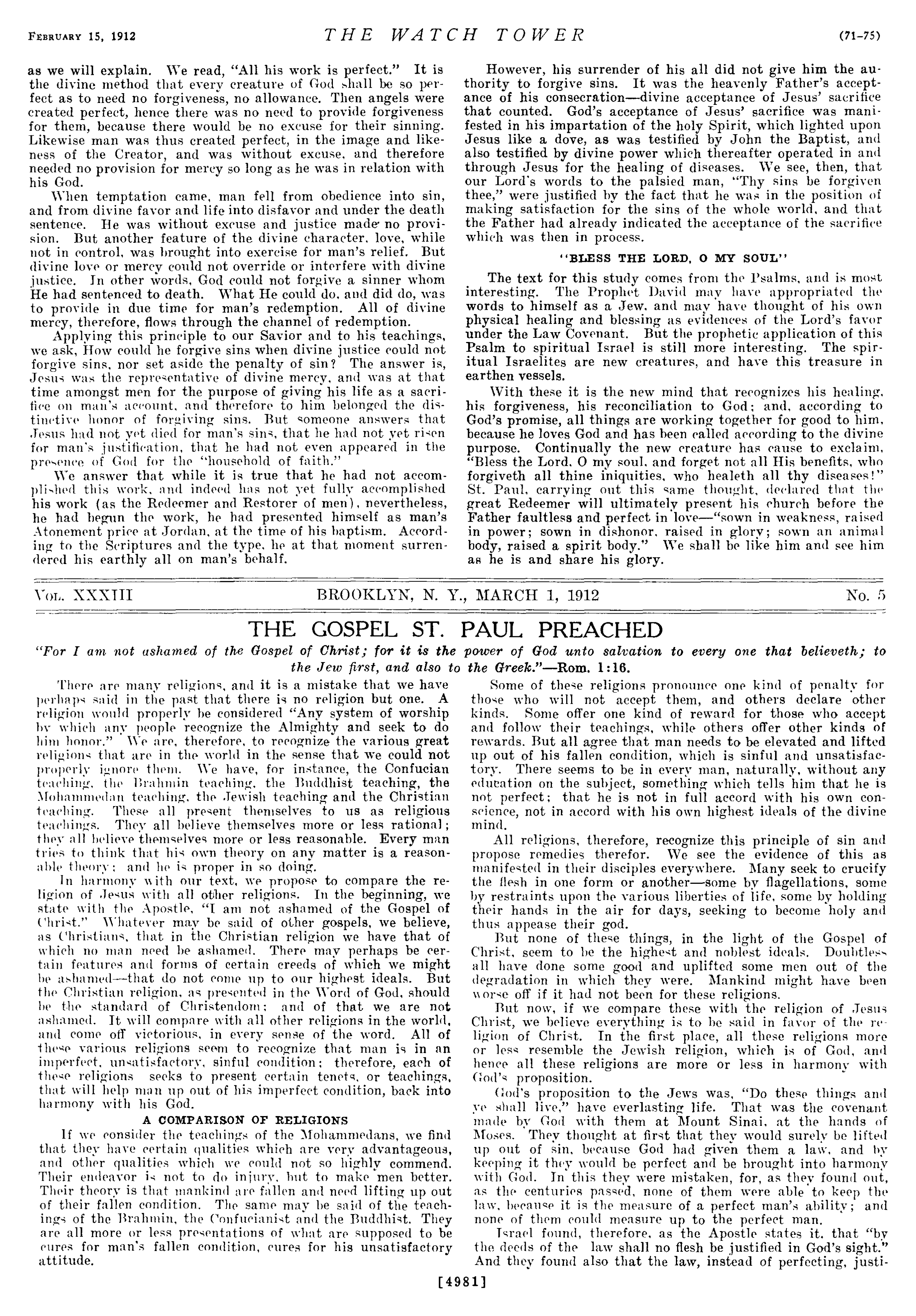
Fesruary 15, 1912 as we will explain. We read, “All his work is perfect.” It is the divine method that every creature of God shall be so perfect as to need no forgiveness, no allowance. Then angels were created perfect, hence there was no need to provide forgiveness for them, because there would be no excuse for their sinning. Likewise man was thus created perfect, in the image and likeness of the Creator, and was without excuse, and therefore needed no provision for mercy so long as he was in relation with his God. When temptation came, man fell from obedience into sin, and from divine favor and life into disfavor and under the death sentence. He was without excuse and justice made no provision. But another feature of the divine character, love, while not in control, was brought into exercise for man’s relief. But divine love or mercy could not override or interfere with divine justice. In other words, God could not forgive a sinner whom He had sentenced to death. What He could do, and did do, was to provide in due time for man’s redemption. All of divine mercy, therefore, flows through the channel of redemption. Applying this principle to our Savior and to his teachings, we ask, How could he forgive sins when divine justice could not forgive sins, nor set aside the penalty of sin? The answer is, Jesus was the representative of divine mercy, and was at that time amongst men for the purpose of giving his life as a sacritice on man’s account, and therefore to him belonged the distinetive honor of forgiving sins. But someone answers that Jesus had not vet died for man’s sins, that he had not yet risen for man's justification, that he had not even appeared in the presenee of God for the “household of faith.” We answer that while it is true that he had not accomplished this work, and indeed has not yet fully accomplished his work (as the Redeemer and Restorer of men), nevertheless, he had begun the work, he had presented himself as man’s Atonement price at Jordan, at the time of his baptism. According to the Scriptures and the type, he at that moment surrendered his earthly all on man’s behalf. Vou. XXXII THE WATCH TOWER BROOKLYN, N. Y., MARCH 1, 1912 (71-75) However, his surrender of his all did not give him the authority to forgive sins. It was the heavenly Father’s acceptance of his consecration—divine acceptance of Jesus’ sacrifice that counted. God’s acceptance of Jesus’ sacrifice was manifested in his impartation of the holy Spirit, which lighted upon Jesus like a dove, as was testified by John the Baptist, and also testified by divine power which thereafter operated in and through Jesus for the healing of diseases. We see, then, that our Lord’s words to the palsied man, “Thy sins be forgiven thee,” were justified by the fact that he was in the position of making satisfaction for the sins of the whole world, and that the Father had already indicated the acceptance of the sacrifice which was then in process. ‘“‘BLESS THE LORD, 0 MY SOUL’’ The text for this study comes from the Psalms, and is most interesting. The Prophet David may have appropriated the words to himself as a Jew, and may have thought of his own physical healing and blessing as evidences of the Lord’s favor under the Law Covenant. But the prophetic application of this Psalm to spiritual Israel is still more interesting. The spiritual Israelites are new creatures, and have this treasure in earthen vessels, With these it is the new mind that recognizes his healing. his forgiveness, his reconciliation to God; and, according to God’s promise, all things are working together for good to him, because he loves God and has been called according to the divine purpose. Continually the new creature has cause to exclaim, “Bless the Lord, O my soul. and forget not all His benefits, who forgiveth all thine iniquities, who healeth all thy diseases!” St. Paul, carrying out this same thought, declared that the great Redeemer will ultimately present his church before the Father faultless and perfect in love—“sown in weakness, raised in power; sown in dishonor, raised in glory; sown an animal body, raised a spirit body.” We shall be like him and see him as he is and share his glory. No. 5 THE GOSPEL ST. PAUL PREACHED “For I am not ushamed of the Gospel of Christ; for it is the power of God unto salvation to every one that believeth; to the Jew first, and also to the Greek.”—Rom. 1:16. There are many religions, and it is a mistake that we have perhaps said in the past that there is no religion but one. A religion would properly be considered “Any system of worship by which any people recognize the Almighty and seek to do him honor.” We are, therefore, to recognize the various great religions that are in the world in the sense that we could not properly ignore them. We have, for instance, the Confucian teaching, the Brahmin teaching, the Buddhist teaching, the Mohammedan teaching, the Jewish teaching and the Christian teaching. These all present themselves to us as_ religious teachings. They all believe themselves more or less rational; they all believe themselves more or less reasonable. Every man tries to think that his own theory on any matter is a reasonable theory; and he is proper in so doing, In harmony with our text, we propose to compare the religion of Jesus with all other religions. In the beginning, we state with the Apostle, “I am not ashamed of the Gospel of Christ.” Whatever may be said of other gospels, we believe, as Christians, that in the Christian religion we have that of which no man need be ashamed. There may perhaps be certain features and forms of certain creeds of which we might be ashamed—that do not come up to our highest ideals. But the Christian religion, as presented in the Word of God, should be the standard of Christendom: and of that we are not ashamed. Jt will compare with all other religions in the world, and come off victorious, in every sense of the word. All of these various religions seem to recognize that man is in an imperfect, unsatisfactory, sinful condition; therefore, each of these religions secks to present certain tenets, or teachings, that will help man up out of his imperfect condition, back into harmony with his God. A COMPARISON OF RELIGIONS lf we eonsider the teachings of the Mohammedans, we find that they have certain qualities which are very advantageous, and other qualities which we could not so highly commend. Their endeavor is not to do injury, hut to make men better. Their theory is that mankind are fallen and need lifting up out of their fallen condition. The same may be said of the teachings of the Brahmin, the Confucianist and the Buddhist. They are all more or less presentations of what are supposed to be cures for man’s fallen condition, cures for his unsatisfactory attitude. Some of these religions pronounce one kind of penalty for those who will not accept them, and others declare other kinds. Some offer one kind of reward for those who accept and follow their teachings, while others offer other kinds of rewards. But all agree that man needs to be elevated and lifted up out of his fallen condition, which is sinful and unsatisfactory. There seems to be in every man, naturally, without any education on the subject, something which tells him that he is not perfect; that he is not in full accord with his own conscience, not in accord with his own highest ideals of the divine mind, All religions, therefore, recognize this principle of sin and propose remedies therefor. We see the evidence of this as manifested in their disciples everywhere. Many seek to crucify the flesh in one form or another—some by flagellations, some by restraints upon the various liberties of life, some by holding their hands in the air for days, seeking to become holy and thus appease their god. But none of these things, in the light of the Gospel of Christ, seem to be the highest and noblest ideals. Doubtless all have done some good and uplifted some men out of the degradation in which they were. Mankind might have been worse off if it had not been for these religions. But now, if we compare these with the religion of Jesus Christ, we believe everything is to be said in favor of the religion of Christ. In the first place, all these religions more or less resemble the Jewish religion, which is of God, and hence all these religions are more or less in harmony with God's proposition. God's proposition to the Jews was, “Do these things and ve shall live,” have everlasting life. That was the covenant made by God with them at Mount Sinai, at the hands of Moses. They thought at first that they would surely be lifted up out of sin, because God had given them a law, and by keeping it they would be perfect and be brought into harmony with God. Jn this they were mistaken, for, as they found out, as the centuries passed, none of them were able to keep the law, because it is the measure of a perfect man’s ability; and none of them could measure up to the perfect man. Tsracl found, therefore, as the Apostle states it. that “by the deeds of the law shall no flesh be justified in God’s sight.” And they found also that the law, instead of perfecting, justi [4981]
Pentru a vă îmbunătăți experiența pe site-ul nostru, folosim cookies și tehnologii similare. Unele cookies sunt esențiale pentru funcționalitatea de bază a site-ului nostru și nu pot fi refuzate. Puteți alege să acceptați sau să refuzați cookies suplimentare. Vrem să vă asigurăm că aceste date nu vor fi vândute sau utilizate în scopuri de marketing. Puteți ajusta preferințele dvs. în orice moment accesând Setările de Confidențialitate din subsolul paginii. Pentru mai multe informații, vă rugăm să consultați
Politica de Confidențialitate
Condiții de utilizare
.


