9
1
9
download/literature/watchtower/1913-5.pdf
watchtower/1913/5/1913-5-1
VOL.
XXXIV
BROOKLYN,
N.
Y"
MARCH
1,
1913
NO.5
MEMORIAL
SUPPER
of
me."-l
Cor.
11:24,
25.
haye
already
seen,
types
of
greater
and
grander
occurrences.
The
choosing
of
the
lamb
on
the
tenth
day
typified
how,
if
Israel
would
be
blessed
and
recognized
as
the
church
of
the
first-born
in
the
antitypical
Passoyer,
they
must
accept
Jesus
thf~n,
five
days
before
that
Passover
Feast,
and
four
days
before
his
crucifixion.
And
it
evidently
was
on
that
very
date
that
our
Lord
offered
himself
finally
to
that
nation
when,
as
their
king,
he
rode
into
the
city
on
the
colt.
(Com
pare
John
12:12-16)
They,
however,
neglected
to
receive
the
Lamb
of
God,
were
at
once
rejected,
and
ceased
from
being
the
typical
iirst-born.
The
14th
day
(which
this
year
[1913]
will
begin
at
6
o
'clock
on
the
evening
of
Sunday,
April
20th,
and
last
until
6
p.
m.
of
the
21st)
was
the
day
in
which
the
Paschal
lamb
was
to
be
killed
and
eaten;
and
the
Hebrew
counting
of
time
(doubtless
divinely
arranged
for
thill
very
purpolle)
permitted
the
eating
of
the"
Last
Supper"
upon
the
same
day
that
the
Lord
was
crucified.
The
Passover
supper
of
lamb
and
herbs
and
unleavened
bread
(fulfilling
the
Law,
which
was
not
ended
until
the
cross)
was
eaten
shortly
after
6
p.
m.
Then
followed
the
institution
of
the
Memorial
supper
of
bread
and
wine,
representative
of
the
body
and
blood
of
the
anti
typical
Lamb.
This
thereafter,
as
often
as
the
occasion
returned
(yearly),
was
to
be
observed
by
his
followers
instead
of
the
eating
of
the
literal
lamb-as
the
commemoration
of
the
anti
typical
Lamb
and
the
greater
passing·
over
of
the
antitypical
first-born,
which
his
blood
effects.
The
waving
of
the
barley
sheaf
of
first-fruits,
on
the
16th
of
Nisan
("
the
morrow
after
the
Sabbath"
or
Passover
Feast
of
the
15th-Lev.
23
:5,
6,
11,
15-17),
typified
the
resur
rection
of
Christ
our
Lord,
as
"the
first-fruits
of
them
that
slept.
"*-1
Cor.
15
:20.
The
two
wave
loaves
offered
on
the
fiftieth
day,
Pente
cost,
represented
the
presenting
of
the
church
before
God
and
its
acceptance
through
the
merit
of
the
great
High
Priest,
indicated
by
the
anointing
of
the
holy
Spirit
at
Pentecost.
The
church
really
is
but
"one
loaf"
(1
Cor.
10:17),
the
two
loaves
representing
the
same
thing
·as
the
two
goats
pre
sented
on
the
day
of
atonement.
It
indicated
that
although
all
presented
were
acceptable
to
God
through
Christ
Jesus,
he
yet
knew
that
an
presented
would
not
come
up
to
the
condition
of
faithfulness
to
the
end.
The
two
loaves
rep
resented,
therefore,
the
two
classes
of
the
consecrated-the
overcoming
little
flock,
and
the
great
company
of
the
con
secrated
servants
of
God
who
do
not
make
the
"high
calling"
theirs,
by
overcoming
the
world
as
they
might
and
should
do.
The
method
of
calculating
the
date
for
Good
Friday
and
Easter
Sunday
in
vogue
among
Episcopalians
and
Roman
Catholics
differs
from
the
foregoing
in
this:
They
celebrate
as
Easter
Sunday
the
first
Sunday
following
the
first
full
moon
after
the
Spring
Equinox,
and
the
preceding
Friday
is
recognized
as
Good
Friday.
This
method
of
counting
was
instituted
by
the
Council
of
Nice,
A.
D.
325,
as
instead
of
the
Jewish
method
which
we
recognize.
But
the
name
"Pass
over"
continued
to
be
used
(not
Eastert
Sunday)
for
a
long
time;
it
was
after
Papacy
had
become
established
in
political
influence,
and
the
ignorant
pagans
began
to
flock
to
the
system
which
enjoyed
the
favor
of
the
government,
that
the
name
"Easter"
was
substituted
for
"Passover,"
because
about
the
same
time
as
the
Passover
the
pagans
had
been
in
the
habit
of
celebrating
the
festival
of
their
Easter
goddess
(Ger
*
Here
is
the
strongest
possible
confirmation
of
the
correctness
of
the
position
taken
in
Studies
in
the
Scriptures,
Vol.
n.-that
our
Lord
was
not
three
full
24·hour
da~'s
in
the
tomb,
but
only
parts
of
the
three
days
and
nights:
that
he
was
crucified
on
the
day
corre·
sponding
to
our
Friday
afternoon,
and
arose
ou
what
corresponded
to
our
Sunday
morning.
The
showing
of
this
type,
that
the
Paschal
lamb
was
to
be
killed
sometime
during
the
14th
of
Nisan,
and
the
wave·
offering
of
the
sheaf
of
first-fruits
",,,,s
to
occur
on
the
16th,
should
settle
the
matter
for
all.
It
agrees
with
the
repeated
statement
(1
Cor.
15:4;
Luke
24
:46)
that
our
Lord
rose
on
"the
third
day,
ac·
cording
to
the
Scriptures."
This
Scripture
concerning
the
first·
fruits
is
the
only
type
which
we
recall
as
in
any
way
pointing
out
the
time
of
our
Lord's
resurrection.
Then,
too,
the
fact
that
history,
as
represented
in
the
traditions
and
customs,
points
out
G
..
od
}<'riday
and
Easter
Sunday
as
celebrations
of
our
Lord's
death
and
resurrec·
tion,
should
have
some
weight
on
so
trivial
a
matter,
unless
some
motive
or
reason
for
misstating
the
dates
can
be
assigned.
'rhe
only
Scripture
seeming
to
oppose
all
these
facts
is
the
declaration
that
our
Lord
would
be
three
days
and
three
nights
in
the
earth;
and
the
only
explanation
that
can
be
offered
to
this
is,
that
the
expression
is
used
in
a
general
and
not
in
a
specific
manner,
the
nights
being
mentioned
to
preclude
the
idea
of
any
cessation
of
death
until
the
third
day.
Thus
understood,
the
expression
would
signify
that
during
portion.
of
three
days
a
ld
ni~hts
our
Lord
would
he
in
the
tomb.
At
all
events
the
evidence
is
overwhelming
that
he
died
on
the
14th
of
Nisan,
and
rose
on
the
16th-the
third
day
after.
t
The
use
of
the
word
Easter
in
Acts
12:4
is
a
mistranslation;
it
should
be
rendered
Passover.-See
Revised
Version.
THE
COMING
"This
do
in
remembrance
The
supper
whjch
our
Lord
instituted
as
a
remembrancer
of
his
great
sacrifice
for
our
sins,
and
not
for
ours
only,
but
also
for
the
sins
of
the
whole
world,
is
striking
in
its
appropriateness
and
its
simplicity.
The
world's
great
men
have
always
sought
very
different
means
of
perpetuating
their
memories.
In
whatever
way
they
would
remind
their
followers
of
their
merits
and
their
greatness,
it
surely
has
not
been
by
a
reminder
and
commemoration
of
their
death--especially
if,
as
in
our
Lord's
case,
it
was
a
death
of
ignominy
and
shame,
a
death
as
a
malefactor
and
criminal.
Another,
more
probably,
would
have
left
instructions
for
medals
to
be
struck
commemorating
some
of
his
mighty
works-such,
for
instance,
as
the
awakening
of
Lazarus,
or
the
stilling
of
the
tempest
on
the
sea,
or
the
triumphal
entry
into
Jerusalem,
while
the
multitude
strewed
the
way
with
palm
branches,
and
cried,
Hosanna
to
the
King
I
But
our
Lord
chose
as
his
remembrancer
that
which
rep
resented
what
was,
in
his
and
in
God's
estimation,
his
mightiest
work-his
Sin-offering
on
our
behalf;
and
that
which
his
real
followers,
and
they
alone,
would
appreciate
more
than
any
other
feature
of
his
mission.
True,
his
followers
would
have
appreciated
something
commemorative
of
his
wonderful
words
or
works,
but
the
worldly
also
could
have
appreciated
those
things.
But
not
so
the
value
of
his
death
as
our
ran
som-sacrifice,
the
basis
of
our
reconciliation
and
at-one-ment,
which
has
never
yet
been
fully
apprehended
by
any
but
the
consecrated
little
flock-the
elect.
And
it
was
for
these
that
the
remembrancer
was
arranged
and
instituted.
And
though
a
Judas
was
present,
he
was
given
a
sop,
and
went
out
from
the
others
before
the
supper
was
ended;
thus
no
doubt
repre
senting
that
in
the
close
of
this
Age,
before
the
little
flock
will
have
finished
their
part
of
having
fellowship
with
their
Lord
in
his
sufferings,
the
sop
of
truth
will
have
become
so
strong
as
to
drive
forth
from
the
company
and
communion
of
the
faithful
all
who
do
not
rightly
appreciate
and
value
the
ransom
accomplished
by
the
Lamb
of
God
for
the
taking
away
of
the
sins
of
the
world.-1
John
2
:19.
DATE
OF
THE
PASCHAL
SUPPER
The
date
of
the
Paschal
supper
at
which
the
Jews
ate
a
lamb,
commemorative
of
their
deliverance,
from
Egyptian
bondage
and
of
the
sparing
of
their
first-born
at
that
time,
was
of
course
calculated
by
the
Jewish
method
of
reckoning
time,
viz.,
lunar
time.
(Exod.
12
:2-14)
Instead
of
dividing
the
months
as
we
do,
they
allowed
the
new
moon
to
mark
the
beginning
of
a
new
month;
and
the
difference
between
the
sun
time
(solar
time)
and
moon
time
(lunar
time)
was
equalized
by
always
beginning
the
new
year
with
the
appearing
of
the
new
moon
about
the
Spring
Equinox.
In
celebrating
their
religious
festivals
the
Jews
still
maintain
this
method
of
reckoning.
And
since
our
Lord,
the
apostles
and
the
earl;}"
church
followed
this
same
rule
for
determining
the
date
for
the
annual
celebration
of
our
Lord's
Last
Supper,
we
also
follow
it.
The
first
new
moon
after
the
vernal
Equinox
is
reckoned
in
Hebrew
almanacs
this
year
(1913)
as
being
April
8th-prob
ably
Jerusalem
observation.
At
6
p.
m.
the
day
before
begins
the
first
day
of
the
Jewish
month
Nisan,
the
first
mcnth
of
the
Jewish
sacred
year.
Beginning
with
the
1st
of
Nisan
the
Hebrews
counted,
and
on
the
tenth
day
the
Paschal
lamb
was
chosen
or
selected
from
the
flock.
On
the
fourteenth
day
(the
full
of
the
moon*)
Ilbetween
evenings"
(at
any
time
between
6
p.
m.
of
the
13th
and
6
p.
m.
of
the
14th
of
Nisan)
the
lamb
was
to
be
killed
and
eaten.
On
the
fifteenth
day
their
Passover
Feast
began,
lasting
seven
days,
the
first
and
the
seventh
days
being
observed
as
specially
holy,
as
Sabbath
days,
or
II
high"
days.
(Exod.
12:
16)
On
the
sixteenth
day,
the
orner
of
the
first-fruits
of
the
barley
harvest
was
offered
to
the
Lord,
and
fifty
days
after
(Pentecost
Day)
they
offered
before
the
Lord
two
wave
loaves.-Lev.
~:;
:17.
These
things
done
by
the
Jews
every
year
were,
as
we
*
As
the
sun
is
a
symbol
of
Christ's
kingdom,
so
the
moon
sym
bolized
Israel
as
a
nation.
(Rev.
12:
1.)
The
12
and
sometimes
13
lunations
symbolize
the
tribes
of
that
nation.
The
moon
was
at
its
full
at
the
time
of
Christ's
crucifixion.
There
it
immediately
began
to
wane
and
waned
for
as
long
as
it
had
previously
increased.
So
Christ's
death
was
the
turning
point
between
the
two
equal
parts
of
Israel's
history.
See
Studies
in
the
Scriptures,
Vol.
II,
p.
218.
As
those
Jews
who
were
unclean,
and
hence
could
not
keep
the
Passover
properly
in
its
proper
season,
were
permitted
to
do
so
on
the
14th
of
the
second
month
(at
the
full
of
the
next
moon-Num.
9
:8·13),
the
lesson
tau~ht
seems
to
be
that
all
prevented
(by
ignor.
ance)
from
accepting
Messiah
as
their
Redeemer,
when
offered
to
them,
will
have
an
opportunity
of
doing
so
when,
in
the
times
of
res·
titution
of
all
things,
their
nation
(moon)
shall
again
be
full
of
bless
ings,
in
the
latter
harvest.
[5191]
(67-68)
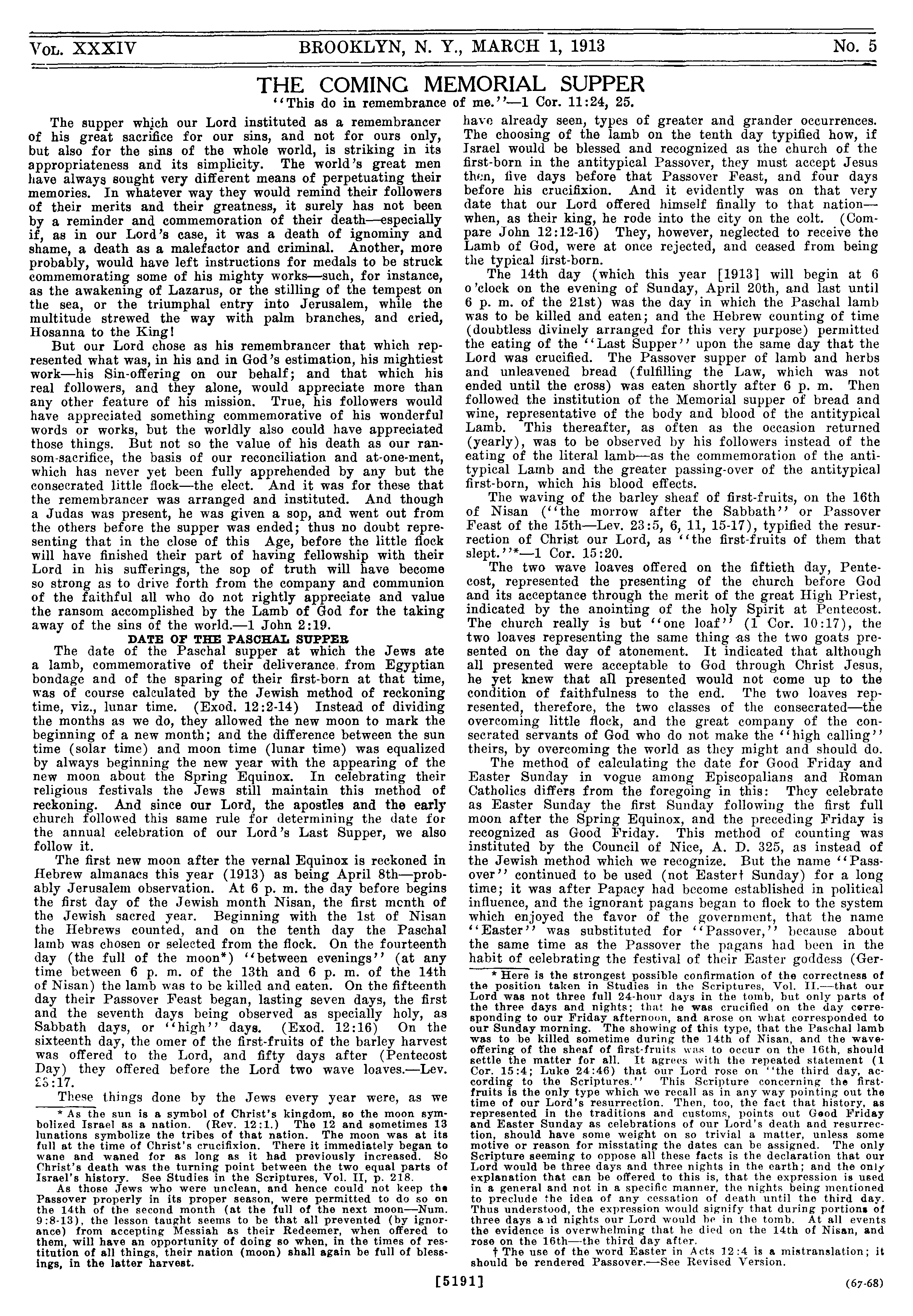
Vou. XXXIV BROOKLYN, N. Y., MARCH 1, 1918 No. 5 = THE COMING MEMORIAL SUPPER ‘¢This do in remembrance of me.’’—1 Cor. 11:24, 25. The supper which our Lord instituted as a remembrancer of his great sacrifice for our sins, and not for ours only, but also for the sins of the whole world, is striking in its appropriateness and its simplicity. The world’s great men have always sought very different means of perpetuating their memories. In whatever way they would remind their followers of their merits and their greatness, it surely has not been by a reminder and commemoration of their death—especially if, as in our Lord’s case, it was a death of ignominy and shame, a death as a malefactor and criminal. Another, more probably, would have left instructions for medals to be struck commemorating some of his mighty works—such, for instance, as the awakening of Lazarus, or the stilling of the tempest on the sea, or the triumphal entry into Jerusalem, while the multitude strewed the way with palm branches, and eried, Hosanna to the King! But our Lord chose as his remembrancer that which represented what was, in his and in God’s estimation, his mightiest work—his Sin-offering on our behalf; and that which his real followers, and they alone, would appreciate more than any other feature of his mission. True, his followers would have appreciated something commemorative of his wonderful words or works, but the worldly also could have appreciated those things. But not so the value of his death as our ransom-sacrifice, the basis of our reconciliation and at-one-ment, which has never yet been fully apprehended by any but the consecrated little flock—the elect. And it was for these that the remembrancer was arranged and instituted. And though a Judas was present, he was given a sop, and went out from the others before the supper was ended; thus no doubt representing that in the close of this Age, before the little flock will have finished their part of having fellowship with their Lord in his sufferings, the sop of truth will have become so strong as to drive forth from the company and communion of the faithful all who do not rightly appreciate and value the ransom accomplished by the Lamb of God for the taking away of the sins of the world.—1 John 2:19. DATE OF THE PASCHAL SUPPER The date of the Paschal supper at which the Jews ate a lamb, commemorative of their deliverance, from Egyptian bondage and of the sparing of their first-born at that time, was of course calculated by the Jewish method of reckoning time, viz., lunar time. (Exod. 12:2-14) Instead of dividing the months as we do, they allowed the new moon to mark the beginning of a new month; and the difference between the sun time (solar time) and moon time (lunar time) was equalized by always beginning the new year with the appearing of the new moon about the Spring Equinox. In celebrating their religious festivals the Jews still maintain this method of reckoning. And since our Lord, the apostles and the early ehurch followed this same rule for determining the date for the annual celebration of our Lord’s Last Supper, we also follow it. The first new moon after the vernal Equinox is reckoned in Hebrew almanacs this year (1913) as being April 8th—probably Jerusalem observation. At 6 p. m. the day before begins the first day of the Jewish month Nisan, the first mcnth of the Jewish sacred year. Beginning with the 1st of Nisan the Hebrews counted, and on the tenth day the Paschal lamb was chosen or selected from the flock. On the fourteenth day (the full of the moon*) ‘‘between evenings’’ (at any time between 6 p. m. of the 13th and 6 p. m. of the 14th of Nisan) the lamb was to be killed and eaten. On the fifteenth day their Passover Feast began, lasting seven days, the first and the seventh days being observed as specially holy, as Sabbath days, or ‘‘high’’ days. (Exod. 12:16) On the sixteenth day, the omer of the first-fruits of the barley harvest was offered to the Lord, and fifty days after (Pentecost Day) they offered before the Lord two wave loaves.—Lev. £5:17. These things done by the Jews every year were, as we * As the sun is a symbol of Christ’s kingdom, so the moon symbolized Israel as a nation. (Rev. 12:1.) The 12 and sometimes 13 lunations symbolize the tribes of that nation. The moon was at its full at the time of Christ’s crucifixion. There it immediately began to wane and waned for as long as it had previously increased. So Christ’s death was the turning point between the two equal parts of Israel's history. See Studies in the Scriptures, Vol. II, p. 218. As those Jews who were unclean, and hence could not keep the Passover properly in its proper season, were permitted to do so on the 14th of the second month (at the full of the next moon—Num. 9:8-13), the lesson taught seems to be that all prevented (by ignorance) from accepting Messiah as their Redeemer, when offered to them, will have an opportunity of doing so when, in the times of res titution of all things, their nation (moon) shall again be full of blessings, in the latter harvest. [5191] have already seen, types of greater and grander occurrences. The choosing of the lamb on the tenth day typified how, if Tsrael would be blessed and recognized as the church of the first-born in the antitypical Passover, they must accept Jesus then, five days before that Passover Feast, and four days before his crucifixion. And it evidently was on that very date that our Lord offered himself finally to that nation— when, as their king, he rode into the city on the colt. (Compare John 12:12-16) They, however, neglected to receive the Lamb of God, were at once rejected, and ceased from being the typical first-born. The 14th day (which this year [1913] will begin at 6 o’clock on the evening of Sunday, April 20th, and last until 6 p. m. of the 21st) was the day in which the Paschal lamb was to be killed and eaten; and the Hebrew counting of time (doubtless divinely arranged for this very purpose) permitted the eating of the ‘‘Last Supper’’ upon the same day that the Lord was crucified. The Passover supper of lamb and herbs and unleavened bread (fulfilling the Law, which was not ended until the cross) was eaten shortly after 6 p.m. Then followed the institution of the Memorial supper of bread and wine, representative of the body and blood of the antitypical Lamb. This thereafter, as often as the occasion returned (yearly), was to be observed by his followers instead of the eating of the literal lamb—as the commemoration of the antitypical Lamb and the greater passing-over of the antitypical first-born, which his blood effects. The waving of the barley sheaf of first-fruits, on the 16th of Nisan (‘‘the morrow after the Sabbath’’ or Passover Feast of the 15th—Lev. 23:5, 6, 11, 15-17), typified the resurrection of Christ our Lord, as ‘‘the first-fruits of them that slept.’’*—1 Cor, 15:20. The two wave loaves offered on the fiftieth day, Pentecost, represented the presenting of the church before God and its acceptance through the merit of the great High Priest, indicated by the anointing of the holy Spirit at Pentecost. The church really is but ‘‘one loaf’’ (1 Cor. 10:17), the two loaves representing the same thing as the two goats presented on the day of atonement. It indicated that although all presented were acceptable to God through Christ Jesus, he yet knew that all presented would not come up to the condition of faithfulness to the end. The two loaves represented, therefore, the two classes of the consecrated—the overcoming little flock, and the great company of the consecrated servants of God who do not make the ‘‘high calling’’ theirs, by overcoming the world as they might and should do. The method of calculating the date for Good Friday and Easter Sunday in vogue among Episcopalians and Roman Catholics differs from the foregoing in this: They celebrate as Easter Sunday the first Sunday following the first full moon after the Spring Equinox, and the preceding Friday is recognized as Good Friday. This method of counting was instituted by the Council of Nice, A. D. 325, as instead of the Jewish method which we recognize. But the name ‘‘Passover’’ continued to be used (not Hastert Sunday) for a long time; it was after Papacy had become established in political influence, and the ignorant pagans began to flock to the system which enjoyed the favor of the government, that the name ‘*Haster’’ was substituted for ‘‘Passover,’’ because about the same time as the Passover the pagans had been in the habit of celebrating the festival of their Easter goddess (Ger“~* Here is the strongest possible confirmation of the correctness of the position taken in Studies in the Scriptures, Vol. II.—-that our Lord was not three full 24-hour days in the tomb, but only parts of the three days and nights; that he was crucified on the day coerresponding to our Friday afternoon, and arose on what corresponded to our Sunday morning. The showing of this type, that the Paschal lamb was to be killed sometime during the 14th of Nisan, and the waveoffering of the sheaf of first-fruits was to occur on the 16th, should settle the matter for all. It agrees with the repeated statement (1 Cor. 15:4; Luke 24:46) that our Lord rose on ‘‘the third day, according to the Scriptures.’’ This Scripture concerning the firstfruits is the only type which we recall as in any way pointing out the time of our Lord’s resurrection. Then, too, the fact that history, as represented in the traditions and customs, points out Geod Friday and Easter Sunday as celebrations of our Lord’s death and resurrection, should have some weight on so trivial a matter, unless some motive or reason for misstating the dates can be assigned. The only Scripture seeming to oppose all these facts is the declaration that our Lord would be three days and three nights in the earth; and the only explanation that can be offered to this is, that the expression is used in @ general and not in a specific manner, the nights being mentioned to preclude the idea of any cessation of death until the third day. Thus understood, the expression would signify that during portions of three days aid nights our Lord would be in the tomb. At all events the evidence is overwhelming that he died on the 14th of Nisan, and rose on the 16th—the third day after. + The use of the word Easter in Acts 12:4 is a mistranslation; it should be rendered Passover.—See Revised Version. (67-68)
Pentru a vă îmbunătăți experiența pe site-ul nostru, folosim cookies și tehnologii similare. Unele cookies sunt esențiale pentru funcționalitatea de bază a site-ului nostru și nu pot fi refuzate. Puteți alege să acceptați sau să refuzați cookies suplimentare. Vrem să vă asigurăm că aceste date nu vor fi vândute sau utilizate în scopuri de marketing. Puteți ajusta preferințele dvs. în orice moment accesând Setările de Confidențialitate din subsolul paginii. Pentru mai multe informații, vă rugăm să consultați
Politica de Confidențialitate
Condiții de utilizare
.


