10
1
10
download/literature/watchtower/1914-21.pdf
watchtower/1914/21/1914-21-1
ST.
PETER
SIFTED
LIKE
WHEAT
NOVEMBER
15.-Mark
14:27·31,53,
54,
66-72.
"Let
him
that
thinketh
he
standeth,
take
St.
Peter
was
admittedly
a
man
of
strong
character,
very
courageous,
but
rather
too
impetuous.
He
is
one
of
the
two
diseipks
of
whom
it
is
\Hitten
that
I'
The
people
perceived
that
they
werc
ignorant
and
unlearned
men."
(Acts
4:
13)
In
some
respects,
therefore,
St.
Peter
may
be
said
to
have
had
less
advantage
than
Jndas.
Both
had
equal
opportunities
in
the
sehool
01
Christ:
yet
how
different
the
results
with
the
two
men!
The
one
went
down
into
the
second
death
despised;
the
other,
after
ups
and
downs
of
trial
and
discipline,
passed
to
a
reward
of
glory,
honor
and
immortality
"\'lith
his
Master,
rank
ing
amongst
the
highest
of
the
apostles.
Our
lesson
for
today
deals
with
the
special
II
sifting'
,
which
came
to
St.
Peter
at
the
time
of
our
Lord's
death,
and
of
which
he
was
forewarned
by
.J
esus,
saying,
"
Simon,
Simon,
behold
Satan
hath
desired
to
have
you,
that
he
may
sift
you
as
wheat;
but
I
have
prayed
for
thee,
that
thy
faith
fail
not."
St.
Peter's
courage,
manifested
on
so
many
occasions,
was
really
his
wcak
point.
Notwithstanding
all
that
Jesus
had
said
to
forewarn
him
of
the
sifting
experien(~es
that
were
just
before
him,
St.
Peter
realized
no
dread,
no
fear.
Henee
he
did
little
watehing
ana
praying
in
comparison
with
what
he
should
have
,lolle,
and
self-collfidence
lea
to
his
unaoing
for
a
time.
It
was
the
same
St.
Peter
who,
when
told
that
he
would
drny
our
Lord
before
the
time
for'the
cock
to
crow
the
next
III
ol'lling,
,1l'c1are<l
that
it
surely
was
a
mistake,
for
he
was
l'e,lllv
to
die
\,-ith
his
Master.
It
was
the
same
St.
Peter
who
dre,,:
his
sword
and
cut
off
the
ear
of
the
high
priest's
servant,
nfknv:lnl
hpalpa
by
Jesus.
It
was
the
same
impulsive
St.
T','trr
who
was
the
first
to
acknowleage
the
Messiahship
of
.Tesus
.
.Je~lls
hall
inquired
what
people
were
saying
about
him
\\'ho
tllPY
said
he
was-and
had
finally
asked,
"Whom
say
ye
that
r
:WI?"
Tlwn
St.
Peter
answrred,
"Thou
art
the
Mes
siah,
the
Son
of
the
Living
God."
JpSI1S
replird
that
this
alls\wr
inllicatell
that
St.
Peter
was
in
a
hlessed
condition
of
relationship
with
Goa,
or
otherwise
he
would
not
have
had
the
knowledge
to
make
this
statement.
He
saill,
"
Flesh
and
blood
hath
not
rpvralccl
this
unto
thep,
but
my
Father
which
is
in
heavl'll.
"
Who
coul,l
think
that
this
same
nohle
character
woul,l
!>p
so
ovprwhdmc,l
with
fpar
that
he
would
deny
his
Mastpr,
evpll
with
curses!
One
thing'
whieh
impresses
itsplf
quickly
and
foreihly
upon
our
minds
is
the
thought
that
the
writers
of
the
New
Testament
,,'pre
eertainly
vpry
Ilifferent
from
the
majority
of
writers
in
that
they
tol,l
the
ahsolute
truth
without
ll1oaitieation
or
var
u'sh.
Rurdy
no
othpr
book
is
like
the
Bible
in
this
respect.
The
fonndprs
of
great
religions
world-systems
ana
of
various
spetarian
systpms
have
manifested
a
vf'ry
ilifferent
spirit.
Their
hprops
are
all
grpat,
noblp,
educatpd,
heroic.
Nf'ver
woulrl
they
think
of
pointing
out
sueh
weaknesses
as
thosp
manifested
by
Rt.
Pd('l'
on
thp
night
in
whieh
our
Lord
was
hetrayed,
whpn
hp
denied
his
Mast,,!,.
Surdy
this
gives
us
greater
confidence
in
the
Bihle--in
its
honesty,
in
its
truthfulness.
'Ve
ean
rely
upon
the
fact
that
the
men
who
thus
frpply
tpll
of
thpir
failings,
and
\vho
speak
of
thpir
lack
of
learning,
mnst
have
been
men
of
great
courage,
01'pat
sineerity.
grept
lovp
for
the
truth.
Surely
their
testimony
is
worthy
of
all
acceptation.
ST.
PETER'S
TRIAL
UNEXPECTED
Tpmptatiolls
will
r'ol11e
in
an
insidious
form.
We
cannot
inl<lgine
that
at
the
time
when
he
cut
off
the
ear
of
the
high
priest's
servant
St.
Pder
hall
any
sympathy
'with
the
thought
of
denying
our
Lonl.
But
circumstances
and
conditions
heed
lest
he
fall.
"-1
Corinthians
10:
12.
changed.
The
::\laster
was
taken
a
prisoner.
\Vhatever
l}()wpr
he
had
previously
exercised
whereby
he
walked
away
from
his
enemies,
and
they
could
not
take
him
because
his
II
hour
had
not
yet
come,"
that
power
he
evidently
was
not
exercising
now
-his
hour
had
come.
To
see
his
Master
apparently
without
friends
in
heaven,
delivered
over
to
his
enemies
and
led
from
one
tribunal
to
the
other,
had
a
paralyzing
effect
upon
St.
Peter.
St.
John
had
such
an
acquaintance
with
some
one
con
nected
with
the
palace
that
he
was
permitted
to
enter
the
court
and
bring
St.
Peter
with
him;
but
they
had
separated.
St.
Pder
was
in
the
courtyard.
It
was
cold,
and
he
approached
an
open
brazier
to
warm
himself.
In
the
light
of
the
court,
sur
rounded
by
the
gossiping
servants
of
the
palace,
he
was
keenly
serutinized
by
one
of
the
maids,
who
said,
"Thou
art
also
a
d:sciple
of
the
Nazarene."
Stunned
by
the
identification
and.
wondering
to
what
it
might
lead,
St.
Ppter
promptly
denied
that
he
had
any
knowl
ellge
of
Jesus.
Then
he
moved
a
way
to
another
part
of
thp
court,
where
the
shadows
were
deeper
anll
the
people
fewer.
But
again
he
was
recognized
as
a
Galilean
and
accusell
of
be
ing
one
of
.Tesus'
disciples.
Again
he
d.enied
the
charge.
The
third
timp
he
was
approached
with
the
same
charge
that
he
was
one
of
.Tesus'
disciples
and
a
Galilean,
and
that
his
speech
betrayed
him.
Again,
with
eursing,
he
denied
that
he
knew
his
Master.
Terrible!
we
say.
And
smely
St.
Peter
felt
afterward
that
it
was
terrible;
for
just
at
that
time,
the
early
morning,
came
the
heginning
of
eock-crowing,
and
he
rememberpd
the
Master's
worlls
that
Satan
had
df'sirerl
to
sift
him
as
wheat,
and
that
]'efore
the
eoek
erew
he
would
have
denied
his
Master
three
tinH'~.
The
wholp
matter
e>llll!'
upon
him
witll
"1'I1slling
forep:
and.
wrapping
his
(·loak
about
his
lH'a'!,
he
hastelle,1
a,yay
into
the
darkness,
",epping
bitterly:
for
just
about
the
time
that
th!'
coek
crl'\\-
..
Tesus
"'as
11'11
furtli
1I0t
far
from
him.
allll
as
11('
looked
at
.Jesus,
the
::\faster
lift(·,!
up
hi~
P\'1'5
allll
looked
at
Rt.
Peter.
It
was
a
s~'mpathetic
glanpe.
not
an
llllgel"l'r!
mil';
but
it
",ellt
straig'ht
to
the
heart.
Rt..
Peter's
crime
was
nothing
like
that
of
.Tnrlas:
lie
lia,l
merely
sought.
to
]lro\,,(·t
liimsplf.
He
liad
not
songht
to
injll1'e
()].
e\'('n
to
risk
the
in
iun'
of
his
:Mast
..
]',
The
thorou!.dllless
of
Rt.
Peter's
repentane~
is
ahulll!antl,v
testifiell
by
lli~
snh:;<"
,[uent
loyalty
evpn
unto
,lr>ath.
Tradition
has
it
that
hI'
W;,h
"0!1l1emned
to
be
crucilh'd:
Iln(!
that,
J'I~m",mb
..
rin~'
how
on,·('
h"
lia,!
rlpnier!
his
Maskr.
li
..
fplt
Unt!
it
would
1)('
too
g1'l'at
an
honor
for
him
to
sharp
I'xad,ly
tIl<'
same
df'ath
as
his
Lord:
lllll!
that,
at
his
own
rpquest.
Ill'
was
el'lH'itipu
hp"d
uownwilrd,
THE
LESSON
TO
ALL
CHRISTIANS
Our
(~old
..
n
Tpxt
yoiees
to
all
Christians
tlil'
lp'sson
of
:-;t.
1'eter's
explc'rienees-"Let
him
that
thinketh
hI'
staulleth.
tal'd'
heed
le~t
lIP
fall."
Wlwn
"'e
are
wf'ilk
in
our
OWII
pstimation
and.
full
of
faitli.
din!!'
t"IJaeiously
to
the
.\1'111
of
thl'
lAm!,
then
we
are
really
~trong'
ill
the
might.
whieh
Cod
supplips
throu!dl
his
ptprnal
:-;011
•
.-\nothcr
ll'sson
is
that
hom'ver
di/Ter
I'llt
the
Cx!)(,,'ielH'PS
of
(~od's
pl'oph',
all
",ho
fall
into
line
for
t
he
great
prollJotiou
to
the
first.
resuITPction
must
I'xpeet
to
en
dnre
sevcre
siftings,
p!'oyillgs~of
their
lov(~
for
th
..
Lord.
t.hl'
trnth.
the
brl'thrl'n.
and
tllPir
lovaltv
to
all
thes('.
"et
us
neY",!'
forget
that
siftiug~
'are
ppl'llIitted,
1I0t
b('eausl'
the
Lord
has
no
interest.
iu
ns,
but
heeans('
only
those'
,,110
cau
stand
siftings,
trials
and
tests,
are
fit
for
places
in
the
kingdom.
VOL.
XXXV
BROOKINN,
N.
Y..
NOVEMBER
1,
1914
No.
21
---_._-----~_
..•
_-----
---_._------------------
MAKING
READY
FOR
THE
REIGN
OF
RIGHTEOUSNESS
"The
nations
'l\pre
angry,
and
thy
wrath
is
come,
ana
the
time
of
the
dead.
that
they
should
be
judged,
ana
that
thou
shouldest
give
rpwarcl
unt.o
thy
servantR
the
prophet.R,
and
to
the
s:lints,
and
them
that
fear
thy
name,
small
and
great;
ana
shouldest
aestl'OY
thrm
that
destroy
the
earth.'
'-Revelation
11:
18.
H
may
he
that
many
of
the
Lora's
people
were
exprrting
or
at
mrst
a
few
werks.
But
as
w,'
eOllle
to
unrlrrstand
thp
more
than
they
should
haw
lookea
for
to
occur
with
the
open-
Rniptlll'es.
we
Ill'rceive
that
it
covers
the
thousand
years
of
ing-
of
the
.I
ewish
ypar
1915,
which
hegan
with
Septem
her
21.
Ch
ri:<t
's
rrign.
The
hnman
mind
seems
to
have
a
natural
tenrlency,
and
one
"Thp
nations
\"ere
angry,
thy
wrath
is
come,
and
the
time
with
whieh
we
shoulll
have
sympathy,
to
expect
matters
to
of
tllP
,lead
that
thl'y
should
he
;iudgea."
The
chmch
are
the
eulminate
more
rapi,lly,
fultilments
to
come
more
su<1aenly,
first
to
rpceive
their
jll,lgment,
the
deeision
in
thl'ir
ease;
for
than
they
ever
rIo
come.
For
instancp.
the
Seriptmes
tell
liS
thp
,,"01'1,1
(iorl
has
appointerl
a
thousand-year
aay.
(Acts
17
:31
;
that
ahout
th,'
time
of
the
sounding
of
the
Sevpnth
Trumpet,
2
Pdn
:1:R)
"'\n,l
that
tholl
sholllrlest
give
rewara
unto
thy
certain
great
events.
rnumerate,l
in
Ollr
text,
will
hegin
to
sel"\":Jnts
the
propllets
fthp
aneient
worthiesl
and
to
the
saints
take
plaee.
Many
Christian
ppople,
looking
at
the
statement,
fa]]
thr
holy
on(>s
I,
anrl
them
that
fpar
thy
name,
small
and
expeet
all
this
to
he
fulfillea
in
a
fpw
minutes,
or
a
few
hams,
great."
All
this
latter
elass-the
world
of
mankina-will
[5563]
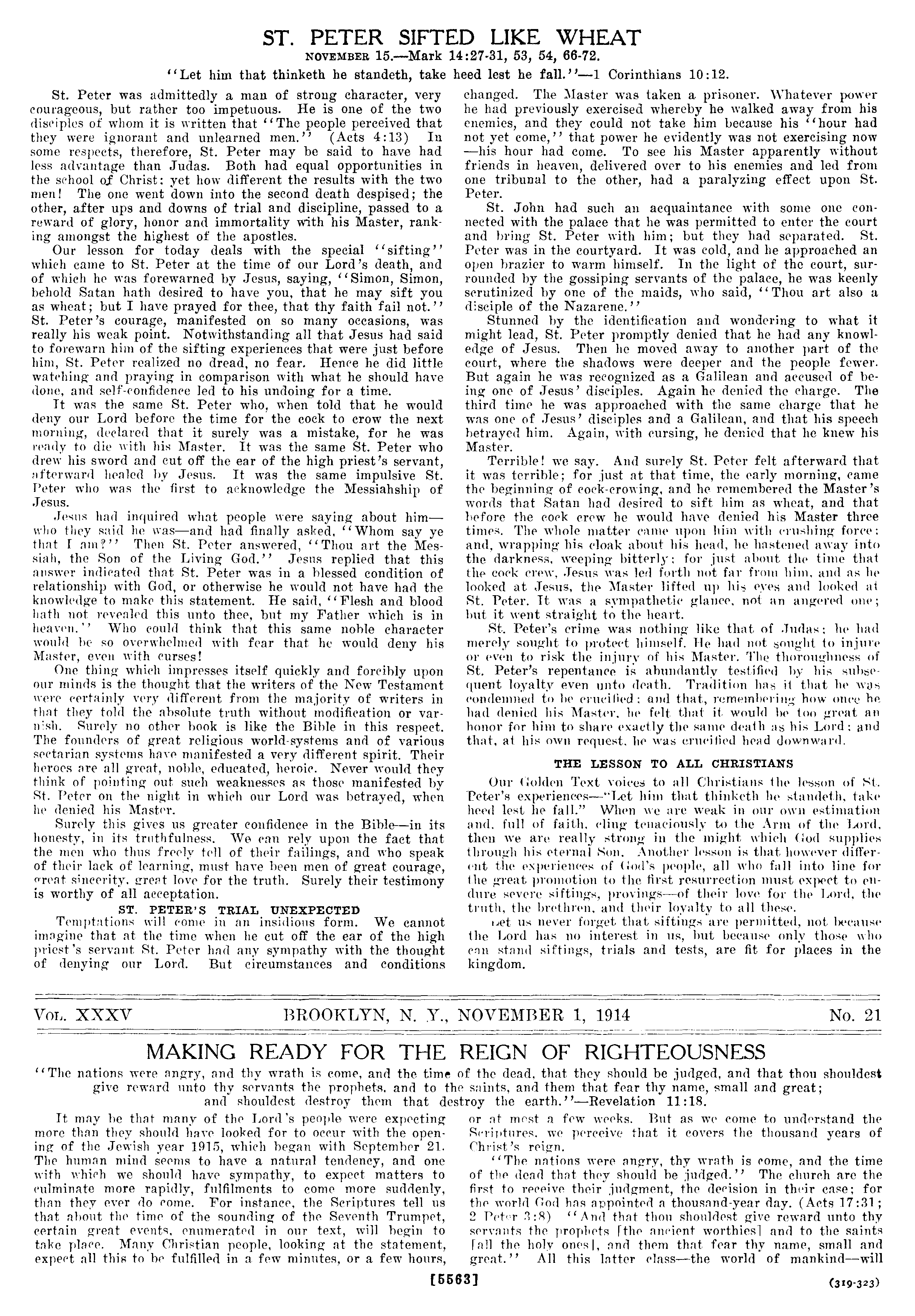
ST. PETER SIFTED LIKE WHEAT NOVEMBER 15.—Mark 14:27-31, 53, 54, 66-72. ‘‘Let him that thinketh he standeth, take heed lest he fall.’’—1 Corinthians 10:12. St. Peter was admittedly a man of strong character, very courageous, but rather too impetuous. He is one of the two disciples of whom it is written that ‘‘The people perceived that they were ignorant and unlearned men.’’ (Aets 4:13) In some respects, therefore, St. Peter may be said to have had less advantage than Judas. Both had equal opportunities in the school of Christ: yet how different the results with the two men! The one went down into the second death despised; the other, after ups and downs of trial and discipline, passed to a reward of glory, honor and immortality with his Master, ranking amongst the highest of the apostles. Our lesson for today deals with the special ‘‘sifting’’ which came to St. Peter at the time of our Lord’s death, and of which he was forewarned by Jesus, saying, ‘‘Simon, Simon, behold Satan hath desired to have you, that he may sift you as wheat; but I have prayed for thee, that thy faith fail not.’’ St. Peter’s courage, manifested on so many occasions, was really his weak point. Notwithstanding all that Jesus had said to forewarn him of the sifting experiences that were just before him, St. Peter realized no dread, no fear. Hence he did little watehing and praying in comparison with what he should have done, and self-confidence Jed to his undoing for a time. Tt was the same St. Peter who, when told that he would deny our Lord before the time for the cock to crow the next morning, declared that it surely was a mistake, for he was ready to die with his Master. It was the same St. Peter who drew his sword and cut off the ear of the high priest’s servant, afterward healed by Jesus. It was the same impulsive St. Peter who was the first to acknowledge the Messiahship of Jesus, Jesus had inquired what people were saying about him— who they said he was—and had finally asked, ‘‘Whom say ye that Tam???’ Then St. Peter answered, ‘‘Thou art the Messiah, the Son of the Living God.’’ Jesus replied that this answer indicated that St. Peter was in a blessed condition of relationship with God, or otherwise he would not have had the knowledge to make this statement. He said, ‘‘Flesh and blood hath not revealed this unto thee, but my Father which is in heaven.’’? Who could think that this same noble character would be so overwhelmed with fear that he would deny his Master, even with curses! One thing which impresses itself quickly and forcibly upon our minds is the thought that the writers of the New Testament were certainly very different from the majority of writers in that they told the absolute truth without modification or varnish. Surely no other book is like the Bible in this respect. The founders of great religious world-systems and of various sectarian systems have manifested a very different spirit. Their heroes are all great, noble, edueated, heroic. Never would they think of pointing out such weaknesses as those manifested by St. Peter on the night in whieh our Lord was betrayed, when he denied his Master. Surely this gives us greater confidence in the Bible—in its honesty, in its truthfulness. We ean rely upon the fact that the men who thus freely tell of their failings, and who speak of their lack of learning, must have been men of great courage, ereat sinecrity. great love for the truth. Surely their testimony is worthy of all aecceptation. ST. PETER’S TRIAL UNEXPECTED Temptations will come in an insidious form. We eannot imagine that at the time when he cut off the ear of the high priest ’s servant St. Peter had any sympathy with the thought of denying our Lord. But cireumstances and conditions Von. XXXV ; BROOKLYN, N. Y., NOVEMBER 1, 1914 : MAKING READY FOR THE REIGN OF RIGHTEOUSNESS changed. The Master was taken a prisoner. Whatever power he had previously exercised whereby he walked away from his enemies, and they could not take him because his ‘‘hour had not yet come,’’ that power he evidently was not exercising now —his hour had come. To see his Master apparently without friends in heaven, delivered over to his enemies and led from one tribunal to the other, had a paralyzing effect upon St. Peter. St. John had such an acquaintance with some one connected with the palace that he was permitted to enter the court and bring St. Peter with him; but they had separated. St. Peter was in the courtyard. It was cold, and he approached an open brazier to warm himself. In the light of the court, surrounded by the gossiping servants of the palace, he was keenly serutinized by one of the maids, who said, ‘‘Thou art also a disciple of the Nazarene.’’ Stunned by the identification and wondering to what it might lead, St. Peter promptly denied that he had any knowledge of Jesus. Then he moved away to another part of the court, where the shadows were deeper and the people fewer. But again he was recognized as a Galilean and aecused of being one of Jesus’ disciples. Again he denied the charge. The third time he was approached with the same charge that he was one of Jesus’ disciples and a Galilean, and that his speech hetrayed him. Again, with cursing, he denicd that he knew his Master. Terrible! we say. And surely St. Peter felt afterward that it was terrible; for just at that time, the carly morning, came the beginning of cock-crowing, and he remembered the Master ’s words that Satan had desired to sift him as wheat, and that hefore the cock crew he would have denied his Master three times. The whole matter came upon him with crushing force: and, wrapping his cloak about his head, he hastened away into the darkness, weeping bitterly: for just about the time that the eock crew, Jesus was Jed forth not far from him, and as he looked at Jesus, the Master Jifted up his eves and looked at St. Peter. It was a sympathetic glance, not an angered one; but it went straight to the heart. St. Peter’s crime was nothing like that of Judas: he had merely sought to protect himself. He had not sought to injure or even to risk the injury of his Master, The thoroughness of St. Peter’s repentance is abundantly testified by his subsequent loyalty even unto death. Tradition has it that he was condemned to be crucified: and that, remembering how once he had denied his Master, he felt that it} would be too great an honor for him to share exactly the same death ag his Lord: and that, at his own request, he was erucified head downward. THE LESSON TO ALL CHRISTIANS Our Golden Text voices to all Christians the lesson of St. Peter’s experiences—"Let him that thinketh he standeth, take heed lest he fall.” When we are weak in our own estimation and, full of faith, cling tenaciously to the Arm of the Lord, then we are really strong in the might which God supplies through his eternal Son, Another lesson is that however different the experiences of God’s people, all who fall into line for the great promotion to the first resurreetion must expect to endure severe siftings, provings—of their love for the Lord, the truth, the brethren, and their loyalty to all these. wet us never forget that siftings are permitted, not because the Lord has no interest in us, but because only those who ean stand siftings, trials and tests, are fit for places in the kingdom. ‘*The nations were angry, and thy wrath is come, and the time of the dead, that they should be judged, and that thou shouldest give reward unto thy servants the prophets, and to the saints, and them that fear thy name, small and great; and shouldest destroy them that destroy the earth.’’—Revelation 11:18. It may be that many of the Lord’s people were expecting more than they should have looked for to oceur with the opening of the Jewish year 1915, which began with Septemher 21. The human mind seems to have a natural tendeney, and one with which we should have sympathy, to expect matters to culminate more rapidly, fulfilments to come more suddenly, than they ever do come. For instance, the Scriptures tell us that about the time of the sounding of the Seventh Trumpet, certain great events, enumerated in our text, will hegin to take place. Many Christian people, looking at the statement, expect all this to be fulfilled in a few minutes, or a few hours, [6563] or at mest a few wecks. But as we come to understand the Scriptures. we perceive that it covers the thousand years of Christ’s reign, “The nations were angry, thy wrath is come, and the time of the dead that they should be judged.’’ The church are the first to receive their judgment, the decision in their ease; for the world God has appointed a thousand-year day. (Acts 17:31; 2 Peter 2:8) ‘And that thou shouldest give reward unto thy servants the prophets [the ancient worthies] and to the saints fall the holy ones|, and them that fear thy name, small and great.’’ All this latter class—the world of mankind—will (319-323)
Pentru a vă îmbunătăți experiența pe site-ul nostru, folosim cookies și tehnologii similare. Unele cookies sunt esențiale pentru funcționalitatea de bază a site-ului nostru și nu pot fi refuzate. Puteți alege să acceptați sau să refuzați cookies suplimentare. Vrem să vă asigurăm că aceste date nu vor fi vândute sau utilizate în scopuri de marketing. Puteți ajusta preferințele dvs. în orice moment accesând Setările de Confidențialitate din subsolul paginii. Pentru mai multe informații, vă rugăm să consultați
Politica de Confidențialitate
Condiții de utilizare
.


