10
1
10
download/literature/watchtower/1914-3.pdf
watchtower/1914/3/1914-3-1
JANUARY
IS.
1914
THE
WATCH
TOWER
of
truth
and
the
spirit
of
error,
the
spirit
of
God
and
the
spirit
have
received
a
knowledge
of
the
truth,
there
remaineth
JlO
of
Satan.
more
a
sacrifice
for
our
sins,
but
a
certain
fearful
looking
for
a
Man
was
not
created
in
this
condition
of
inability
to
discern
decision
and
a
fiery
indignation
which
shall
devour
the
adver·
right
and
wrong,
good
and
evil.
He
was
created
perfect,
in
the
saries
"-of
God.
The
Apostle
mentions
especially
the
rejec-
image
and
likeness
of
God.
Sin
has
wrought
death,
not
merely
tion
of
the
atoning
work
of
Christ,
saying
that
such
count
the
to
man's
body,
but
also
to
his
mind,
his
conscience.
The
ability
blood
of
the
covenant
wherewith
they
were
sanctified
a
com·
to
discern
between
right
and
wrong
varies,
therefore.
Addi-
mon
thing,
and
do
despite
to
the
spirit
of
favor
which
has
tionally,
some
have
opportunities
for
instruction
more
than
brought
them
thns
far.
others,
and
-thus
their
responsibility
is
increased.
The
world
in
'rhose
who
quench
the
spirit
of
holiness,
or
"grieve
the
general
knows
not
God,
and
hence
could
not
sin
against
the
spirit,"
are
described
by
St.
James
(5:
14)
as
spiritually
sick.
holy
Spirit
in
that
full
sense
or
degree
which
would
be
pun·
Cut
off
from
fellowship
with
God,
they
have
one
last
resort;
ished
with
the
second
death.
"The
god
of
this
world
hath
viz.,
to
request
the
assistance
of
sanctified
elders
of
the
church
blinded
the
minds
of
them
that
believe
not.'
'-2
Corinthians
to
pray
for
them
and
to
anoint
them
with
oil,
symbolic
of
the
4
:4.
holy
Spirit.
The
prayer
of
faith
shall
save
these
spiritually
Some
knowledge
is
necessary
to
bring
us
to
an
appreciation
sick;
and
the
Lord
will
raise
them
up;
and
though
they
ha
va
of
Christ
as
the
Sent
of
God.
'rhen
if
we
accept
him
and
be·
committed
sins,
these
shall
be
forgiven
them.
come
his
consecrated
disciples,
or
followers,
we
receive
the
"THE
HOLY
SPIRIT
SHALL
TEACH"
~~~~~ti~~r
o~y~:e
o~o~n~~:::~~d~~s
o~~i:g~~rSe
t~n~l
V~l~~~g~rdo;l;~
The
Lord's
faithful
followers
were
to
expect
that
amongst
in
proportion
as
we
are
filled
with
the
holy
Spirit.
Our
reo
their
tribulations
would
be
false
accusations
which
would
bring
sponsibility
increases
with
our
joy
in
the
Lord
and
our
prepara.
them
before
magistrates.
For
the
most
part
the
disciples
were
tion
for
the
heavenly
glories
to
which
we
have
been
called.
It
unlearned,
and
would
feel
great
trepidation
in
the
presence
is
these
advanced
disciples
of
Jesus
that
are
in
danger
of
of
educated
officials.
They
wpre
to
know,
howeVl'r,
that
the
grieving
the
holy
Spirit
whereby
they
were
sealed-of
quench.
Lord's
blessing
would
be
upon
them;
and
that
they
would
have
ing
the
spirit
of
holiness
in
their
hearts.
(Ephesians
4:
:30;
\\isdom
superior
to
that
whieh
was
naturally
theirs.
They
need
1
Thessalonians
5
:]9)
While
the
quenching
and
the
grieving
not
anxiously
premeditate
what
their
ans,rers
would
be,
but
commit
all
to
the
Lord,
expecting
divine
assistance.
are
not
instantaneous
works,
they
are
the
paths
which
lead
to
the
second
death.
Ii;very
Christian,
therefore,
should
press
on
Nothing
in
this
implies
that
the
ministers
of
Christ
either
toward
perfection
of
holiness-the
filling
with
the
spirit.
in
the
pulpit
or
in
the
class
meeting
should
attempt
to
repre·
The
Apostle
presents
this
thought
in
Hebrews
6
:4-6,
de.
sent
the
Lord
without
studying
their
subjeet.
On
the
con-
eluring
that
those
who
have
tasted
of
the
good
"Word
of
God
trary,
eaeh
should
aceept
to
himself
St.
Paul's
words
to
Tim-
and
the
powers
of
the
age
to
come,
and
who
have
been
made
othy:"
Study
to
show
thyself
approved
unto
God,
a
workman
partakers
of
the
holy
Spirit,
cannot
be
renewed
unto
repent.
that
needeth
not
to
be
ashamed,
rightly
dividing
the
Word
of
ance,
if
they
with
full
wilfulness
and
deliberation
reject
Christ
truth."
(2
Timothy
2:
15)
There
is
a
difference
between
and
righteousness,
and
turn
to
sin.
Again,
later
on,
he
says
standing
before
a
congregation
of
God's
people
as
a
mouth·
(Hebrewi
10:
26,
27),
"For
if
we
sin
wilfully
after
that
we
pieee
of
his
Word
and
being
called
before
magistrates.
-
-
-
-
-
-
-
-
LEVITICUS
NINE
AND
SIXTEEN
Apparently
we
have
failed
to
make
clear
our
thought
reo
sJleeting
the
teachings
of
these
two
chapters.
Our
statement
in
TABERNACLE
SHADOWS
that
they
both
picture
the
Day
of
Atonement
saerifices
has
been
misunderstood.
We
do
not
mean
to
say
that
the
two
ceremonies
took
place
on
the
same
par
ticular
Day
of
Atonement.
Our
thought
is
that
the
anti
type
of
the
two
took
place
at
the
same
time
in
the
antitypical
atone
ment
day-the
Gospel
age.
The
record
of
the
Ninth
Chapter
relates
to
the
consecration
of
the
priests.
The
serviee
there
pictured
represents
the
con
secration
of
Aaron,
and
was
to
be
repeated
in
the
case
of
every
priest
who
attained
the
office
of
high
priest.
That
is
to
say,
this
service
\\"as
to
be
repeated
only
when
a
high
priest
should
die
awl
his
successor
in
the
office
should
be
inaugurated.
Thus
the
eerpmony
might
be
performed
several
times
in
one
year,
if
several
high
priests,
one
after
another,
died
in
one
year
and
successors
took
their
places.
Or
this
ceremony
of
Leviticus
9
might
not
be
repeated
for
many
years;
as,
for
example,
Aaron
!i'"ed
nearly
forty
years
after
his
appointment
to
the
office,
and
llE'nee
not
until
his
son
Eleazar
became
high
priest
would
this
conspcration
service
be
repeated.
On
the
contrary,
the
Day
of
Atonement
descrilled
in
the
16th
chapter
recurred
every
year.
The
lines
of
harmony
between
the
two
ceremonies
are
indio
eated
by
the
saerifices,
which
in
both
cases
were
a
bullock
and
a
goat.
These
represented
the
same
sacrifices
in
antitype
the
hullock
representing
the
high
priest
and
the
goat
represent·
ing
the
Ululer
pripsts;
for
J
csus
died
only
once--not
twiee.
Therdore
the
death
of
the
bullock
in
both
instances
repre·
sented
the
one
saerifice
of
Jesus.
And
beeause
the
church
dies
only
once,
therefore
the
sacrifice
of
the
goat
in
both
instances
represents
the
death
of
the
church
as
members
of
the
antitypical
priesthood
under
the
headship
of
their
great
High
Priest.
Why,
then,
the
two
pietures1
may
be
asked.
We
reply,
Be·
eause
the
death
of
Jesus
had
two
distinct
aspects,
and
similarly
the
death
of
the
church
has
two
aspects.
Only
by
dying
to
the
earthly
nature
was
it
possible
for
Jesus
and
the
church
to
at·
tain
the
heavenly
nature
and
the
offiee
of
the
royal
priesthood
-to
qualify
for
the
work
of
Messiah.
Even,
therefore,
if
the
world
had
not
needed
to
be
redeemed
from
sin,
the
Priest
must
have
given
the
same
sacrifice
exactly,
in
order
to
attain
his
high
position.
And
so
would
the
undn-priests.
On
the
other
hand,
as
mankind
are
sinners,
needing
to
be
redeemed,
atonement
for
sin
would
have
been
necessary
before
the
work
of
restitution
eould
go
on,
entirely
regardless
of
the
exaltation
of
Christ
and
the
ehurch
to
the
heavenly
plane.
Thus
the"
better
saerifiees"
of
Messiah
eover
two
distinct·
Iy
separate,
yet
both
important,
works.
It
was
necessary
that
.Tesus
and
his
followers
should
suffer
and
enter
into
their
glory.
Anll
this
is
emphasized
by
Levitieus
9.
It
was
also
necessary
that
a
sacrifice
for
sins
should
be
offcrpd
on
behalf
of
man·
kind,
in
order
to
permit
them
to
come
to
restitution
blessing;
and
this
is
typified
in
Leviticus
16.
So
we
repeat
that
the
sacriiiccs
of
Levitieus
9
and
those
of
the
16th
ehaptn
are
identical
sacrifices,
accomplished
in
this
same
antitypical
atone
ment
day-the
Gospel
age.
VOL.
XXXV
----------------
----._------------
BROOKLYN,
N.
Y.,
FEBRUARY
1,
1914
_____
-_--_--:--_-_--:c..-_-_-=:-=====--:-=-=-
=-=-
_---'------'-
No.3
THE
ANOINTED-THE
MESSIAH-THE
CHRIST
The
teaching
of
the
Law,
in
type
and
testimony,
is
to
the
come.
The
secret
was-Ii
Ghrist
in
you,
the
hope
of
glory."-
effect
that
God
purposed
to
raise
up
11
great
Priest,
who
would
Colossians
1
:26,
27.
also
be
a
King;
and
that
this
priestly
King
and
kingly
Priest
In
other
words,
our
Lorcl
.Tesus
is,
primarily,
the
Anointell
should
cancel
the
sins
of
the
people,
and
be
investpd
with
power
One
and,
according
to
the
Scripture
tei'timony,
is
very
high·
to
rule,
and
with
authority
as
a
Mediator
to
help
them
back
ly
exalted.
But
he
was
not
the
completion
of
the
divine
ar·
to
God.
To
the
surprise
of
the
typical
people,
Israel,
instead
rangement
regarding
the
anointecl.
The
heavenly
Father
pur-
of
assuming
the
office
of
Priest
and
King
in
conjunction,
he
posed
not
to
have
Jesus
alone,
but
that
he
should
be
the
Head
merely
died!-Luke
24:20,21.
of
the
anointed,
and
the
church
the
body.
(Eph.
1:22,
23;
Thpn
came
the
time
for
the
holy
Spirit
to
reveal
to
the
5:
29-~2;
Col.
1:
24)
This
was
the
mystery.
The
great
Messiah
church
what
had
previously
been
a
mystery;
for
when
God
was
to
bless
the
world
as
the
antitypical
Prophet,
Priest,
and
had
through
the
propllets
spoken
of
Messiah
as
a
King
upon
King.
God
appointed
Jesus
as
the
Head,
awl
elected
certain
his
throne,
he
hall
declared
that
whieh
would
l,e
mysterious
to
saintly
ones
to
he
the
members
of
his
body.
Until
this
body
the
people-wonlcl
not
he
ensily
understood.
God
hnd
pllrposely
of
Christ
was
complete,
the
hlpssing
promised
to
Abraham
could
kept
his
plan
a
secret
until
the
due
time
for
revealing
it
s:hould
not
come
upon
the
wOl'ld.-Gal.
:1:
Hi,
29.
[5391]
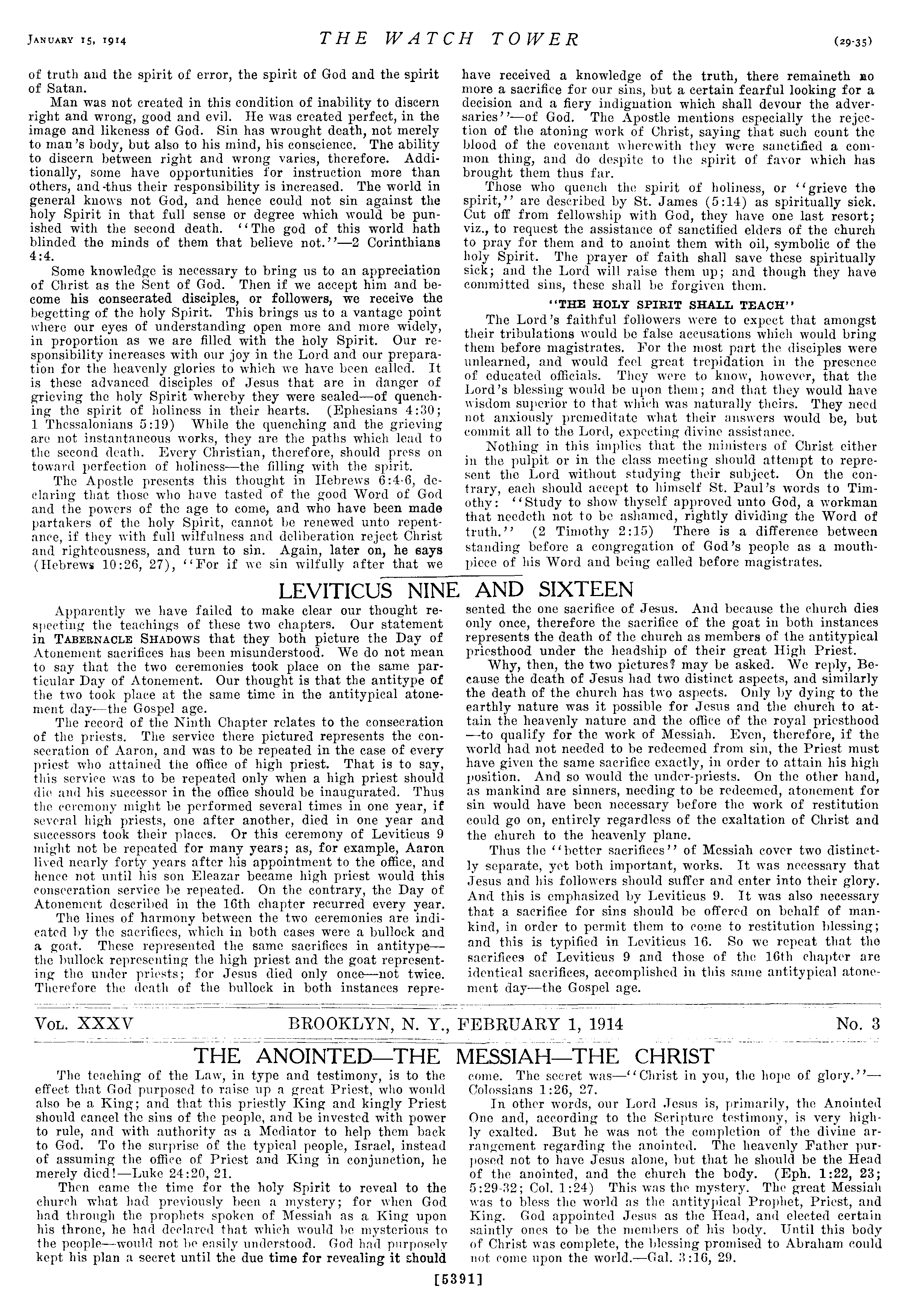
JANUARY 15, IQT4 of truth and the spirit of error, the spirit of God and the spirit of Satan. Man was not created in this condition of inability to discern right and wrong, good and evil. He was created perfect, in the image and likeness of God. Sin has wrought death, not merely to man’s body, but also to his mind, his conscience. The ability to discern hetween right and wrong varies, therefore. Additionally, some have opportunities for instruction more than others, and-thus their responsibility is increased. The world in general knows not God, and hence could not sin against the holy Spirit in that full sense or degree which would be punished with the second death. ‘‘The god of this world hath blinded the minds of them that believe not.’’—2 Corinthians 4:4. Some knowledge is necessary to bring us to an appreciation of Christ as the Sent of God. Then if we accept him and become his consecrated disciples, or followers, we receive the begetting of the holy Spirit. This brings us to a vantage point where our eyes of understanding open more and more widely, in proportion as we are filled with the holy Spirit. Our responsibility increases with our joy in the Lord and our preparation for the heavenly glories to which we have been called. It is these advanced disciples of Jesus that are in danger of grieving the holy Spirit whercby they were sealed—of quenching the spirit of holiness in their hearts. (Ephesians 4:30; 1 Thessalonians 5:19) While the quenching and the grieving are not instantaneous works, they are the paths which lead to the second death. Every Christian, therefore, should press on toward perfection of holiness—the filling with the spirit. The Apostle presents this thought in Hebrews 6:4-6, deelaring that those who have tasted of the good Word of God and the powers of the age to come, and who have been made partakers of the holy Spirit, cannot be renewed unto repentance, if they with full wilfulness and deliberation reject Christ and righteousness, and turn to sin. Again, later on, he says (Hebrews 10:26, 27), ‘‘For if we sin wilfully after that we THE WATCH TOWER (29-35) have received a knowledge of the truth, there remaineth no more a sacrifice for our sins, but a certain fearful looking for a decision and a fiery indignation which shall devour the adversaries’’—of God. The Apostle mentions especially the rejection of the atoning work of Christ, saying that such count the blood of the covenant wherewith they were sanctified a common thing, and do despite to the spirit of favor which has brought them thus far. Those who quench the spirit of holiness, or ‘‘grieve the spirit,’’ are described by St. James (5:14) as spiritually sick. Cut off from fellowship with God, they have one last resort; viz, to request the assistance of sanctified elders of the church to pray for them and to anoint them with oil, symbolic of the holy Spirit. The prayer of faith shall save these spiritually sick; and the Lord will raise them up; and though they have committed sins, these shall be forgiven them. ‘THE HOLY SPIRIT SHALL TEACH’? The Lord’s faithful followers were to expect that amongst their tribulations would be false accusations which would bring them before magistrates, For the most part the disciples were unlearned, and would feel great trepidation in the presence of educated officials. They were to know, however, that the Lord’s blessing would be upon them; and that they would have wisdom superior to that which was naturally theirs. They necd not anxiously premeditate what their answers would be, but commit all to the Lord, expecting divine assistanec. Nothing in this implics that the ministers of Christ either in the pulpit or in the class meeting should attempt to represent the Lord without studying their subject. On the contrary, each should accept to himself St. Paul’s words to Timothy: ‘‘Study to show thyself approved unto God, a workman that needeth not to be ashamed, rightly dividing the Word of truth.’’? (2 Timothy 2:15) There is a difference between standing before a congregation of God’s people as a mouthpiece of his Word and being called before magistrates. LEVITICUS NINE AND SIXTEEN Apparently we have failed to make clear our thought respeeting the teachings of these two chapters. Our statement in TABERNACLE SHADOWS that they both picture the Day of Atonement sacrifices has been misunderstood. We do not mean to say that the two ceremonies took place on the same particular Day of Atonement. Our thought is that the antitype of the two took place at the same time in the antitypical atonement day—the Gospel age. The record of the Ninth Chapter relates to the consecration of the priests. The service there pictured represents the consecration of Aaron, and was to be repeated in the case of every priest who attained the office of high priest. That is to say, this service was to be repeated only when a high priest should die and his suecessor in the office should be inaugurated. Thus the ceremony might be performed several times in one year, if several high priests, one after another, died in one year and suecessors took their places. Or this ceremony of Leviticus 9 might not be repeated for many years; as, for example, Aaron lived nearly forty years after his appointment to the office, and hence not until his son Eleazar became high priest would this consceration service he repeated. On the contrary, the Day of Atonement described in the 16th chapter recurred every year. The lines of harmony between the two ceremonies are indieated by the sacrifices, which in both cases were a bullock and a goat. These represented the same sacrifices in antitype— the bullock representing the high priest and the goat representing the under priests; for Jesus died only once—not twice. Therefore the death of the bullock in both instances repre Vou. XXXV__ The teaching of the Law, in type and testimony, is to the effect that God purposed to raise up a great Priest, who would also be a King; and that this priestly King and kingly Priest should cancel the sins of the people, and be invested with power to rule, and with authority as a Mediator to help them back to God. To the surprise of the typical people, Isracl, instead of assuming the office of Priest and King in conjunction, he merely died!—Luke 24:20, 21. Then came the time for the holy Spirit to reveal to the church what had previously been a mystery; for when God had through the prophets spoken of Messiah as a King upon his throne, he had declared that which would be mysterious to the people—would not he easily understood. God had purposely kept his plan a secret until the due time for revealing it should a BROOKLYN, N. Y., FEBRUARY 1, 1914 ; THE ANOINTED—THE MESSIAH—THE CHRIST sented the one sacrifice of Jesus. And because the church dies only once, therefore the sacrifice of the goat in both instances represents the death of the church as members of the antitypical priesthood under the headship of their great High Priest. Why, then, the two pictures? may be asked. We reply, Because the death of Jesus had two distinct aspects, and similarly the death of the church has two aspects. Only by dying to the earthly nature was it possible for Jesus and the church to attain the heavenly nature and the office of the royal priesthood —to qualify for the work of Messiah. Even, therefore, if the world had not needed to be redeemed from sin, the Priest must have given the same sacrifice exactly, in order to attain his high position. And so would the under-priests. On the other hand, as mankind are sinners, needing to be redeemed, atonement for sin would have been necessary before the work of restitution could go on, entirely regardless of the exaltation of Christ and the church to the heavenly plane. Thus the ‘‘hetter sacrifices’’ of Messiah cover two distinctly separate, yet both important, works. It was necessary that Jesus and his followers should suffer and enter into their glory. And this is emphasized by Leviticus 9. It was also necessary that a sacrifice for sins should be offered on behalf of mankind, in order to permit them to come to restitution blessing; and this is typified in Leviticus 16. So we repeat that the sacrifices of Leviticus 9 and those of the 16th chapter are identical sacrifices, accomplished in this same antitypical atonement day—the Gospel age. No. 3 come. The secret was—‘‘Christ in you, the hope of glory.’’— Colossians 1:26, 27. In other words, our Lord Jesus is, primarily, the Anointed One and, according to the Seripture testimony, is very highly exalted. But he was not the completion of the divine arrangement regarding the anointed. The heavenly Father purposed not to have Jesus alone, but that he should be the Head of the anointed, and the church the body. (Eph. 1:22, 23; §:29-32; Col. 1:24) This was the mystery. The great Messiah was to bless the world as the antitypical Prophet, Priest, and King. God appointed Jesus as the Head, and elected certain saintly ones to be the members of his body. Until this body of Christ was complete, the blessing promised to Abraham could not come upon the world.—Gal. 3:16, 29. [5391]
Pentru a vă îmbunătăți experiența pe site-ul nostru, folosim cookies și tehnologii similare. Unele cookies sunt esențiale pentru funcționalitatea de bază a site-ului nostru și nu pot fi refuzate. Puteți alege să acceptați sau să refuzați cookies suplimentare. Vrem să vă asigurăm că aceste date nu vor fi vândute sau utilizate în scopuri de marketing. Puteți ajusta preferințele dvs. în orice moment accesând Setările de Confidențialitate din subsolul paginii. Pentru mai multe informații, vă rugăm să consultați
Politica de Confidențialitate
Condiții de utilizare
.


