6
1
6
download/literature/watchtower/1901-18.pdf
watchtower/1901/18/1901-18-1
SEPTEMBER
1.
1901
ZION}S
WATCH
TOWER
(291-292;
we
sometime~
say,
"I
see
God's
hand
in
this."
And
again,
we
are
informed
that
"all
flesh
shall
see
the
salvation
of
God."
Aw]
agalll.
'Luok
unto
Ill\'
an,l
h"
~
P
,aVl'd,
all
the
ends
of
the
earth."
ALLEGHENY,
PA.,
SEPTEMBER
If5,
1001
VIEWS
FROM
THE
WATCH
TO\VER
No.
18
onto
the
innocent
and
unsuspecting
Romans
a
whole
btrillg
of
"legends!
"
Ah
me!
Four
years
of
preaching
amI
workin~
doe~
not
seem
to
have
brought
any
more
light
mto
his
bpnightp,]
IJlll1,1
I
for
thpn
he
wrote
that
strange
ppistle
to
the
Hebrell'
I
\\
bn
can
read
the
elew'nth
('hapt('r
of
that
epistle
in
the
light
of
"the
hest
modern
scho]arship,"
with
any
degree
of
al1oll',I11('e
for
the
ignorant
writer?
Poor
Panl
'-To
think
of
the
sermons
written
and
spoken
from
the
"legelJ(l~"
quoted
by
Paul
1II
that
chapter
H
ellon.:?];
to
gIve
a
man
spiritual
nightmare!
And
the
preaphrrR
hal'c
h('lieved
those
stories
to
be
tnlP,
an,1
so
have
decpl\'(',]
their
Hocks.
"The
bhnd
leading
the
blind!"
These
(]eludel]
prea('h
erR
have
cit('d
Abraham
for
an
e'(ample
of
faith,
liling,
Ravmf:
faith,
10,
thps,'
centuries
past'
An,]
yet
.\braham
lIe\'('r
hvcd'
To
bUttl
('ss
1.lIPir
sermons
on
pI
ay('r,
thpRe
saml'
preachers
have
quot('(]
again
aIH]
again
Abraham'R
petitions
as
fuund
in
the
"le,o.!endR"
recorded
m
Gen,
15,
17
am]
18!
\\'hat
a
debt
of
gratItud('
\I
e
OIVP
to
thc
"higher
CI
itrci~m,"
that
our
eyes
have
bern
oprne,l
and
that
with
the
ver~-
he~inning
of
this
glad
new
ccntmy
"the
best
modern
scholarship"
ha~
hru~hpd
away
the
m)ths
anrl
"lcgemls"
of
the
ages
alld
~ll'en
u-
a
"new
theology"
found('d
upon
the
latest
rcs('arehps
of
'the
higher
criticism!"
The
scrious
feature
of
the
matter
is,
that
CllI
htJan
lH,,,ple
in
gpneral
are
but
"bab('s"
as
resperts
a
kno\Vh'.],~~c
of
Gnd'"
\YOId,
and
henee
lIable
to
lose
their
httle
all
of
faith:
('spe
dal1y
\\
hen
thc
doubtR
are
suggeRted
hy
theIr
h'.I,]pl"
te
whom
they
have
been
taught
to
look
too
impliCItly
fO!
gui,]
ance
in
matters
of
faith.
The
\Yard
of
Go,l
e1parly
shows
us
that
so
gleat
a
LJ1ItIl!=,
away
from
the
faith
IS
to
be
cxpected
here,
in
th.,
('I](}
of
till'
age,
as
"il1
ju~tify
our
':\[astpr's
words,-"\\'hen
tIll'
:-;on
III
Man
cOlIIeth
[is
prcsent]
shall
he
fin,]
ffllth
on
th,'
",ldil'"
(Luk('
8
18)
Th('~e
<Ill'
the
"pelI!ou~
tllll.,_"
IllI'lltllllll'd
11\'
the
Apostlp,
and
of
\\hose
de('eptlOns
our
LOId
"aid,-"lf
Ii.
'1\
ere
posslb1P
r
if
they
\\
('re
not
divinely
ai,led
1
th('
\
PI
Y
,],'d
wOlll.1
be
mis]e,l
hy
them
,"-':Uatt,
24
:2~,
cumpare
2
'1'111'
2
'10-12;
2
Tim,
:l:
1-5.
Th('
only
safl"guanl
for
the
LOI,l's
ppople
now
i..;
tlll
"present
truth"
with
w]lIch
the
Lord
I~
'0
bountIfully
,up
plying
the
"table"
of
his
fully
consecrated
people.
God
has
so
arrangp,]
the
outward
evidences
respeding
the
Rihll'
that
the
,,01'1.]
and
all
\\ho
have
the
spirit
of
the
\loIl,]
('an
finll
plenty
to
cavil
at
and
stumble
over.
The
Lord's
intentIOn
was
and
still
iR
that
only
from
the
m8tde
can
IllS
\\'oICl
and
pJ.m
he
spen
in
t
helT
true
beauty
and
strength.
IIe
lilt
l'nds
it
j
0
be
"sufTteient,
that
the
man
of
God
may
he
tholOughly
fur
nish('d
unto
evel:-'
good
work"
But
who
arp
gplluilW]Y
Ii/L'1l
of
God.
IS
the
question.
The
diffi('ulty
IS
that
m.m,I'
profl'~'"
ing
to
be
men
of
Go,]
are
l1Ipn
of
tlIPir
own-not
,'ool-,'nat.,,]
and
many
of
thp
consecrated
are
con~p('ratp.l
to
.1
parll<'uI.n
work
or
theorv
or
sect
in~tead
of
to
God.
~ow
tIll'
"lillur
of
trial"
has
eOl~le
which
\\ill
"llOw
the
r('al
Stall<llllg
of
l'llp1.
one
profpssing
godliness.
God
is
now
makIllg
it
'Iud"
l"h_lbl,
for
every
"man
of
GOlt"
to
be
thoroughh
fUllll~",'d
fulh
('quipped.
at
the
balllP
time
tllat
]lP
IS
l)l'n;l11.tlol~~
tltl'
\,lIpi
sary
to
bring
in
l'rror
like
a
flood.-I~a,
28':2,
I
K,~Il,
;)!I
]
\J
In
VICW
of
tlipsp
('on,]ition~
kt
all
who,p
P,I"~
all'
opl'n
..
d,
"ho
"ep
whl're
we
are
and
what
is
C0Il1111g-,
hI'
al"1
t
Itl-t
tor
themselves
that
th('y
may
be
of
the
"brethren"
II
ho
\I
III
"pc
and
be
d('liyereu,
by
giving'
the
morp
earnp~t
hl'ed
10
the
tllIngs
whieh
(;od
has
shown
u~,
le~t
\Ie
let
tlt.'nl
~lIp;
:In,}
secondly,
for
all
who
give
any
evidenl'e
of
bcing
"],rl'ihreu."
to
asslbt
them
as
llIuch
as
lieth
in
U8.
Thus
\It'
nLIV
make
our
own
cal1ing
and
election
sure,
an,l
IIl1nister
grace
to
all
with
\I
hom
we
come
in
contact.-2
Pet.
1:
10;
Eplt.
4
:2\J
THE
OUTLOOK-WAR
AND
PROSPERITY
As
our
rca']ers
are
aware,
we
credit
the
pro-prJ
It~·
of
the
world
during
the
past
three
years
very
largely
to
tltPlr
\lars,
which
have
put
hundrcds
of
nllllions
of
dollars
into
elrrlll.JllOll
among
the
people,
and
stimulated
manufartunng,
shI)lhuild
mg,
etc.,
at
a
('ost
of
an
increase
of
publIc
,]"ht8,
\\
hleh,
]'ping
put
into
the
shape
of
negotiable
bond".
i~
prapfH'al1~
.m
ml'r('ase
in
the
world's
cir('ulating
medium-monpy,
0ur
principal
reason
for
looklllg'
for
a
furthpr
l1PII(),l
ot
A
writ('r
in
tll(,
Adl'allcc
fae('tiously
points
out
the
an
taO'onbm
betwe('n
the
Bible
and
its
true
fri('nds
on
the
one
sid~,
and
the
Higher
Criti('s
on
the
other.
But
he
does
not
se('m
to
lealize
that
th('
fol1ow('rR
of
these
higher
critics
are
in
mo~t
of
th('
pulpitR
and
III
the
most
influential
pews
of
Chri,ten,]om
:-that
th('
se('ret
of
the
prevalent
skepticism
and
indiITel('nee
of
profpsRmg-
ChristianR
is
d011Ut.
It
is
not
the
]Olll]
awl
fou]·mouthe,]
infidelity
of
a
century
ago;
but
nnj('!l
marc
in~J(lious
and
dang-prouf',
bccause
it
has
a
"form
of
godhlleR~"-mu('h
more
decephYe
to
such
as
are
sincere
truth,~e('kers.
The
wnter
say~:-
..
]1('yon,]
[my
question
S0111C
unkno\"n
'writcr
gathered
up
tIl('
I",'..:pnd&
of
hl~
time
a
11<1
IISP,]
i.1wm
to
deReribe
a
hero,
'Y]WIll
h"
name']
"c\lnaham
A
la1.('r
writ('r
use,l
the
same
l"I!f'lIds.
but
h('
callet]
his
hpro
IRaac.
\Vithout
douLt
all
th.
-.'
~t"lle~
II
ere
inwnte']
to
ac('oUl1t
for
the
supremacy
of
hI
a"]
()\
..
r
E,]om."
f-:o
"~Jill
a
Hev.
Dr.
in
his
'leeture'
to
"Ollll'
fifty
l:t,hl'~
of
lll~
ehur('h
a
f('w
days
sin('e-in
a
Con
!!J'('!!.d
wna]
('
h
111
('h
not
],11
from
BORton
I
At
the
close
of
the
].",tUl'p.
allWn!!
olh('rs
t]ll-
qu('stJon
wa~
asked:
'Doctor,
do
~Oll
l",!ipn'
that
,111,1'
R\leh
I'pl<<lIh
a~
Abraham
and
Isaac
ever
ll\l'd
,,'
''''p]]
,
[
.]Oll't
kuoll','
r('phe,]
the
Doctor.
'It
is
quite
I',,~,ild('
th'lt
I'el
~Oll-'
h"o1ring
tho~e
names
hayc
lived,
but
I'lobahh
tl.p~e
1l1UWS
Ipll,e~.'nt
nntlOns
or
tJibe~,
I
should
sa:-'
th
It
the
\H'ight
of
b('st
modern
scholarship
is
against
tll('
tht'''ll
that
allY
hlH'h
pel~on~
as
Abraham
rnd
Isaac
adu:J1!1
],v",!'"
1:"IIl~
I!'o!ll
tll,'
b"ek\lo",I~
a
III
I
1I0t
falPilial
\llth
the
"best
1II0d"l11
'~,
h"l:lIship,"
I
was
\\(Jl1t
to
p'(clalm,
"Such
knowledge
i.,
too
\1011<[
..
]
fill
for
IIlP:
It
IH
hIgh,
I
cannot
attain
unto
it!"
\\
hat
a
Illt.\'
that
I~aLlh
eoul,]
not
have
heard
a
course
of
]c'd
U
Il'-.
i
Ike
t
h.,,,,,
bdll!
('
h"
JlroJlhe~ie,l!
Then
he
would
hal"
),"1'11
~t"II"d
thp
lIIll!tltiC,lt1<lll
of
muklllg-
such
a
reference
a~
Ill'
fil1d
III
hl~
plophp(',I-Chapter
~I
:8:
"But
thou,
Israpl,
a1t
11I\
~I'I
I':11lt.
,In,'ol.
whn!ll
I
haH'
chol'{'n,
the
Reed
of
Abra
halll
ill
\
flll'l1d"
.\wl
al1'lthl"
b]lllld"r
worse
than
the
first:
"Look
;ll1t"
.\hl.\h:llu
\'0111
f,,1.11<'I,
aUll
Iinto
~arah
that
bare
\'ou'
fll!
I
(',J1kd
hllli
al,,!\(',
all']
h]ess(',]
him
and
incrpa~e']
illlli
,,,
1:111
,t
11I:11'
1",
1.hat
'·thp
bp~t
modern
scholarshIp"
II
ill
dl~I
(II
1'1.
It
Indl'I'd
It
h:.,
1I0t
aheady
pro\,ell,
that
110
such
1'1"1'11<'1
,I~
IH
Iwh
.'1
PI'
!lloplll'-Ip,l
or
hvp,l
1'\,('11;
TIllS
would
do
1I1U,
h
111
..
le.llll1g
the
\I
a,l'
tor
a
solId
foulldatiun
for
our
fad
II'
It
1_
.1
~]('.J!
pd,1
a]~o
tl'at
.\lat1.11<'w
could
not
have
heard
"I
1",101
:1
1"1\
l
..
l'tlll
p_
coll,'''lllIllg
tll!.'
"highpr
critIcIsm"
before
h"
II
I
otl'
hl-
1,0"1,.
fll!
h('
II
ould
have
OIl11tte,]
the
first
chapter
II
h!('h
h.I'
dl't'('I\(',1
"I
IlJall,\
Igl101allt
soulH
slllee
III~
tIllle!
A
~ll'at
11:.1111
IH'opk
ha'('
Il\l"]
in
tllllpH
pa~t
and
"fell
on
sll'ep"
),l'll"1
lll~
th
It
ill
Honll'
lI.1y
.[PSIl-.
II
a"
descpnlle,l
frum
1\bl'a
h.lll1'
\!,~
1\
11,11
19l1or.ll,""!
\\
h,l'
('oul,[
not
the
\\he
men
o.
tit
..
I':,l~t
hal'l'
dl~"O\l'l
..
d
thl~
1ll'1I
knowledg-e
ag-ps
ago?
.\!OI('O\('1.
Ilhal
}ll'lp
It
\\ou]d
hayc
b,'en
to
Je"us
if
he
c'mld
1
1
,1\
P
kno\\'J]
thl'
'
I.I~t
\I"I't[
ot
0111'
be~t
1II0dpln
"eho]al
~h1])'"
1I"
II
ould
1I0t
hll\
P
h("'11
d(,(,(,ll'e,l,
nor
would
he
have
d""l'l\
l,d
"t
hel
H
hI'
quotlllg
trom
tho~('
"01,[
legends,"
as
He
,lId
III
.\Iatt,
:2:2.;;:2.
"I
alll
tIll'
God
of
Abl,lham,
and
the
(;od
01
b,lal",
all']
thp
God
of
.Jaeub!"
Nor
wuu]d
He
have
SI\l<1'
......
0111
fatiln
.\hraham
rp,l0lced
to
"pc
my
day;
and
he
1'.111
It
,Ind
lIa',
'..:1.1<1.
I
-'1\
untu
YOU
hdorp
.\hraham
wa~
I
am
"
.Tohn
S
:,ti,
,
.-,t'.
'1'h('11
'think
of
the
uufortunate
Stephen!
lI.l<]
hp
0111,'
kllO'11l
til"
IP~llltH
of
..
the
hp~t
mOl
[ern
seholar
~11l1'''
ii"
Ill'~
"I
II
oul,}
loa\('
"1'01'1'11
a~
lIP
dl'[
in
Arts
7
:5-al1l]
H'
11llgllt
loa\!'
-.a\('I]
hlH
hfe
l
If
he
was
ignorant
or
so
f"o]lslt
a-
10
I
p]I<',\I
-.('
a"
tJ
ue
a
lot
of
"lcgl'n,l::!"
about
people
II
hll
n"l
"I
[ilp,l.
\I
b,l
"hou]<!
1101..
the
multitude
gnash
on
him
\lltb
tlll'ir
t
..
dh.
~top
th"lr
('IUS,
lun
upon
hlln
with
one
a('('OI
d,
l':l~t
hUll
out
of
the
cIty
alld
StOIl(,
him
to
death
I
,LIlllpS
too
II
a~
dp('('ll'pd
am]
']Iwt(',]
a-.
a
fa('t
a
passage
from
tJ:o~e
~.llne
"ul,}
lpg-ends";
eTaH.
~'2;1.
Dut
the
most
deluded
of
al1
those
poor,
ignorant
mpn,
II
ho
]ilpd
and
\lOIk,',[
11\
tile
fhst
cpntury
was
Pau]
,
How
unhappy
h,'
mu-t
he
pyen
in
heaven
(If
there
is
any
heaven),
If
he
11011'
kllow~
the
"Iu~t
word
of
be~t
modern
scholarship!"
Hi-.
IgnOlallcP
flr-.t
app('ars
111
quotll1g
the
sume
"01<1
legend"
that
foolp,]
.Tanws
111
lus
]ptter
to
the
Galatians-:l
:u.
He
repeat,;
the
myth
III
hlR
l"ttpr
to
th('
Romans--4:
1-4.
But
worse
than
this,
in
the
mnth
chapter
he
<1igs
up
and
palms
off
[2875]
*
*
*
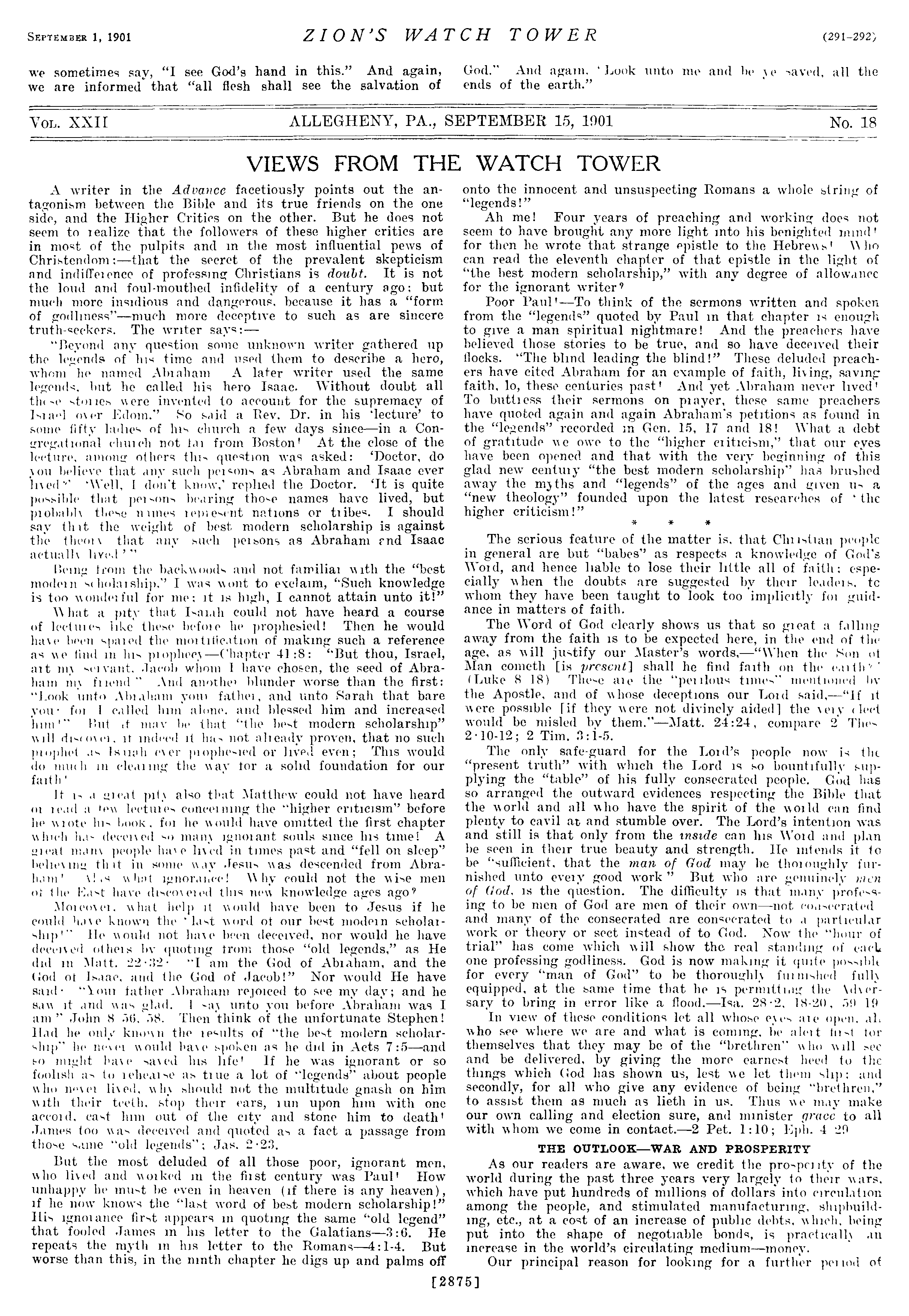
SEPTEMBER 1, 1901 we sometimes say, “I see God’s hand in this.” And again, we are informed that “all flesh shall see the salvation of ZION’S WATCH TOWER (291-292) God." And agam. * Look unto me and be ye saved, all the ends of the earth.” Vou. XAIT A writer in the Advance facetiously points out the antagonism between the Bible and its true friends on the one side, and the Higher Crities on the other. But he does not secm to realize that the followers of these higher critics are in most of the pulpits and im the most influential pews of Christendom:—that the seeret of the prevalent skepticism and indifferenee of professing Christians is doubt. It is not the loud and foul-mouthed infidelity of a century ago: but much more insidious and dangerous. because it has a “form of godliness’—much more deceptive to such as are sincere truth-seckers. The writer savs:— “Bevond any question some unknown writer gathered up the legends of his time and used them to deseribe a hero, whom he named Abraham <A later writer used the same levends, but he ealled his hero Isaac. Without doubt all these stories were invented to account for the supremacy of Israel over Edom.” So said a Rev. Dr. in his ‘lecture’ to some fifty ladies of Tas chureh a few days since—in a Coneregatronal church not far from Boston! At the close of the leeture, among others this question was asked: ‘Doctor, do you believe that any such persons as Abraham and Isaac ever lived” ‘Well, [ don’t know,’ rephed the Doctor. ‘It is quite possible that persons bearing those names have lived, but probably these names represent nations or tribes. I should sav thit the weight of best modern scholarship is against the theory, that any such persons as Abraham end Isaac actually lived?” Beme from the baekwoods and not familiar with the “best modern scholarship.’ IT was wont to exclaim, “Such knowledge is too wonderful fer me: it is high, I cannot attain unto it!” What a pity that Isainsh could not have heard a course of lectures ike these before he prophesied! Then he would have heen spared the mortification of making such a reference as we find in lis propheey—Chanter 41:8: “But thou, Israel, att ma servant. Jacob whom T have chosen, the seed of Abraham omy frend And another blunder worse than the first: “Look unto Abraham your father, and unto Sarah that bare vou for TP ealled him alone. and blessed him and increased ham't But af may be that Cthe best modern scholarship” will discover. af indeed at has not already proven, that no such prophet as Tsueh ever prophesied or jived even; This would do much in cleaing the way tor a solid foundation for our faith’ It 1. a great pity also that Matthew could not have heard or read a tew leetures concerning the “higher eriticism” before he wrote lus book. for he would have omitted the first chapter which has decorved so mans ignorant souls since his time! A great many people have lived in tones past and “fell on sleep” beheving thit in some way Jesus was descended from Abrahom! Abas whet ignorance! Why could not the wise men of the East have discovered this new knowledge ages ago? Moreover, what help it would have been to Jesus if he could have known the * last word of our best modein seholatship!” He would not have been deceived, nor would he have deceived others ly quoting trom those “old legends,” as He did im Matt. 22°32: "DT am the God of Abiaham, and the Ged ot Isaae, and the God of Jacob!” Nor would He have said: “Lor father Abraham rejoiced to see my day; and he saw it and was elad. | say unto vou before Abraham was I am” John $ 56. 58. Then think of the unfortunate Stephen! Had he only known the results of “the best modern scholarsInp’ he never would bave spoken as he did in Aets 7:5—and co might bave saved dus lifet lf he was ignorant or so foolish as to rehearse as true a lot of “legends” about people Who never lived, whys should not the multitude gnash on him with their teeth. stop their ears, 1un upon hm with one accord, cast him out of the city and stone him to death! James too was deceived and quoted as a fact a passage from those same “old levends”; Jas, 2°23, But the most deluded of all those poor, ignorant men, who lived and worked im the first century was Paul! How unhappy be must be even in heaven (if there is any heaven), if he now knows the “last word of best modern scholarship!” lis ignotance first appears im quoting the same “old legend” that fooled James in his letter to the Galatians—3:6. He repeats the myth in his letter to the Romans—4:1-4. But worse than this, in the ninth chapter he digs up and palms off ALLEGHENY, PA., SEPTEMBER 15, 1901 VIEWS FROM THE WATCH TOWER No. 18 onto the innocent and unsuspecting Romans a whole string of “legends!” Ah me! Four years of preaching and working does not seem to have brought any more light into his benighted mind! for then he wrote that strange epistle to the Hebrews! Who ean read the eleventh chapter of that epistle in the light of “the best modern scholarship,” with any degree of allowance for the ignorant writer? Poor Pault—To think of the sermons written and spoken from the “legends” quoted by Paul in that chapter 1s enough to give a man spiritual nightmare! And the preachers have believed those stories to be true, and so have deceived their flocks. “The blind leading the blind!” These deluded preachers have cited Abraham for an example of faith, living, saving faith, lo, these centuries past! And yet Abraham uever lived! To buttiess their sermons on prayer, these same preachers have quoted again and again Abraham's petitions as found in the “legends” recorded in Gen. 15, 17 and 18! What a debt of gratitude we owe to the “higher criticism,” that our eves have been opened and that with the very beginning of this glad new century “the best modern scholarship” haa brushed away the myths and “legends” of the ages and given u- a ‘new theology” founded upon the latest researches of * the higher criticism!” * * * The scrious feature of the matter is, that Chistian people in general are but “babes” as respects a knowledge of God's Word, and hence liable to lose their little all of faith: cspecially when the doubts are suggested by their leaders. tc whom they have been taught to look too implicitly for guidance in matters of faith. The Word of God clearly shows us that so meat a falling away from the faith 1s to be expected here, in the end of the age, as will justify our Master’s words,——“When the Son ot Man cometh [is present] shall he find faith on the eaith*’ (Luke 8 18) These ae the “perilous times” mentioned by the Apostle, and of whose deceptions our Lord said,—‘“If it were possible [if they were not divinely aided] the very clect would be misled by them.”"—Matt. 24:24, compare 2 Thes 2°10-12; 2 Tim, 3:1-5. The only safe-guard for the Lord’s people now is the “present truth? with which the Lord is so bountifully supplying the “table” of his fully consecrated people. God has so arranged the outward evidences respecting the Bible that the world and all who have the spirit of the world can find plenty to cavil at and stumble over. The Lord’s intention was and still is that only from the inside can Ins Word and plan be seen in their true beauty and strength. He intends it to be “sufficient, that the man of God may he thoroughly furnished unto every good work” But who are genuinely men of God, 1s the question. The difficulty is that many professing to be men of God are men of their own—not couscerated and many of the consecrated are consecrated to a particular work or theory or sect instead of to God. Now the “hour of trial” has come which will show the real standing of cack one professing godliness. God is now making it quite possible for every “man of God” to be thoroughly furnished fully equipped, at the same time that he 1s permittiay the \dversary to bring in error like a flood.—Isa, 28-2, 18-20, 59 19 In view of these conditions let all whose eves ate open, al. who see where we are and what is coming, be alert tust tor themselves that they may be of the “brethren” who will see and be delivered, by giving the more carnest heed to the things which God has shown us, lest we let them slip: and secondly, for all who give any evidence of being “brethren,” to assist them as much as Heth in us. Thus we may make our own calling and election sure, and minister grace to all with whom we come in contact.—2 Pet. 1:10; Mph. 4 29 THE OUTLOOK—WAR AND PROSPERITY As our readers are aware, we credit the prosperity of the world during the past three years very largely to their wars, which have put hundreds of millions of dollars into mreulation among the people, and stimulated manufacturing, shipbuilding, ete., at a cost of an increase of public debts, which, being put into the shape of negotiable bonds, is practically an increase in the world’s circulating medium—moncy. Our principal reason for looking for a further period of [2875]
To enhance your experience on our website, we use cookies and similar technologies. Some cookies are essential for the core functionality of our site and cannot be declined. You can choose to accept or decline additional cookies. We want to assure you that none of this data will be sold or used for marketing purposes. You can adjust your preferences at any time by accessing the Privacy Settings from the footer of the page. For more information, please refer to our
Privacy Policy
Terms of Use
.


