8
1
8
download/literature/watchtower/1902-15.pdf
watchtower/1902/15/1902-15-1
(223-227)
ZION'S
WATCH
TOWER
ALLEGHENY,
PA.
God
and
the
worship
of
Mammon?
Is
it,
or
is
it
not,
true
that
while
nommally
worslupIng
Jehovah
the
vast
majority
are
bowing
down
to
the
golden
calf
of
wealth,
honor
of
men,
dlgmty,
tItles,
etc.,
etp.
\\e
fear
that
it
is
only
too
true
that
there
never
was
a
time
when
money,
mfluence,
power
and
honors
of
mpn
were
more
exalted
or
worshiped
or
more
striven
for
than
at
prc~ent.
We
are
not
making
wholesale
condem
natIOns,
nor
suggesting
that
no
excuse
or
allowance
should
be
made
in
this
matter.
On
the
contrary,
we
would
claim
that
it
is
true
of
many
today,
as
it
was
true
of
Aaron,
that
they
are
led,
yea,
almost
forcNl,
into
the
positions
which
they
oc
cupy
in
re8peet
to
the
worship
of
Mammon,
in
respect
to
their
ouellienpe
and
servilIty
to
the
popular
sentiment-to
the
gen
eral
craze
for
the
worship
of
the
golden
calf;
the
worship
of
great
human
instItutions;
the
worship
of
wealth;
the
worship
of
tItles
and
influence,
and
the
tendency
to
be
identified
WIth
these
and
in
some
measure
to
share
in
the
glory,
both
by
con
tnuuting
to
and
by
participation
in
their
revels.
It
IS
nearly
nIneteen
centuries
~ince
the
New
Covenant*
was
seal('(l
with
the
precious
blood
of
our
Mediator,
and
he
left
his
people
and
ascended
up
on
high,~oing
up
into
the
moun
tain,
into
the
pn-sence
of
God.
His
absence
was
longer
pro
tracted
than
had
been
expected,
and
meantime
many
of
those
who
had
tru~ted
in
him
and
waited
for
him
and
expected
his
comIng
agam
to
lead
hIS
people
into
the
land
of
promise,
have
ceased
to
expect
him,
and
are
elaiming
that
he
will
not
come
agaIn
to
lead
and
deliver
them-are
claiming
that
it
is
neces
sary
that
other
leaders
should
take
charge
and
deliver
the
people.
Thp
heads
of
the
various
parties
in
conference
have
decld('d,
not
that
Mammon
shall
be
to
them
instead
of
God,
but
that
Mammon
shall
be
the
representative
of
God,
to
lead
the
peoplp
to
success;
tha.t
Mammon
shall
convert
and
civilize
the
world;
that
Mammon
shall
bring
in
for
the
groaning
crea
tion,
in
a
natural
way,
the
various
blessings
craved,
and
causp
the
('arth
to
blossom
as
the
rose.
Meantime
the
leader
whom
GOll
hall
appointed
to
bring
the
deliverance
returns,
is
present.
He
is
justly
wroth
and
indignant
at
present
conditions.
He
has
set
up
his
~tandard
of
truth
and
righteousness,
and
is
even
now
standing
at
the
gate
of
the
camp,
and
is
calling,
as
did
Moses
in
the
type,
"Who
is
on
the
Lord's
side?
Let
him
com('
unto
m('
I
And
all
the
sons
of
Levi
gathered
them~elves
unto
him."
(Exod.
~2:2(j)
Let
all
who
are
truly
the
Lord's,
howpvpr
much
thcy
may
have
been
entangled
with
the
popular
fallacies
of
our
day,
WIth
its
love
of
money
and
titles,
its
sel
fishnpss,
lov('
of
honor
of
men,
etc.,-let
all
of
the
true-hearted
be
prompt
to
take
thcir
placl's
on
the
Lord's
side.
Shortly
the
great
timp
of
trouble
is
to
begin,
which
will
mean
the
com·
plete
overthrow
of
all
who
uphold
the
worship
of
Mammon,
how('Vl'r
mm'h
they
claim
that
it
is
really
the
worship
and
sprvicl'
of
.Tl'hovah.
-~.
See-February
15.
1909.
and
June
15.
1919,
issues
in
re
Covenant~.
Moses
as
a
Mediator
showed
himself
grandly
as
a
man,
and
beautifully
typified
the
faithfulness
of
our
Lord
and
Redeemer.
How
pathetic
is
Moses'
plea-"lf
thou
wilt
forgive
theIr
sins-."
He
left
the
sentence
incomplete,
as
tho
it
were
beyonc
thinking
that
God
could
permit
such
an
mfraction
of
the
Covenant
he
had
just
made.
But
Moses
proceeds
and
expresses
to
the
Lord
his
willingness,
his
preference,
but
if
Israel's
sin
cannot
be
forgiven
he
also
may
be
blotted
out
of
the
book
of
life.
We
exclaim,
Noble
mall!
Pure
patriot!
And
we
take
to
ourselvps
a
lesson
of
unselfish
devotion
to
others.
But
when
we
look
from
Mosei!
the
type,
to
.Jesus
the
antitype
we
see
the
same
lesson
brought
out
in
a
still
more
pronounced
form.
The
Mediator
of
the
New
Cove
nant,
realIzing
that
it
is
impossible
for
God
to
forgive
sin,
to
blot
out
sin,
gave
his
own
life
as
the
redemption
price
for
sinners.
He
actually
did
what
Moses
proffered
to
do
and
meant,
for
he
gave
not
mprely
a
prospect
of
life
and
a
tem
porary
existence
such
as
Moses
possessed,
but
he
gave
his
all,
with
his
rights
to
eternal
life
as
a
man,
on
our
behalf.
But
tho
the
Father
was
pleased
with
his
devotion-indped
had
fore
seen
it,
and
had
made
this
arrangement
for
the
cancelation
of
man's
guilt
and
sentence
of
death,
yet
he
purposed
that
the
great
Mediator
of
the
Covenant,
through
whose
blood-death
-it
was
sealed,
should
not
suffer
everlastIng
extinction,
but
that
on
the
contrary
he
would
reward
him
for
his
nobility
and
devotion,
both
to
men
and
to
God's
law,
by
raising
him
from
the
dead
to
a
still
higher
plane
of
life-to
glory,
honor
and
immortalIty.-Phil.
2:5-11.
And
as
the
Lord
said
to
Moses,
"Go
now;
and
lead
the
people
unto
the
place"
designated,
so
he
has
appointed
that
our
Mediator
who
has
actually
given
his
life
for
us
and
has
rpceh'ed
the
new
life
with
superior
power
and
glory,
should
be
the
leadpr
and
thp
commander
of
the
people,
and
bring
whosoever
of
them
wills
back
into
full
accord
with
God,
back
to
the
Edenic
conditions,
the
land
of
promise.
But
as
the
Lord
said
to
Moses
in
rpspect
to
the
people
and
their
sin,
so
it
will
be
with
mankind;
viz.,
"Their
sins
shall
be
visited
upon
them."
They
will
receive
stripes
or
chastisempnts
in
proportion
as
thpy
participated
willingly
or
knowingly
in
a
course
of
sin.
Ro
it
will
be
during
the
Millpnnial
age;
altho
the
Lord
will
forgive
the
original
sin,
and
remit
its
ppnalty
of
dpath,
neverthPless,
to
whatever
extpnt
men
have
sinned
wilfully,
on
their
own
account,
against
light
and
knowlerlge
and
opportunity,
in
that
same
proportion
they
are
personally
re'lponsihlp,
and
will
be
obligpd
to
suffer
stripes
of
chastise
ments
even
while
being
brought
by
the
Redeemer
back
from
the
plane
of
death
to
the
plane
of
perfection,
harmony
with
God
and
everlasting
life.
And
those
who
will
not
profit
by
the
lessons,
who
will
not
obey
the
great
Teacher
and
Leader,
the
antitype
of
Moses,
shall
be
"cut
off
from
amongst
the
people,"
as
the
Lord
has
declared.-Acts
3
:23.
Yor,.
XXIII
ALLEGHENY,
PA.,
AUGUST
1,
1902
VIEWS
FROM
THE
WATCH
TOWER
No.
Ii)
TROUBLE
AMONGST
METHODISTS
For
many
years
Rev.
Agar
Beet,
D.
D.,
has
been
theological
tutor
of
Richmond
Collegp,
England.
Of
him
a
prominent
Eng
Ii'lh
journal
says:
"Dr.
Beet
occupies
a
unique
position
in
J\Tethorlism.
He
is
the
only
Methodist
theologian
today
who
has
won
a
very
great
r('putatlOn
outside
his
own
denomination.
His
writings,
partIcularly
on
the
question
of
eschatology,
have
won
a
very
wille
circulation,
and
have
prol1uccd
a
profound
ef
fprt
in
many
lluarters."
Dr
Bpet,
it
sel'm'l,
got
to
stIlllymg
the
Bihle
anrl
found
in
it
nothing
to
support
thc
common
supposi
tion
that
<iod
has
so
ronstituterl
man
that
he
can
never
cease
to
he.
He
has
found
it
to
teach,
on
thp
contrary,
that
pver
lasting
life
is
Gorl's
gift
through
Christ
to
our
rlying
rare,
and
that
a
refusal
of
that
gift
would
signify
neath-not
life,
in
torment
or
otherwise:
that
"the
wages
of
sin
is
neath;"
that
"thp
'IOU
1
that
sinnrth
it
shall
rliC'
:"
that
"hp
that
hath
the
Ron
hath
life,
and
he
that
hath
not
the
Son
hath
not
life,
but
the
wrath
of
Gorl
rthe
curse-the
sentence
of
neath]
ahideth
on
hIm."
Dr
Beet's
rriml'
consisterl
in
teaching
these
Bible
truths
with
which
Methorlist
rloctrines,
like
those
of
so
many
other
"tranitions
of
the
ancil'nts,"
conflict.
To
tpach
along
these
Bihliral
lines
woulO
lluickly
extinguish
all
the
"fires
of
hpll"
whirh
Methollists
have
pokPd
so
industriously
for
a
century;
it
would
rdi('ve
<ioll
of
thl'
chargps
of
injustice
anrl
lovplessness
aTIlI
lll'vilishness
hurIen
against
him
by
some
of
his
falll'n
crea
tures
who,
npVPrtheless,
know
well
that
they
are
not
so
deprav('d
as
either
to
plan
or
work
out
such
rliabohcal
tortures;
it
would
show
up
Mpthollism
as
well
as
other
"isms"
as
slanrlerers
of
God
III
thesp
rl'sppcts,
anrl
woulll
undermine
confidence
in
the
infallibil-
ity
of
their
teachings,
and
send
the
people
for
instruction
to
the
Bible
instead
of
to
creeds
and
catechisms
of
the
dark
ages
and
to
other
blind
guides.
The
"\\'pslevan
In"titutlOn
Committep"
('onl'ludpll
that
till'
foregoing
grouiIds
were
quite
sufficient
for
dropping
Dr.
Beet
from
the
college
faculty.
There
is
plenty
of
room
for
Higher
Criticism
Infinelity
and
for
anti-Scriptural
evolution
theories
in
all
such
institutions,
hut
no
room
for
the
truth-the
Bible
must
not
he
heard,
for
it,
being
the
great
antagonist
of
error,
would
speprlily
make
havoc
of
the
multitudinous
errors
developl'd
in
medieval
times
and
duly
labeled
"Orthodoxy."
In
a
defense
of
his
position,
published
in
The
Methodist
Times
(London),
Dr.
Beet
says:
"During
the
last
('pntury
Methodist
opinion
ahout
thl'
doom
of
the
lost
has
completely
changed.
Very
few
Wesleyan
mlll
isters
can
now
rean
Wesley's
sermons
on
'Hell'
and
on
'Etl'rnity,'
Nos.
73
and
54,
without
repudiating
much
of
their
tC'aC'hmg
,dth
indignation.
Evidentlv
thl'
wntpr
HI'('Ppt('(l
on
these
topirs
current
phraseology
without
nuly
weighing
itR
meaning.
But
I
notice
that,
when
selecting
fifty-three
sermons
as
an
emhodiment
of
his
distinctive
teaching
Wesley
din
not
in
cluile
these
sermons;
and
that,
in
the
sermon
on
'The
Great
AS'lize,'
whiph
hI'
did
indudp,
there
i",
vpry
little
whieh
con-
trailicts
the
tpaching
of
my
book.
•
"This
change
of
opinion
has
bepn
carefully
ignored.
Many
scholarly
and
godly
ministers
have
nursed
their
doubts
in
silence,
some
under
a
sense
of
guilt
for
concealing
their
opinions,
until
the
need.
for
concealment
has
become
to
them
a
humiliating
and
intolerable
bondage.
In
some
cases,
men
have
not
dared
even
to
think,
lest
the
thoughts
they
daren
not
utter
[3048]
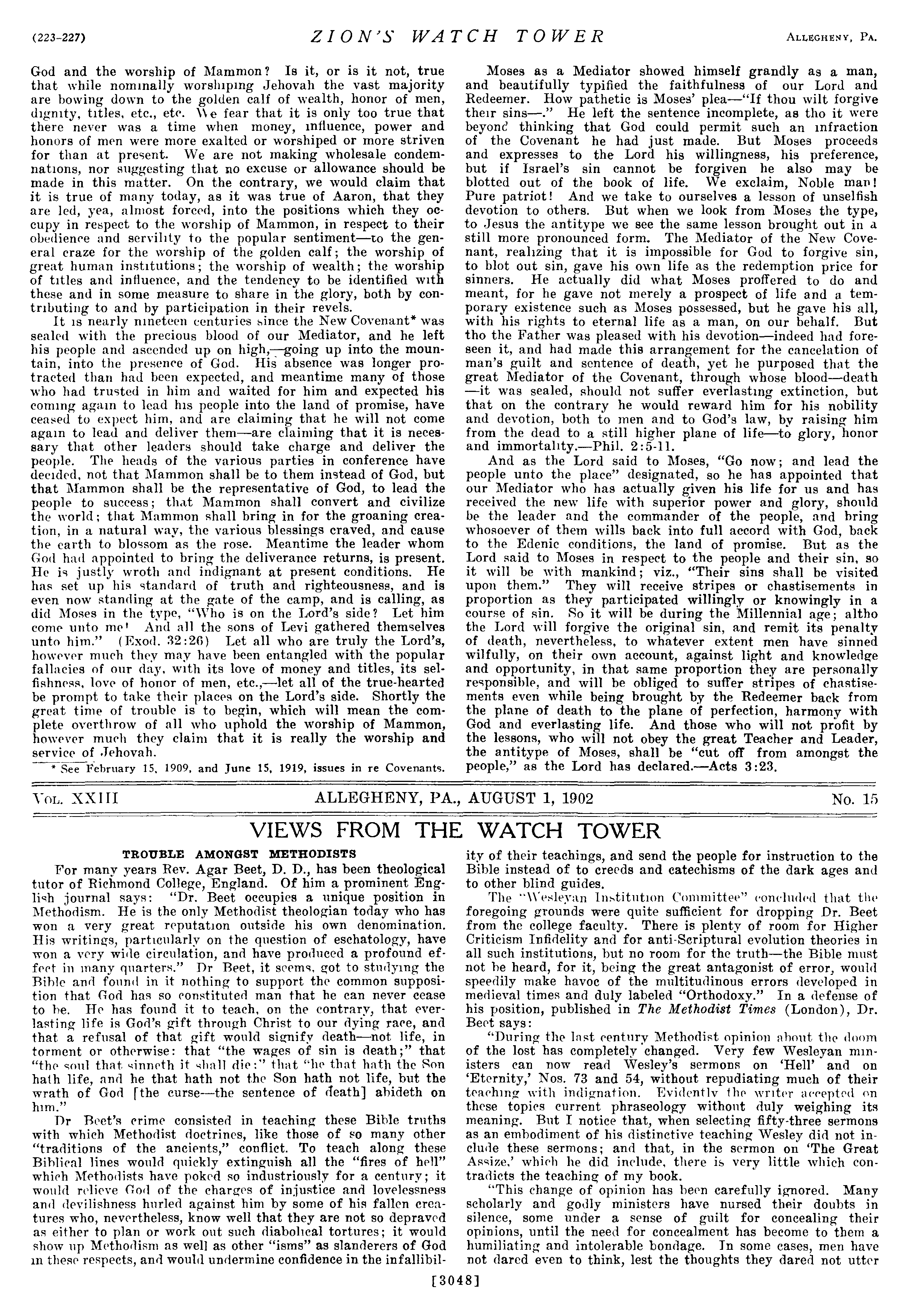
(223-227) God and the worship of Mammon? Is it, or is it not, true that while nominally worshiping Jehovah the vast majority are bowing down to the golden calf of wealth, honor of men, dignity, titles, ete., ete. We fear that it is only too true that there never was a time when money, influence, power and honors of men were more exalted or worshiped or more striven for than at present. We are not making wholesale condemnations, nor suggesting that no excuse or allowance should be made in this matter. On the contrary, we would claim that it is true of many today, as it was true of Aaron, that they are led, yea, almost forced, into the positions which they occupy in respect to the worship of Mammon, in respect to their obedience and servility to the popular sentiment—to the general craze for the worship of the golden calf; the worship of great human institutions; the worship of wealth; the worship of titles and influence, and the tendency to be identified with these and in some measure to share in the glory, both by contributing to and by participation in their revels. It 1s nearly nineteen centuries since the New Covenant* was sealed with the precious blood of our Mediator, and he left his people and ascended up on high,—going up into the mountain, into the presence of God. His absence was longer protracted than had been expected, and meantime many of those who had trusted in him and waited for him and expected his coming again to lead his people into the land of promise, have ceased to expect him, and are claiming that he will not come again to lead and deliver them—are claiming that it is necessary that other leaders should take charge and deliver the people. The heads of the various parties in conference have decided, not that Mammon shall be to them instead of God, but that Mammon shall be the representative of God, to lead the people to success; that Mammon shall convert and civilize the world; that Mammon shall bring in for the groaning creation, in a natural way, the various blessings craved, and cause the earth to blossom as the rose. Meantime the leader whom God had appointed to bring the deliverance returns, is present. He is justly wroth and indignant at present conditions. He has set up his standard of truth and righteousness, and is even now standing at the gate of the camp, and is calling, as did Moses in the type, “Who is on the Lord’s side? Let him come unto me! And all the sons of Levi gathered themselves unto him.” (Exod, 32:26) Let all who are truly the Lord’s, however much they may have been entangled with the popular fallacies of our day, with its love of money and titles, its selfishness, love of honor of men, etc.,—let all of the true-hearted be prompt to take their places on the Lord’s side. Shortly the great time of trouble is to begin, which will mean the complete overthrow of all who uphold the worship of Mammon, however much they claim that it is really the worship and service of Jehovah. * See February 15, 1909, and June 15, 1919, issues in re Covenants. ZION’S WATCH TOWER ALLEGHENY, Pa, Moses as a Mediator showed himself grandly as a man, and beautifully typified the faithfulness of our Lord and Redeemer. How pathetic is Moses’ plea—If thou wilt forgive their sins—.” He left the sentence incomplete, as tho it were beyonce thinking that God could permit such an infraction of the Covenant he had just made. But Moses proceeds and expresses to the Lord his willingness, his preference, but if Israel’s sin cannot be forgiven he also may be blotted out of the book of life. We exclaim, Noble man! Pure patriot! And we take to ourselves a lesson of unselfish devotion to others. But when we look from Moses the type, to Jesus the antitype we see the same lesson brought out in a still more pronounced form. The Mediator of the New Covenant, realizing that it is impossible for God to forgive sin, to blot out sin, gave his own life as the redemption price for sinners. He actually did what Moses proffered to do and meant, for he gave not merely a prospect of life and a temporary existence such as Moses possessed, but he gave his all, with his rights to eternal life as a man, on our behalf. But tho the Father was pleased with his devotion—indeed had foreseen it, and had made this arrangement for the cancelation of man’s guilt and sentence of death, yet he purposed that the great Mediator of the Covenant, through whose blood—death —it was sealed, should not suffer everlasting extinction, but that on the contrary he would reward him for his nobility and devotion, both to men and to God’s law, by raising him from the dead to a still higher plane of life—to glory, honor and immortality.—Phil, 2:5-11. And as the Lord said to Moses, “Go now; and lead the people unto the place” designated, so he has appointed that our Mediator who has actually given his life for us and has received the new life with superior power and glory, should be the leader and the commander of the people, and bring whosoever of them wills back into full accord with God, back to the Edenie conditions, the land of promise. But as the Lord said to Moses in respect to the people and their sin, so it will be with mankind; viz., “Their sins shall be visited upon them.” They will receive stripes or chastisements in proportion as they participated willingly or knowingly in a course of sin. So it will be during the Millennial age; altho the Lord will forgive the original sin, and remit its penalty of death, nevertheless, to whatever extent men have sinned wilfully, on their own account, against light and knowledge and opportunity, in that same proportion they are personally responsible, and will be obliged to suffer stripes of chastisements even while being brought by the Redeemer back from the plane of death to the plane of perfection, harmony with God and everlasting life. And those who will not profit by the lessons, who will not obey the great Teacher and Leader, the antitype of Moses, shall be “cut off from amongst the people,” as the Lord has declared.—Acts 3:23. Vou. XXITI ALLEGHENY, PA., AUGUST 1, 1902 No. 15 VIEWS FROM THE WATCH TOWER TROUBLE AMONGST METHODISTS For many years Rev. Agar Beet, D. D., has been theological tutor of Richmond College, England. Of him a prominent English journal says: ‘‘Dr. Beet occupies a unique position in Methodism. He is the only Methodist theologian today who has won a very great reputation outside his own denomination. His writings, particularly on the question of eschatology, have won a very wide circulation, and have produced a profound effect in many quarters.” Dr Beet, it scems, got to studying the Bible and found in it nothing to support the common supposition that God has so constituted man that he can never eease to be. He has found it to teach, on the contrary, that everlasting life is God’s gift through Christ to our dying race, and that a refusal of that gift would signify death—not life, in torment or otherwise: that “the wages of sin is death;” that “the soul that sinneth it shall die:” that “he that hath the Son hath life, and he that hath not the Son hath not life, but the wrath of God [the curse—the sentence of death] abideth on him.” Dr Beet’s crime consisted in teaching these Bible truths with which Methodist doctrines, like those of so many other “traditions of the ancients,” conflict. To teach along these Biblieal lines would quickly extinguish all the “fires of hell” which Methodists have pokcd so industriously for a century; it would relieve God of the charges of injustice and lovelessness and devilishness hurled against him by some of his fallen creatures who, nevertheless, know well that they are not so depraved as either to plan or work out such diabolical tortures; it would show up Methodism as well as other “isms” as slanderers of God in these respects, and would undermine confidence in the infallibil ity of their teachings, and send the people for instruction to the Bible instead of to creeds and eatechisms of the dark ages and to other blind guides, The “Wesleyan Institution Committee” concluded that the foregoing grounds were quite sufficient for dropping Dr. Beet from the eollege faculty. There is plenty of room for Higher Criticism Infidelity and for anti-Scriptural evolution theories in all such institutions, but no room for the truth—the Bible must not be heard, for it, being the great antagonist of error, would speedily make havoc of the multitudinous errors developed in medieval times and duly labeled “Orthodoxy.” In a defense of his position, published in The Methodist Times (London), Dr. Bect says: “During the last century Methodist opinion ahout the doom of the lost has completely changed. Very few Wesleyan ministers can now read Wesley’s sermons on ‘Hell’ and on ‘Eternity,’ Nos. 73 and 54, without repudiating much of their teaching with indignation. Evidently the writer aceepted on these topies current phraseology without duly weighing its meaning. But I notice that, when selecting fifty-three sermons as an embodiment of his distinctive teaching Wesley did not include these sermons; and that, in the sermon on ‘The Great Assize,” which he did include, there is very little which contradicts the teaching of my book. “This change of opinion has been carefully ignored. Many scholarly and godly ministers have nursed their doubts in silence, some under a sense of guilt for concealing their opinions, until the need for concealment has become to them a humiliating and intolerable bondage. In some eases, men have not dared even to think, lest the thoughts they dared not utter [3048]
To enhance your experience on our website, we use cookies and similar technologies. Some cookies are essential for the core functionality of our site and cannot be declined. You can choose to accept or decline additional cookies. We want to assure you that none of this data will be sold or used for marketing purposes. You can adjust your preferences at any time by accessing the Privacy Settings from the footer of the page. For more information, please refer to our
Privacy Policy
Terms of Use
.


