5
1
5
download/literature/watchtower/1902-23.pdf
watchtower/1902/23/1902-23-1
(J55-356)
ZION'S
WATCH
TOWER
AI,LI!GH:£NY.
PA.
law
and
much
advantage
every
way
over
them.
If
their
knowledge
of
the
Lord
led
them
to
kindly
salutations
and
kindly
actions,
much
more
should
the
Christian's
greater
kno\\
ledge
of
the
dlvine
will
and
his
anointing
of
the
holy
Spirit
enable
him
to
be
kind,
considerate
and
affectionate
to
ward
others--doing
good
unto
all
men
as
we
have
oppor
tunity,
especially
to
the
household
of
falth,
Our
Golden
Text
IS
an
exhortation
to
spiritual
Israelites
and
is
in
full
accord
with
the
sentiments
of
this
lesson
as
witnessed
by
the
conduct
of
Naomi
and
Ruth
and
Boaz
and
his
laborers.
Let
us
with
increasing
light
and
knowledge
and
pnvilege
make
still
further
progress
III
all
the
fruits
of
the
splnt
of
love.
Fmally,-lt
is
unsafe
to
neglect
to
have
the
Lord
for
our
God,
and
to
neglect
to
make
his
people
our
people.
Accept
ance
of
the
Lord
means
ultimately
a
change
in
all
of
life's
interests
and
affairs
if
we
would
abide
in
his
love
and
favor.
The
sacrifice
of
earthly
thing:>
may
cost
us
tears
and
heart
aches
at
firAt;
but
eventually
we
will
be
more
than
compen
sated-as
was
Ruth,
only
in
hlgher,
spiritual
biesslllgs.
VOL.
XXIII
ALLEGHENY,
PA.,
DECEMBER
1,
]902
VIEWS
FROM
THE
WATCH
TOWER
No.
23
THE
CHURCH
AS
THE
MAKER
OF
THE
WORLD'S
CONSCIENOE
This
topic
is
treated
in
a
manner
with
which
we
sympa
thize
but
do
not
agree,
by
Rev.
S.
Z.
Batten,
in
an
article
in
the
A.mcncan
Journal
of
SOC'lology.
He
asserts
that
money
and
military
glory
are
the
"false
ideals"
before
the
world,
and
mqUires
whether
or
not
the
church
has
really
spoken
out
against
either
of
these.
He
thinks
not
and
proceeds:-
"In
church
and
college,
in
society
and
in
the
press,
rich
men
are
honored
and
flattered
and
held
up
as
models
to
be
adored
and
Imltated.
The
influence
of
all
this,
as
anyone
can
see,
is
to
degrade
the
common
morals;
it
is
to
set
up
a
false
ideal
of
life;
it
is
to
fire
the
imagination
of
the
young
with
unholy
and
unworthy
ambitions;
it
is
to
cast
discredit
on
the
poorcr
and
humbler
workers
in
the
kingdom
of
God.
Every
careful
student
of
modern
society
declares
that
the
reign
of
commerclahsm
has
come,
and
with
the
reign
of
this
commer
eiahsm
there
has
come
a
sad
confusion
of
moral
values.
This
commerciallsm
places
moncy
above
life,
and
things
before
men,
'Our
whole
society,'
says
Felix
Adler,
'is
infiltrated
with
the
money-getting
idea.'
There
IS
danger
lest
a
commercialism
utterly
destitute
of
moral
and
spiritual
conceptions
shall
usurp
the
place
whIch
should
be
held
by
truer
and
Christlier
ideals.
"Clo~ely
akin
to
this
is
another
false
ideal
which
is
set
up
before
the
people
for
honor
and
imitation.
As
every
one
knowA,
the
milItary
ideal
has
held
sway
for
untold
ages
over
the
nunds
and
hearts
of
men,
and
the
great
men
of
history
are
largely
military
leaders
and
conquerors.
How
far
militarism
is
necessary
in
an
imperfect
and
evolving
society
it
does
not
concern
us
here
to
lllquire.
The
military
captain
no
doubt
has
had
his
work
to
do
in
the
world,
and
let
him
have
his
wreath
ot
laurcl
leaves.
But
the
mihtary
ideal,
it
is
needless
to
say,
is
not
the
Christian
ideal,
and
the
two
can
never
be
completely
harmonized."
Mr.
Batten
considers
it
the
Church's
duty
to
quicken
the
political
conscience
of
the
world;
and
considers
it
a
dangerous
sign
that
people
have
ceased
to
expect
unselfishness
in
politics.
He
continues:-
"As
cvery
one
knows,
a
double
standard
of
morality
pre·
vails,
and
men
have
one
kind
of
right
for
their
personal
and
family
hves,
and
a
different
kind
of
right
for
their
political
and
commercial
lives.
All
such
things
as
sentiment,
conscience
and
love
are
ruled
out
of
politics,
and
we
are
told
that
the
Decalogue
and
the
Sermon
on
the
Mount
have
nothing
to
do
"lth
a
political
campaign
.
.
.
.
The
chancellor
of
the
German
rlllpire
has
lately
declarcd;
'I
can
not
conduct
foreign
policy
from
the
point
of
VlCW
of
pure
moral
philosophy.
It
is
not
ours
to
ask
what
is
right
and
what
is
wrong.
The
politician
i~
no
judge
of
morals;
he
has
solcly
to
m3intain
the
interests
and
rights
of
his
country.'
Another
man,
not
himself
a
prac
tica
1
politician,
but
a
political
philosopher,
Professor
Wil
loughby,
declare~:
'It
is,
in
fact,
quite
superfluous
to
show
in
this
ag-e
that
from
their
own
inherent
nature
divine
and
moral
sanctions
can
have
no
application
to
political
matters'
So
long'
a
~
such
scntiments
prevail
in
high
places,
it
is
not
sur
prj~ing-
that
they
should
appear
in
low
places.
And
so
long
as
such
sentimcnts
prevail,
whether
in
high
places
or
in
low,
that
long-
the
church
of
Jesus
Christ
will
have
a
most
fiery
and
1
elentless
mi~sion."
Inquiring
into
the
church's
attitude
on
social
questions,
he
declares
that
"in
our
time
the
power
of
Christianity
is
to
be
proved
by
its
abihty
to
create
a
Christian
type
of
human
so
ciety,"
and
adds:-
"It
is
intolerable
to
all
right
religion
that
numbers
of
people
should
be
miserable
and
needy
while
there
is
plenty
to
spare
in
the
Father's
house.
No
one
who
believes
in
Jesus
Christ
can
believe
that
it
is
the
will
of
the
heavenly
Father
that
one
part
of
the
human
family
shan
go
hungry
and
des
titute
while
another
part
is
living
in
luxury
and
ease.
The
most
tragic
fact
about
this
poverty
and
ignorance
is
not
the
hunger
and
suffering,
though
these
are
sad
enough.
The
sad-
dest
feature
about
It
all
is
the
waste
of
human
life,
the
fact
that
the
wonderful
possibilities
in
these
human
brothers
are
never
unfolded
and
realized.
A
social
and
industrial
system
in
w?i~h
one
man
con~rols
~housands
o.f
lives
and
is
possessed
of
ml1hons
of
money;
m
whiCh
able-bodied
men
willing
to
work
walk
the
streets
in
desperation
looking
for
a
job;
in
which
thousands
of
women,
owmg
to
oppressive
labor
and
small
re
muneration,
are
under
a
continual
temptation
to
barter
woman
hood
for
gain;
in
w~ich
are
tenements
not
fit
for
pig-sties
where
women
fight
WIth
fever,
and
infants
pant
for
air
and
wail
out
their
httle
lives;
in
which
the
sweater's
den
and
the
glOg-shop
thrive-~uch
a
society
is
very
far
indeed
from
that
order
whirh
God
wishes
and
ordains."
,
,
To
the
query,
Isn't
this
a
hazardous
topic?
he
replies:
"That
may
be;
but
hazardous
to
whom'
To
the
preacher?
All
the
real
hazard
to
him
arises
from
the
fact
that
he
is
faithless
to
his
trust.
To
the
hearers?
Would
to
God
it
were
more
hazardous
to
those
Who
are
guilty
of
the
monstrous
wrongs
which
hurt
their
fellows
and
hinder
the
kingdom
of
God!
.
.
.
.
"The
ml~~ion
of
the
('hur{'h
is
eVIdent;
the
('hun,h's
ereOt'lI
tials
are
clear;
the
need
of
the
world
is
great.
Nothincr
could
be
more
weak
and
pitiful
than
for
the
churches
to
conf:'ss
that
whole
provinces
of
life
lie
beyond
their
interest.
Nothing
could
be
more
cruel
and
cowardly
than
for
the
churches
to
say
that
they
have
no
word
to
offer
on
the
problems
which
make
the
peril
and
the
opportunity
of
our
time.
Nothing
could
be
more
calamitous
and
short-sighted
than
for
the
churches
to
leave
to
outsiders,
to
unbelievcrs
often,
the
discussion
of
cur
rent
wrongs
and
the
leadership
in
moral
reform."
THE
GENTLEMAN'S
WRONG
VIEW-POINT
'Ve
admire
Mr.
Batten's
zeal
and
courage
for
the
right,
but
discern
that,
like
1~1any
more,
he
is
in
trouble
by
reason
of
a
misconception
of
the
divine
plan
of
the
acres
and
the
church's
mission
thereunder.
t>
The
church
should,
indeed,
"lift
up
a
standard
for
the
peo
ple,"
the
wOlld
i-in
her
pUlpits,
in
her
press,
and
in
the
"hv
ing
epistles"
of
her
people.
But
she
is
not
to
blame
that
the
world
in
general
will
not
follow
her
precepts
and
example.
Did
our
Lord
himself
or
his
apostles
transform
politics?
or
recon
struct
society?
or
ab?lish
wars
and
injustices
in
their
day?
Assuredly
not,
UnsatIsfactory
as
is
the
condition
of
things
at
present
it
was
much
worse
for
the
poor
"groaning
creation"
then.
(Rom.
8,22)
Were
our
lord
and
the
apostles
at
fault
then?
By
no
means.
Neithcr
i~
the
church
to
blame
that
pres
ent
conditions
are
what
they
are.
But
perhaps
Rev.
Batten
would
reply:
The
conditions
now
are
different
from
what
they
were
in
the
days
of
the
apostles;
-now
we
have
what
we
can
the
"Christian
World"
of
Europe
and
America
and
in
these
lands
of
"Christendom";
surely
we
should
expect
Christian
methods
in
politics,
finance
and
society.
What
folly,
dear
brother!
Is
it
possible
for
us
to
deceive
ourselves
into
thinking
that
the
world
is
Christianized?
Is
it
possible
for
us
even
to
consider
that
the
professed
church
membership
is
Christianized?
Surely
the
term
Christtan
world
is
as
much
a
misnomer
as
the
term
ChristIan
Scientist.
Call
ing
worldliness
Christianity
no
more
makes
it
so
than
calling
black
white
would
change
it.
The
church
"whose
names
are
written
in
heaven"
consists
only
of
those
who
have
the
spirit,
mind,
will,
disposition
of
their
Lord
and
Master,
their
Redeemer.
These,
today
as
ever,
are
but
a
"little
flock"
as
compared
to
even
the
nominal
church,
and
are
scattered
here
and
there
throughout
the
sects,
whose
BabyJonish,
worldly,
fleshly
splrit
troubles
them.
but
whose
wine
of
false
doctrine
deceives
them.
(Rev.
14:8;
17:2;
18:
3)
Wherever
they
are,
they
are
striving
after
and
more
and
more
attaining
to
the
high
ideals
of
their
Teacher,
whose
word
they
hear,
reverence
and
follow.
During
the
absence
of
the
Chief
Shepherd
the
flock
has
become
greatly
scattered
by
[3112]
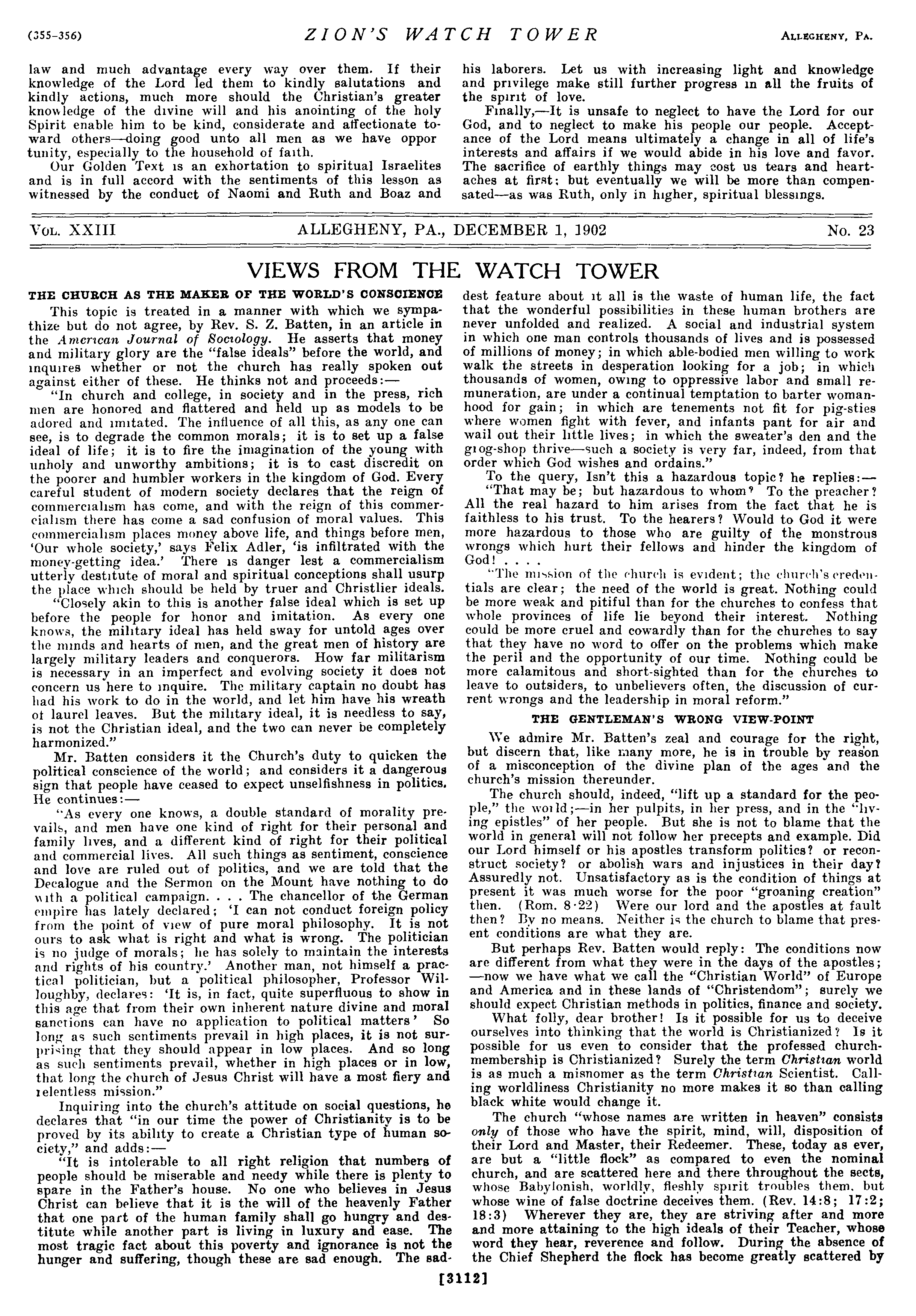
(355-356) law and much advantage every way over them. If their knowledge of the Lord led them to kindly salutations and kindly actions, much more should the Christian’s greater knowledge of the divine will and his anointing of the holy Spirit enable him to be kind, considerate and affectionate toward others—doing good unto all men as we have oppor tunity, especially to the household of faith. Our Golden Text 1s an exhortation to spiritual] Israelites and is in full accord with the sentiments of this lesson as witnessed by the conduct of Naomi and Ruth and Boaz and ZION’S WATCH TOWER ALLEGHENY, Pa. his laborers. Let us with increasing light and knowledge and privilege make still further progress in all the fruits of the spirit of love. Finally,—It is unsafe to neglect to have the Lord for our God, and to neglect to make his people our people. Acceptance of the Lord means ultimately a change in all of life’s interests and affairs if we would abide in his love and favor. The sacrifice of earthly things may cost us tears and heartaches at first: but eventually we will be more than compensated—as was Ruth, only in higher, spiritual blessings, Vou. XXIII ALLEGHENY, PA., DECEMBER 1, 1902 No. 23 VIEWS FROM THE WATCH TOWER THE CHURCH AS THE MAKER OF THE WORLD’S CONSCIENCE This topic is treated in a manner with which we sympathize but do not agree, by Rev. S. Z. Batten, in an article in the American Journal of Sociology. He asserts that money and military glory are the “false ideals” before the world, and inquires whether or not the church has really spoken out against either of these. He thinks not and proceeds:— __ “In church and college, in society and in the press, rich men are honored and flattered and held up as models to be adored and imitated. The influence of all this, as any one can see, is to degrade the common morals; it is to set up a false ideal of life; it is to fire the imagination of the young with unholy and unworthy ambitions; it is to cast discredit on the poorer and humbler workers in the kingdom of God. Every careful student of modern society declares that the reign of commercialism has come, and with the reign of this commercialism there has come a sad confusion of moral values. This commercialism places money above life, and things before men, ‘Our whole society,’ says Felix Adler, ‘is infiltrated with the money-getting idea.’ There is danger lest a commercialism utterly destitute of moral and spiritual conceptions shall usurp the place which should be held by truer and Christlier ideals. “Closely akin to this is another false ideal which is set up before the people for honor and imitation. As every one knows, the miltary ideal has held sway for untold ages over the minds and hearts of men, and the great men of history are largely military leaders and conquerors. How far militarism is necessary in an imperfect and evolving society it does not concern us here to inquire. The military captain no doubt has had his work to do in the world, and let him have his wreath ot laurel leaves. But the military ideal, it is needless to say, is not the Christian ideal, and the two can never be completely harmonized.” Mr. Batten considers it the Church’s duty to quicken the political conscience of the world; and considers it a dangerous sign that people have ceased to expect unselfishness in politics, He continues :— “As every one knows, a double standard of morality prevails, and men have one kind of right for their persona] and family lives, and a different kind of right for their political and commercial lives. All such things as sentiment, conscience and love are ruled out of politics, and we are told that the Decalogue and the Sermon on the Mount have nothing to do with a political campaign. . . . The chancellor of the German empire has lately declared; ‘I can not conduct foreign policy from the point of view of pure moral philosophy. It is not ours to ask what is right and what is wrong. The politician is no judge of morals; he has solely to maintain the interests and rights of his country.’ Another man, not himself a practical politician, but a political philosopher, Professor Wiilloughby, declares: ‘It is, in fact, quite superfluous to show in this age that from their own inherent nature divine and moral sanctions can have no application to political matters’ So long as such sentiments prevail in high places, it is not surprising that they should appear in low places. And so long as such sentiments prevail, whether in high places or in low, that long the church of Jesus Christ will have a most fiery and relentless mission.” Inquiring into the church’s attitude on social questions, he declares that “in our time the power of Christianity is to be proved by its ability to create a Christian type of human society,’ and adds:— “Tt is intolerable to all right religion that numbers of people should be miserable and needy while there is plenty to spare in the Father’s house. No one who believes in Jesus Christ can believe that it is the will of the heavenly Father that one part of the human family shall go hungry and destitute while another part is living in luxury and ease. The most tragic fact about this poverty and ignorance is not the hunger and suffering, though these are sad enough. The sad dest feature about 1t all is the waste of human life, the fact that the wonderful possibilities in these human brothers are never unfolded and realized. A social and industrial system in which one man controls thousands of lives and is possessed of millions of money; in which able-bodied men willing to work walk the streets in desperation looking for a job; in which thousands of women, owing to oppressive labor and small remuneration, are under a continual temptation to barter womanhood for gain; in which are tenements not fit for pig-sties where women fight with fever, and infants pant for air and wail out their little lives; in which the sweater’s den and the giog-shop thrive—such a society is very far, indeed, from that order which God wishes and ordains.” To the query, Isn’t this a hazardous topic? he replies: — “That may be; but hazardous to whom? To the preacher? All the real hazard to him arises from the fact that he is faithless to his trust. To the hearers? Would to God it were more hazardous to those who are guilty of the monstrous arangs which hurt their fellows and hinder the kingdom of od! .... “The mission of the church is evident; the church's credentials are clear; the need of the world is great. Nothing could be more weak and pitiful than for the churches to confess that whole provinces of life lie beyond their interest. Nothing could be more cruel and cowardly than for the churches to say that they have no word to offer on the problems which make the peril and the opportunity of our time. Nothing could be more calamitous and short-sighted than for the churches to leave to outsiders, to unbelievers often, the discussion of current wrongs and the leadership in moral reform.” THE GENTLEMAN’S WRONG VIEW-POINT We admire Mr. Batten’s zeal and courage for the right, but discern that, like many more, he is in trouble by reason of a misconception of the divine plan of the ages and the church’s mission thereunder, The church should, indeed, “lift up a standard for the people,” the wo1ld;—in her pulpits, in her press, and in the “hving epistles” of her people. But she is not to blame that the world in general will not follow her precepts and example. Did our Lord himself or his apostles transform politics? or reconstruct society? or abolish wars and injustices in their day? Assuredly not. Unsatisfactory as is the condition of things at present it was much worse for the poor “groaning creation” then. (Rom. 8°22) Were our lord and the apostles at fault then? By no means. Neither is the church to blame that present conditions are what they are. But perhaps Rev. Batten would reply: The conditions now are different from what they were in the days of the apostles; —now we have what we call the “Christian World” of Europe and America and in these lands of “Christendom”; surely we should expect Christian methods in politics, finance and society, What folly, dear brother! Is it possible for us to deceive ourselves into thinking that the world is Christianized? Is it possible for us even to consider that the professed churchmembership is Christianized? Surely the term Christian world is as much a misnomer as the term Christian Scientist. Calling worldliness Christianity no more makes it so than calling black white would change it. The church “whose names are written in heaven” consists only of those who have the spirit, mind, will, disposition of their Lord and Master, their Redeemer. These, today ag ever, are but a “little flock” as compared to even the nominal church, and are scattered here and there throughout the sects, whose Babylonish, worldly, fleshly spirit troubles them, but whose wine of false doctrine deceives them. (Rev. 14:8; 17:2; 18:3) Wherever they are, they are striving after and more and more attaining to the high ideals of their Teacher, whose word they hear, reverence and follow. During the absence of the Chief Shepherd the flock has become greatly scattered by [3112]
To enhance your experience on our website, we use cookies and similar technologies. Some cookies are essential for the core functionality of our site and cannot be declined. You can choose to accept or decline additional cookies. We want to assure you that none of this data will be sold or used for marketing purposes. You can adjust your preferences at any time by accessing the Privacy Settings from the footer of the page. For more information, please refer to our
Privacy Policy
Terms of Use
.


