7
1
7
download/literature/watchtower/1902-9.pdf
watchtower/1902/9/1902-9-1
(127-131)
ZION'S
WATCH
TOWER
ALLJ!CHJ!NY.
PA.
step
in
the
divine
program
was
the
arrangement
for
the
justi
fication
of
the
Gospel
church-not
actually,
but
by
faith,
reckonedly.
So
many
as
believed,
so
many
as
accepted
Jesus,
were
reckonedly
justified-reckonedly
had
the
legal
curse
lifted
from
them,
tho
they
were
actually
allowed
to
remain
under
the
w~aknesses
and
difficultIes
resulting
from
that
curse.
To
such
of
these,
reckonedly
justified
ones,
as
made
full
consecration
of
themselves
to
the
Lord,
the
privilege
was
granted
of
walking
by
faIth
in
the
footsteps
of
Jesus,
and
being
conformed
to
his
sacrifiCIal
death
;-the
promised
reward
for
this
being
a
share
in
the
Lord's
glory,
honor
and
immortality.
But
not
until
the
last
member
of
this
elect
body
of
Christ
shall
have
been
ac
cepted
as
faithful
will
this
Gospel
age
of
sacrifice
terminate.
(4)
As
the
Apostle
explaInS,
the
Lord
IS
reckomng
that
the
various
members
of
the
body
of
Christ
are
fillinj.;
up
a
measure
of
the
afflictions
of
Christ
(they
are
joined
with
him
in
the
atonement
sacnfice;
not
that
theu
sacnfice
could
have
been
acceptable
with
God
at
all
without
that
of
their
Lord
Jesus,
but
that
they
are
acceptable
to
God
through
and
under
the
merit
of
his
sacrifice).
"I
beseech
you,
therefore,
brethren,
that
ye
present
your
bodies
a
living
sacrifice,
holy,
acc('ptable
to
God,
your
reasonable
service."
(Rom.
12:
1)
When
the
church's
saenfice
is
complete
the
whole
work
of
suffering
for
sin
ends,
and
forthwith
the
church
WIll
be
received
to
condi
tions
of
glory
with
her
Lonl,
III
the
first
resurrertJOn,
as
he
was
received
by
the
Father
from
the
dead
after
he
had
finished
his
sacrifice.
'rhen,
according
to
the
Scriptures,
the
Lord
will
appropriate
on
behalf
of
the
whole
human
family
so
much
of
the
merit
of
his
own
sacrifice,
and
of
the
entire
sacrifice
of
the
church,
as
Justice
('oulll
demantl,
and
Justice
will
be
fully
satisfied
of
all
its
legal
claims
against
mankind.
(5)
As
a
result
of
such
a
legal
satisfaction
of
the
claims
of
Justice,
early
in
the
Millennial
day,
there
will
be
no
hindrance
whatever
to
prevent
the
institution
of
the
restitution
arrangements
which
God
has
provided
in
Christ
and
the
church,
and
of
which
all
the
holy
prophets
have
spoken
since
the
world
began.-Acts
3:
19-23.
(6)
Thus
seen,
the
curse
or
condemnation
for
Adam's
sin
WIll
be
no
more-as
a
legal
sentence
against
mankind
from
thenceforth
forever.
Full
atonement
will
have
been
made
and
accepted,
for
the
sins
of
the
whole
world.*
But
this
will
not
mean
that
the
effects
of
the
curse
will
then
instantly
dis
appear;
just
as
if
a
man
imprisoned
for
crime
by
an
earthly
court
lost
his
hair,
his
sight,
his
hearing,
and
in
general
his
entire
health,
while
serving
out
the
imprisonment;
if
he
were
then
pardoned
and
set
free
the
pardon
would
not
restore
to
him
his
hair,
his
sight,
his
hearing,
all
his
health.
These
must
be
sought
for
in
some
other
directlOn.
Justice
is
not
responsi
ble
for
their
loss,
and
has
nothing
to
do
with
their
restoration.
The
freeu
man
must
look
for
some
good
physician.
Just
so
WIth
the
race
and
its
release
from
the
sentence--from
the
condemnation
to
death,
It
must
also
look
to
the
"Good
Physician."
And
this
is
just
what
God
is
provilling
for
the
world
in
the
glorified
Christ-a
wonderful
and
faithful
Prophet,
Priest
and
King-to
rule
anu
blesE!
and
uplIft
the
redeemeu
world,
or
so
many
of
the
race
as
will
accept
his
Just
and
gracious
terms.
(7)
Here,
then,
we
see
the
distinctions
between
Christ,
the
RerleC'IIler,
and
Christ,
the
Life-giver.
We
WC'Te
redeemed
by
the
saCrifice
of
Christ,
and
through
the
merits
of
that
sacrifice
all
WIll
be
freed
from
the
condemnation;
and
then,
as
the
Life-giver,
he
who
previously
redeemed
will
restore
as
many
as
will
acrept
his
favors,
bringing
them
[lark
to
the
conditions
of
perfection
from
which
they
fell-back
to
a
con
dItion
in
harmony
with
their
Creator,
and
thus
hack
to
a
condition
of
at-one-ment
with
God
by
tt.e
close
of
the
MilJ('n
nial
age.
*
See
"Tabernacle
Shadous
of
Better
Sacrifices"
VOL.
XXIII
ALLEGHENY,
PA.,
MAY
I,
1903
YEARLY
RECKONINGS-SPIRITUAL
ACCOUNTS
No.
n
"Many,
0
Lord
my
God,
are
thy
wonderful
works
which
thou
hast
done,
a;nd
thy
thoughts
whwh
are
to
1lsward:
they
can
not
be
reckoned
up
in
order
unto
thee
j
if
I
would
declare
a-nd
speak
of
them,
they
are
more
than
can
be
numbered."-Psalm
40
:5.
Business
men
are
at
great
expense
to
secure
accuracy
in
spirit,
and
growing
also
in
our
knowledgc
anu
apprC'ciation
of
their
accounts.
Millions
of
dollars
are
spent
every
year
in
the
Lord
and
of
his
wonderful
plan.
details
of
bookkeeping,
an
important
part
of
which
is
to
enable
We
trust
that
each
reader,
as
he
takes
a
conscientious
vipw
proprietors
to
know
definitely
upon
which
items
of
their
busi-
of
the
situation,
whichever
way
he
feels
that
the
balance
stands
nes~
there
is
a
profit,
and
upon
which
there
is
a
loss,-to
the
(favorable
or
unfavorable,
as
compared
with
a
year
ago),
can
intent
that
the
profitable
branches
may
be
increased,
and
the
nevertheless
thank
God
that
by
his
grace
we
are
what
WC'
are,
unprofitable
ones
corrected.
This
is
admittedly
a
wise
pro-
and
where
we
are
;-still
his,
with
heQffts
striving
for
things
cedurt'.
of
the
spirit,
and
not
for
things
of
the
flesh.
If
any
have
If
thp
case
be
such
with
those
who
are
seeking
temporal
slipped
to
some
extent
backward,
let
~uch
thank
the
Lonl
that
wealth
and
its
honors,
how
much
more
careful
accountmg
matters
are
not
worse
than
they
are,
that
they
han'
not
wholly
Rhould
hI'
attempteu
in
connection
'\1th
spiritual
matters!
let
go
of
his
hand,
and
rellllquished
their
share
in
the
pxcecJing
The
Lord's
people
are
not
merely
seeking
for
wealth,
which
great
and
precious
promises
of
his
"Vord.
Let
tllPJl1
thank
will
la"t
for
a
few
years,
and
then
must
be
parted
with-at
God
that
this
day
of
reckoning
and
reviewing
of
aC'rounts
finds
the
tomb,
If
not
sooner
;-they
are
seeking
for
the
riches
which
them
de'lirous
of
being
on
the
Lord's
side,
and
nwkinli
a
better
pell~h
not,
and
which
thieves
do
not
break
into
and
steal.
record
during
the
year
before
us.
Let
us
look
togetlwr
at
our
:l\'lore
than
this,
with
the
heavenly
riches
they
are
assuredly
text,
and
see
if
we
cannot
join
heartily
with
the
Prop!tC't
in
sepkinli
al~o
heavenly
honors
and
glorics-even
joint-ht'irship
the
sentiment
expressed.
He
divides
tllP
subject
into
two
parts:
with
the
King
of
kingB
and
Lord
of
lords,
in
the
Millennial
(1)
Thankfulness
to
God
for
his
wonderful
work
of
lirace
KingdonI,
and
in
the
glorious
opportuniticB
which
it
will
bring
already
done
or
accomplished;
and
(2)
for
his
thoughts:
hIS
in
connC'ction
with
the
promised
blessing
of
all
the
families
of
plans,
his
purposes,
toward
us,
which
are
not
yet
accompb~hcd
thc
('al
tho
allll
which
we
have
grasped
by
his
promiRes,
with
(lUI'
arms
The
general
settlement
day
with
the
world
is
at
the
close
of
faith,
of
the
0111
year,
and
the
beginning
of
a
new
ont',
but
with
the
Looking
back
at
the
things
that
God
already
hRR
done
for
phm
ch
Rn
equRlly
appropriate
occasion,
or,
indeed,
a
still
more
Ug,
we
spe
that
the
Prophpt
has
defined
some
of
thest'.
Baying,
appropriatt'
one,
comes
with
the
annual
r('Jl1embranct'r
of
our
"He
brought
me
up
Rlso
out
of
an
horrible
pit,
and
out
of
the
Lord's
death
as
our
Pasgover
Lamb--Rnd
of
our
participation
miry
clay,
and
set
my
feet
upon
a
rock
~nd
esta?lished
my
with
him
in
his
sacrifice:
and
in
the
Easter
celphration
of
his
goings."
(Verse
2)
If
we
eRn
apply
thIS
heartily
to
our
resurrection,
and
of
our
figurative
rising
with
him
to
walk
in
selves,
what
a
cause
it
is
for
thankfulness.
As
we
look
about
newnes~
of
hfe--in
prospt'ct
of
the
actual
resurrection
in
which,
us
and
see
the
whole
world
lying
in
the
Wicked
One,
without
if
faithful,
we
shall
be
changed
in
a
moment,
in
the
twinkling
God
and
having
no
real
hope,-merely
vague
impresslOns-and
of
an
eye,
to
be
like
Our
glorious
Redeemer,
to
see
him
as
be
when
we
look
back
and
see
how
the
Lord
has
delivered
us
from
is,
and
to
share
his
glory.
the
horrible
pit
of
condemnation
and
sin,
how
he
has
had
Let
us
see
how
our
spiritual
accounts
stand
for
the
year
mercy
upon
us
Rnd
delivered
us,
and
established
our
fret
of
past-since
last
we
broke
together
the
emblems
of
our
Re-
faith
upon
the
rock
foundation,
Christ
and
his
redemptive
deemer's
sacrifice
and
of
our
own
participation
with
him.
Let
work,
well
may
we
give
thanks,
and
tell
his
merries
all
abroad.
us
note
whether
or
not
the
year's
experiences
hRve
brought
us
Looking
back
we
may
see
that
happy
day
that
fixed
our
choice
nearer
to
the
Lord,
or
have
in
any
measure
separated
us
from
upon
our
Saviour
and
our
God,
as
being
the
time
from
which
the
warmth
of
his
love
and
fellowship,
and
from
fellowship
our
goings
have
been
established,--our
courSe
no
longer
vacil
with
fellow
members
of
his
body.
Every
year
should
find
us
lating.
It
was
there
that
we
obtained
a
fixed
purpose,
a
nearer
to
the
Lord,
not
only
in
the
purposes
of
our
heRrts,
but
b:;J1ast
which
.ha'l
hindert'd
us
f~om
b~ing
upset
.when
tossed,
in
the
conduct
of
our
lives,-nearer
to
the
perfect
standard.
hIther
and
thIther,
by
the
varyIng
wmds
of
phIlosophy
and
We
should
be
making
progress.
growing
in
all
the
graces
of
thp
human
speculation.
PrRise
God
for
this
which
he
already
ha~
[3000]
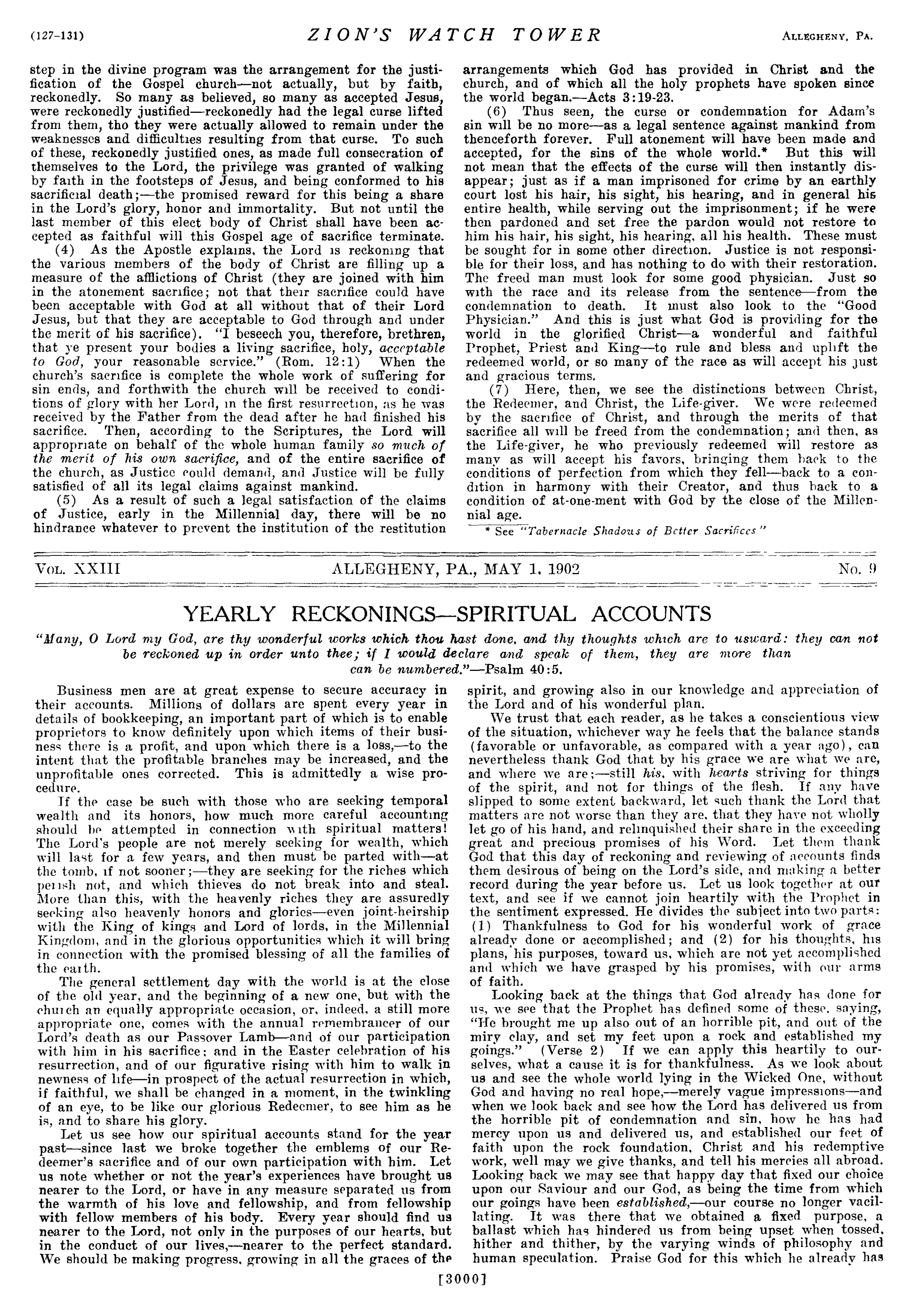
(127-131) step in the divine program was the arrangement for the justification of the Gospel churech—not actually, but by faith, reckonedly. So many as believed, 80 many as accepted Jesus, were reckonedly justified—reckonedly had the legal curse lifted from them, tho they were actually allowed to remain under the weaknesses and difficulties resulting from that curse. To such of these, reckonedly justified ones, as made full consecration of themselves to the Lord, the privilege was granted of walking by faith in the footsteps of Jesus, and being conformed to his sacrificial death;—the promised reward for this being a share in the Lord’s glory, honor and immortality. But not until the last member of this elect body of Christ shall have been accepted as faithful will this Gospel age of sacrifice terminate. (4) As the Apostle explains, the Lord 1s reckoning that the various members of the body of Christ are filling up a measure of the afflictions of Christ (they are joined with him in the atonement sacrifice; not that their sacrifice could have been acceptable with God at all without that of their Lord Jesus, but that they are acceptable to God through and under the merit of his sacrifice). “I beseech you, therefore, brethren, that ye present your bodies a living sacrifice, holy, acceptable to God, your reasonable service.” (Rom, 12:1) When the church’s sacrifice is complete the whole work of suffering for sin ends, and forthwith the church will be received to conditions of glory with her Lord, in the first resurrection, as he was received by the Father from the dead after he had finished his sacrifice. Then, according to the Scriptures, the Lord will appropriate on behalf of the whole human family so much of the merit of his own sacrifice, and of the entire sacrifice of the church, as Justice could demand, and Justice will be fully satisfied of all its legal claims against mankind. (5) As a result of such a legal satisfaction of the claims of Justice, early in the Millennial day, there will be no hindrance whatever to prevent the institution of the restitution Vou. XXIII YEARLY RECKONINGS—SPIRITUAL ACCOUNTS ZION’S WATCH TOWER ALLEGHENY, Pa. arrangements which God has provided in Christ and the church, and of which all the holy prophets have spoken since the world began.—Acts 3:19-23. (6) Thus seen, the curse or condemnation for Adam’s sin will be no more—as a legal sentence against mankind from thenceforth forever. Full atonement will have been made and accepted, for the sins of the whole world.* But this will not mean that the effects of the curse will then instantly disappear; just as if a man imprisoned for crime by an earthly court lost his hair, his sight, his hearing, and in general his entire health, while serving out the imprisonment; if he were then pardoned and set free the pardon would not restore to him his hair, his sight, his hearing, all his health. These must be sought for in some other direction. Justice is not responsible for their loss, and has nothing to do with their restoration. The freed man must look for some good physician. Just so with the race and its release from the sentence—from the condemnation to death. It must also look to the “Good Physician.” And this is just what God is providing for the world in the glorified Christ—a wonderful and faithful Prophet, Priest and King—-to rule and bless and uphft the redeemed world, or so many of the race as will accept his just and gracious terms. (7) Here, then, we see the distinctions between Christ, the Redeemer, and Christ, the Life-giver. We were redeemed by the sacrifice of Christ, and through the merits of that sacrifice all will be freed from the condemnation; and then, as the Life-giver, he who previously redeemed will restore as many as will accept his favors, bringing them hack to the conditions of perfection from which they fell—back to a condition in harmony with their Creator, and thus hack to a condition of at-one-ment with God by tke close of the Millennial age. * See “Tabernacle Shadous of Better Sacrifices” ALLEGHENY, PA., MAY 1, 1902 No. 9 “Many, O Lord my God, are thy wonderful works which thou hast done, and thy thoughts which are to usward: they can not be reckoned up in order unto thee; if I would declare and speak of them, they are more than can be numbered.”—Psalm 40:5. Business men are at great expense to secure accuracy in their accounts. Millions of dollars are spent every year in details of bookkeeping, an important part of which is to enable proprietors to know definitely upon which items of their business there is a profit, and upon which there is a loss,—to the intent that the profitable branches may be increased, and the unprofitable ones corrected. This is admittedly a wise procedure. Tf the case be such with those who are seeking temporal wealth and its honors, how much more careful accounting should be attempted in connection with spiritual matters! The Lord’s people are not merely seeking for wealth, which will last for a few years, and then must be parted with—at the tomb, 1f not sooner ;—they are seeking for the riches which perish not, and which thieves do not break into and steal. More than this, with the heavenly riches they are assuredly secking also heavenly honors and glorics—even joint-heirship with the King of kings and Lord of lords, in the Millennial Kingdom, and in the glorious opportunities which it will bring in connection with the promised blessing of all the families of the earth. The gencral settlement day with the world is at the close of the old year, and the beginning of a new one, but with the church an equally appropriate occasion, or, indeed, a still more appropriate one, comes with the annual remembrancer of our Lord’s death as our Passover Lamb—and of our participation with him in his sacrifice; and in the Easter celebration of his resurrection, and of our figurative rising with him to walk in newness of life—in prospect of the actual resurrection in which, if faithful, we shall be changed in a moment, in the twinkling of an eye, to be like our glorious Redeemer, to see him as he is, and to share his glory. Let us see how our spiritual accounts stand for the year past—since last we broke together the emblems of our Redeemer’s sacrifice and of our own participation with him. Let us note whether or not the year’s experiences have brought us nearer to the Lord, or have in any measure separated us from the warmth of his love and fellowship, and from fellowship with fellow members of his body. Every year should find us nearer to the Lord, not only in the purposes of our hearts, but in the conduct of our lives,—nearer to the perfect standard. We should be making progress, growing in all the graces of the spirit, and growing also in our knowledge and appreciation of the Lord and of his wonderful plan. We trust that each reader, as he takes a conscientious view of the situation, whichever way he feels that the balance stands (favorable or unfavorable, as compared with a year ago), can nevertheless thank God that by his grace we are what we are, and where we are;—still his, with hearts striving for things of the spirit, and not for things of the flesh. If any have slipped to some extent backward, let such thank the Lord that matters are not worse than they are, that they have not wholly let go of his hand, and relinquished their share in the exceeding great and precious promises of his Word. Let them thank God that this day of reckoning and reviewing of accounts finds them desirous of being on the Lord’s side, and making a better record during the year before us. Let us look together at our text, and see if we cannot join heartily with the Prophet in the sentiment expressed. He divides the subject into two parts: (1) Thankfulness to God for his wonderful work of grace already done or accomplished; and (2) for his thoughts, his plans, his purposes, toward us, which are not yet accomplished and which we have grasped by his promises, with our arms of faith. Looking back at the things that God already has done for us, we see that the Prophet has defined some of these. saying, “He brought me up also out of an horrible pit, and ont of the miry clay, and set my feet upon a rock and established my goings.” (Verse 2) If we can apply this heartily to ourselves, what a cause it is for thankfulness. As we look about us and see the whole world lying in the Wicked One, without God and having no real hope,—merely vague impressions—and when we look back and see how the Lord has delivered us from the horrible pit of condemnation and sin, how he has had mercy upon us and delivered us, and established our feet of faith upon the rock foundation, Christ and his redemptive work, well may we give thanks, and tell his mercies all abroad. Looking back we may see that happy day that fixed our choice upon our Saviour and our God, as being the time from which our goings have been established,—our course no longer vacillating. It was there that we obtained a fixed purpose, a ballast which has hindered us from being upset when tossed, hither and thither, by the varying winds of philosophy and human speculation. Praise God for this which he already has [3000]
To enhance your experience on our website, we use cookies and similar technologies. Some cookies are essential for the core functionality of our site and cannot be declined. You can choose to accept or decline additional cookies. We want to assure you that none of this data will be sold or used for marketing purposes. You can adjust your preferences at any time by accessing the Privacy Settings from the footer of the page. For more information, please refer to our
Privacy Policy
Terms of Use
.


