7
1
7
download/literature/watchtower/1903-10.pdf
watchtower/1903/10/1903-10-1
MAY
1.
J903
ZION'S
J-f,'ATCH
TOWER
(142-141)
rest
contentedly
therein
after
doing
all
within
our
power.
In
Paul's
case
it
may
be
that
conditions
at
Rome
would
be
more
favorable
to
his
ministry
later
than
they
were
at
this
time.
It
may
be
also
that
the
Lord
had
a
work
for
him
to
do
in
the
interim
as
a
prisoner
at
ClIlsarea,-amongst
the
Romans.
And
so
in
our
affairs:
we
are
to
look
for
the
opportunities
of
service
as
they
come,
and
leave
to
our
Lord
the
supervision
of
our
life
as
a
whole.
As
a
result
of
the
communication
of
the
plot
to
the
Roman
captain,
he
sent
the
Apostle
under
a
strong
military
escort
to
the
Roman
capital
of
Judea,-0l1lsarea.
There
the
Apostle,
al
though
kept
a
prisoner,
was
doubtle88
made
comfortable,
await
ing
the
trial
before
the
Roman
governor,
Felix.
The
essence
of
this
lesson
as
a
whole,
in
its
application
to
us,
is
expressed
in
the
Apostle'!!
words,
"If
God
be
for
us
who
can
be
against
us
,"
-Rom.
8:31.
INTERESTING
QUESTIONS
ANSWERED
wmOH
WERE
THE
MORE
RESPONSIBLE;
JUDAS
OR
AN
ANIAS
AND
SAPPHIRA?
Question.-
What
difference
should
we
recognize
as
between
the
condition
of
Judas
Iscariot
and
hiS
crime,
and
Ananias
and
Sapphira
and
their
crime'
The
one
sinned
before
the
holy
spirit
was
dispensed
at
Pentecost;
the
others
subsequently.
If
Judas'
case
merited
the
verdict
of
second
death,
would
not
the
others
merit
the
same'
If
Ananias
and
Sapphira
did
not
sin
the
sin
unto
death,
how
should
we
regard
the
case
of
Judas'
Answer.-There
would
appear
to
be
considerable
difference
between
these
two
cases.
Both
crimes
were
committed
against
much
light;
both
were
reprehensible;
but
that
of
Judas
seems
to
us
to
be
much
the
more
serious
of
the
two.
While
he
lived
prior
to
Pentecost,
we
are
to
remember
that
he
was
one
of
the
twelve
upon
whom
Jesus
had
specially
conferred
a
measure
of
his
spirit-such
a
measure
as
permitted
him,
with
the
others,
to
perform
miracles
of
healing,
casting
out
of
devils,
etc.,
as
recorded.
His
position
was
one
of
special
closeness
to
the
Lord
and
his
personal
instruction,
both
by
precept
and
example.
We
remember
our
Lord's
words
to
the
disciples,
"To
you
it
is
given
to
know
the
mysteries
of
the
kingdom;
but
to
them
that
are
without
these
things
are
spoken
in
parables."
All
this
privilege,
opportunity,
knowledge,
contact,
made
Judas
specially
responsible.
Then,
too,
his
crime
would
have
been
bad,
wicked,
had
it
been
against
any
ordinary
person;
but
was
seriously
in
tensified
by
being
a
crime
against
him
who
spake
and
acted
as
never
man
spake
or
acted
before.
It
is
from
this
standpoint
that
our
Lord's
declaration,
that
he
was
the
son
of
perdition,
seems
to
have
special
weight,
or
import,
as
implying
that
he
had
enjoyed
a
sufficiency
of
light
and
knowledge
of
righteous
ness
to
constitute
a
trial,
and
that
his
deliberate
sin
against
such
lig-ht
and
knowledge
meant
the
'lerond
death.
In
the
case
of
Ananias
and
Sapphira
they
were
beginners;
they
had
not
been
long
in
the
church;
they
never
met
the
Master,
and
had
not
known
the
apostles
a
great
while.
They
saw
others
consecrating
their
goods
and
noted
that
they
were
correspondingly
appreciated
in
the
church.
They
wished
to
have
such
an
appreciation,
and
wished
to
do
some
good
with
their
means;
but
a
selfish
feeling,
combined,
perhaps,
with
a
feeling
of
caution,
ensnared
them
into
a
wrong
course
of
conduct
which
the
Apostle
Peter
denominates
"lying
unto
the
holy
spirit."
We
do
not
positively
say
that
they
will
have
any
future
or
further
opportunity
for
gaining
everlasting
life;
we
know
of
no
Scrip
ture
which
guarantees
to
us
that
they
will
have
any
such;
yet
it
seems
to
us
not
improbable
that
they
will
have
a
further
opportunity
in
which
they
will
have
greater
light,
and
greater
knowledge
of
right
and
wrong,
and
of
the
results
attaching.
SHALL
WE
USE
THE
TERM
"EVOLUTION,"
ETC.?
Question-I
note
your
opposition
to
the
evolution
theory;
yet
in
MILLEN1\'IAL
DAWN,
Vol.
1.,
page
31,
you
remark
the
pos-
sibility
that
something
of
an
evolutionary
development
was
used
by
our
Creator
in
bringing
the
various
species
of
animals
each
to
its
own
perfection.
Let
me
ask,
then:
Cannot
we
Chris
tians
hold
to
the
word
"evolution"
with
propriety'
and
may
we
not
even
think
of
Adam
as
having
reached
human
perfection
by
a
process
of
development
as
one
of
the
species
animal'
Answer-No;
to
both
questions.
We
regard
the
words
Evo1Jution
and
Evolutionist
as
now
definitely
attached
to
a
par
ticular
theory.
These
words
belong
wholly
to
those
who
invented
and
now
have
them,
and
we
believe
that,
as
Christians,
we
would
do
well
to
avoid
them
thoroughly,
as
the
thought
connected
with
the
word
is
a
mechanical
one,
pure
and
simple,
as
in
opposition
to
a
creative
one.
We
would
hold
that
God
did
develop
dif·
ferent
species,
each
to
its
perfection,
and
that
he
developed
these,
either
by
a
long
or
a
short
process,
from
the
earth
itself;
but
we
cannot
admit,
as
evolutionists
would
claim,
that
this
was
merely
a
development
which
needed
not
the
Lifegiver
to
start
it,
and
to
maintain
and
direct
it.
We
would
claim
that
God
is
the
director
of
all
the
forces
of
nature,
and
that
they
are
all
of
his
own
creation,
and
results,
therefore,
of
his
direct
creation
in
every
instance-fish,
fowl,
brute,
man.
It
would
not
strike
us
as
reasonable
to
suppose
a
gradllal
development
of
a
perfect
man
by
an
evolutionary
process
with·
out
his
having
some
measure
of
responsibility
added
at
some
stage
of
his
career
before
he
reached
perfection.
Neither
would
it
be
reasonable
to
suppose
the
evolution
of
a
man
from
a
lower
order
of
being
to
absolute
perfection
of
his
own
kind,
without
a
history,
literature,
etc.,
etc.;
neither
would
it
be
reasonable
to
suppose
a
human
being
so
evolved
from
a
lower
order
of
being
to
human
perfection,
as
being
in
ignorance
of
good
and
evil
up
to
the
time
that
he
reached
perfection.
If
we
who
are
in
a
fallen
condition
are
held
to
be
responsible
to
divine
law,
would
not
those
of
the
human
family
who
had
not
yet
reached
full
perfection,
hut
who
had
considerable
intelligence,
be
reasonably
amenable
to
law
also
'-supposing
your
theory
to
be
true.
From
whatever
standpoint
we
would
view
the
matter
we
can
find
no
ground
whatever
for
supposing
that
Adam
ever
had
a
human
father,
either
perfect
or
imperfect
in
the
flesh.
Much
more
would
we
disbelieve
that
he
ever
had
a
father
of
a
lower
order
of
being,
who
could
give
him
life
in
the
divine
likeness,
in
heart
and
head.
Furthermore,
to
!luppose
such
a
possible
evolu
tion
of
a
man
to
perfection
from
a
condition
of
imperfection,
would
be
to
suppose
that
man,
in
the
present-time
imperfect
condition,
is
his
own
savior,
and
could
re-commence
a
process
of
evolution
just
as
well
as
he
could
have
carried
on
such
a
process
before
reaching
perfection.
If
such
a
proposition
should
be
con
sidered
true,
it
would
negative
all
the
Scriptural
teachings
we
have
respecting
the
necessity
for
a
Redeemer
and
for
his
in
terference
in
order
supernaturally
to
bring
about
times
of
resti
tution
of
all
things.
VOL.
XXIV
ALLEGHENY,
PA.,
MAY
15,
1903
"LOOKING
FOR
THAT
BLESSED
HOPE"
No.
10
"1
will
come
again
and
receive
you
unto
myself,'
that
where
1
am,
there
ye
may
be
aZso."-John
14:
3.
What
joyful
hopes,
what
exuberant
anticipations,
('luster
around
this
promise,
in
the
hearts
of
the
Lord's
faithful!
In
a
few
words
it
sums
up
all
the
good
things
that
God
hath
in
reservation
for
them
that
love
him.
But
not
all
mankind
have
such
feelings
in
respect
to
this
subject
;-not
all
are
aware
of
the
gracious
blessings
lwld
in
store
for
the
world,
awaiting
that
auspicious
time
for
their
dissemination;
and
not
all
mankind
are
in
such
a
condition
of
mind
and
hpart
as
to
be
able,
with
joy,
to
anticipate
meeting
the
Lord.
We
can
readily
surmise
that
not
only
a
large
proportion
of
nominal
Christendom,
but
a
comparatively
large
proportion
of
true
Christians,
are
not
living
in'
that
attitude
of
heart
and
daily
life
which
would
permit
them
to
antiCipate
this
meeting
with
sentiments
of
pleasure.
Not
only
do
false
doctrines
hinder
a
joyful
anticipation
of
this
great
event,
but
sin,
likewise,
hinders
such
jovful
an
ticipation,
induces
shame
and
fear,-knowing
that
even
those
conditions
of
heart
which
may
be
hidden
from
fellow-sen-ants
cannot
be
hidden
from
the
Master.
We
pray
with
the
prophet,
"Cleanse
thou
me
from
secret
faults.
keep
back
thy
f!ervant
also
from
pre!mmptuous
sins,"
and
to
the
extent
that
this
is
the
desire
of
our
hearts,
and
the
effort
of
our
lives,-to
the
extent
that
the
testimony
of
God's
Word
dwells
in
us
rightly,
and
cnables
us
to
recognize
the
lengths
and
breadths
of
divine
love
and
compassion
covering
unintentional
shortcomings,-to
this
extent
the
Lord's
faithful
ones
are
able
to
rejoice
in
this
promise,
and
to
look
forward
with
joy
ll'Ji
only
to
the
meeting
with
the
Lord,
but
also
to
their
abiding
everlastingly
in
his
presence
and
companionship.
But
to
all
others-to
all
who
are
not
living
up
to
their
privileges
as
children
of
God
and
[3191]
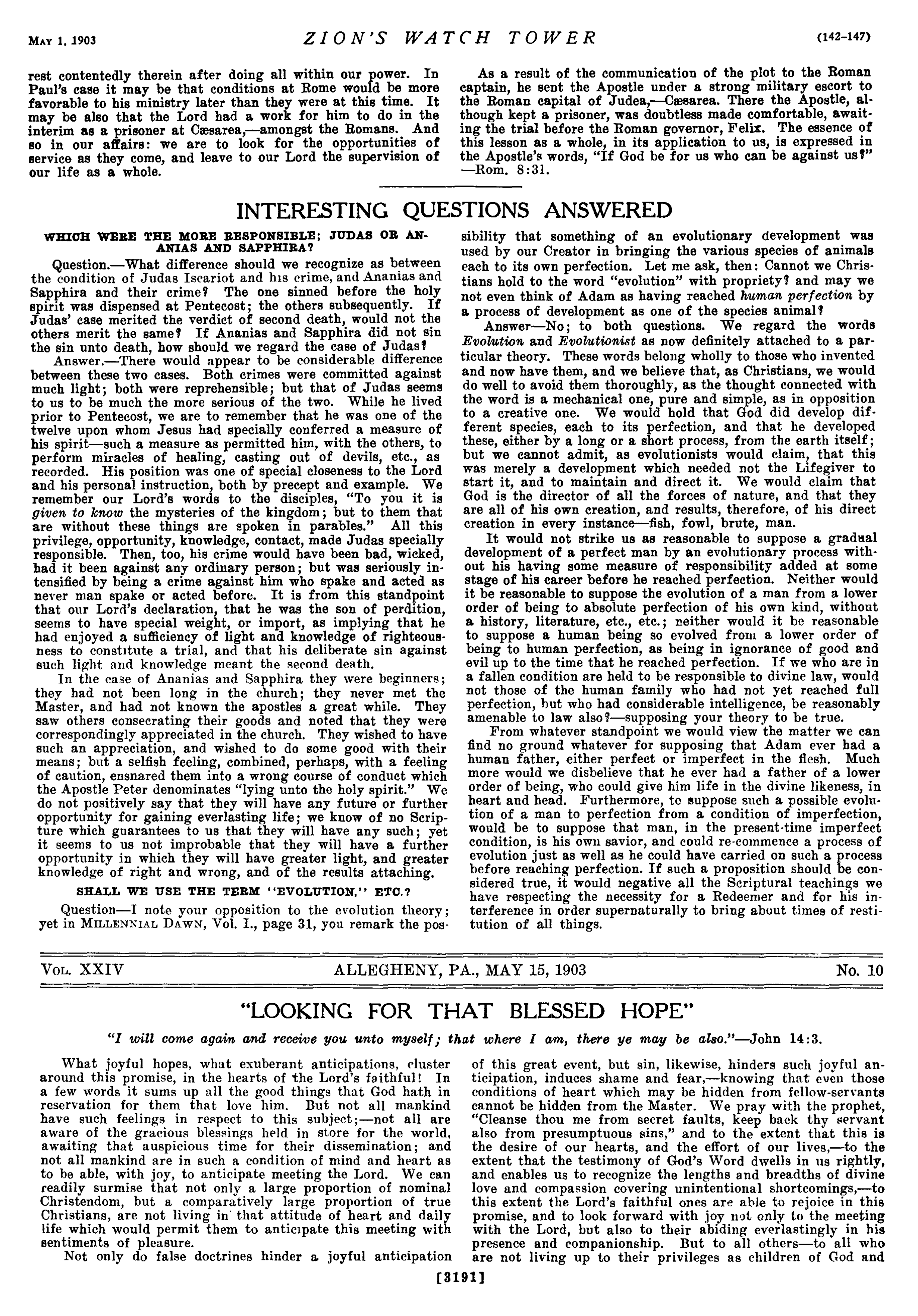
May 1, 1903 ZION’S rest contentedly therein after doing all within our power. In Paul’s case it may be that conditions at Rome would be more favorable to his ministry later than they were at this time. It may be also that the Lord had a work for him to do in the interim as a prisoner at Cesarea,—amongst the Romans. And so in our affairs: we are to look for the opportunities of service as they come, and leave to our Lord the supervision of our life as a whole. WATCH TOWER (142-147) As a result of the communication of the plot to the Roman captain, he sent the Apostle under a strong military escort to the Roman capital of Judea,—Cesarea. There the Apostle, although kept a prisoner, was doubtless made comfortable, awaiting the trial before the Roman governor, Felix. The essence of this lesson as a whole, in its application to us, is expressed in the Apostle’s words, “If God be for us who can be against us?” —Rom, 8:31. INTERESTING QUESTIONS ANSWERED WHICH WERE THE MORE RESPONSIBLE; JUDAS OR ANANIAS AND SAPPHIRA? Question What difference should we recognize as between the condition of Judas Iscariot and his crime, and Ananias and Sapphira and their crime? The one sinned before the holy spirit was dispensed at Pentecost; the others subsequently. If Judas’ case merited the verdict of second death, would not the others merit the same? If Ananias and Sapphira did not sin the sin unto death, how should we regard the case of Judas? Answer.—There would appear to be considerable difference between these two cases. Both crimes were committed against much light; both were reprehensible; but that of Judas seems to us to be much the more serious of the two. While he lived prior to Pentecost, we are to remember that he was one of the twelve upon whom Jesus had specially conferred a measure of his spirit—such a measure as permitted him, with the others, to perform miracles of healing, casting out of devils, etc., as recorded. His position was one of special closeness to the Lord and his personal instruction, both by precept and example. We remember our Lord’s words to the disciples, “To you it is given to know the mysteries of the kingdom; but to them that are without these things are spoken in parables.” All this privilege, opportunity, knowledge, contact, made Judas specially responsible, Then, too, his crime would have been bad, wicked, had it been against any ordinary person; but was seriously intensified by being a crime against him who spake and acted as never man spake or acted before. It is from this standpoint that our Lord’s declaration, that he was the son of perdition, seems to have special weight, or import, as implying that he had enjoyed a sufficiency of light and knowledge of righteousness to constitute a trial, and that his deliberate sin against such light and knowledge meant the second death. In the case of Ananias and Sapphira they were beginners; they had not been long in the church; they never met the Master, and had not known the apostles a great while. They saw others consecrating their goods and noted that they were correspondingly appreciated in the church. They wished to have such an appreciation, and wished to do some good with their means; but a selfish feeling, combined, perhaps, with a feeling of caution, ensnared them into a wrong course of conduct which the Apostle Peter denominates “lying unto the holy spirit.” We do not positively say that they will have any future or further opportunity for gaining everlasting life; we know of no Scripture which guarantees to us that they will have any such; yet it seems to us not improbable that they will have a further opportunity in which they will have greater light, and greater knowledge of right and wrong, and of the results attaching. SHALL WE USE THE TERM ‘‘EVOLUTION,’’ ETC.? Question—I note your opposition to the evolution theory; yet in MILLENNIAL Dawn, Vol. I., page 31, you remark the pos Vout. XXIV ALLEGHENY, PA., MAY 15, 1903 sibility that something of an evolutionary development was used by our Creator in bringing the various species of animals each to its own perfection. Let me ask, then: Cannot we Christians hold to the word “evolution” with propriety? and may we not even think of Adam as having reached human perfection by a process of development as one of the species animal? Answer—No; to both questions. We regard the words Evolution and Evolutionist as now definitely attached to a particular theory. These words belong wholly to those who invented and now have them, and we believe that, as Christians, we would do well to avoid them thoroughly, as the thought connected with the word is a mechanical one, pure and simple, as in opposition to a creative one. We would hold that God did develop different species, each to its perfection, and that he developed these, either by a long or a short process, from the earth itself; but we cannot admit, as evolutionists would claim, that this was merely a development which needed not the Lifegiver to start it, and to maintain and direct it. We would claim that God is the director of all the forces of nature, and that they are all of his own creation, and results, therefore, of his direct creation in every instance—fish, fowl, brute, man. It would not strike us as reasonable to suppose a gradual development of a perfect man by an evolutionary process without his having some measure of responsibility added at some stage of his career before he reached perfection. Neither would it be reasonable to suppose the evolution of a man from a lower order of being to absolute perfection of his own kind, without a history, literature, ete., ete.; neither would it be reasonable to suppose a human being so evolved from a lower order of being to human perfection, as being in ignorance of good and evil up to the time that he reached perfection. If we who are in a fallen condition are held to be responsible to divine law, would not those of the human family who had not yet reached full perfection, but who had considerable intelligence, be reasonably amenable to law also?—supposing your theory to be true. From whatever standpoint we would view the matter we can find no ground whatever for supposing that Adam ever had a human father, either perfect or imperfect in the flesh. Much more would we disbelieve that he ever had a father of a lower order of being, who could give him life in the divine likeness, in heart and head. Furthermore, te suppose such @ possible evolution of a man to perfection from a condition of imperfection, would be to suppose that man, in the present-time imperfect condition, is his own savior, and could re-commence a process of evolution just as well as he could have carried on such a process before reaching perfection. If such a proposition should be considered true, it would negative all the Scriptural teachings we have respecting the necessity for a Redeemer and for his interference in order supernaturally to bring abuut times of restitution of all things. No. 10 “LOOKING FOR THAT BLESSED HOPE” “IT will come again and receive you unto myself ; that where I am, there ye may be also.’—John 14:3. What joyful hopes, what exuberant anticipations, cluster around this promise, in the hearts of the Lord’s faithful! In a few words it sums up all the good things that God hath in reservation for them that love him. But not all mankind have such feelings in respect to this subject;—not all are aware of the gracious blessings held in store for the world, awaiting that auspicious time for their dissemination; and not all mankind are in such a condition of mind and heart as to be able, with joy, to anticipate meeting the Lord. We can readily surmise that not only a large proportion of nominal Christendom, but a comparatively large proportion of true Christians, are not living in that attitude of heart and daily life which would permit them to anticipate this meeting with sentiments of pleasure. Not only do false doctrines hinder a joyful anticipation of this great event, but sin, likewise, hinders such joyful anticipation, induces shame and fear,—knowing that even those conditions of heart which may be hidden from fellow-servants cannot be hidden from the Master. We pray with the prophet, “Cleanse thou me from secret faults, keep back thy servant also from presumptuous sins,” and to the extent that this is the desire of our hearts, and the effort of our lives,—to the extent that the testimony of God’s Word dwells in us rightly, and enables us to recognize the lengths and breadths of divine love and compassion covering unintentional shortcomings,—to this extent the Lord’s faithful ones are able to rejoice in this promise, and to look forward with joy not enly to the meeting with the Lord, but also to their abiding everlastingly in his presence and companionship. But to all others—to all who are not living up to their privileges as children of God and [3191]
To enhance your experience on our website, we use cookies and similar technologies. Some cookies are essential for the core functionality of our site and cannot be declined. You can choose to accept or decline additional cookies. We want to assure you that none of this data will be sold or used for marketing purposes. You can adjust your preferences at any time by accessing the Privacy Settings from the footer of the page. For more information, please refer to our
Privacy Policy
Terms of Use
.


