7
1
7
download/literature/watchtower/1903-22.pdf
watchtower/1903/22/1903-22-1
NOVEJUU
15.
1903
ZION'S
WATCH
TOWER
(435-436)
was
prospering
him
in
the
matter
to
which
he
had
called
him,
he
evidently
was
full
of
joy
and
satisfaction
and
peace.
So
it
should
be
with
all
the
Lord's
people
who
have
been
called
to
be
heirs
of
God,
joint-heirs
with
Jesus
Christ
their
Lord,
for
"an
inheritance
incorruptible,
undefiled
and
fadeth
not
away,
reo
served
in
heaven
for
you
who
are
kept
through
faith
and
by
the
power
of
God
unto
salvation,
ready
to
be
revealed
in
the
last
time."
They,
too,
should
realize
that
the
proper
way
to
show
their
appreciation
of
the
Lord's
promised
blessings
is
by
a
manifestation
of
faith
in
him,
confidently
trusting
and
rejoicing
in
these.
Wherever
we
find
fear,
trepidation,
unrest,
we
may
know
that
these
are
symptoms
of
some
spiritual
mal-
ady;
because
whatever
may
be
the
outward
disturbances,
troubles,
vexations,
it
is
the
privilege
of
those
who
are
the
Lor~'s
to
have
~he
peace
of
God
which
passeth
all
understanding
contmually
rUlIng
in
their
hearts.
It
is
their
privilege
to
real
ize
fully,
thoroughly
that
all
things
are
working
together
for
good
to
them
because
they
love
the
Lord,
and
with
this
thought
of
their
call
to
the
kingdom
and
of
the
Lord's
willingness
that
they
should
serve
therein,
and
with
the
assurance
that
he
will
give
grace
and
glory
and
no
good
thing
withhold
from
those
who
walk
uprightly,
we
certainly
have
reason
for
thankfulness
and
heart-rejoicing
before
him.
VOL.
XXIV
ALLEGHENY,
P
A.,
DECEMBER
1,
1903
No.
23
"HALLELUJAHl
WHAT
A
SAVIORl"
CHRIST,
THE
INSTRUCTOR,
JUSTIFIER,
SANCTIFIER
AND
DELIVERER
OF
HIS
PEOPLE.
"Who
of
God
is
made
unto
us
wisdam,
and
rigMeQ'lJ,SneS8,
[justification],
a.nd
sanctification,
and
redemption
[deUverance]."
-1
Cor.
1:30.
CHRIST
OUR
W1SDOM
is
the
particular
class
referred
to
in
this
scripture-"who
of
Since
God's
dealings
with
his
creatures
recognize
their
God
is
made
unto
us
justification,"
or
righteousness.
wills,
the
first
step
in
his
dealings
with
tllem,
therefore,
is
to
(4)
How
God
has
arranged
or
caused
Christ
to
be
our
give
them
knowledge,
or
"wisdom,"
as
it
is
translated
in
the
"righteousness,"
or
justification,
is
not
here
explained'
but
above
Scripture.
It
is
for
this
reason
that
preaching
was
the
what
we
know
of
divine
law
and
character
assures
us
th~t
the
first
command
of
the
Gospel
age.
To
the
worldly-minded
the
principle
of
Justice,
the
very
founda.tion
o~
divine
government,
preaching
of
forgiveness
on
account
of
faith
in
the
crucified
must
someho~
have
been
fully
satisfied
In
all
of
its
claims.
Jesus
did
not
seem
the
wise
course.
To
them
it
would
have
And
other
sCrIptures
fully
substantiate
this
conclusion.
They
seemed
better
for
God
to
have
commanded
something
to
be
as~ert
tha~
God
so
arranged
II;s
to
have
the
price
of
man's
sin
done
by
them.
But,
as
Paul
says-"It
pleased
God
to
save
paid
for
him;
and
that
~he
pr~ce
paid
w~s
an
exact
equivalent,
those
who
believe
by
[knowledge
imparted
through
what
the
a
rans?7l?'
or
c?rrespo~dtng
prwe,
offsettmg
in
every
particular
worldly
consider]
the
foolishness
of
this
preaching."-1
Cor.
th?
~mgm~l
sin
and
Just
penal~y,
death,
as
it
came
upon
the
1
:21.
ongmal
smner
and
through
him
by
heredity
upon
all
men.
The
first
gift
of
God
to
our
redeemed
race,
therefore
was
(Rom.
5:
12,
18-20)
He
tells
us
that
this
plan
of
salvation
was
knowledge.
adopted
because
by
it
"God
might
be
[or
continue]
just
and
(1)
Knowledge
of
the
greatness
and
absolute
justice
of
[yet
be]
the
justifier
of
him
[any
sinner]
that
believeth
in
the
God
with
whom
we
have
to
do.
This
knowledge
was
pre-
Jesus"-tllat
Comes
unto
God
under
the
terms
of
the
New
pared
for
by
the
Mosiac
Law,
which
was
a
"schoolmaster,"
or
~ovenant,
o~
which
Christ
Jes~s
is
the
mediator,
having
sealed
pedagogue,
to
lead
men
to
Christ.
And
Christ.
by
his
obedi-
It,
or
made
It
a
covenant,
by
hIS
own
precious
blood.-Heb.
13:
ence
to
that
law,
magnified
the
law
and
showed
its
honorable-
21;
10:29.
ness,
its
worthiness;
and
thus
honored
God,
the
authOr
of
that
(5)
While
the
benefits
of
this
gracious
arrangement
are
law,
and
showed
his
character.
only
for
"us,"
for
"believers,"
for
those
who
come
unto
God
by
(2)
Knowledge
of
his
own
weakness,
of
his
fallen,
sinful
Christ-under
the
provisions
of
the
*New
Covenant-these
ben
and
helpless
condition,
was
also
needful
to
man,
that
he
might
efits
.a~e,
nevertheless.
made
applicable
to
all;
for
God's
spcdal
appr('ciate
his
need
of
a
Savior
such
as
God's
plan
had
pro-
prOVISIOn
for
the
whole
world
of
sinners
is
that
all
shall
"come
vided
for
him.
to
a
knowledge.
0t
the
tmth(
that
they
may,
if
then
they
will
(3)
Knowledge
of
how
the
entire
race
of
Adam
fell
from
accept
the
conditIons
of
~od
~
covenant,
be
everlastingly
saved.
diYine
favor
and
from
mental,
moral
and
physical
perfection,
A
knowledge
and
a
reJection
of
error-of
false
doctrines
through
llim,
was
also
necessary.
'Vithout
this
knowledge
which
misrepresent
the
divine
eharact('r
even
thOlwh
thcy
be
we
could
not
have
seen
how
God
could
be
just
in
accepting
the
mixed
with
a
little
misconstrued
truth-will
not
~
constitute
one
life,
of
Christ,
as
the
ransom
price
for
the
life
of
the
whole
grounds
for
condemnation;
but
a
knowlcdgc
of
the
t1'uth
and
a
world.
rejection
of
it
will
bring
condemnation
to
the
second
death.
.
(4)
Without
knowledge
as
to
what
is
the
penalty
for
sin
The
Greek
te~t
states
this
much
more
emphatically
than
our
-that
"the
wages
of
sin
is
death"-we
never
should
have
been
common
Enghsh
translation.
It
says,
"come
to
an
aCC1lrate
able
to
understand
how
the
death
of
our
Redeemer
paid
the
knowledge
of
the
truth."-l
Tim.
2
:4.
penalty
against
Adam
and
aU
in
him.
(6)
The
provision
macIe
was
sufficient
for
all
me'n.
Our
(5)
Knowledge,
in
these
various
respects,
was,
therefore,
Lord
gave
himself
[in
death]
a
ransom--a
corresponding
price
absolutely
necessary
to
us,
as
without
it
we
could
have
had
-for
all;
he
was
a
"propitiation
[or
sufficient
Ratisfactionl
for
no
proper
faith,
and
could
not
have
availed
ourselves
of
God's
the
sinR
of
the
whole
world."
(I
John
2:2)
As
a
conse
provision
of
justification,
sanctification
and
deliverance
through
qucnce,
he
iR
hoth
ahle
and
willing
"to
Rave
unto
the
uttermost
Christ.
[i.
e.,
to
save
from
sin,
and
from
divine
disfavor,
and
from
Most
heartily,
therefore,
we
thank
God
for
knowledge
or
death,
and
all
these
everlastingly]
all
that
come
unto
God
by
wisdom
concerning
his
plan.
And
we
see
that
this
wisdom
him."
(Heb.
7:
25)
And
inasmuch
as
God's
provision
is
so
came
to
us
through
Christ;
because.
had
it
not
been
for
the
broad,
that
all
shall
come
to
an
exact
knowledge
of
the
truth,
plan
of
salvation
of
which
he
and
his
cross
are
the
center,
it
respecting
these
proviRions
of
divine
mercy
under
the
terms
of
would
have
been
useless
to
give
the
knowledge,
useless
to
the
New
Covenant;-inasmuch
as
the
provision
is
that
all
preach,
because
there
would
have
been
no
salvation
to
offer.
the
.sin
and
prejudice-blind~d
eyes
shall.be
opened,
and
that
the
deVil.
who
for
long
centurIcs
has
decClved
men
with
his
mis-
CHRIST
OUR
JUSTIFICATION
representations
of
the
truth.
is
to
be
bound
for
a
thousand
That
Christ
is
made
unto
righteousness
or
justification
years,
so
that
he
can
deceive
the
nations
no
more;
and
that
then
implies,-
a
highway
of
holiness
shall
be
cast
up
in
which
the
most
stupid
(
1)
That
we
are
unjust,
or
unrighteous
in
the
sight
of
cannot
err
or
be
deceived;
and
in
view
of
all
this
provision
God
God,
and
unworthy
of
his
favor.
declares
that
all
men
will
be
saved
from
the
guilt
and
penalty
(2)
That,
in
view
of
our
unworthiness,
God
had
in
some
incurred
through
Adam's
sentence.
Because,
when
all
of
these
manner
arrang'ed
that
Christ's
righteouflness
Rhould
stand
,l!ood
blessed
arrangements
have
been
carried
into
effect,
there
will
for
"us,"
and
thus
give
"us"
a
standing
before
God
which
be
tl-O
reason
for
a
solitary
member
of
the
human
family
re
we
could
not
otherwise
have
because
of
our
imperfections-our
maining.
a
stranger
and
alien
fr?m
God's
family
except
by
his
unrighteousness.
O'l.lin
chfJ'lce
or
preference
for
unrI.l!hteousness,
and
that
with
an
(3)
This
scripture
does
not
imply
that
Christ's
righteous.
accurate
knowledge
that
all
unrighteousness
is
sin.
Such
as,
of
ness
covers
every
sinner,
so
that
God
now
views
everv
sinner
as
their
own
preference,
knowingly
choose
sin,
when
the
way
and
thoug-h
he
were
righteous,
and
treats
all
as
his
children.
No,
mean'!
of
becoming
servants
of
God
are
clearly
under~tood
by
it
refers
merely
to
a
special
class
of
sinners-sinners
who,
hav-
them,
are
wilful
sinners
on
their
own
account,
and
will
receive
ing
come
to
a
knowledge
of
sin
and
righteousness,
and
having
the
second
death
sentence
as
the
wages
of
their
own
opposition
learned
the
undesirableness
of
sin,
have
repented
of
sin,
and
to
God's
righteous
arrangements.
sought
to
flee
from
it
and
to
come
into
harmony
with
God.
This
•
See
June
IS,
1919,
issue.
for
critical
examination
of
Covenants.
[3279]
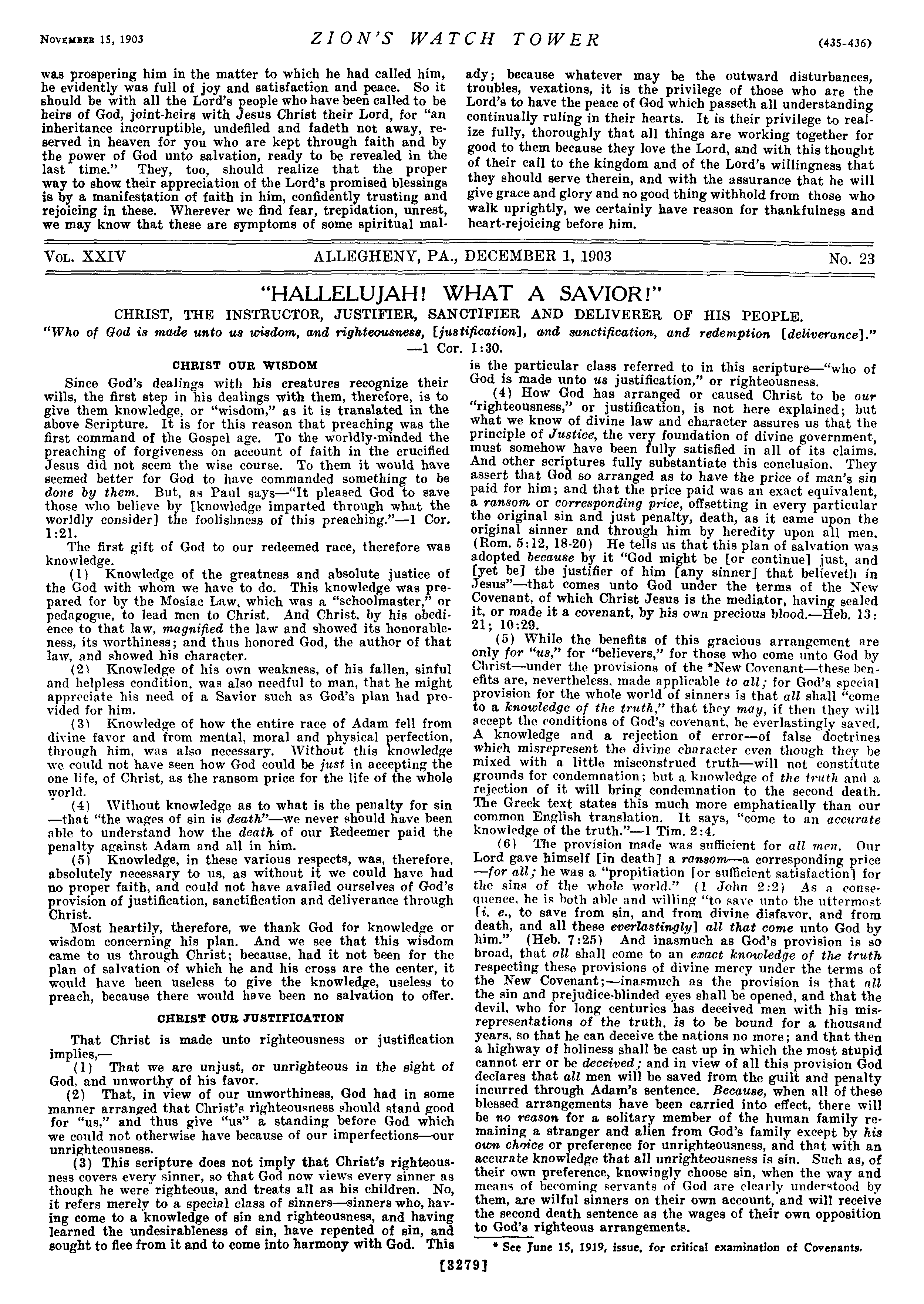
NovemBer 15, 1903 was prospering him in the matter to which he had called him, he evidently was full of joy and satisfaction and peace. So it should be with all the Lord’s people who have been called to be heirs of God, joint-heirs with Jesus Christ their Lord, for “an inheritance incorruptible, undefiled and fadeth not away, reserved in heaven for you who are kept through faith and by the power of God unto salvation, ready to be revealed in the last time.” They, too, should realize that the proper way to show their appreciation of the Lord’s promised blessings is by a manifestation of faith in him, confidently trusting and rejoicing in these. Wherever we find fear, trepidation, unrest, we may know that these are symptoms of some spiritual mal Vou. XXIV ZION’S WATCH TOWER ALLEGHENY, PA., (435-436) ady; because whatever may be the outward disturbances, troubles, vexations, it is the privilege of those who are the Lord’s to have the peace of God which passeth all understanding continually ruling in their hearts. It is their privilege to realize fully, thoroughly that all things are working together for good to them because they love the Lord, and with this thought of their call to the kingdom and of the Lord’s willingness that they should serve therein, and with the assurance that he will give grace and glory and no good thing withhold from those who walk uprightly, we certainly have reason for thankfulness and heart-rejoicing before him. DECEMBER 1, 1903 No. 23 “HALLELUJAH! WHAT A SAVIOR!” CHRIST, THE INSTRUCTOR, JUSTIFIER, SANCTIFIER AND DELIVERER OF HIS PEOPLE. “Who of God is made unto us wisdom, and righteousness, [justification], and sanctification, and redemption [deliverance].” —1 Cor. 1:30. CHRIST OUR WISDOM Since God’s dealings with his creatures recognize their wills, the first step in his dealings with them, therefore, is to give them knowledge, or “wisdom,” as it is translated in the above Scripture. It is for this reason that preaching was the first command of the Gospel age. To the worldly-minded the preaching of forgiveness on account of faith in the crucified Jesus did not seem the wise course. To them it would have seemed better for God to have commanded something to he done by them, But, as Paul says—“It pleased God to save those who believe by [knowledge imparted through what the worldly consider] the foolishness of this preaching.”—-1 Cor. 1:21, The first gift of God to our redeemed race, therefore was knowledge. {1} Knowledge of the greatness and absolute justice of the God with whom we have to do. This knowledge was prepared for by the Mosiac Law, which was a “schoolmaster,” or pedagogue, to lead men to Christ. And Christ, by his obedience to that law, magnified the law and showed its honorableness, its worthiness; and thus honored God, the author of that law, and showed his character. (2) Knowledge of his own weakness, of his fallen, sinful and helpless condition, was also needful to man, that he might appreciate his need of a Savior such as God’s plan had provided for him. (3) Knowledge of how the entire race of Adam fell from divine favor and from mental, moral and physical perfection, through him, was also necessary. Without this knowledge we could not have seen how God could be just in accepting the one life, of Christ, as the ransom price for the life of the whole world. “ (4) Without knowledge as to what is the penalty for sin —that “the wages of sin is death”—we never should have been able to understand how the death of our Redeemer paid the penalty against Adam and all in him. (5) Knowledge, in these various respects, was, therefore, absolutely necessary to us, as without it we could have had no proper faith, and could not have availed ourselves of God’s provision of justification, sanctification and deliverance through Christ. Most heartily, therefore, we thank God for knowledge or wisdom concerning his plan. And we see that this wisdom came to us through Christ; because, had it not been for the plan of salvation of which he and his cross are the center, it would have been useless to give the knowledge, useless to preach, because there would have been no salvation to offer. CHRIST OUR JUSTIFICATION That Christ is made unto righteousness or justification implies,— (1) That we are unjust, or unrighteous in the sight of God, and unworthy of his favor. (2) That, in view of our unworthiness, God had in some manner arranged that Christ’s righteousness should stand good for “us,” and thus give “us” a standing before God which we could not otherwise have because of our imperfections—our unrighteousness. (3) This scripture does not imply that Christ’s righteousness covers every sinner, so that God now views every sinner as though he were righteous, and treats all as his children. No, it refers merely to a special class of sinners—sinners who, having come to a knowledge of sin and righteousness, and having learned the undesirableness of sin, have repented of sin, and sought to flee from it and to come into harmony with God. This is the particular class referred to in this scripture—“‘who of God is made unto us justification,” or righteousness. . (4) How God has arranged or caused Christ to be our “righteousness,” or justification, is not here explained; but what we know of divine law and character assures us that the principle of Justice, the very foundation of divine government, must somehow have been fully satisfied in all of its claims. And other scriptures fully substantiate this conclusion. They assert that God so arranged as to have the price of man’s sin paid for him; and that the price paid was an exact equivalent, &% ransom or corresponding price, offsetting in every particular the original sin and just penalty, death, as it came upon the original sinner and through him by heredity upon all men. (Rom. 5:12, 18-20) He tells us that this plan of salvation was adopted because by it “God might be [or continue] just, and {yet be] the justifier of him {any sinner] that believeth in Jesus”—that comes unto God under the terms of the New Covenant, of which Christ Jesus is the mediator, having sealed it, or made it a covenant, by his own precious blood.—Heb. 13: 21; 10:29. (5) While the benefits of this gracious arrangement are only for “us,” for “believers,” for those who come unto God by Christ—under the provisions of the *New Covenant—these benefits are, nevertheless. made applicable to all; for God’s special provision for the whole world of sinners is that all shall “come to a knowledge of the truth,” that they may, if then they will accept the conditions of God’s covenant, be everlastingly saved, A knowledge and a rejection of error—of false doctrines which misrepresent the divine character even though they he mixed with a little misconstrued truth—will not constitute grounds for condemnation; but a knowledge of the truth and a rejection of it will bring condemnation to the second death. The Greek text states this much more emphatically than our common English translation, It says, “come to an accurate knowledge of the truth.”—1 Tim. 2:4. (6} The provision made was sufficient for all men. Our Lord gave himself [in death] a ransom—a corresponding price —for ail; he was a “propitiation [or sufficient satisfaction] for the sins of the whole world.” (1 John 2:2) As a consequence, he is both able and willing “to save unto the uttermost {i. ¢., to save from sin, and from divine disfavor, and from death, and all these everlastingly] all that come unto God by him.” (Heb. 7:25) And inasmuch as God’s provision is so broad, that oll shall come to an exact knowledge of the truth respecting these provisions of divine mercy under the terms of the New Covenant;—inasmuch as the provision is that all the sin and prejudice-blinded eyes shall be opened, and that the devil, who for long centurics has deceived men with his misrepresentations of the truth, is to be bound for a thousand years, so that he can deceive the nations no more; and that then a highway of holiness shall be cast up in which the most stupid cannot err or be deceived ; and in view of all this provision God declares that all men will be saved from the guilt and penalty incurred through Adam’s sentence. Because, when all of these blessed arrangements have been carried into effect, there will be no reason for a solitary member of the human family remaining a stranger and alien from God’s family except by his own choice or preference for unrighteousness, and that with an accurate knowledge that all unrighteousness is sin. Such as, of their own preference, knowingly choose sin, when the way and means of becoming servants of God are clearly understood by them, are wilful sinners on their own account, and will receive the second death sentence as the wages of their own opposition to God’s righteous arrangements. * See June 15, 1919, issue, for critical examination of Covenants. [3279]
To enhance your experience on our website, we use cookies and similar technologies. Some cookies are essential for the core functionality of our site and cannot be declined. You can choose to accept or decline additional cookies. We want to assure you that none of this data will be sold or used for marketing purposes. You can adjust your preferences at any time by accessing the Privacy Settings from the footer of the page. For more information, please refer to our
Privacy Policy
Terms of Use
.


