7
1
7
download/literature/watchtower/1904-19.pdf
watchtower/1904/19/1904-19-1
VOL.
XXV
ALLEGHENY,
PA.,
OCTOBER
1,
1904
No.
19
SONS
AND
DAUGHTERS
OF
CONSOLATION-COMFORT
''Joses,
by
the
Apostles,
was
surnamed
Barnabas,
which
M,
being
interpreted,
the
son
of
consolation
[comfort)"-Acts
4:36.
Comfort:
Consolation!
What
rest
and
refreshment
and
hold
that
the
character
and
words
of
Jesus
have
today
upon
peace
and
joy
these
words
imply!
That
the
name
"son
of
con-
our
hearts,
and
also
upon
the
hearts
of
many
who
are
not
hltl
solation,"
or
comfort,
should
be
given
to
any
o~e
of
mature
people
in
the
full
consecrated
sense.
It
was
not
by
continually
years
tells
a
whole
volume
in
itself
respecting
the
general
char-
chiding
the
apostles,
and
accusing
them,
but
because,
instead,
acter
of
the
person.
We
know
little
about
Barnabas
but
if
our
Lord
sympathized
with
them,
assisted
them,
and
inter
this
one
sentence
of
holy
writ
comprised
the
sum
of
ou;
knowl-
preted
their
heart-intentions
liberally,
generously,
that
they
euge
we
could
not
fail
to
love
and
appreciate
him.
became
more
and
more
his
faithful
followers,
even
unto
death.
In
one
sense
of
the
word
the
church
is
spoken
of
as
a
mother,
Note
the
case
of
the
woman
taken
in
sin,
and
our
Lord's
failure
Zion,
and
all
the
true
people
of
God
are
thus
represented
as
to
make
any
pharisaical
tirade
against
her.
Mark
his
reproof
her
children-sons
and
daughters.
Some
of
these
are
sons
of
to
those
who
stood
by:
"He
that
is
without
sin,
let
him
cast
~omfort
and
daughters
of
comfort,
while
others
are
sons
and
the
first
stone."
Mark
how,
when
they
were
all
thus
convicted
daughters
of
pain,
continually
causing
more
or
less
of
distress
of
imperfection
in
some
particular
themselves,
our
Lord
said
to
and
discomfort
to
others
and
to
themselves.
We
want
to
see
this
the
woman,
"Neither
do
I
condemn
thee;
go,
and
sin
no
more."
sub.iect
in
its
true
light,
in
order
that
we
may
each
act
accord-
(John
8:
3-11)
Notice
his
dealing
with
the
Apostle
Peter,
after
illgly;-thrrt
a
larger
and
an
increasing
number
of
the
children
he
had
denied
him,
cursing
and
swearing.
Many
of
the
Lord's
of
Zion
shall
be
sons
and
daughters
of
comfort
to
all
with
whom
followers,
if
in
his
stead,
would
have
felt
it
their
bounden
duty
they
come
in
contact,
and
thus
in
a
gcneral
way
comforters
to
to
rebuke
Peter
publicly
before
all
the
apostles,
and
to
have
the
church
as
a
whole.
Some
may
be
inclined
to
query,
Does
required
public
confession
and
some
sori
of
penance;
and
on
the
true
church
need
comfort?
Are
not
the
majority
too
com-
every
possible
occasion
afterward
to
have
thrown
in
his
face
fortabie
already?
Do
they
not
rather
need
to
be
stirred
up,
to
his
weakness
and
disloyalty,.
Such
have
not
rightly
interpreted
be
reminded
of
their
sins,
tv
be
chided
and
made
generally
as
and
copied
the
Lord's
spint,
and
hence
are
not
sons
and
daugh
uncomfortable
as
possible,
to
the
intent
that
they
may
thus
be
ters
of
consolation
in
the
church.
They
are,
in
the
contrary,
helped
onward
and
upward?
strife-breeders,
vexatious
hinderers
of
the
work
they
desne
to
We
would
not
ignore
the
fact
that
there
are
occasions
when
forward.
They
should
hear
the
Master's
voice,
"Takc
my
yoke
reproofs
and
corrections
in
righteousness
are
proper,
as
the
upon
you
and
learn
of
me."
In
proportion
as
we
learn
of
the
Apostle
advised.
But
we
have
no
sympathy
at
all
with
the
Lord
we
become,
not
mouthpieces
for
the
law
merely,
but
mouth
thought
so
common
with
some
good
people;
viz.,
that
they
pieces
specially
for
mercy
and
love
and
helpfulness
and
com
should
always
be
feeling
miRerable
with
themselves
and
mak-
fort.
ing
other
people
miserable,
by
continually
nagging
and
fault-
So
far
as
the
record
shows,
our
Lord
did
not
once
mention
finding,
upbraiding
and
terrorizing.
We
believe
that
such
well
to
Peter
either
his
profanity
or
his
disloyalty.
Peter
knew
meant
but
mistaken
efforts
have
done
much
harm,
have
driven
about
these
without
being
told;
he
had
already
wept
over
them
j
away
from
the
family
circle
of
Zion
many
who
could
not,
with-
a
mere
word
from
the
Lord
in
chiding,
reproof,
might
have
dis
out
hypocrisy,
claim
that
they
were
the
vilest
of
sinners,
nor
couraged
him,-perhaps
hopelessly.
The
nearest
thing
to
a
properly
appreciate
prayers
in
which
they
were
represented
as
reproof
in
our
Lord's
conduct
and
language
was
the
inqUIry,
saying,
"Lord,
be
merciful
unto
us,
miserable
sinners
I"
when
"Lovest
thou
me?"
Let
all
who
would
be
true
sons
and
daugh
they
realized
divine
favor
and
forgiveness-justification
from
ters
of
consolation
in
Zion
learn
this
lesson
from
the
great
an
things.
Teacher-not
to
strive
to
punish
and
correct
and
rl'prove
and
Those
nl'eding
reproof,
rebuke,
etc.,
are
such
as
are
walking
rebuke;
but
to
avoid
these
so
far
as
possible,
and
to
inquire,
after
the
flesh
and
not
after
the
Spirit-in
violation
of
their
not
so
much
about
the
past
as
about
the
present-What
is
the
covenant.
Those
who
should
be
warned
to
flee
from
the
wrath
offender's
present
attitude
toward
the
Lord
and
toward
his
to
come
are
such
as
have
never
yet
fled
for
refuge
to
the
hope
flock?
set
bpfore
them
in
the
Gm,pel,-such
as
are
without
God,
and
OOMFORT
AND
COMFORTING
NEEDF'OL
have
no
hope
in
the
world-no
relationship
to
Christ,
through
faith
and
obedience.
But
the
true
"wheat,"
the
true
members
It
was
with
the
full
appreciation
of
the
fact
that
the
church
of
the
body
of
Christ,
the
consecrated,
are,
however
imperfectly,
would
need
comfort
rather
than
chiding
and
reproof
that
our
continually
sl'eking
to
walk
after
the
Spirit;
though
they
are
Lord
said,
"If
I
go
not
away
the
Comforter
[the
holy
Spirit]
well
aware
that
because
of
imperfections
of
the
flesh
they
do
cannot
come."
The
ransom
must
be
paid,
must
be
presented
not
and
cannot
walk
up
to
the
spirit.
These,
instead
of
needing
in
the
"Most
Holy,"
to
the
heavenly
Father,
before
his
blessing
rpproofs
and
rt'bukes
and
smitings
and
upbraidings
for
their
could
be
bestowed.
That
blessing
would
yield
the
comfort
of
shortcomings,
which
they
admit
and
deplore
and
strive
against,
the
begetting
of
the
spirit
and
comfort
of
the
exceeding
great
need
sympathy,
aSsIstance,
comfort.
and
precious
promises
to
those
who
had
accepted
Jesus,-and
to
those
who
would
believe
on
him
through
their
word.
True,
our
Few
probably
have
noticed
to
what
extent
the
Scriptures
Lord
spoke
of
the
holy
Spirit
as
reproving-but
not
as
reprov
administer
this
very
"balm
of
Gilead"
to
the
true
children
of
ing
the
church;
he
said,
"He
shall
reprove
the
world
of
sin,
of
Zion
j
hut
the
Scriptures
are
full
of
comfort,
and
there
is
great
righteousness,
and
of
a
coming
judgment."
The
nearest
sugges
need
that
all
who
are
truly
the
Lord's
people
should
see
to
it
tion
to
reproof
in
respect
to
the
holy
Spirit's
dealing
with
the
that
they
are
m;Jre
and
more
sons
and
daughters
of
comfort
in
church
is
that
given
by
the
Apostle,
when
he
says,
"Grieve
not
the
church,
administering
to
one
another
the
helpfUlness
and
the
holy
Spirit
of
God,
whereby
ye
are
sealed
unto
the
day
of
encouragement
and
refre;:hment
which
the
Lord
intended.
Our
redemption."
And
again
he
says,
"Quench
not
the
Spirit."-
Lord
spoke
of
the
holy
Spirit
as
the
Comforter,
and
he
mentions
h
31Th
5
19
h
·
If
1
f
t
'
"I
'11
th
F
th
Ep
.
4:
0;
ess.:.
Im;:e
a
so
as
a
com
or
er,
saymg,
WI
pray
e
a
er,
and
he
shall
give
you
another
comforter."
(John
14:16)
To
The
grand
provision
made
for
the
comfort
of
the
Lord's
what
extent
our
Lord
Jesus
was
a
comforter
we
may
judge
as
people
clearly
mdicates
a
necessity
for
such
comfort;
nor
is
we
look
back
to
the
three
and
a
half
years
of
his
ministry,
and
at
this
necessity
difficult
to
find.
The
Lord's
people
are
beset
on
its
riMe
hear
him
Ray
to
his
faithful
ones,
"I
will
not
leave
you
every
hand
with
adverse
conditions-the
world,
the
flesh,
the
comfortless"-orphans,
bereaved
of
a
caretaker.
And
as
re-
adversary-seeking
to
intimidate
or
discourage
or
entrap
the
sPPetR
his
care
over
the
apostles
while
with
them,
we
have
a
new
creature,
so
as
to
hinder
its
development
in
grace,
knowl
~l1ggestion
from
his
prayer
to
the
Father,
"Of
those
whom
thou
edge
and
love,
and
ultimately
to
hinder
it
from
the
attainment
Ilfl>l
given
me
I
have
10>lt
none
save
the
son
of
perdition,"
as
the
of
the
perfection
and
glory
to
follow,
which
God
has
promised
8criptures
foretold.-John
17:
12.
to
the
faithful
only.
What
we
need,
in
order
to
make
us
sons
and
daughters
of
consolation
in
the
church,
is
a
lar~er
measure
It
had
been
foretold
of
our
Lord
in
auvance
through
the
of
love
and
sympathy
in
our
hearts.
In
proportion
as
sym
nrophcts,
that
he
would
be
a
comforter,
as
we
read,
"The
Spirit
pathy
and
love
come
in,
they
will
crowd
out
the
spirit
of
strife
~f
the
Lord
God
is
upon
me;
beeau>le
Jehovah
hath
anointed
and
contention
and
judging
and
fault-finding;
even
as
they
me
to
preach
good
tidings
unto
the
meek;
he
hath
sent
me
to
crowded
out
at
first
the
spirit
of
the
flesh-anger,
malice,
bind
up
the
broken-hearted;
...
,
to
comfnrt
all
that
mourn;
hatred,
strife,
vain-glory.
to
appoint
unto
them
that
mourn
in
Zion,
to
give
them
beauty
As
a
rule
(there
probably
are
exceptions
to
all
rules)
those
for
ashes,
the
oil
of
joy
for
mourning,
the
garment
of
praise
who
have
the
spirit
of
helpfulness,
of
comfort,
of
consolation,
for
the
spirit
of
heaviness."-Isa.
61:
1-3.
and
who
are
able
to
pour
this
balm
into
the
wounded
hearts
of
All
this
means
that
our
Lord
Jesus
was
a
comforter
in
Zion
others
most
liberally,
are
those
who
themselves
have
passed
above
and
beyond
all
other
comforters.
He
entered
into
sym-
through
severe
trials.
difficulties,
disciplines,
and
who
have
pathy
with
the
meek
and
lowly
and
right-intentioned
in
all
of
thu!l
been
touched
with
a
feeling
of
the
mfirmities
of
our
race,
their
weaknesses
and
trials
and
difficulties;
and
this
is
th~
and,
more
than
this.
have
been
touched
with
a
feeling
of
sym-
(291-292)
[3434
J
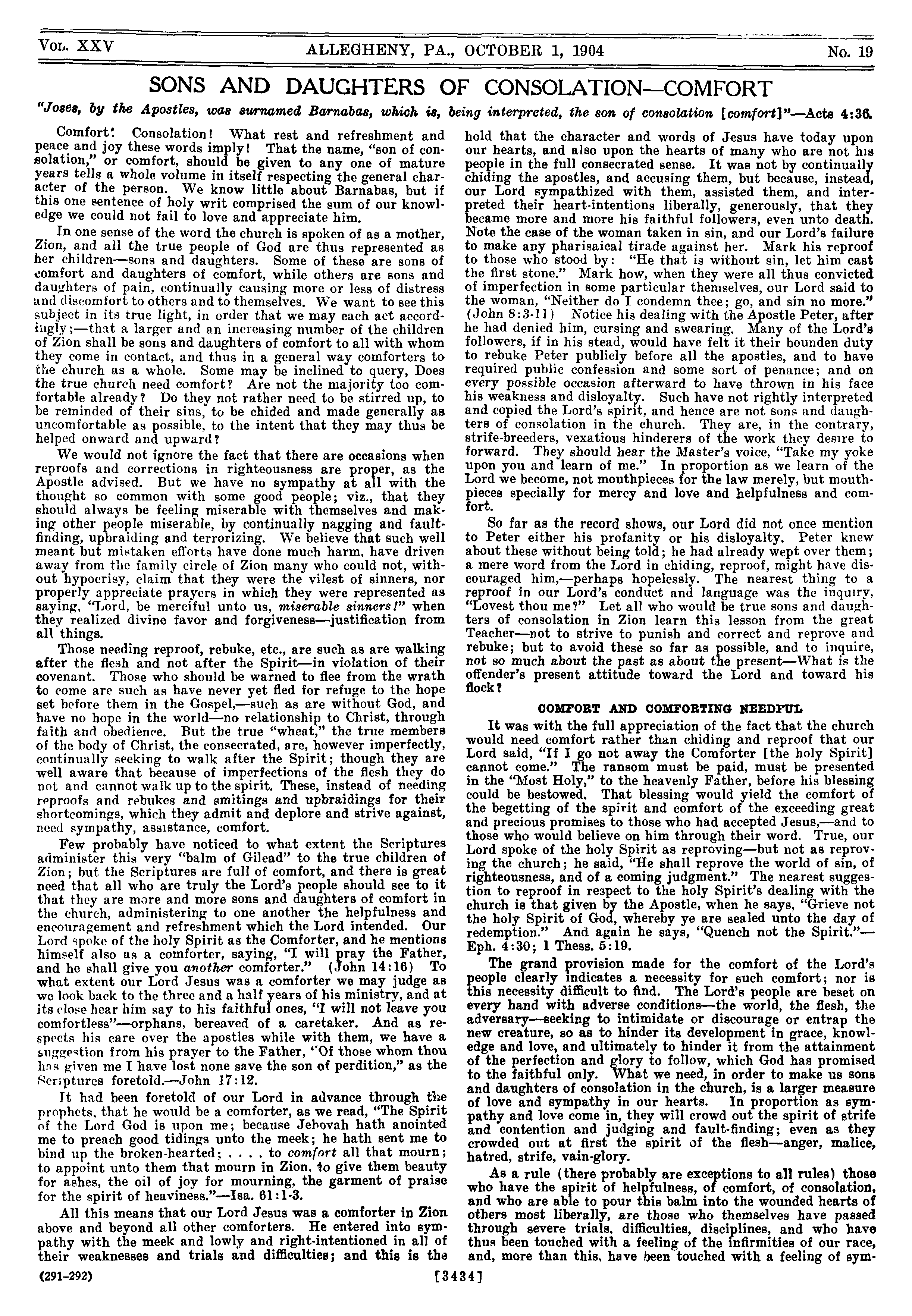
ae ce er Vou. XXV ALLEGHENY, PA., OCTOBER 1, 1904 No. 19 SONS AND DAUGHTERS OF CONSOLATION—COMFORT “Joses, by the Apostles, was surnamed Barnabas, which is, being interpreted, the son of consolation [comfort]”—Acts 4:36 Comfort: Consolation! What rest and refreshment and peace and joy these words imply! That the name, “son of consolation,” or comfort, should be given to any one of mature years tells a whole volume in itself respecting the general character of the person. We know little about Barnabas, but if this one sentence of holy writ comprised the sum of our knowledge we could not fail to love and appreciate him. _ In one sense of the word the church is spoken of as a mother, Zion, and all the true people of God are thus represented as her children—sons and daughters. Some of these are sons of veomfort and daughters of comfort, while others are sons and daughters of pain, continually causing more or less of distress and discomfort to others and to themselves. We want to see this subject in its true light, in order that we may each act accordiigly ;—that a larger and an increasing number of the children of Zion shall be sons and daughters of comfort to all with whom they come in contact, and thus in a general way comforters to the church as a whole. Some may be inclined to query, Does the true church need comfort? Are not the majority too comfortable already? Do they not rather need to be stirred up, to be reminded of their sins, to be chided and made generally as uncomfortable as possible, to the intent that they may thus be helped onward and upward? We would not ignore the fact that there are occasions when reproofs and corrections in righteousness are proper, as the Apostle advised. But we have no sympathy at all with the thought so common with some good people; viz., that they should always be feeling miserable with themselves and making other people miserable, by continually nagging and faultfinding, upbraiding and terrorizing, We believe that such well meant but mistaken efforts have done much harm, have driven away from the family circle of Zion many who could not, without hypocrisy, claim that they were the vilest of sinners, nor properly appreciate prayers in which they were represented as saying, “Lord, be merciful unto us, miserable sinners!” when they realized divine favor and forgiveness—justification from all things. Those needing reproof, rebuke, etc., are such as are walking after the flesh and not after the Spirit—in violation of their covenant. Those who should be warned to flee from the wrath to come are such as have never yet fled for refuge to the hope set before them in the Gospel,—such as are without God, and have no hope in the world—no relationship to Christ, through faith and obedience. But the true “wheat,” the true members of the body of Christ, the consecrated, are, however imperfectly, continually seeking to walk after the Spirit; though they are well aware that because of imperfections of the flesh they do not and cannot walk up to the spirit. These, instead of needing reproofs and rebukes and smitings and upbraidings for their shortcomings, which they admit and deplore and strive against, need sympathy, assistance, comfort. Few probably have noticed to what extent the Scriptures administer this very “balm of Gilead” to the true children of Zion; but the Scriptures are full of comfort, and there is great need that all who are truly the Lord’s people should see to it that they are more and more sons and daughters of comfort in the church, administering to one another the helpfulness and encouragement and refreshment which the Lord intended. Our Lord spoke of the holy Spirit as the Comforter, and he mentions himself also as a comforter, saying, “I will pray the Father, and he shall give you another comforter.” (John 14:16) To what extent our Lord Jesus was a comforter we may judge as we look back to the three and a half years of his ministry, and at its close hear him say to his faithful ones, “I will not leave you comfortless”—orphans, bereaved of a caretaker. And as respects his care over the apostles while with them, we have a suggestion from his prayer to the Father, “Of those whom thou has given me I have lost none save the son of perdition,” as the Seriptures foretold——John 17:12. Tt had been foretold of our Lord in advance through the prophets, that he would be a comforter, as we read, “The Spirit of the Lord God is upon me; because Jehovah hath anointed me to preach good tidings unto the meek; he hath sent me to bind up the broken-hearted; .... to comfort all that mourn; to appoint unto them that mourn in Zion, to give them beauty for ashes, the oil of joy for mourning, the garment of praise for the spirit of heaviness.”—Isa. 61:1-3. All this means that our Lord Jesus was a comforter in Zion above and beyond all other comforters. He entered into sympathy with the meek and lowly and right-intentioned in all of their weaknesses and trials and difficulties; and this is the (291-292) hold that the character and words of Jesus have today upon our hearts, and also upon the hearts of many who are not his people in the full consecrated sense. It was not by continually chiding the apostles, and accusing them, but because, instead, our Lord sympathized with them, assisted them, and interpreted their heart-intentions liberally, generously, that they became more and more his faithful followers, even unto death. Note the case of the woman taken in sin, and our Lord’s failure to make any pharisaical tirade against her. Mark his reproof to those who stood by: “He that is without sin, let him cast the first stone.” Mark how, when they were all thus convicted of imperfection in some particular themselves, our Lord said to the woman, “Neither do J condemn thee; go, and sin no more.” {John 8:3-11) Notice his dealing with the Apostle Peter, after he had denied him, cursing and swearing. Many of the Lord’s followers, if in his stead, would have felt it their bounden duty to rebuke Peter publicly before all the apostles, and to have required public confession and some sort of penance; and on every possible occasion afterward to have thrown in his face his weakness and disloyalty. Such have not rightly interpreted and copied the Lord’s spirit, and hence are not sons and daughters of consolation in the church. They are, in the contrary, strife-breeders, vexatious hinderers of the work they desire to forward, They should hear the Master’s voice, “Take my yoke upon you and learn of me.” In proportion as we learn of the Lord we become, not mouthpieces for the law merely, but mouthpieces specially for mercy and love and helpfulness and comort. So far as the record shows, our Lord did not once mention to Peter either his profanity or his disloyalty. Peter knew about these without being told; he had already wept over them; a mere word from the Lord in chiding, reproof, might have discouraged him,—perhaps hopelessly. The nearest thing to a reproof in our Lord’s conduct and language was the inquiry, “Lovest thou me?” Let all who would be true sons and daughters of consolation in Zion learn this lesson from the great Teacher—not to strive to punish and correct and reprove and rebuke; but to avoid these so far as possible, and to inquire, not so much about the past as about the present—What is the offender's present attitude toward the Lord and toward his ock? COMFORT AND COMFORTING NEEDFUL It was with the full appreciation of the fact that the church would need comfort rather than chiding and reproof that our Lord said, “If I go not away the Comforter [the holy Spirit] cannot come.” The ransom must be paid, must be presented in the “Most Holy,” to the heavenly Father, before his blessing could be bestowed. That blessing would yield the comfort of the begetting of the spirit and comfort of the exceeding great and precious promises to those who had accepted Jesus,—and to those who would believe on him through their word. True, our Lord spoke of the holy Spirit as reproving—but not as reproving the church; he said, “He shall reprove the world of sin, of righteousness, and of a coming judgment.” The nearest suggestion to reproof in respect to the holy Spirit’s dealing with the church is that given by the Apostle, when he says, “Grieve not the holy Spirit of God, whereby ye are sealed unto the day of redemption.” And again he says, “Quench not the Spirit.”— Eph. 4:30; 1 Thess, 5:19. The grand provision made for the comfort of the Lord’s people clearly indicates a necessity for such comfort; nor is this necessity difficult to find. The Lord’s people are beset on every hand with adverse conditions—the world, the flesh, the adversary——seeking to intimidate or discourage or entrap the new creature, so as to hinder its development in grace, know]edge and love, and ultimately to hinder it from the attainment of the perfection and gory to follow, which God has promised to the faithful only. hat we need, in order to make us sons and daughters of consolation in the church, is a larger measure of love and sympathy in our hearts. In proportion as sympathy and love come in, they will crowd out the spirit of strife and contention and judging and fault-finding; even as they crowded out at first the spirit of the flesh~—anger, malice, hatred, strife, vain-glory. As a rule (there probably are exceptions to all rules) those who have the spirit of helpfulness, of comfort, of consolation, and who are able to pour this balm into the wounded hearts of others most liberally, are those who themselves have passed through severe trials, difficulties, disciplines, and who have thus been touched with a feeling of the infirmities of our race, and, more than this, have been touched with a feeling of sym [34384]
To enhance your experience on our website, we use cookies and similar technologies. Some cookies are essential for the core functionality of our site and cannot be declined. You can choose to accept or decline additional cookies. We want to assure you that none of this data will be sold or used for marketing purposes. You can adjust your preferences at any time by accessing the Privacy Settings from the footer of the page. For more information, please refer to our
Privacy Policy
Terms of Use
.


