7
1
7
download/literature/watchtower/1904-3.pdf
watchtower/1904/3/1904-3-1
VOL.
XXV
ALLEGHENY,
PA.,
FEBRUARY
1,
1904
VIEWS
FROM
THE
WATCH
TOWER
No.3
COST
OF
CHRISTIANIZING
THE
WORLD
It
takes
$:100,000,000
a
year
to
"keep
up
the
work
of
Chris
tianizIng
our
own
land,"
says
the
Central
Christian
Advocate
(Kan
..
as
City,
Mo.).
whllc
"fully
$1,000,000"
is
annually
ab
sorlJPd
in
the
Chn~bani7:ltion
of
the
whole
world.
"The
monpy
i
..
almost
wholly
voluntary."
Of
the
sum
required
for
the
United
States,
the
same
paper
says:-
"The
sum
of
$31,000,000
was
laid
on
the
altar
by
Catho
lics,
$2G,000,000
by
Methodists,
$20,000,000
by
Presbyterians,
$14,000,000
by
Epl5copalians,
$12,000,000
by
Baptists,
$75,000
by
the
f'alvation
A
rmy.
In
adllition
to
these
expenditures
noted
ahove.
tlll're
werp
also
paid
out,
under
church
super
\ision,
funlls
p~t
illlatell
as
follows:
For
new
buildings,
$27,
000,000;
for
hoslJltals,
$28.000,000;
for
euucation,
$21,000,000
and
for
Sundav
schools,
$7,000,000.
"The
progrps~
and
\Ipalth
at
church
institutions
in
this
counbv
can
be
im]Jrp~siV('ly
illustrated
by
a
single
comparison.
In
1800
there
wpre
2,::140
ehmches,
valued
at
$1,500,000;
today
tllpre
n
rp
I
78,-Hll
,
valuell
at
$i24,!H
1,372.
These
figures
speak
not
of
selfishness,
hut
of
the
true~t
altruism,
of
philanthropy,
and
of
th!'
willingne
..
s
to
pay
the
pi
ice
of
enthroning
Christ
in
the
\\'0I1d.
"Fifty
yean!
ngo.
we
rpafl
further,
the
annual
outlay
for
chllleh
purposes
throughout
the
entirp
worM
"as
but
half
as
muph
n~
it
is
tmlay.
or
$;)00,000,000.
The
$1,000,000,000
of
the
pres!'nt
year,
moreov!'r,
will
he
wholly
inadequate
in
the
years
that
are
to
follow,
beeau~e
the
resistless
advance
of
Christi
anity
is
npcompanicd
with
an
increasing
cost,
which
can
be
Illet
only
by
the
frpe-will
offerings
of
mcn.
women
and
children.
This
post
is
in
a
sen~e
the
measure
of
the
increasing
determi
nation
of
good
ppople
that
Christ
shall
be
enthroned
king.
"The
phIlosophy
of
the
ages
is
the
Christianizing
of
the
WOrll!.
That
is
tIll'
kpy
to
the
evolution
going
on
everywhere.
Chri~ti:Hlit.v
is
making
its
stpady
anll
resistless
advance,
now
here,
now
there,
now
evelywhere,
likp
the
rising
waters
of
a
univprsal
tille.
It.
explains
till'
pa~t
achievements
of
the
best
in
the
In
ce,
and
inspiI
l'S
our
hope
fO!
the
future
of
the
race.
Whnt
will
be,
ultimately,
will
be
well,
became
it
will
be
Christ.
like."
*
*
*
A
blessing
SUi
ely
comes
to
everyone
who
conscientiously
saerifieps
time
or
1Il0!lpy
in
the
lauelaMe
effort
to
help
fellow
erf'atnres.
'Ve
rf'joiee
to
give
credit
for
some
measure
of
un
selfislmf'ss
being
represented
in
the~e
figures,
but
reflect
that
SOlllC
of
this
1I10n('y
may
have
been
drawn,
threatened
or
eoaxed
froJl1
ratllPr
unwilling
gohers,
and
that
the
collectors
of
~OJl1e
Ir
rgl'
J)('ncvoleni
soc\('ti('~
receive
one-half
of
their
col
Ipetion'5
fm
theIr
services.
which
arc
not
perhaps
wholly
un
splfish.
BOII·en'r.
eWIl
If
we
wPI'e
uncertain
that
present
com·
p:u,slllg
of
sea
and
laml
to
make
a
proselyte
were
no
better
in
its
I
esuIt
than
in
the
olden
times
missions
(Matt.
23:
15)
we
should
still
agree
that
the
stirring
of
men's
hearts
to
sympathy
and
giving
does
good
to
the
givers:
another
demonstration
that
It
is
"more
blessed
to
give
than
to
receive."
On
the
other
hand
we
are
not
so
sure
either
that
this
money
was
given
to
"enthrone
Christ
in
the
world."
A
strong
evidence
to
the
contrary
is
that
when
our
Lord's
second
com
ing
and
kingdom
are
referred
to,
even
amongst
preachers,
the
subject
falls
flat,
if
indeed
it
does
not
arouse
angry
opposi
tion.
These
things
and
others
lead
us
to
fear
that
it
is
self
enthronement
in
the
world
that
is
sought.
Sectarian
or
churehianity
enthronement,
we
believe,
is
greatly
coveted
by
Protestants
as
well
as
Catholics.
They
could
almost
ignore
their
differences
and
combine-so
anxious
are
they
to
conquer
the
world.
But
we
are
glad
that
even
though
the
Lord
may
permit
them
again
to
get
a
measure
of
control,
as
Papacy
had
it
dur
ing
the
dark
ages,
we
have
the
assurance
of
his
Word
that
it
shall
not
again
triumph
to
the
same
extent,
but
be
cut
short
by
the
great
time
of
trouble
which
will
usher
in
the
real
reign
of
Mpssiah,
which
they
do
not
desire.
'Ye
nre
glad,
too,
to
believe
that
their
opposition
is
largely
the
result
of
blindness,
and
that
with
the
later
opening
of
the
eyes
of
their
understanding
they
will
rejoice
in
the
new
heaven
!In,1
new
earth
conditions
(the
new
social
and
ecclesiastical
eonllitions)
introduced
by
that
long-promised
kingdom
of
heaven,
which
will
surely
prove
to
be
"the
desire
of
all
na
tions."-Isa.65:17-25;
Hag.
2'6,
7.
Meantime
now,
as
during
the
dark
ages,
God
has
"a
pecu
liar
people"
whom
he
is
calling
out
and
educating
for
his
com
ing
work.
These
bend
their
energies,
physical
and
financial.
to
the
work
they
see
directed
in
the
Lord's
'Vord
:-the
preachinJ;'
of
the
gospel
of
the
kingdom
and
the
gathering
of
those
having
heal
ing
ears,
not
to
sectarian
"bundles,"
but
to
the
Lord
him
self.
Though
insignificant
in
name
and
fame
amongst
the
worldly
\\
ise
and
mighty,
these
are
mighty
now
in
the
Lonl's
hand~
to
the
pulling
down
of
the
strongholds
of
error.
And
in
the
future,
I~lorified
as
the
"Lamb's
wife,"
they
shall
be
joint
heirs
with
their
Lord
in
the
glorious
kingdom
work
of
bk",~ln\.(
all
the
families
of
the
earth
with
the
true
light
and
assistance.
These
can
afford
to
be
peculiarly
like
Christ
and
the
apostles
now,
that
by
and
by
they
may
be
like
them
in
glory.
SCIENCE
FALSELY
SO
CALLED
Our
wise
men,
anxious
to
disprove
the
Bible
record
of
the
creation,
"prove"
much
by
the
stone
formations
of
the
earth's
crnst;
and
freely
talk
about
millions
of
years
being
neeessalY
to
produce
the
stone
conditions
which
are
everywhere
apparent.
Their
long
arguments
and
wise
conclusions
were
made
to
look
very
sllly
recently
by
an
accident
near
East
St.
Louis.
A
car
of
Inne
and
a
car
of
potatoes
were
partly
submerged
together
in
the
river.
The
slacking
lime
fired
the
car
and
the
aston
ishing
result
was
that
every
potato
was
turned
to
flinty
stone
in
less
than
twenty-four
hours.
The
Lord's
people
have
no
need
to
feel
ashamed
of
the
old
Book.
"MY
PEOPLE
DO
NOT
CONSIDER"
"Con.sider
what
I
SOiJj,
and
the
Lord
gll,e
thee
lmderstandimg."-2
Tim.
2:
7.
Con~idl'r-r('jJpct.
tllJnk,
stuel.\',
ponder.
""hatever
may
be
while
knowing
something
about
their
Creator
and
Redeemer,
do
,aid
of
th
...
lwnthpn
rl'lIgions
Hncl
of
pllUrchianity
in
respect
to
not
know
}mn
in
the
sense
of
being
really
acquainted
with
his
tht'ir
1WjniriIl\.(
liUlp
thought,
IIttJe
study,
tJ'is
i~
not
the
case
character.
In
many
respects
they
worship
a
strange
God,
be-
WIth
tlll'
r~l.gion
of
thl'
Hll>lp.
It
is
not
a
religion
of
credulity
pame
they
have
failed
to
get
rightly,
thoroughly,
acquainted
-"shut
:Villi!
1'.1'1''1
nJltI
O]JC']l
your
mouth,"
llllel
swallow
what
with
him.
Such
3n
acquaintance
pan
only
be
obtained
along
i~
put
th"J
"in.
Tn/p.:t
h
a
religiOn
of
fnith;
hut
a
faith
ba"lPd
the
line
suggested
in
our
text:
by
giving
heed,
by
considering,
UpOIl
re';.!'
oll:ll,]p
t'vld"ncps--'\
knl)\\
ledge
of
GOll.
whose
plan
rptJeeting.
studying
the
revelation
which
God
has
made
re-
,LIllI
cknadpJ'
It
lpVl'llll:l.
Hence
it
i"
th'lt
the
Seripturps
invitl'
Rppding
h1moelf.
Not
that
the
Scriptures
give
us
a
detailed
tit"
::lll\1;u]
ttl
11111'1./"1'.
tt'
,,,:,\'(·h.
[,)
J<ltlV,'.
'1\'111'1.
·'C01J!P.ld
tld'\('riptIon
of
our
Creator;
but,
rather,
by
revealing
to
us
his
1I~
IP'\"lIll
[O,!l'!:"'"
'\'1.1
i1
;~
l\tl,tlh""f'\ol'
(ilat,dlllt'IIl,,·
plan'J,
they
permit
us
through
an
understanding
of
the
divine
'Y'[(,lll~
of
,,'liglOll
:1
p,1
t·llllr('],jallil~'"
llli~IIamcd
Christianity,
plan~
to
haY(,
an
understnnding
of
the
divine
chnral'ter
which
ttl
II
1:11':;1'
(''ttc'nt
II'HI
~('
tId.:
"l'rijl'nrlll
onler,
pn,lcilvorillg'
to
thoqp
plnn
..
C'xpmplify
and
illustrate.
A
a
ma.n
is
known
by
his
,,),1
'1111
],:!
rlllony.
llllln]:.
I'n
"
h,·
',i:-l
of
(olllparatil'p
ignorance,
v,
ork~.
'0
(i(ld
is
known
1>y
his
works.
'Vhoever,
therefore,
J',
i
11l'1'
n'"n
on
.l
],:hi,
of
gr,)"
,1,
III
:-:'
:1('('
anll
in
the
knowledge
woulrl
know
God-appreciate
the
divine
character-must
come
"f
11k
trllth.
to
such
a
knowledge
through
an
acquaintance
with
the
divine
_\~
\\('
Sl'('
illis
to
h('
tI
11('
to,lar
in
1l0111innl
~piritnld
Israel,
plan
which
God
is
outworking.
'0
V,I'
Jillll
1t
\\:\.,
tlue
III
nldl'lI
tilll/'R
in
I\('~hlv
I~r:\I'J.
to
whom
~atall.
the
great
aflversary.
seems
to
understand
this
mat-
i
h
"
I
on]
d(,,'hn'-.--"Thl'
0'\
knO\\dJ/
Ili~
l)\\,ncr
and
the
ass
his
t('r
thoroughly,
and
employs
his
arts
of
deception
to
hinder
1I1n
-t"I'~
('j,)':
hill
f-l,II'J
doj],
]'ot
]
..
]1(1",.
1I1y
]woplc
do
nnt
ron-
lllpn
frnm
appH·ciating
the
divine
plan,
anu
thus
to
hinder
an
,/I/I'!"
(
"'1.
1;1\
WI':'
1'1'
not
to
IJJl,l,'rsbnd
the
Lorel
to
:J
pprppiation
of
the
divine
character-to
prevent
a
real
knowl-
Illl'an
that
tl,,'
.l<"~~
lJa11
Iln
k'lll\\'l,',l,!p
of
him
who~e
sacrifices
pUEp
f'f
(io,l.
He
has
hepn
sllece~~ful.
marvelously
so.
a'l
the
ill1,]
cprpI110l11al
Ln;
:11111
"Ol-
..
lllp
hall
their
llailv
attpntion:
\P(l~tl('
rJ('P}:upR,
along
thpse
Jinps.
The
God
of
thi~
world
has
n!'lther
s1l0ul,1
WI'
hp
Ullllp!stdOc!
tf1
imply
thnt
nominal
Chris-
hlilllletl
the
minds
of
thpm
which
believe
r·ot,-lest
the
glorious
tian~,
who
in
vallOlH
\\a~'s
manifp,t
some
respect
and
revpr-
b:!ht
of
thE'
Q'oodness
of
Gocl.
n'J
it
shines
in
the
fape
of
Jesus
('l1ce
for
the
LOI"II.
arp
"holly
ignorant
of
him.
The
thou~ht
is
Christ.
should
shine
into
their
hearts.
(2
Cor.
4
:4,
6)
It
is
1':1
ther
that
God's
professed
ppople
today,
as
in
olden
times,
impossible
for
him
to
hinder
all
knowledge
and
all
appreciation
(35-36)
[3312]
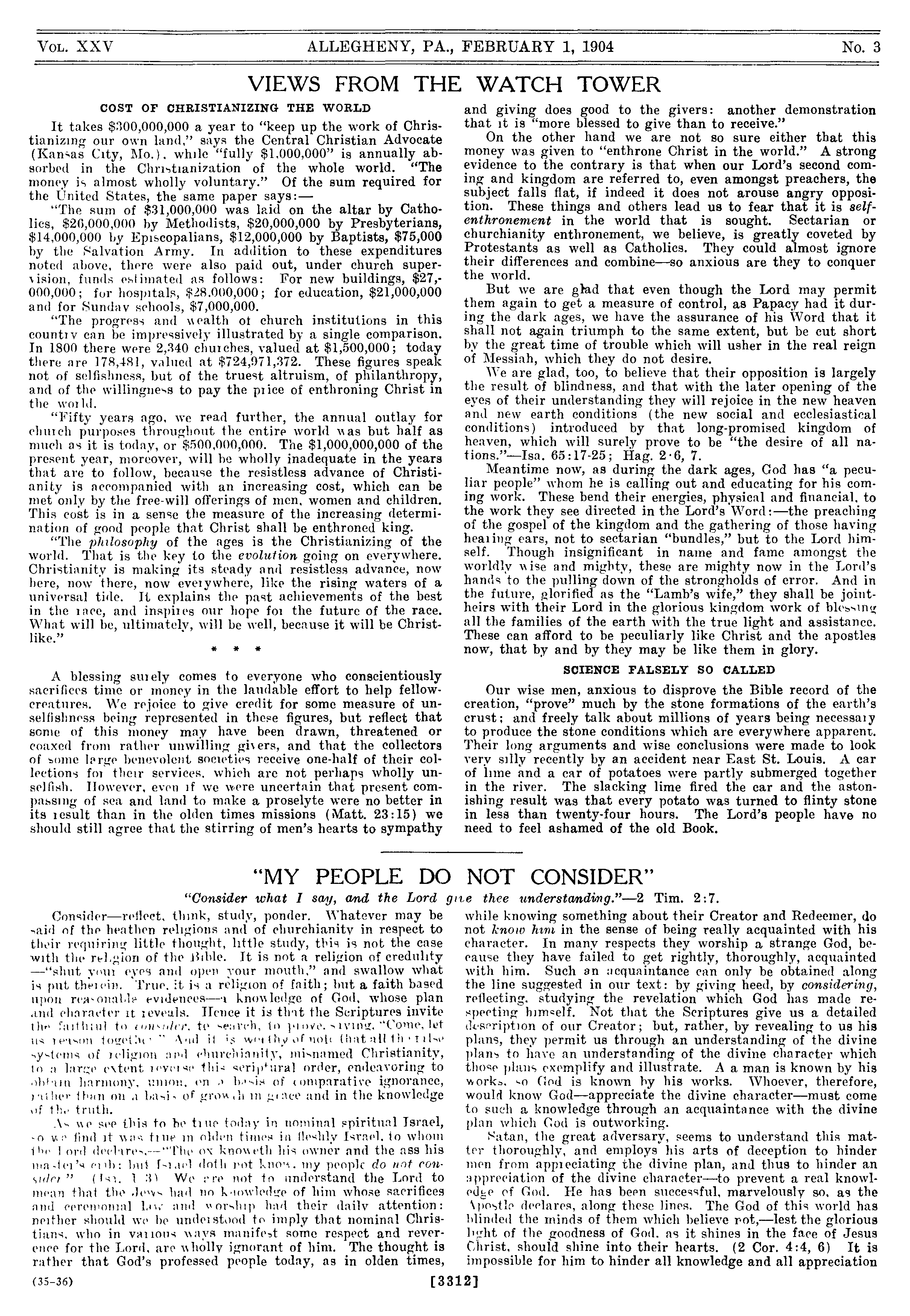
Vou. XXV ALLEGHENY, PA., FEBRUARY 1, 1904 No. 3 VIEWS FROM THE WATCH TOWER COST OF CHRISTIANIZING THE WORLD It takes $300,000,000 a year to “keep up the work of Christianizing our own land,” says the Central Christian Advocate (Kansas City, Mo.). while “fully $1,000,000” is annually absorbed in the Christianization of the whole world. “The money is almost wholly voluntary.” Of the sum required for the United States, the same paper says:— “The sum of $31,000,000 was laid on the altar by Catholies, $26,000,000 by Methodists, $20,000,000 by Presbyterians, $14,000,000 by Episcopalians, $12,000,000 by Baptists, $75,000 by the Salvation Army. In addition to these expenditures noted above, there were also paid out, under church supervision, funds estimated as follows: For new buildings, $27,000,000; fur hospitals, $28.000,000; for education, $21,000,000 and for Sunday schools, $7,000,000. “The progress and wealth ot church institutions in this country can be impressively illustrated by a single comparison. In 1800 there were 2,340 churches, valued at $1,500,000; today there are 178,481, valued at $724,971,372. These figures speak not of selfishness, but of the truest altruism, of philanthropy, and of the willingness to pay the price of enthroning Christ in the world. “Vifty years ago, we read further, the annual outlay for church purposes throughout the entire world was but half as much as it is today, or $500,000,000. The $1,000,000,000 of the present year, moreover, will be wholly inadequate in the years that are to follow, because the resistless advance of Christianity is accompanied with an increasing cost, which can be met only by the free-will offerings of men, women and children, This cost is in a sense the measure of the increasing determination of good people that Christ shall be enthroned king. “The philosophy of the ages is the Christianizing of the world. That is the key to the evolution going on everywhere. Christianity is making its steady and resistless advance, now here, now there, now everywhere, like the rising waters of a universal tide. It explains the past achievements of the best in the 1ace, and inspires our hope for the future of the race. What will be, ultimately, will be well, because it will be Christlike.” * * * A blessing surely comes to everyone who conscientiously sacrifices time or moncy in the landable effort to help fellowcreatures. We rejoice to give credit for some measure of unselfishness being represented in these figures, but reflect that some of this money may have been drawn, threatened or coaxed from rather unwilling givers, and that the collectors of some large benevolent societies receive one-half of their collections for their services, which are not perhaps wholly unselfish. Tlowever, even 1f we were uncertain that present compassing of sea and land to make a proselyte were no better in its result than in the olden times missions (Matt. 23:15) we should still agree that the stirring of men’s hearts to sympathy “MY PEOPLE DO and giving does good to the givers: another demonstration that 1¢ is “more blessed to give than to receive.” On the other hand we are not so sure either that this money was given to “enthrone Christ in the world.” A strong evidence to the contrary is that when our Lord’s second coming and kingdom are referred to, even amongst preachers, the subject falls flat, if indeed it does not arouse angry opposition. These things and others lead us to fear that it is selfenthronement in the world that is sought. Sectarian or churchianity enthronement, we believe, is greatly coveted by Protestants as well as Catholics. They could almost ignore their differences and combine—so anxious are they to conquer the world. But we are ghad that even though the Lord may permit them again to get a measure of control, as Papacy had it during the dark ages, we have the assurance of his Word that it shall not again triumph to the same extent, but be cut short by the great time of trouble which will usher in the real reign of Messiah, which they do not desire. We are glad, too, to believe that their opposition is largely the result of blindness, and that with the later opening of the eyes of their understanding they will rejoice in the new heaven and new earth conditions (the new social and ecclesiastical conditions) introduced by that long-promised kingdom of heaven, which will surely prove to be “the desire of all nations.” —Isa, 65:17-25; Hag. 2-6, 7. Meantime now, as during the dark ages, God has “a peculiar people” whom he is calling out and educating for his coming work. These bend their energies, physical and financial, to the work they see directed in the Lord’s Word:—the preaching of the gospel of the kingdom and the gathering of those having heaiing ears, not to sectarian “bundles,” but to the Lord himself. Though insignificant in name and fame amongst the worldly wise and mighty, these are mighty now in the Lord’s hands to the pulling down of the strongholds of error. And in the future, glorified as the “Lamb’s wife,” they shall be jointheirs with their Lord in the glorious kingdom work of blessing all the families of the earth with the true light and assistance. These can afford to be peculiarly like Christ and the apostles now, that by and by they may be like them in glory. SCIENCE FALSELY SO CALLED Our wise men, anxious to disprove the Bible record of the creation, “prove” much by the stone formations of the earth’s crust; and freely talk about millions of years being necessary to produce the stone conditions which are everywhere apparent. Their long arguments and wise conclusions were made to look very silly recently by an accident near East St. Louis. <A car of lime and a car of potatoes were partly submerged together in the river. The slacking lime fired the car and the astonishing result was that every potato was turned to flinty stone in less than twenty-four hours. ‘The Lord’s people have no need to feel ashamed of the old Book. NOT CONSIDER” “Consider what I say, and the Lord give thee wnderstanding.”—2 Tim. 2:7. Consider—retlect, think, study, ponder. Whatever may be said of the heathen religions and of churchianity in respect to their requiring little thought, httle study, this is not the case with the rel.gion of the Bible. It is not a religion of credulity —‘shut your eyes and open your mouth,” and swallow what is put therein. ‘True, it is a religion of faith; but a faith based upon reasonable evidences—a knowledge of God, whose plan and character it reveals. TIenee it is that the Scriptures invite the Saithiul to eonsades, te seureh, to paove. siving, “Come, let us reion fowetig: " And dois werthy of note Chat all ths tailse systems of religion apd churehianity, misnamed Christianity, toa large extent reverse this seriptural order, endeavoring to obtain harmony, wnion, eno» basis of comparative ignorance, pather then on a basis of grow chim eenace and in the knowledge wf the truth. As we see this ta he true today in nominal spiritual Tsrael, -o we find it was true im olden times in fleshly Esracl, to whom dhe Lord declares-—"The ox knoweth his owner and the ass his ma-fer’a erth: but f-rael doth rot know. my people do not consider? (Tax, 1 BY We vere not to understand the Lord to mean that the Jews had no haowledee of him whose sacrifices and ceremomal Lay and worship had their daily attention: neither should we be understood te imply that nominal Christians, who in va1ious wavs manifest some respect and reverence for the Lord, are wholly ignorant of him. The thought is rather that God’s professed people today, as in olden times, (35-36) while knowing something about their Creator and Redeemer, do not know hin in the sense of being really acquainted with his character. In many respects they worship a strange God, because they have failed to get rightly, thoroughly, acquainted with him. Such an acquaintance can only be obtained along the line suggested in our text: by giving heed, by considering, reflecting. studying the revelation which God has made respecting himself, Not that the Scriptures give us a detailed deseription of our Creator; but, rather, by revealing to us his plans, they permit us through an understanding of the divine plans to have an understanding of the divine character which those plans exemplify and illustrate. A aman is known by his works. so Ged is known hy his works. Whoever, therefore, would know God—appreciate the divine character—must come to such a knowledge through an acquaintance with the divine plan which God is outworking. Satan, the great adversary, seems to understand this matter thoroughly, and employs his arts of deception to hinder men from appreciating the divine plan, and thus to hinder an appreciation of the divine character—to prevent a real know}edge of God. He has been successful, marvelously so, as the Apostle deelares, along these lines. The God of this world has blinded the minds of them which believe rot,—lest the glorious heht of the goodness of God. as it shines in the face of Jesus Christ, should shine into their hearts. (2 Cor. 4:4, 6) It is impossible for him to hinder all knowledge and all appreciation [3312]
To enhance your experience on our website, we use cookies and similar technologies. Some cookies are essential for the core functionality of our site and cannot be declined. You can choose to accept or decline additional cookies. We want to assure you that none of this data will be sold or used for marketing purposes. You can adjust your preferences at any time by accessing the Privacy Settings from the footer of the page. For more information, please refer to our
Privacy Policy
Terms of Use
.


