7
1
7
download/literature/watchtower/1904-5.pdf
watchtower/1904/5/1904-5-1
FJ';BRUARY
15,
1904
ZION'S
WATCH
TOWER
(63-67)
for
good
to
those
who
love
the
Lord.
We
must
all
die
to
win
our
heavenly
prizes
beyond
the
veil.
The
Elijah
class
this
side
the
veil
must
and
will
be
vanquished,
but
the
apparent
defeat
only
hastens
the
kingdom
glories,
powers
and
blessings
prom
ised.
"Be
thou
faithful
unto
death
and
I
will
give
thee
a
crown
of
life."
GO
TELL
IT
TO
JESUS
The
disciples
of
John
knew
where
to
go
with
the
message
-where
to
_
find
sympathy
and
consolation
in
respect
to
their
loss.
There
is
a
lesson
for
us
in
this.
To
whom
shall
we
go
with
trials,
difficulties,
sorrows,
troubles,
disappointments'
The
Lord
invites
us
to
come
to
him
with
everything
which
is
too
heavy
for
ourselves,
with
every
care.
He
cares
for
us
and
will
grant
the
blessing
to
trusting
souls.
Doubtless
those
who
went
to
Jesus
became
his
disciples,
and
thus
their
trials
in
connection
with
their
leader
and
teacher
brought
them
into
closer
knowledge
and
fellowship
with
the
great
Teacher.
And
so
it
will
be
doubtless
with
those
whu
are
the
friends
of
the
Lord's
people
at
the
present
time:
the
vengeance
of
the
anti
typical
Jezebel
upon
the
antitypical
Elijah
will
move
their
friends
and
associates
to
still
greater
love
and
interest,
and
will
be
the
means
of
attracting
more
closely
to
the
Lord
the
great
company.
OUR
GOLDEN
TEXT
Those
who
prepared
the
lesson
evidently
did
not
see
that
John
the
Baptist
belongs
to
a
separate
class
of
the
saved
from
those
addressed
in
the
text.
No
promise
was
made
to
John
of
a
crown
of
life.
That
promise
belongs
to
us,
the
Gospel
church-called
chosen,
and
faithful.
John,
however,
will
have
a
great
blessing,
for
we
mark
again
our
Lord's
words,
"There
hath
not
arisen
a
greater
prophet
than
John
the
Baptist-and
yet
I
say
unto
you
that
the
least
in
the
kingdom
is
greater
than
he."
VOL.
XXV
ALLEGHENY,
PA"
MARCH
1,
1904
VIEWS
FROM
THE
WATCH
TOWER
1\0
.
.)
"WARS
AND
RUMORS
OF
WARS"
In
using
the
above
words
(Matt.
24:
6)
our
Lord
indicated
by
their
connection
that
the
mere
fact
of
war
should
prove
nothing
to
his
people
respecting
the
consummation
of
the
age.
They
were
to
be
otherwise
guided
in
their
discernment
of
the
sign~
of
the
times.
Whatever
thrrefore
we
have
to
say
respect
ing
wars
is
based
on
some
knowledge
of
the
divine
plan,
aside
from
these
frequently
occurring
disturbances.
Our
expectations
respecting
a
war
have
been
realized.
We
based
that
expectation
not
on
any
private
information,
nor
on
prophecy,
but
upon
the
thought
that
unless
war
intervened
to
prolong
the
commercial
prosperity
of
Christendom
a
great
financial
depression
would
be
sure
to
come
speedily;
and
be
cause
we
could
not
see
time
enough
for
such
a
depression
and
a
recovery
from
it
and
a
subsequent
depression,
all
before
October,
1914,
when
prophecy
teaches
us
to
expect
the
great
climax
of
earth's
troubles.
'Ve
have
in
the
Scriptures
what
we
think
is
clear
testimony
respecting
that
date,
but
no
particulars
or
dates
for
the
intervening
time.
It
is
not
our
intention
to
enter
upon
the
role
of
prophet
to
any
degree,
but
merely
to
give
below
what
seems
to
us
rather
likely
to
bc
the
trend
of
events
-gh
ing
also
the
reasons
for
our
expectations.
The
preBent
outlook
is
that
the
succes~
of
the
Japanese
over
the
Russians
thus
early
in
their
war
will
prolong
the
conflict
and
quite
probably
draw
into
it
many
other
civilized
nations.
The
nussian
character
is
badly
damaged
by
the
fall,
and,
as
a
result,
haughtiness,
pridc
and
contempt
for
others,
are
among
the
1lJH'n\
iable
characteristics
of
their
rulinp:
('lasses,-and
the
peace-loving
Czar
is
under
tlleir
control.
This
will
make
it
donhly
difficult
for
Russia,
as
a
great
nation,
to
accept
defeat
at
the
llands
of
a
small
nation
like
Japan,
which
they
have
srarrely
been
willing
to
acknowledge
as
civilized,
or
in
any
degree
a
factor
in
the
world's
affair...
It
would,
we
believe,
be
wisdom
on
Russia'R
part
to
propose
terms
for
peace;
but
re
mC'mbering
the
proverb,
"Pride
goeth
before
destruction
and
a
haughty
spirit
before
a
fall,"
we
incline
to
think
that
Russia
will
blunder
into
a
prolonged
war,
di!lastrous
to
her
prestige,
finances,
etc.
Meantime
Great
Britain
is
seemingly
disposed
to
use
the
opportunity
of
Russia's
distraction
to
add
Thibet-China
to
her
empire,
either
directly
or
a~
a
suzerainty.
Thibet
is
a
rich
country,
adjoins
India
on
the
east,
and
its
people
are
peaceable
-unskilled
in
modl'rn
warfare
a11(]
couln
e'l!lily
he
Rubjugated
if
no
European
nation
interfered-and
Russia
alone
could
or
would
interfere.
The
present,
therefore,
is
England's
auspi
cious
moment
for
satisfying
her
"land-hung-er"-for
opening
up
a
new
market
for
the
products
of
civilization.
Turkey
will
be
restlesR,
too,
when
she
sees
her
chief
oppo
nent,
Russia,
busy
afar
off.
France,
Russia's
ally,
will
feel
keenly
for
Russia,
and
were
it
not
for
the
alliance
between
Great
Britain
and
Japan
she
most
surely
would
back
her
ally
and
send
her
powerful
fleet
against
the
Japanese.
She
well
knows,
however,
that
this
would
bring
England
to
the
assistance
of
Japan,
and
that
the
British
fleet
is
the
most
powerful
in
the
world.
Still,
pride
and
"honor"
are
powerful
factors
with
the
French,
who
are
a
very
excitable
people,
and
there
is
no
knowing
when
she
may
conclude
that
"French
honor"
demands
her
participation
in
the
war.
The
German
Emperor,
we
may
be
Rure,
could
scarcely
re
main
quiet
at
such
an
auspiciouq
moment
as
the
preRent
one
for
"cutting
a
dash"
that
would
bring
himself
and
Germany
into
prominence
before
the
world.
He
will
probably
seek
to
befriend
Russia,
his
powerful
neighbor
on
the
east,
to
secure
her
friendship
and
also
to,
if
possible,
break
the
tie
now
unit
ing
France
and
Russia.
Thus
Germany
and
France
may
~'et
vie
with
each
other
for
Russia's
friendship
and
may
both
be
led
into
the
war.
Even
the
United
States
may
become
involved,
improbable
as
that
may
at
present
appear.
If
the
Great
Powers
of
Europe
become
involved,
as
above
suggested,
it
would
be
very
difficult
for
this
nation
to
remain
neutral.
The
seed
for
trouble
is
alreally
planted
in
the
"Note"
sent
by
the
American
Secretary
of
State
to
the
Great
Powers,
proposing
that
the
war
be
limited
so
as
not
to
invoh-e
the
independence
of
China.
The
"Note"
is
",imple
enough
and
well
intentioned,
and
beneficent,
and
has
bl'en
generally
as~ented
to,
but
it
may
not
be
lived
up
to
by
all,
and
ihe
United
States
may
yet
feel
"honor-bound"
to
insist
on
the
terms
of
that
agreement,
and
this
may
mean
participa
tion
in
war.
We
do
not
say
that
the
foregoing
will
take
plnce,
nor
that
it
is
likely
to
occur:
we
are
merely
outlining
bare
pos.oribilities.
Nevertheless,
there
is
something
behind
it
worth
considering;
because
the
Scriptures
seem
to
imply
some
sort
of
a
general
war
preceding
or
C'onnected
with
the
great
time
of
trouble
annrchy-with
whirh
thi
..
age
will
clORe
a11<]
usher
in
the
Mil
lennial
period.
For
instance,
,Toel
(:l:9-16)
ralls
on
all
the
nations
to
prepare
for
war;
to
beat
plowshares
and
pruning
hooks
into
swords
and
spears,
to
cause
pursuits
of
agriculture
to
give
pla('p
to
pursuits
of
war,
and
for
even
the
weak
among
the
nations
to
feign
!ltrength.
The
connection
shows
this
to
be
at
about
thc
present
time,
and
mentions
that
the
"harve!lt"
is
ripe
(also
Rev.
14:
15-20)
and
the
Lord's
holy
ones
as
about
to
"rome
down."
This
may
he
fulfilled
in
the
anarchy
in
which
"l'very
mnn'
..
ham]
shall
be
against
llis
neighbor,"
but
we
incline
to
expect
its
fulfilment
in
a
general
and
worldwide
call
to
arms.
Another
reason
why
we
incline
to
expect
a
general
war
is,
that
at
present
the
nations
are
so
strong
that
a
successful
anarchous
uprising
against
them
WOU]I]
be
little
short
of
a
miracle.
But
such
a
general
war
would
increase
taxation
and
breed
general
discontent
alarmingly
and
quickly,
cnusing
the
seeds
of
Socialist
propaganda
to
shoot
up
and
blossom
and
bring
forth
red-ham]el]
anarchy
speedily.
The
credit
of
the
nations
would
he
weakened
also
by
their
increaRed
debts;
money
would
become
proportionately
scarce
and
interest
rates
pro
portionately
higher,
with
corresponding
effects
influencinO'
the
gcneral
welfare
and
prosperity
of
Christendom.
0
ANOTHER
FACTOR-RELIGIOUS
AMBITIONS
It
may
appear
strange
to
consiller
religious
ambitions
a
fn
ctor
provocative
of
war;
but
it
is
true,
nevertheless,
tllat
miqguidrd
emotions,
supposedly
religiou~,
have
been
potent
fnrtors
in
many
wars.
Just
now
the
apathy
of
the
public
of
Christendom
on
religious
subjects
is
noted
as
a
result
of
the
love
of
money
and
the
cares
of
busine~s.
All
the
more
those
of
r!'ligiolls
proclivities
are
looking
for
another
issue
more
popular
than
personal
repentance,
faith
in
the
precious
blood
and
consecration
to
divine
service.
They
have
been
seeking
it
in
"social
uplift"
schemes
which
have
been
more
or
leRs
suc
r(,Rsful;
and
now
the
"civilization"
of
the
uttermost
parts
of
the
earth
is
the
popular
scheme
amongst
them.
They
tell
us
that
the
conversion
of
the
world
is
merely
a
question
of
dollars
and
cl'nts,
but
do
not
explain
to
us
why
it
is
that
the
lands
of
dollars
and
cents
are
the
lands
of
discontent
and
murder
and
suicide,
etc.,
more
than
others.
AR
an
l'viden('e
of
this
Rpirit
of
aggression
"for
Christ's
sake,"
not!'
the
following:
[3327]
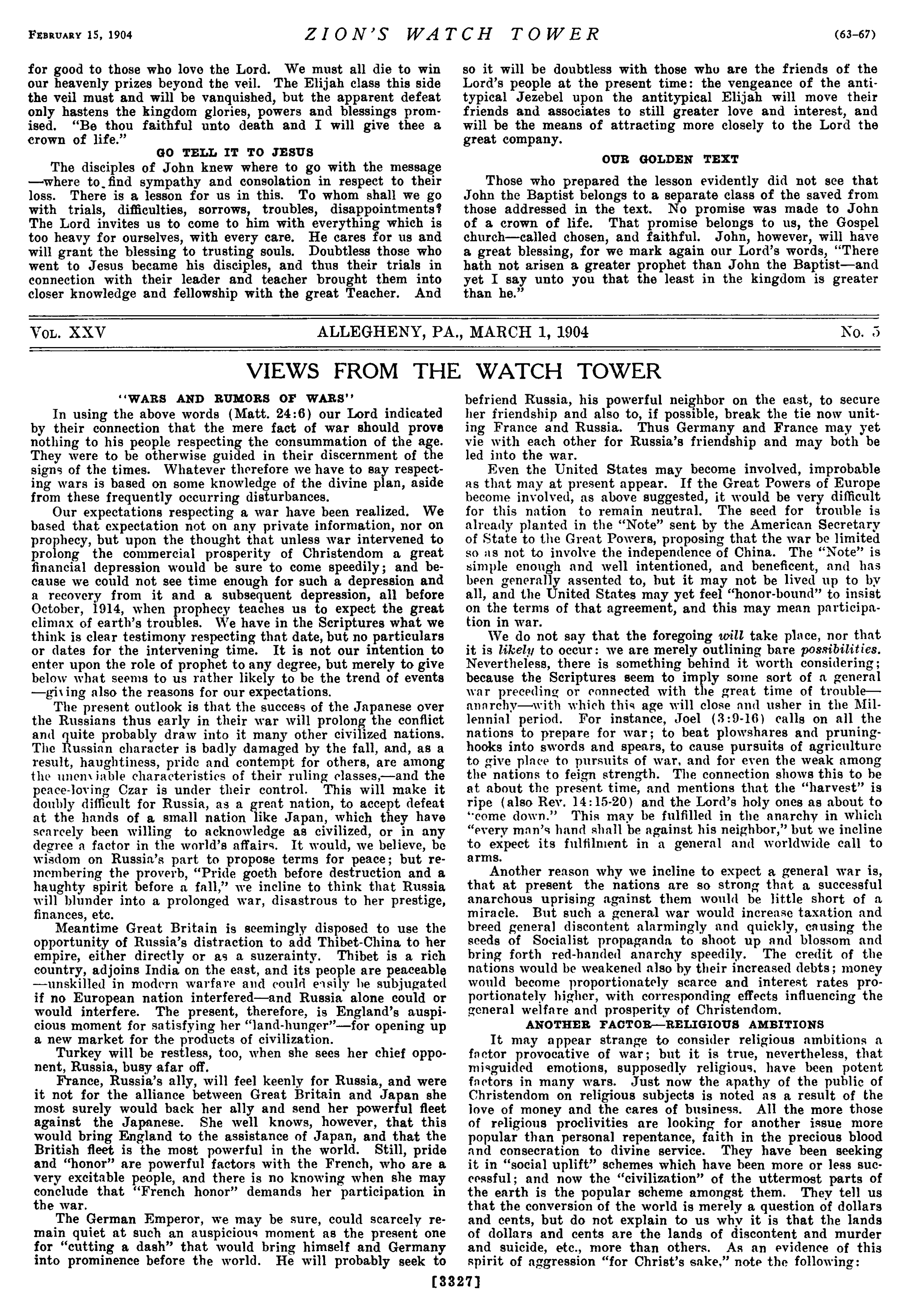
Fesruary 15, 1904 for good to those who love the Lord. We must all die to win our heavenly prizes beyond the veil. The Elijah class this side the veil must and will be vanquished, but the apparent defeat only hastens the kingdom glories, powers and blessings promised. “Be thou faithful unto death and I will give thee a erown of life.” GO TELL IT TO JESUS The disciples of John knew where to go with the message —where to_find sympathy and consolation in respect to their loss. There is a lesson for us in this. To whom shall we go with trials, difficulties, sorrows, troubles, disappointments? The Lord invites us to come to him with everything which is too heavy for ourselves, with every care. He cares for us and will grant the blessing to trusting souls. Doubtless those who went to Jesus became his disciples, and thus their trials in connection with their leader and teacher brought them into closer knowledge and fellowship with the great Teacher. And Vou. XXV ZION’S WATCH TOWER ALLEGHENY, PA., MARCH 1, 1904 (63-67) so it will be doubtless with those whu are the friends of the Lord’s people at the present time: the vengeance of the antitypical Jezebel upon the antitypical Elijah will move their friends and associates to still greater love and interest, and will be the means of attracting more closely to the Lord the great company. OUR GOLDEN TEXT Those who prepared the lesson evidently did not sce that John the Baptist belongs to a separate class of the saved from those addressed in the text. No promise was made to John of a crown of life. That promise belongs to us, the Gospel church—called chosen, and faithful. John, however, will have a great blessing, for we mark again our Lord’s words, ‘There hath not arisen a greater prophet than John the Baptist—and yet I say unto you that the least in the kingdom is greater than he.” No. 5 VIEWS FROM THE WATCH TOWER ‘“‘WARS AND RUMORS OF WARS’’ In using the above words (Matt. 24:6) our Lord indicated by their connection that the mere fact of war should prove nothing to his people respecting the consummation of the age. They were to be otherwise guided in their discernment of the signs of the times. Whatever therefore we have to say respecting wars is based on some knowledge of the divine plan, aside from these frequently occurring disturbances. Our expectations respecting a war have been realized. We based that expectation not on any private information, nor on prophecy, but upon the thought that unless war intervened to prolong the commercial prosperity of Christendom a great financial depression would be sure to come speedily; and because we could not see time enough for such a depression and a recovery from it and a subsequent depression, all before October, 1914, when prophecy teaches us to expect the great climax of earth’s troubles. We have in the Scriptures what we think is clear testimony respecting that date, but no particulars or dates for the intervening time. It is not our intention to enter upon the role of prophet to any degree, but merely to give below what seems to us rather likely to be the trend of events —giving also the reasons for our expectations. The present outlook is that the success of the Japanese over the Russians thus early in their war will prolong the conflict and quite probably draw into it many other civilized nations. The Russian character is badly damaged by the fall, and, as a result, haughtiness, pride and contempt for others, are among the unenviable characteristics of their ruling classes,—and the peace-loving Czar is under their control. This will make it doubly difficult for Russia, as a great nation, to accept defeat at the hands of a small nation like Japan, which they have scarcely been willing to acknowledge as civilized, or in any degree a factor in the world’s affairs. It would, we believe, be wisdom on Russia’s part to propose terms for peace; but remembering the proverb, “Pride goeth before destruction and a haughty spirit before a fall,” we incline to think that Russia will blunder into a prolonged war, disastrous to her prestige, finances, etc. Meantime Great Britain is seemingly disposed to use the opportunity of Russia’s distraction to add Thibet-China to her empire, either directly or as a suzerainty. Thibet is a rich country, adjoins India on the east, and its people are peaceable —unskilled in modern warfare and could easily he subjugated if no European nation interfered—and Russia alone could or would interfere. The present, therefore, is England’s auspicious moment for satisfying her “land-hunger”—for opening up a new market for the products of civilization. Turkey will be restless, too, when she sees her chief opponent, Russia, busy afar off. France, Russia’s ally, will feel keenly for Russia, and were it not for the alliance between Great Britain and Japan she most surely would back her ally and send her powerful fleet against the Japanese. She well knows, however, that this would bring England to the assistance of Japan, and that the British fleet is the most powerful in the world. Still, pride and “honor” are powerful factors with the French, who are a very excitable people, and there is no knowing when she may conclude that ‘French honor” demands her participation in the war. The German Emperor, we may be sure, could scarcely remain quiet at such an auspicious moment as the present one for “cutting a dash” that would bring himself and Germany into prominence before the world. He will probably seek to befriend Russia, his powerful neighbor on the east, to secure her friendship and also to, if possible, break the tie now uniting France and Russia. Thus Germany and France may yet vie with each other for Russia’s friendship and may both be led into the war. Even the United States may become involved, improbable as that may at present appear. If the Great Powers of Europe become involved, as above suggested, it would be very difficult for this nation to remain neutral. The seed for trouble is already planted in the “Note” sent by the American Secretary of State to the Great Powers, proposing that the war be limited so as not to involve the independence of China. The “Note” is simple enough and well intentioned, and beneficent, and has been generally assented to, but it may not be lived up to by all, and the United States may yet feel “honor-bound” to insist on the terms of that agreement, and this may mean participation in war. We do not say that the foregoing will take place, nor that it is likely to occur: we are merely outlining bare possibilities. Nevertheless, there is something behind it worth considering; because the Scriptures seem to imply some sort of a general war preceding or connected with the great time of trouble— anarehy—with which this age will close and usher in the Millennial period. For instance, Joel (3:9-16) calls on all the nations to prepare for war; to beat plowshares and pruninghooks into swords and spears, to cause pursuits of agriculture to give place to pursuits of war, and for even the weak among the nations to feign strength. The connection shows this to be at about the present time, and mentions that the “harvest” is ripe (also Rev. 14:15-20) and the Lord’s holy ones as about to “eome down.” This may be fulfilled in the anarchy in which “every man’s hand shall be against his neighbor,” but we incline to expect its fulfilment in a general and worldwide call to arms. Another reason why we incline to expect a general war is, that at present the nations are so strong that a successful anarchous uprising against them would be little short of a miracle. But such a general war would increase taxation and breed general discontent alarmingly and quickly, causing the seeds of Socialist propaganda to shoot up and blossom and bring forth red-handed anarchy speedily. The credit of the nations would be weakened also by their increased debts; money would become proportionately scarce and interest rates proportionately higher, with corresponding effects influencing the general welfare and prosperity of Christendom. ANOTHER FACTOR—RELIGIOUS AMBITIONS It may appear strange to consider religious ambitions a factor provocative of war; but it is true, nevertheless, that misguided emotions, supposedly religious, have been potent factors in many wars. Just now the apathy of the public of Christendom on religious subjects is noted as a result of the love of money and the cares of business. All the more those of religious proclivities are looking for another issue more popular than personal repentance, faith in the precious blood and consecration to divine service. They have been seeking it in “social uplift” schemes which have been more or less successful; and now the “civilization” of the uttermost parts of the earth is the popular scheme amongst them. They tell us that the conversion of the world is merely a question of dollars and cents, but do not explain to us why it is that the lands of dollars and cents are the lands of discontent and murder and suicide, etc., more than others. As an evidence of this spirit of aggression “for Christ’s sake,” note the following: [3327]
To enhance your experience on our website, we use cookies and similar technologies. Some cookies are essential for the core functionality of our site and cannot be declined. You can choose to accept or decline additional cookies. We want to assure you that none of this data will be sold or used for marketing purposes. You can adjust your preferences at any time by accessing the Privacy Settings from the footer of the page. For more information, please refer to our
Privacy Policy
Terms of Use
.


