7
1
7
download/literature/watchtower/1904-8.pdf
watchtower/1904/8/1904-8-1
(111-115)
ZION'S
WATCH
TOWER
ALLIlGHIlNY.
PA.
glory
and
virtue,"
that
we
may
be
ever
in
the
attitude
of
O'lr
dear
Brother
Paul,
who
rejoiced
that
he
was
"counted
worthy
to
suffer
shame
for
his
name,"
who
did
so
much
for
us!
"For
him,
I
count
as
gain
each
loss,
Disgrace
for
him,
renown;
Well
might
I
glory
in
the
cross
While
he
prepares
my
crown."
May
these
be
the
sentiments
of
each
dear
"footstep
fol
lower"
(1
Pet.
2:
21)
until
they
"finish
then
cour..,e
with
joy"
and
see
their
dear
Redeemer
face
to
face.
With
true
Christian
love,
I
remain
yours
in
the
"one
hope
of
our
calling."
1\1.
1\1.
Sl'RIXGEU,-Col)l0i'tcUI".
DEAR
BRO.
RussELL,-
I
have
been
long
wanting
to
write
to
yOli.
Since
August
last
year
when
the
Lord
graciouslv
called
me,
I
have
been
by
his
gracious
help
holding
steadily
on
to
the
faith.
Your
books.
togf'ther
with
ZION'S
WATCH
TOWER,
(to
which
I
look
forward
eagerly)
and
other
interesting
tracts,
etc.,
have
been
a
valuable
help
to
me,
RO
instructive
have
they
been.
It
has
helped
to
give
the
daily
reading
of
the
Holy
Word
an
additional
delight.
Many
paSRages
having
struck
me
as
being
peculiarly
beautiful,
I
have
learned
them
oy
heart,
and
while
at
my
work
(hf'ing
an
engine
driver)
I
love
to
rcpeat
thf'm
over
and
over
to
myRelf
amid
the
roar
and
r'tttle
of
the
revolving
machinery.
I
have
tried,
oh,
so
hard.
with,
I
hope,
the
blessing
of
the
Lord,
to
interest
some
of
mv
fellow-work
men
in
the
great
truth,
and
as
you
know
have
-caused
two
of
them
at
least
to
become
Rubscrlbers
to
the
'VATCH
TOWER.
As
a
child
of
God,
wholly
consecrated
to
him,
I
am
anxious
that
all
around
mc
shouM
partnkp
of
thc
bl"""iIlgs
am]
rp~H'e
of
mind
that
a
child
of
God
has
amid
the
numprous
distrac
tions
of
life.
My
eyes
have
heen
opened
to
the
fact
that
there
are
many
blessed
privileges
I
can
live
up
to
pven
in
this
life,
and
my
Father
ha'i
bem
surpassingly
good
to
me.
I
am
a
s'lm
pIe
man
and
do
not
know
very
much.
hut
the
good
fortune
that
has
come
to
me
and
in
which
you
have,
under
God,
taken
a
part,
impels
me
to
write
to
you,
repeat1l1g
my
thanks
with
a
rejoicing
heart.
\Yith
much
Christian
love,
yours
very
sincerely,
W.
R.
CONVERS.-India
..
DEAD
BRETHREN,-
Some
weeks
ago
I
received
(as
a
Presbyterian
minister,
I
suppose)
a
free
copy
of
your
"Div1l1e
Plan
of
the
~ges."
Before
acknowledging
it,
I
have
taken
time
to
read
It.
I
now
ask
that
you
will
send
a
cloth-bound
copy
of
it
to
a
friend
and
send
your
bill
to
me.
You
can
also
put
me
down
as
a
subscriber
to
ZION'S
WATCH
TOWER.
I
expect
later
to
order
the
MILLENNIAL
DAWN
series
in
leather.
It
is
needless
to
say
that
the
"Divine
Plan
of
the
Ages"
has
both
interested
and
comforted
me.
I
am
anxious
to
follow
up
the
series
and
to
exchange
a
personal
letter
or
two
on
some
point~.
.
Yours
very
truly,
A.
W.
N.,-Mtssoun.
DEAR
BROTHER,-
.
Regarding
the
article
in
the
Feb.
1
TOWER
"Can
the
EthIO
pian
Change
His
Skin,"
allow
me
to
say,
that
I
have.
asce~
tained
by
inquiry,
from
different
colored
people,
that
m
thiS
small
town
there
are
several
instances
of
thiS
change
tak1l1g
place.
It
usually
begins
with
a
small
spot
on
some
pa~t
~f
the
body
and
gradually
enlarge~,
and,
s~range
to.
say,
the
mdl
viduals
are
loath
to
speak
of
It.
:My
m~ormabon
extends.
to
other
communities,
and
the
same
expenences
are
occurrmg
there.
Thill
appears
to
be
general
amongst
the
race
all
over
the
country.
If
a
general
inquiry
was
made
amongst
the
colored
peo'ple
throughout
the
country
it
would
be
found
that
thi'i
is
generally
the
case.
I
think
that
thi~
is
one
of
the
many
indications
of
the
great
changes
that
Will
soon
take
place
when
our
dear
Redeemer
assumes
his
power
and
reigns.
Yours
in
the
service
of
the
loving
Master,
C.
C.
SEABROOK,-[(alisas.
GENTLEMEN
,-
Being
in
possession
of
the
first
three
volumes
of
the
MIL
LENNIAL
DAWN
series,
through
a
rather
peculiar
circumstance,
I
request
information
in
regard
to
the
succeeding
volumes,
and
prices.
I
may
as
well
inform
you
that
heretofore
I
had
hP('n
a
skeptic
in
regard
to
the
Bible
until
I
got
hold
of
the
hooks
mentioned.
No
person
of
intelligence
can
read
these
books
and
not
be
convinced.
They
are
truly
wonderful
and.
sh~w
that
God
would
surely
raise
up
men
who
can
and
Will
mterpret
the
Scriptures
harmoniously.
Yours
respectfully,
H.
C.
MITCHELL.-Ohio.
\"or,.
XXV
ALLEGHENY,
PA.,
APRIL
15,
1904
VIEWS
FROM
THE
WATCH
TOWER
Xo.8
COULD
THE
HEATHEN
DO
WORSE?
General
AlexeI
Nicolacvitch
Kouropatkin,
the
famous
sol
dier,
upon
whom
Russia
depends
for
the
success
of
her
army
in
the
far
east,
is
said
to
be
the
most
popular
officer
in
the
Russian
service,
allll
is
recognized
as
the
Czar's
best
gcneral.
He
was
a
boy
of
eighteen
when
he
began
his
military
career
untler
Skobeleff
and
participated
in
all
the
brilliant
engage
mrnts
in
the
war
against
the
Bokharans.
Kouropatkin
did
not
become
well
known
in
the
Russian
army,
says
Ernest
Haskell
in
the
New
York
Evening
Post,
until
years
afterward,
when
hc
was
Skobelefl"s
favorite
captain
and
chief
of
staff
at
Plevna,
Turkestan,
in
the
conque'it
of
Khokand.
Here
is
a
picture
of
Kouropatkin
as
presented
by
the
Indianapolis
Journal:
..
'It
has
been
twenty-two
years
since
the
capture
of
Geok
Tepe;
perhaps
Kouropatkin
has
become
less
sanguinary
with
age.
But
if
he
should
live
to
he
a
hundred
and
in
that
time
should
become
as
mild-mannered
and
soft-hearted
as
any
hu
manitarian
of
the
ago,
he
could
never
live
down
the
memory
of
that
dreadful
day.
Gcok
Tepe
was
a
fortress
in
Central
Asia
helll
by
thc
Turkoman"
and
besieged
for
a
month
by
Russian
forces
under
Skobeleff.
Kouropatkin
was
the
active
('omnul1l<ler.
and
wl\pn
at
la"t
the
strollghold
fell
111'
~.1VP
orch'rs
to
givc
nn
qll,li"tl'r
011
al'l'ouut
of
,1ge
or
Rr\:.
A
11d
hrrp
he
adlled
thc
("rowning
tnudl
to
the
unlovl'ly
leput:ltlOn
as
a
hlll11an
ii,'pr
wlti"h
lIP
had
<ralllcd
in
t:l!~
Rus-;o-Tllrkl~h
war.
"
'The""
words
of
an
eye-;itness
give
a
faint
idea
of
the
glories
of
civilized
warfare
as
pxemplificd
by
this
famous
gen
era
I.
He
~a~'s:
Thc
wholt·
COlllltr,V
WU'i
l'overed
With
l'nrp<;cs.
The
1ll0l'lling
after
the
battle
they
lay
in
rows
like
freshly
mown
hay,
as
they
bad
been
swept
down
by
tht>
mitrailleurs
and
artillery.
Hunrlreds
(If
women
were
sabered,
aIHl
I
myself
saw
littlo
ballies
bayoneted
or
slashed
to
pieces.
Many
women
werl'
(lishonored
before
bemg
killed.
The
troops,
marl
with
drink
and
the
lust
of
fighting,
were
allowecl
to
plunder
and
kill
for
three
days
after
the
assault.'
"-Literary
Digest.
FROM
TALK
TO
ACTION
"Hitherto
Socialism
has
been
a
theory.
It
has
been
de-
bated
by
doctrinaires;
it
has
sometimes
been
appliecl
in
micro
scopic
experiments,
but
never
until
now
has
It
captured
the
government
of
a
State
as
important
as
Saxony.
There
IS
no
parallel
to
it
in
the
history
of
civilization.
"It
would
seem
to
be
uood
policy
for
the
German
Socialists
to
concentrate
their
efforts
on
making
Saxony
an
object
lesson
in
the
value
of
their
theories.
Of
course
their
roarl
is
not
yet
clear.
The
lower
house
of
the
Saxon
Parliament
is
chosen
by
a
complicated
system
of
double
elcction,
and
most
of
the
mem
bers
of
the
upper
are
appointel1
for
life.
Still
these
paper
harriers
cannot
long
stand
against
a
determined
popular
ma
jority
of
a
hundred
thousand.
If
the
Saxon
people
really
want
Socialism
they
can
get
it
.
"Like
the
other
German
States
and
the
Empire
itself,
Sax
onv
has
advanced
some
distance
in
this
direction
already.
The
railroads
and
telegraphs
are
public
property.
The
business
which
in
this
country
is
done
by
express
companies,
msurance
companies
and
private
savings
banks
is
done
there
largely
by
puhlic
agencies,
municipal,
royal
or
imperial.
If
we
should
begin
now
to
socialize
our
business
affairs
it
would
take
us
twenty
years
to
reach
the
point
at
which
Germany
stands
today.
"Since
the
State
in
Germany
now
does
everything
that
it
can
do
consistently
with
the
maintenance
of
the
present
social
system,
the
advocates
of
a
new
social
system
have
no
prelimi
naries
to
dispose
of
before
putting
their
own
theories
to
a
com
plete
test.
They
have
waned
through
the
shallows
of
public
own('rship
of
public
utilities,
anll
the
next
move
must
be
to
strike
out
into
the
deep
waters
of
Socialism.
"It
seems
to
be
'up
to'
the
German
Socialists
to
try
this
experimcnt
in
Saxony.
A
kingdom
as
populous
as
Ohio
fur
nif<!Irs
an
ample
fiel(]
for
a
fair
te4.
Tht>
grcat
l'ottnn
mills
of
Chemnitz,
the
machine
shops
of
Zwickau,
the
type
foundries
of
Leipzig,
the
mines
of
the
Erzgebirge,
would
be
impressive
examples
of
socialized
industry
if
they
were
worked
success
fully
by
the
State.
Probably
the
success
of
such
an
experi
ment
would
complete
the
triumph
of
the
Social
Democrats
in
the
German
Empire,
and
it
would
certainly
give
a
powerful
[3350]
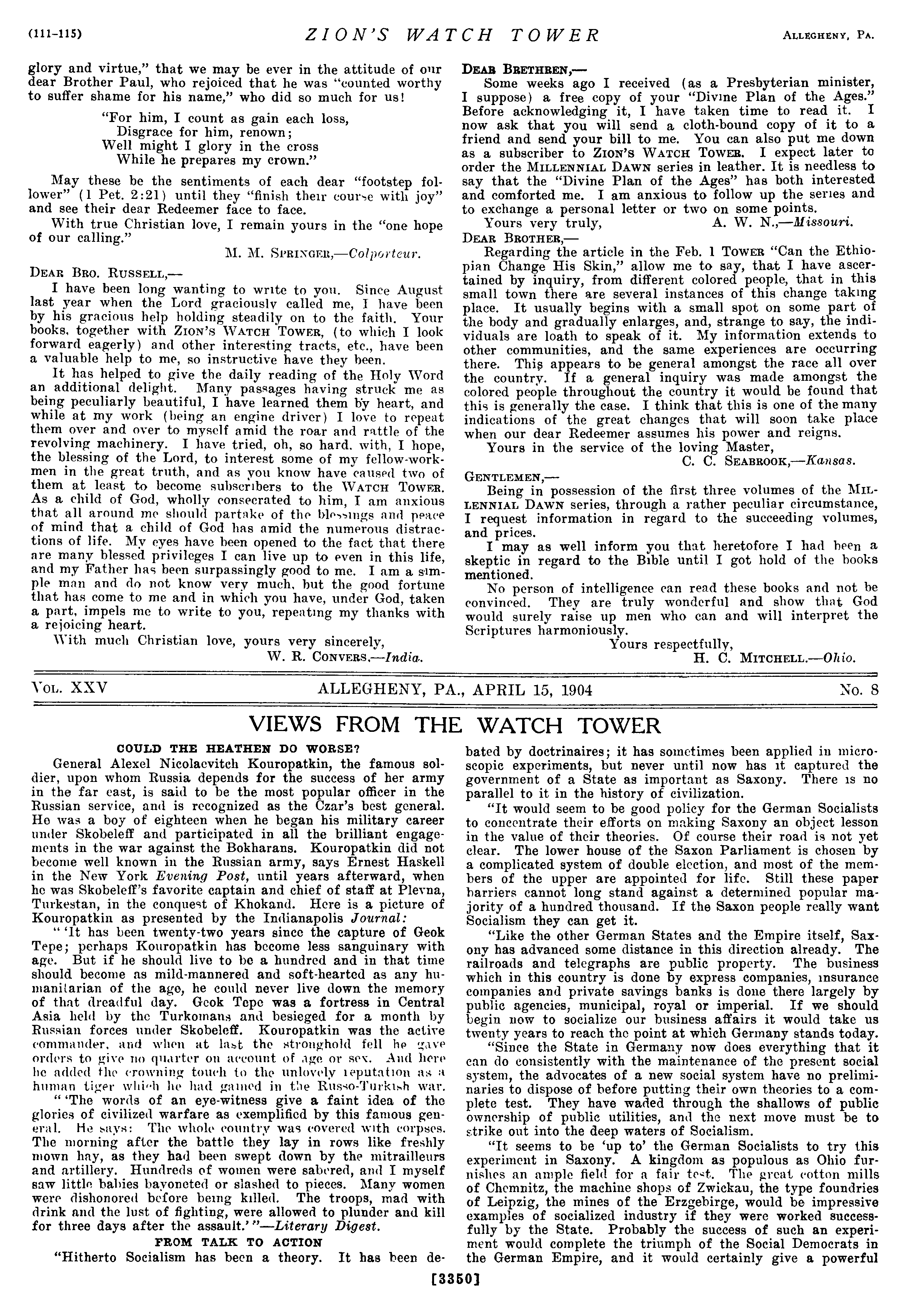
(111-115) glory and virtue,” that we may be ever in the attitude of our dear Brother Paul, who rejoiced that he was “counted worthy to suffer shame for his name,” who did so much for us! “For him, I count as gain each loss, Disgrace for him, renown; Well might I glory in the cross While he prepares my crown.” May these be the sentiments of each dear “footstep follower” (1 Pet. 2:21) until they “finish their course with joy” and see their dear Redeemer face to face. With true Christian love, I remain yours in the “one hope of our calling.” M. M. Sprincer,—Colporteur. Dear Bro. RUSSELL,— I have been long wanting to write to you. Since August last year when the Lord graciously called me, I have been by his gracious help holding steadily on to the faith. Your books, together with Zron’s Warcu Tower, (to which I look forward eagerly) and other interesting tracts, etc., have been a valuable help to me, so instructive have they heen. It has helped to give the daily reading of the Holy Word an additional delight. Many passages having struck me as being peculiarly beautiful, I have learned them by heart, and while at my work (being an engine driver) I love to repeat them over and over to myself amid the roar and rattle of the revolving machinery. I have tried, oh, so hard. with, I hope, the blessing of the Lord, to interest some of my fellow-workmen in the great truth, and as you know have caused two of them at least to become subscribers to the Warcu Tower. As a child of God, wholly consecrated to him, I am anxious that all around me should partake of the blessings and peace of mind that a child of God has amid the numerous distraections of life. Mv eyes have been opened to the fact that there are many blessed privileges I can live up to even in this life, and my Father has been surpassingly good to me. I am a simple man and do not know very much, but the good fortune that has come to me and in which you have, under God, taken a part, impels me to write to you, repeating my thanks with a rejoicing heart. With much Christian love, yours very sincerely, W. R. Convers.—India. ZION’S WATCH TOWER ALLEGHENY, Pa. Dean BRETHREN,— Some weeks ago I received (as a Presbyterian minister, I suppose) a free copy of your “Divine Plan of the Ages.” Before acknowledging it, I have taken time to read it. I now ask that you will send a cloth-bound copy of it to a friend and send your bill to me. You can also put me down as a subscriber to Zion’s WarcH Tower. I expect later to order the MILLENNIAL Dawn series in leather. It is needless to say that the “Divine Plan of the Ages” has both interested and comforted me. I am anxious to follow up the series and to exchange a personal letter or two on some points, Yours very truly, A. W. N..—WMissouri. Dear BROTHER, . Regarding the article in the Feb. 1 TowEr “Can the Ethiopian Change His Skin,” allow me to say, that I have ascertained by inquiry, from different colored people, that in this small town there are several instances of this change taking place. It usually begins with a small spot on some part of the body and gradually enlarges, and, strange to say, the individuals are loath to speak of it. My information extends to other communities, and the same experiences are occurring there. This appears to be general amongst the race all over the country. If a general inquiry was made amongst the colored people throughout the country it would be found that this is generally the case. I think that this is one of the many indications of the great changes that will soon take place when our dear Redeemer assumes his power and reigns. Yours in the service of the loving Master, Cc. C. SEaBrooK,—Kansas. GENTLEMEN,— Being in possession of the first three volumes of the MIrLENNIAL DAWN series, through a rather peculiar circumstance, I request information in regard to the succeeding volumes, and prices. I may as well inform you that heretofore I had heen a skeptic in regard to the Bible until I got hold of the books mentioned. No person of intelligence can read these books and not be convinced. They are truly wonderful and show that God would surely raise up men who can and will interpret the Scriptures harmoniously. Yours respectfully, H. C. MircHey.—Ohio. Vou. XXV ALLEGHENY, PA., APRIL 15, 1904 No. 8 VIEWS FROM THE WATCH TOWER COULD THE HEATHEN DO WORSE? General Alexel Nicolacvitch Kouropatkin, the famous soldier, upon whom Russia depends for the success of her army in the far east, is said to be the most popular officer in the Russian service, and is recognized as the Czar’s best general. He was a boy of eighteen when he began his military career under Skobeleff and participated in all the brilliant engagements in the war against the Bokharans. Kouropatkin did not become well known in the Russian army, says Ernest Haskell in the New York Evening Post, until years afterward, when he was Skobeleff’s favorite captain and chief of staff at Plevna, Turkestan, in the conquest of Khokand. Here is a picture of Kouropatkin as presented by the Indianapolis Journal: “It has been twenty-two years since the capture of Geok Tepe; perhaps Kouropatkin has become less sanguinary with age. But if he should live to be a hundred and in that time should become as mild-mannered and soft-hearted as any humanilarian of the age, he could never live down the memory of that dreadful day. Geok Tepe was a fortress in Central Asia held by the Turkomans and besieged for a month by Russian forces under Skobeleff. Kouropatkin was the active commander, and when at last the stronghold fell he gave orders to give no quarter on account of age or sex. And here he added the crowning touch to the unlovely reputation as a human tiger which he had gained in the Russo-Turkish war. “The words of an eye-witness give a faint idea of the glories of civilized warfare as exemplificd by this famous general, He says: The whole country was covered with corpses. The morning after the battle they lay in rows like freshly mown hay, as they had been swept down by the mitrailleurs and artillery. Hundreds of women were sabered, and I myself saw little babies bayoneted or siashed to pieces. Many women were dishonored before being killed. The troops, mad with drink and the lust of fighting, were allowed to plunder and kill for three days after the assault.’ ”—Literary Digest. FROM TALK TO ACTION “Hitherto Socialism has been a theory. It has heen de bated by doctrinaires; it has somctimes been applied in microscopic experiments, but never until now has it captured the government of a State as important as Saxony. There 1s no parallel to it in the history of civilization. “It would seem to be good policy for the German Socialists to concentrate their efforts on making Saxony an object lesson in the value of their theories. Of course their road is not yet clear. The lower house of the Saxon Parliament is chosen by a complicated system of double elcetion, and most of the members of the upper are appointed for life. Still these paper harriers cannot long stand against a determined popular majority of a hundred thousand. If the Saxon people really want Socialism they can get it. “Like the other German States and the Empire itself, Saxony has advanced some distance in this direction already. The railroads and telegraphs are public property. The business which in this country is done by express companies, insurance companies and private savings banks is done there largely by public agencies, municipal, royal or imperial. If we should begin now to socialize our business affairs it would take us twenty years to reach the point at which Germany stands today. “Since the State in Germany now does everything that it can do consistently with the maintenance of the present social system, the advocates of a new social system have no preliminaries to dispose of before putting their own theories to a complete test. They have waded through the shallows of public ownership of public utilities, and the next move must be to strike out into the deep waters of Socialism. “Tt seems to be ‘up to’ the German Socialists to try this experiment in Saxony. A kingdom as populous as Ohio furnishes an ample field for a fair test. The great cotton mills of Chemnitz, the machine shops of Zwickau, the type foundries of Leipzig, the mines of the Erzgebirge, would be impressive exampies of socialized industry if they were worked successfully by the State. Probably the success of such an experiment would complete the triumph of the Social Democrats in the German Empire, and it would certainly give a powerful [3350]
To enhance your experience on our website, we use cookies and similar technologies. Some cookies are essential for the core functionality of our site and cannot be declined. You can choose to accept or decline additional cookies. We want to assure you that none of this data will be sold or used for marketing purposes. You can adjust your preferences at any time by accessing the Privacy Settings from the footer of the page. For more information, please refer to our
Privacy Policy
Terms of Use
.


