8
1
8
download/literature/watchtower/1905-21.pdf
watchtower/1905/21/1905-21-1
VOL.
XXVI
ALLEGHENY,
P
A.,
NOVEMBER
1,
1905
VIEWS
FROM
THE
WATCH
TOWER
No.
21
WATCH
TOWER
VIEWS
OF
SOCIALISM
Some
of
the
dear
friends
have
quite
mistaken
our
recent
publication
of
items
on
the
progress
of
Socialism.
In
the
volumes
of
the
MILLENNIAL
DAWN
series
(especially
in
VOL.
IV)
we
have
endeavored
to
show
that
we
have
great
sympathy
with
every
movement
designed
to
benefit
mankind-including
Socialism-but
that
from
the
Bible
viewpoint
the
hope
of
the
world
lies
in
none
of
these
human
devices,
but
only
in
the
second
coming
of
Christ
and
in
the
kingdom
of
the
heavens
then
to
be
established.
We
do
point
out,
nowever,
that
God
purposes
to
allow
mankind
to
try
various
projects
for
its
own
relief
only
to
learn
their
futility,
and
that
the
end
of
all
these
faIlures
will
be
discouragement
and
anarchy;
but
that
the
Lord's
people,
better
Informed
than
others
through
the
Scriptures.
will
not
only
not
be
led
to
discouragement
and
anarchy,
but
can
by
faith
rejoice
in
the
troubles
knowing
of
the
glorious
outcome
of
peace
and
blessing
these
will
usher
in-the
Millennium.
THE
FRENCH
DISESTABLISHMENT
The
church
and
its
supreme
Pontiff
are
blamed
by
Emile
Combes,
ex-PremIer
of
France,
for
the
disruption
of
the
Con
cordat.
A~
Mr.
Combes
was
the
leading
spirit
in
the
sever
ance
of
this
bond
between
church
and
state,
his
utterance,
which
appears
in
the
Deutsche
Revue
(Stuttgart),
is
probably
the
most
authoritative
that
has
been
given
out
on
the
Govern
ment's
side
of
the
dispute.
He
says
in
a
recent
article:-
"It
is
time
that
in
France
an
administrative
organization
of
clergy
be
suppressed,
which
transforms
the
pulpit
into
a
pol~t~cal
tribune,.
where
with
unrestrained
liberty
all
the
polItIcal
and
sOCIal
reforms,
all
the
measures
taken
in
the
interests
of
liberty
and
progress
are
oontroverted
and
pointed
out
to
the
faithful
as
so
many
crimes
against
religion.
Separated
from
the
state
the
church
can
utter
what
opinions
it
likes
about
statesmen
and
their
acts,
but
this
can
not
be
permitted
in
a
church
allied
to
the
state
by
a
treaty
which
accords
to
ecclesiastics
a
legally
recognized
authority
and
all
the
privileges
of
state
functionaries."
A
GUAT
OONFERENOE
FOR
ULIGIOVS
OO-OPERATION
The
Literary
Digest
says:-
More
than
seventeen
million
church
members,
belonging
to
twenty-six
different
communions,
we
are
told,
will
be
rep
resented
at
the
great
gathering
in
New
York
city,
beginning
November
15,
to
discuss
and
plan
for
church
federations.
Co
operation
in
service
is
said
to
be
the
goal
the
conference
will
have
in
view,
and
no
organic
union
of
denominations
will
be
attempted.
The
idea
of
federation,
represented
by
this
con
ference,
believes
the
Chicago
Tribune,
is
practicable
"because
it
makes
possible
union
without
fusion,"
and
the
Rochester
Democrat
and.
Chronicle
surmises
that
its
resulting
organiza
tion
"may
beoome
one
of
the
great
moral,
social
and
religious
factors
of
the
coming
age."
The
coming
conference
has
been
planned
and
promoted
by
the
National
Federation
of
Churches
and
Christian
Organizations,
which
came
into
being
in
1900.
Dr.
F.
M.
North,
writing
of
the
approaching
Interchurch
Conference
on
Federation,
says:-
"Should
the
present
promise
of
its
import
be
realized,
there
should
be
an
influence
in
its
utterance
and
its
action
so
powerful
as
to
create
a
new
epoch
in
the
progress
of
Christ's
kingdom
.
.
.
.
.
It
is,
however,
in
the
Evangelical
Alliance
of
the
United
States
of
America
that
the
historian
will
find
the
organized
influence
which
has
most
strongly
emphasized
the
principles
underlying
federation."-See
MILLENNlAL
DAWN,
Vol.
Ill.,
chap.
6.
THE
POPE
ON
THE
BIBLE
It
betokens
a
marked
change
in
the
attitude
of
the
church
of
Rome
toward
the
Bible
for
the
laity,
when
the
Pope
gives
his
blessing
to
an
association
engaged
in
sending
it
forth
in
the
language
of
the
people.
The
St.
Jerome
Association
is
engaged
in
this
for
Italy,
and
when
requested
to
bestow
his
blessing
on
the
new
work
and
the
spread
of
the
Gospel,
the
Pope
answered:-
"Gladly
do
I
give
my
blessing,
and
that
with
both
hands
and
with
full
heart,
for
I
do
not
doubt
that
this
work
will
produce
the
richest
fruit
and
is
already
blessed
by
God.
The
more
we
read
the
Gospel
the
stronger
our
faith
becomes.
The
Go~pels
are
writings
that
are
valuable
for
everybody
and
under
all
circumstances.
I
have
lived
among
the
common
people
and
know
what
they
want
and
what
pleases
them.
Tell
them
the
simplest
BIble
stories
and
you
will
have
attentive
listeners
and
effect
blessed
results.
"Your
purpose
IS
to
spread
the
Gospels.
You
are
doing
a
noble
work.
Some
people
think
that
the
peasants,
with
their
plain,
everyday
way
of
thinking,
would
not
profit
by
the
read
ing
of
the
Scriptures.
This
is
incorrect.
The
average
peasant
is
a
shrewder
thinker
than
we
may
suspect,
and
knows
how
to
draw
the
correct
lessons
from
the
Scriptures,
often
even
better
than
many
of
the
preachers.
But
it
is
not
only
the
common
people
and
the
lower
classes
who
will
profit
by
the
reading
of
the
Scriptures.
"No
matter
how
many
prayer
books
and
books
of
devotion
there
may
be
for
the
priests,
none
is
better
than
the
Gospels.
This
is
an
unsurpassed
book
of
devotion,
the
true
bread
of
life.
I
grant
an
especial
apostolic
blessing
on
all
those
who
preach
the
Gospel,
who
hear
and
read
it,
whether
on
a
Sunday
or
a
week
day.
I
bestow
my
blessing
on
all
members
of
the
St.
Jerome
Society
and
all
who
co-operate
in
the
sacred
work
of
spreading
the
Gospel."-Christiwr.
IntelUgencer.
HIGH
ENGLISH
OHUROHMEN
FAVOR
HIGHER
CRITIOISM
London.-A
committee
of
101
clergymen
sent
out
a
request
some
time
ago
for
petitions
on
the
subject
of
Biblical
crIticism,
or
the
so-called
"higher
criticism."
Over
1700
clergymen
ot
the
Church
of
England
having
signed
the
declaration,
the
Widespread
and
far-reaching
character
of
the
petition
has
aroused
comment
and
caused
criticism.
That
1700
clergymen
should
have
signed
a
document
of
that
kind
is
regarded
as
an
amazing
thing.
The
document
itself
calls
attention
to
the
momentous
intellectual
character
of
"higher
criticism"
or
Biblical
criticism.-Globe-Democmt.
FIFTEEN
PER
OENT
OF
NEBRASKA
OHUROHES
ARE
PASTOBLESS
Lincoln,
Neb.-Fifteen
per
cent.
of
the
Protestant
churches
of
Nebraska
are
without
pastors,
and
it
is
impossible
to
secure
ministers
to
fill
the
vacant
pulpits.
Acoording
to
reports
re
ceived
at
the
headquarters
of
the
CongregatIOnal.
Methodist
and
Lutheran
churches
here
scarcely
a
week
passes
but
some
minister
breaks
away
from
the
calling
to
engage
in
another
line
of
work.
The
prosperity
of
the
farming
industry
has
called
away
the
greater
number,
but
many
have
also
gone
into
business
and
other
professions.
DISPBOOFS
OF
THE
BVOLVTION
THEORY
"To
the
stUdent
of
architecture
it
may
be
surprising
to
learn
that
the
arch,
until
recently
supposed
to
have
been
un·
known
to
the
ancients,
was
frequently
employed
by
the
pre
Babylonians.
Such
an
arch,
in
a
poor
state
of
preservation,
was,
a
few
years
ago,
discovered
in
the
lowest
stratum,
be
neath
the
Babylonian
city
of
Nippur.
More
recently
an
arched
drain
was
found
beneath
the
old
city
of
Fara,
which
the
Ger
mans
have
excavated
in
Central
Babylonia.
'111e
city,
although
one
of
the
earliest
known,
was
built
upon
an
earlier
ruin,
and
provided
with
an
arched
drain
constructed
of
small
plano
convex
brickS.
It
measures
about
one
meter
in
height
and
has
an
equal
width.
"While
delving
among
the
ruined
cities
of
the
world,
we
are
thus
flnding
that
at
the
time
when
we
supposed
that
man
was
primitive
and
savage,
he
provided
his
home
and
city
with
'improvements'
which
we
are
inclined
to
call
modern,
but
which
are
only
reinventing."-Prof.
E.
J.
Banks.
VNTIL
HE
OOME
I
When
we
celebrate
the
Lord's
Memorial
supper
we
show
forth
his
death.
until
he
come-until
at
his
coming
he
changes,
glorifies
us,
setting
us
up
as
his
kingdom.-I
Cor.
11:26.
We
are
using
our
talents,
until
he
come.-Luke
19:
13.
We
are
fighting
the
good
fight
of
faith,
until
he
come.-
1
Tim.
6:
12-14.
We
are
enduring
tribulation,
until
he
come.-2
Thess.
1:7.
We
are
to
be
patient
until
he
come.-James
5:8.
We
wait
for
the
crown
of
righteousness,
until
he
come.
2
Tim.
4:8.
We
wait
for
the
crown
of
glory,
until
he
come-I
Pet.
5
:4.
We
wait
for
re-union
with
departed
friends,
until
he
come.-I
Thess.
4:13-18.
We
wait
for
Satan
to
be
bound
until
he
come.-Rev.
20:3.
•
•
•
Until
he
come,
then,
does
not
point
to
a
special
moment,
hour
or
day,
but
to
the
period
of
his
presence
(parousia)
,
during
which
his
"harvest"
work
will
gather
and
glorify
his
saints
and
establish
his
promised
kingdom.
[3652]
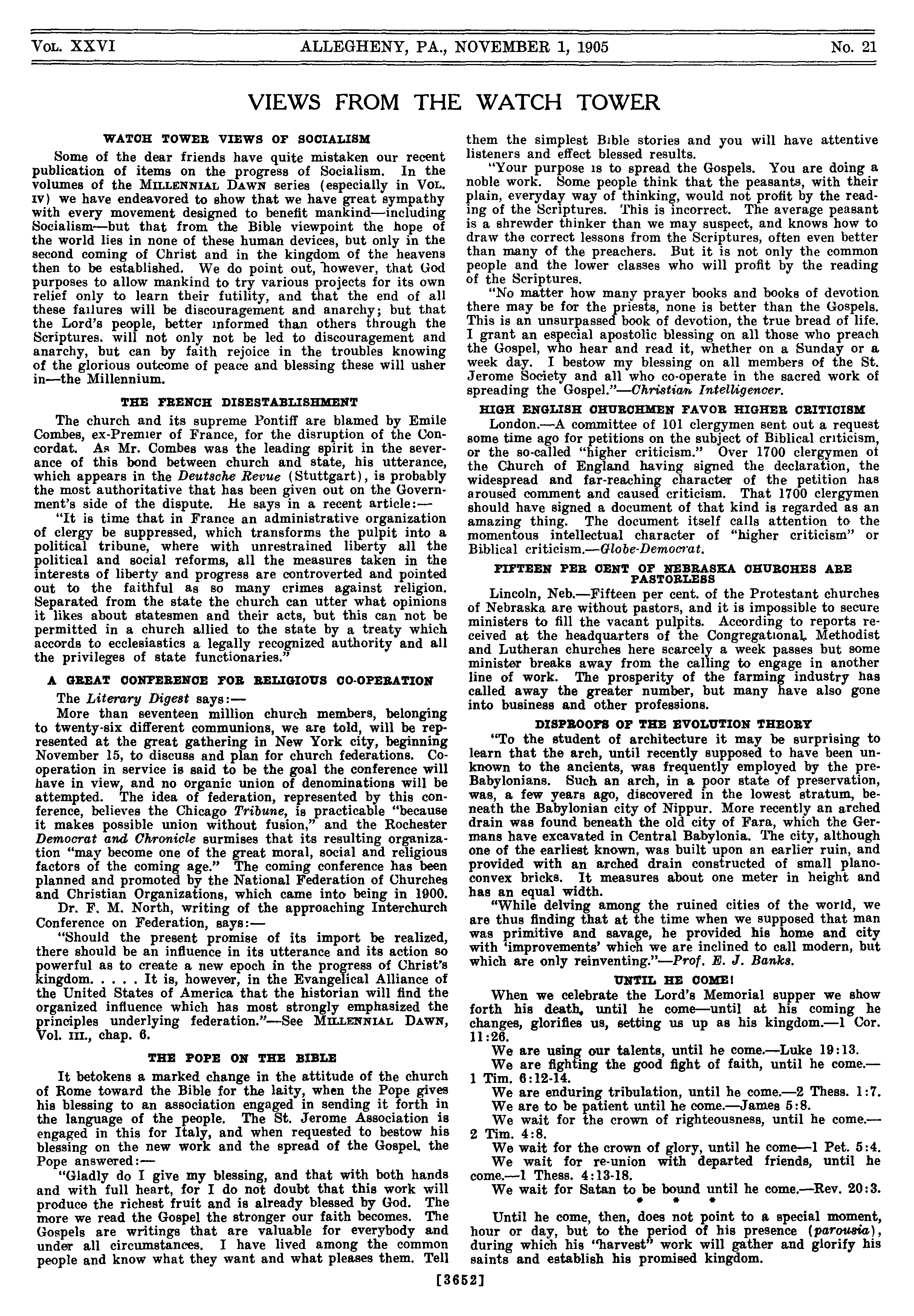
Vou. XXVI ALLEGHENY, PA., NOVEMBER 1, 1905 No. 21 VIEWS FROM THE WATCH TOWER WATCH TOWER VIEWS OF SOCIALISM Some of the dear friends have quite mistaken our recent publication of items on the progress of Socialism. In the volumes of the MILLENNIAL Dawn series (especially in VoL. Iv) we have endeavored to show that we have great sympathy with every movement designed to benefit mankind—including Socialism—but that from the Bible viewpoint the hope of the world lies in none of these human devices, but only in the second coming of Christ and in the kingdom of the heavens then to be established. We do point out, however, that God purposes to allow mankind to try various projects for its own relief only to learn their futility, and that the end of all these failures will be discouragement and anarchy; but that the Lord’s people, better informed than others through the Scriptures. will not only not be led to discouragement and anarchy, but can by faith rejoice in the troubles knowing of the glorious outcome of peace and blessing these will usher in—the Millennium. THE FRENCH DISESTABLISHMENT The church and its supreme Pontiff are blamed by Emile Combes, ex-Premier of France, for the disruption of the Concordat. As Mr. Combes was the leading spirit in the severance of this bond between church and state, his utterance, which appears in the Deutsche Revue (Stuttgart), is probably the most authoritative that has been given out on the Government’s side of the dispute. He says in a recent article:— “It is time that in France an administrative organization of clergy be suppressed, which transforms the pulpit into a political tribune, where with unrestrained liberty all the political and social reforms, all the measures taken in the interests of liberty and progress are controverted and pointed out to the faithful as so many crimes against religion. Separated from the state the church can utter what opinions it likes about statesmen and their acts, but this can not be permitted in a church allied to the state by a treaty which accords to ecclesiastics a legally recognized authority and all the privileges of state functionaries.” A GREAT CONFERENCE FOR RELIGIOUS CO-OPERATION The Literary Digest says:— More than seventeen million church members, belonging to twenty-six different communions, we are told, will be represented at the great gathering in New York city, beginning November 15, to discuss and plan for church federations. Cooperation in service is said to be the goal the conference will have in view, and no organic union of denominations will be attempted. The idea of federation, represented by this conference, believes the Chicago Tribune, is practicable “because it makes possible union without fusion,” and the Rochester Democrat and Chronicle surmises that its resulting organization “may become one of the great moral, socia] and religious factors of the coming age.” The coming conference has been planned and promoted by the National Federation of Churches and Christian Organizations, which came into being in 1900. Dr. F. M. North, writing of the approaching Interchurch Conference on Federation, says:— “Should the present promise of its import be realized, there should be an influence in its utterance and its action so powerful as to create a new epoch in the progress of Christ’s kingdom. .... It is, however, in the Evangelical Alliance of the United States of America that the historian will find the organized influence which has most strongly emphasized the principles underlying federation.”--See MILLENNIAL Dawn, Vol. 111., chap. 6. THE POPE ON THE BIBLE It betokens a marked change in the attitude of the church of Rome toward the Bible for the laity, when the Pope gives his blessing to an association engaged in sending it forth in the language of the people. The St. Jerome Association is engaged in this for Italy, and when requested to bestow his blessing on the new work and the spread of the Gospel, the Pope answered :— “Gladly do I give my blessing, and that with both hands and with full heart, for I do not doubt that this work will produce the richest fruit and is already blessed by God. The more we read the Gospel the stronger our faith becomes. The Gospels are writings that are valuable for everybody and under all circumstances. I have lived among the common people and know what they want and what pleases them. Tell them the simplest Bible stories and you will have attentive listeners and effect blessed results. “Your purpose 1s to spread the Gospels. You are doing a noble work. Some people think that the peasants, with their plain, everyday way of thinking, would not profit by the reading of the Scriptures. This is incorrect. The average peasant is a shrewder thinker than we may suspect, and knows how to draw the correct lessons from the Scriptures, often even better than many of the preachers. But it is not only the common people and the lower classes who will profit by the reading of the Scriptures, “No matter how many prayer books and books of devotion there may be for the priests, none is better than the Gospels. This is an unsurpassed book of devotion, the true bread of life. I grant an especial apostolic blessing on all those who preach the Gospel, who hear and read it, whether on a Sunday or a week day. I bestow my blessing on all members of the St. Jerome Society and all who co-operate in the sacred work of spreading the Gospel.”—Christian Intelligencer, HIGH ENGLISH CHURCHMEN FAVOR HIGHER CRITICISM London.—A committee of 101 clergymen sent out a request some time ago for petitions on the subject of Biblical criticism, or the so-called “higher criticism.” Over 1700 clergymen ot the Church of England having signed the declaration, the widespread and far-reaching character of the petition has aroused comment and caused criticism. That 1700 clergymen should have signed a document of that kind is regarded as an amazing thing. The document itself calls attention to the momentous intellectual character of “higher criticism” or Biblical criticism.—G@lobe-Democrat. FIFTEEN PER CENT OF NEBRASKA OHURCHES ARE PASTORLESS Lincoln, Neb.—-Fifteen per cent. of the Protestant churches of Nebraska are without pastors, and it is impossible to secure ministers to fill the vacant pulpits. According to reports received at the headquarters of the Congregational. Methodist and Lutheran churches here scarcely a week passes but some minister breaks away from the calling to engage in another line of work. The prosperity of the farming industry has called away the greater number, but many have also gone into business and other professions. DISPROOFS OF THE EVOLUTION THEORY “To the student of architecture it may be surprising to learn that the arch, until recently supposed to have been unknown to the ancients, was frequently employed by the preBabylonians. Such an arch, in a poor state of preservation, was, a few years ago, discovered in the lowest stratum, beneath the Babylonian city of Nippur. More recently an arched drain was found beneath the old city of Fara, which the Germans have excavated in Central Babylonia. The city, although one of the earliest known, was built upon an earlier ruin, and provided with an arched drain constructed of smal] planoconvex bricks. It measures about one meter in height and has an equal width. “While delving among the ruined cities of the world, we are thus finding that at the time when we supposed that man was primitive and savage, he provided his home and city with ‘improvements’ which we are inclined to call modern, but which are only reinventing.”—Prof, HB. J. Banks. UNTIL HE COME! When we celebrate the Lord’s Memorial supper we show forth his death, until he come—unti] at his coming he changes, glorifies us, setting us up as his kingdom.—1 Cor. 11:26. We are using our talents, until he come.—Luke 19:13. We are fighting the good fight of faith, until he come.— 1 Tim, 6:12-14. We are enduring tribulation, until he come.—2 Thess. 1:7. We are to be patient until he come.—James 5:8. We wait for the crown of righteousness, until he come— 2 Tim. 4:8. We wait for the crown of glory, until he come—1 Pet. 5:4. We wait for re-union with departed friends, until he come.—1I Thess. 4:13-18. We wait for Satan to be bound until he come.—Rev. 20:3. * * * Until he come, then, does not point to a special moment, hour or day, but to the period of his presence (parousia), during which his “harvest” work will gather and glorify his saints and establish his promised kingdom. [3652]
To enhance your experience on our website, we use cookies and similar technologies. Some cookies are essential for the core functionality of our site and cannot be declined. You can choose to accept or decline additional cookies. We want to assure you that none of this data will be sold or used for marketing purposes. You can adjust your preferences at any time by accessing the Privacy Settings from the footer of the page. For more information, please refer to our
Privacy Policy
Terms of Use
.


