8
1
8
download/literature/watchtower/1905-8.pdf
watchtower/1905/8/1905-8-1
(111-115)
ZION'S
WATCH
TOWER
ALLEGHENY,
PA.
We
see
that
if
Jesus
had
kept
his
life,
had
not
sacrificed
it,
he
might
indeed
have
maintained
it
forever,
but
he
would
not
in
that
event
have
been
privileged
to
bestow
life
upon
the
church
and
the
world.
His
death,
the
just
for
the
unjust,
applied
to
his
believing
disciples,
justified
them
to
life,
"through
faith
in
his
blood."
His
death
thus
brings
forth
choice
fruit
in
his
church,
his
bride,
his
members.
And,
indirectly,
the
fruitage
will
be
still
larger,
for
his
disciples,
justified
through
faith
in
his
blood,
are
invited
and
privileged
to
lay
down
their
lives
with
his,
to
become
dead
with
him.
The
results
or
fruitage
in
their
case
as
members
of
his
body
means
a
still
larger
crop
in
the
age
to
come.
Otherwise
stated,
our
Lord
as
the
one
grain
bring
..
forth
much
fruit,
an
hundred
and
forty
and
four
thou
sand,
besides
the
"great
company"
whose
number
is
known
to
no
man.
And
through
the
hundred
and
forty
and
four
thou
sand,
his
representatives,
his
members,
the
result
will
ultimately
be
a
still
larger
fruitage,
when
all
the
families
of
the
earth
shall
have
the
fullest
opportunity
of
reconciliation
to
the
Father
and
of
life
everlasting
upon
the
divine
conditions.
TERMS
OF
DISOIPLESHIP
Stating
matters
far
beyond
the
comprehension
of
his
hear
ers,
our
Lord
proceeded
to
mark
out
the
course
of
his
imme
diate
followers
in
language
which
they
would
understand
after
the
begetting
of
the
spuit,
after
Pentecost,
saying,
"He
that
loveth
his
life
shall
lose
it;
and
he
that
hateth
his
life
in
this
world
shall
keep
it
unto
life
eternal."
That
is
to
say,
if
we
esteem
highly
our
present
existence,
under
present
imperfect
conditions,
we
will
not
be
willing
to
lay
down
our
lives
in
the
Lord's
service
in
the
hope
of
future
life,
seen
only
by
the
eye
of
faith.
We
must
love
less
the
present
life
under
present
imperfect
conditions
in
order
to
appreciate
more
the
eternal
life
under
better
conditions.
Whoever
is
satisfied
with
the
sinful
and
im
perfect
condition
in
the
present
life
is
in
no
state
of
mind
to
become
the
Lord's
disciple.
Being
satisfied
with
present
con
ditions,
he
will
be
unwilling
to
sacrifice
them
for
the
really
better
ones
which
the
Lord
commends.
We
have
no
reason
to
think
that
the
Lord's
words
apply
beyond
this
Gospel
age-in
the
Millennial
age
things
will
be
greatly
transformed,
reor
ganized.
The
Lord's
language
limits
the
matter,
saying,
"in
this
world,"-that
is,
this
kosmos
or
order
of
things.
Still
continuing
to
explain
the
requirements
of
present
dis
cipleship,
our
Lord
declares,
If
any
man
will
be
my
servant
let
him
follow
me;
where
I
am
there
will
also
my
servant
be.
By
this
language
our
Lord
shows
that
his
faithful
followers
shall
ultimately
share
his
divine
nature
in
the
spirit
realm.
Again
he
states
the
same
matter
in
different
language,
saying,
"If
any
man
will
serve
me
him
will
the
Father
honor."
The
Father
honored
the
Son
because
of
his
faithfulness
even
unto
death;
the
Father
accepts
as
sons
the
followers
of
the
Son,
justified
through
his
blood;
and
those
who
are
faithful
in
walking
in
his
steps
the
Father
will
surely
honor
as
he
honored
Jesus,
the
first-born,
whom
he
raised
from
the
dead
to
glory,
honor
and
immortality,
far
above
angels,
principalities
and
powers
and
every
name
that
is
named.
Let
us
all
be
faithful
fol
lowers.
•
VOL.
XXVI
ALLEGHENY,
PA.,
APRIL
15,
1905
VIEWS
FROM
THE
WATCH
TOWER
No.8
THE
WELSH
REVIVAL
Conflicting
views
of
the
significance
of
the
Welsh
revival
abound.
The
movement
is
novel
in
that
it
seems
to
be
outside
the
labors
of
"ministers,"
carried
on
by
men
and
women
hither
to
without
reputation
and
still
manifesting
"little
ability."
Indeed,
the
meetings
are
described
as
"go-as-you-please,"
in
many
respects.
We
rejoice
that
it
seems
well
established
that
better
morals
and
much
less
drunkenness
mark
the
region
affected.
Lady
Henry
Somerset
writes
to
friends
respecting
this
spontaneous
revival,
contrasting
it
favorably
with
the
less
successful
efforts
being
put
forth
in
London
by
the
ministers
and
others,
in
co-operation
with
Dr.
Torrey
and
Mr.
Alexander,
"American
Evangelists."
The
latter
movement
has
had
all
kinds
of
advertising,
and
every
assistance
that
$57,000
could
command.
An
extract
from
Lady
Somerset's
letter
follows:
"Dr.
Torrey
spoke
simple,
straightforward
words
without
any
great
magnetic
force,
although
you
could
not
but
feel
the
earnestness
of
the
man
and
the
strength
of
his
belief,
and
yet
his
words
to
me
were
a
disappointment.
Ten
thousand
men
and
women
were
there,
who,
speaking
generally,
professed
Christianity.
They
were
gathering
in
a
city
where
sadness
and
sin
abound.
where
the
indifferent
crowd
the
pavements,
and
the
hopel('8s
fill
our
slums
and
mean
streets.
The
revivalist
took
for
his
text,
'Rejoice
in
the
Lord
alway,
and
again
I
say,
Rejoice.'
Joy,
he
said,
was
the
characteristic
of
the
Christian,
joy
overflowing
filled
his
heart,
illumined
his
features,
welled
out
in
his
words.
Does
it
T
I
thought,
as
I
looked
round
the
audience.
Ought
it
to
do
s01
was
the
question
that
rose
in
my
hl'art.
"The
cries
of
the
oppressed
in
Russia
are
ringIDI'l'
in
our
('ar",
thl'
cru('l
grasp
of
poverty
holds
our
people
in
the
iron
Jrrip
of
hun~r,
the
steps
of
the
man
who
is
seeking
work
in
Yllin
!Il'at
npon
our
8treets,
th('
sin
which
mars,
blight8
and
destroy8
in
stalking
abroad
at
this
very
hour,
the
drink
poison
is
inflaming
mpn's
brains
and
cursing
their
lives.
Can
our
attitude
as
Christians
be
one
of
joy?
"Ought
we
not
rather
to
weep
with
Christ
over
sorrowful,
wayward
Humanity,
and
humbly
face
the
dread
responSIbility
whirh
rests
upon
us
1
Calm,
self-satisfied
we
all
sat
there,
and
never
a
word
did
the
revivalist
say
to
those
listening
thousands
to
arOUl:;e
them
to
the
fact
that
the
state
of
London,
nay
of
the
world,
lies
at
the
door
of
the
lethargic
church
itself.
We
sang
songs
over
and
over
again
about
heaven,
about
joining
our
loved
ones
yonder.
"A
young
man
with
a
beautiful
voice
in
the
top
gallery
sang
a
solo
about
"Telling
Mother
I'll
Be
There,"
but
to
me
the
note
of
a
real
revival
was
missing,
which
should
sound
the
call
to
be
about
the
business
of
our
Master,
to
be
in
dead
earnest
that
God's
will
be
done
on
earth,
and
to
understand
that
it
is
the
business
of
His
church
to
get
it
done.
And
as
I
went
away
after
the
meeting,
to
the
slums
of
the
East
End,
I
felt
more
strongly
than
ever
that
to
define
our
understandmg
of
what
heaven
will
be
is
an
impossibility.
One
thing
we
know,
however-that
it
must
mean
an
eternal
harmony
between
our
will
and
God's,
and
that
our
present
peace
lies
in
doing
his
will
now.
"But
it
is
still
more
difficult
to
understand
how
joy
can
be
the
keynote
of
our
Christianity
if
the
revivalists
really
be
lieve
that
for
some
an
eternity
of
torment
awaits
them,
without
even
the
escape
through
the
purifying
fire
which
the
tenderer
spirit
of
the
medieval
church
granted
as
a
recognition
of
the
mercy
of
God;
for
them
it
surely
seems
to
me
joy
is
impos
sible.
"It
i8
as
though
one
individual,
with
a
cry
of
etDultation
and
a
shout
of
Alleluia,
found
the
fire
escape,
while
the
rest
of
the
household
peri-shed
in
the
flames.
But
the
impression
produced
on
my
mind
may
have
been
possibly
heightened
by
the
contrast
presented
by
the
wonderfully
vivid
realization
of
the
simple
work
of
the
spirit
which
has
been
blowing
like
the
divme
breath
through
the
valleys
of
South
Wales.
"There
organizations
has
been
unknown,
money
has
been
unsought,
newspaper
puffs
nonexistent;
indeed,
the
revivalist
has
still
to
be
found.
True
it
is
that
the
figure
of
Evan
Roberts
stands
out
strongly,
and
yet
the
revival
is
independent
of
him.
"There
is
no
order
of
service,
no
set
choir,
only
bursts
of
wonderful
Welsh
melody,
no
hymn
books-the
words
are
writ
ten
in
the
hearts
of
the
worshipers.
The
little
whitewashed
chapels
resound
with
song,
song
exquisite
in
its
harmony,
solemn
as
death,
and
yet
jubilant
as
a
choir
of
angels.
Then
stillness,
prayers,
soft
sobbing
from
broken
hearts,
confession,
profession,
all
the
wonderful
gamut
of
the
soul's
experience,
but
all
spontaneous,
with
no
settled
effect,
only
the
greatest
effect
of
all,
the
reality
of
human
need
and
divine
power.
"What
wonder
Wales
has
been
shaken
as
never
before
since
the
j1;reat
religious
revival
a
century
and
a
half
ago!
What
wonder
the
drink
shops
are
empty,
that
at
the
assizes
there
has
been
no
crime!
"Everywhere
as
you
move
about
you
feel
a
great
hush
as
though
Christ
walked
over
the
mountains
and
into
the
mining
towns
and
out
through
the
valleys
among
the
sons
and
daug-h
ters
of
toil,
whose
eyes
have
been
opened
to
see
him
as
he
came
to
them
by
the
way."
This
dear
writer
seems
to
be
"ripe"
for
the
message
of
present
truth
as
are
all
the
best
hearts
the
world
over.
We
trust
that
somehow
she
and
all
such
will
be
reached
within
the
next
ten
years.
It
is
said
to
be
remarkable,
too,
that
the
eternal
torment
idea
is
but
seldom
referred
to
in
the
Welsh
movement.
Thl'
editor
of
Review
of
Reviews,
Mr.
Stead,
has
given
con
siderable
attention
to
the
Welsh
movement
and
predicts
that
the
blaze
there
started
will
sweep
over
the
world.
He
declares
that
he
sees
evidences
of
clairvoyance
in
connection
with
Mr.
Evan
Roberts,
the
leader
of
the
revival.
Mr.
Stead
is
hImself
[3540]
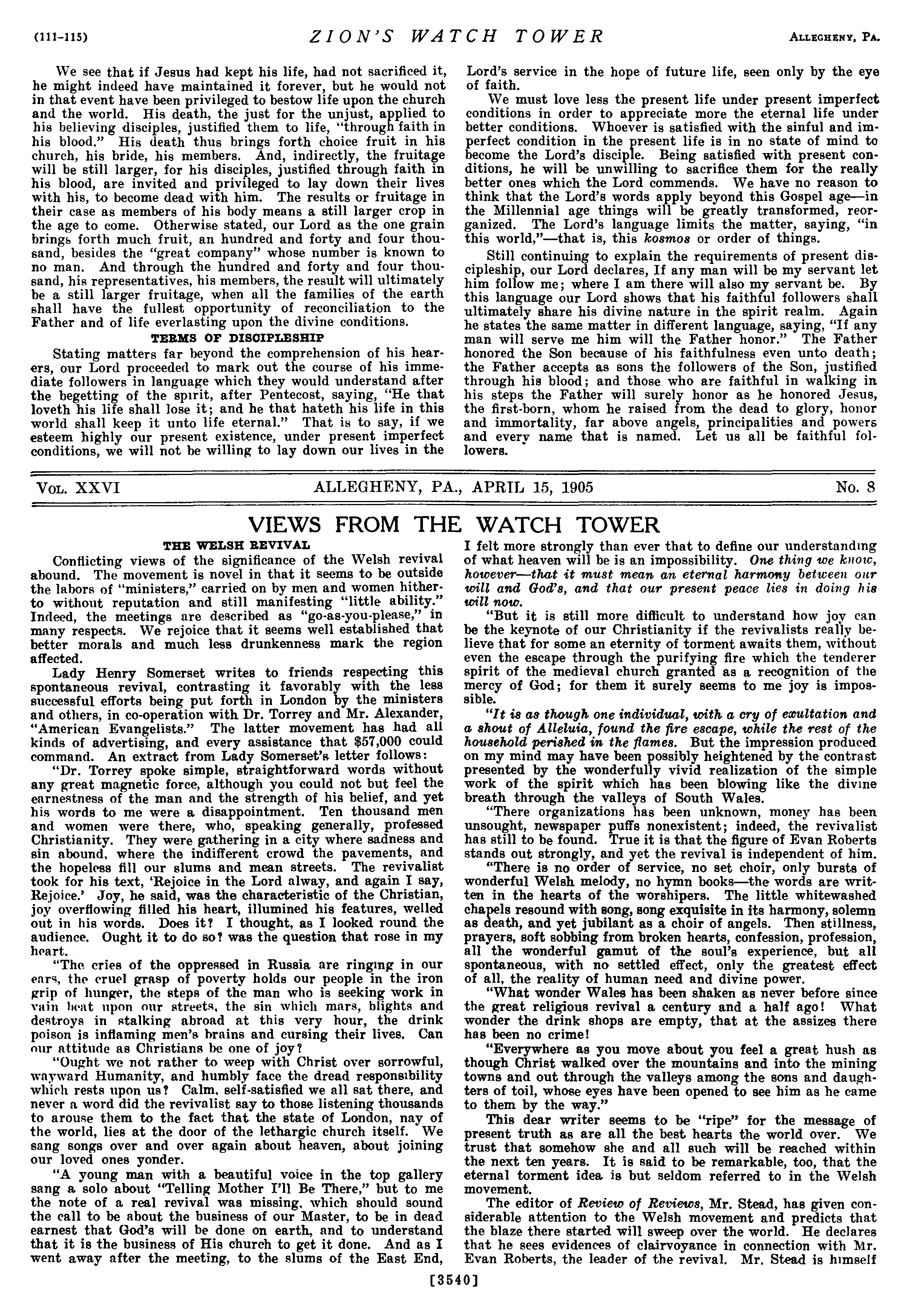
(111-115) We see that if Jesus had kept his life, had not sacrificed it, he might indeed have maintained it forever, but he would not in that event have been privileged to bestow life upon the church and the world. His death, the just for the unjust, applied to his believing disciples, justified them to life, ‘‘through faith in his blood.” His death thus brings forth choice fruit in his church, his bride, his members. And, indirectly, the fruitage will be still larger, for his disciples, justified through faith in his blood, are invited and privileged to lay down their lives with his, to become dead with him. The results or fruitage in their case as members of his body means a still larger crop in the age to come. Otherwise stated, our Lord as the one grain brings forth much fruit, an hundred and forty and four thousand, besides the “great company” whose number is known to no man. And through the hundred and forty and four thousand, his representatives, his members, the result will ultimately be a still larger fruitage, when all the families of the earth shall have the fullest opportunity of reconciliation to the Father and of life everlasting upon the divine conditions. TERMS OF DISCIPLESHIP Stating matters far beyond the comprehension of his hearers, our Lord proceeded to mark out the course of his immediate followers in language which they would understand after the begetting of the spirit, after Pentecost, saying, “He that loveth his life shall lose it; and he that hateth his life in this world shall keep it unto life eternal.” That is to say, if we esteem highly our present existence, under present imperfect conditions, we will not be willing to lay down our lives in the ZION’S WATCH TOWER ALLEGHENY, Pa, Lord’s service in the hope of future life, seen only by the eye of faith. We must love less the present life under present imperfect conditions in order to appreciate more the eternal life under better conditions. Whoever is satisfied with the sinful and imperfect condition in the present life is in no state of mind te become the Lord’s disciple. Being satisfied with present conditions, he will be unwilling to sacrifice them for the really better ones which the Lord commends. We have no reason to think that the Lord’s words apply beyond this Gospel age—in the Millennial age things will be greatly transformed, reorganized. The Lord’s language limits the matter, saying, “in this world,”—that is, this kosmos or order of things. Still continuing to explain the requirements of present discipleship, our Lord declares, If any man will be my servant let him follow me; where I am there will also my servant be. By this language our Lord shows that his faithful followers shall ultimately share his divine nature in the spirit realm. Again he states the same matter in different language, saying, “If any man will serve me him will the Father honor.” The Father honored the Son because of his faithfulness even unto death; the Father accepts as sons the followers of the Son, justified through his blood; and those who are faithful in walking in his steps the Father will surely honor as he honored Jesus, the first-born, whom he raised from the dead to glory, honor and immortality, far above angels, principalities and powers and every name that is named. Let us all be faithful followers. Vou. XXVI ALLEGHENY, PA. APRIL 15, 1905 No. 8 VIEWS FROM THE WATCH TOWER THE WELSH REVIVAL Conflicting views of the significance of the Welsh revival abound, The movement is novel in that it seems to be outside the labors of ‘‘ministers,” carried on by men and women hitherto without reputation and still manifesting “little ability.” Indeed, the meetings are described as “go-as-you-please,” in many respects. We rejoice that it seems well established that better morals and much less drunkenness mark the region affected. . Lady Henry Somerset writes to friends respecting this spontaneous revival, contrasting it favorably with the less successful efforts being put forth in London by the ministers and others, in co-operation with Dr. Torrey and Mr. Alexander, “American Evangelists.” The latter movement has had all kinds of advertising, and every assistance that $57,000 could command. An extract from Lady Somerset’s letter follows: “Dr. Torrey spoke simple, straightforward words without any great magnetic force, although you could not but feel the earnestness of the man and the strength of his belief, and yet his words to me were a disappointment. Ten thousand men and women were there, who, speaking generally, professed Christianity. They were gathering in a city where sadness and sin abound, where the indifferent crowd the pavements, and the hopeless fill our slums and mean streets. The revivalist took for his text, ‘Rejoice in the Lord alway, and again I say, Rejoice.’ Joy, he said, was the characteristic of the Christian, joy overfiowing filled his heart, illumined his features, welled out in his words. Does it? I thought, as I looked round the audience. Ought it to do so? was the question that rose in my heart. “The cries of the oppressed in Russia are ringing in our ears, the cruel grasp of poverty holds our people in the iron grip of hunger, the steps of the man who is seeking work in vain heat upon our streets, the sin which mars, blights and destroys in stalking abroad at this very hour, the drink poison is inflaming men’s brains and cursing their lives, Can our attitude as Christians be one of joy? “Ought we not rather to weep with Christ over sorrowful, wayward Humanity, and humbly face the dread responsibility which rests upon us? Calm, self-satisfied we all sat there, and never a word did the revivalist say to those listening thousands to arouse them to the fact that the state of London, nay of the world, lies at the door of the lethargic church itself. We sang songs over and over again about heaven, about joining our loved ones yonder. “A young man with a beautiful voice in the top gallery sang a solo about “Telling Mother I’ll Be There,” but to me the note of a real revival was missing, which should sound the call to be about the business of our Master, to be in dead earnest that God’s will be done on earth, and to understand that it is the business of His church to get it done. And as I went away after the meeting, to the slums of the East End, I felt more strongly than ever that to define our understanding of what heaven will be is an impossibility. One thing we know, however—that it must mean an eternal harmony between our will and God’s, and that our present peace lies in doing his will now. “But it is still more difficult to understand how joy can be the keynote of our Christianity if the revivalists really believe that for some an eternity of torment awaits them, without even the escape through the purifying fire which the tenderer spirit of the medieval church granted as a recognition of the mercy of God; for them it surely seems to me joy is impossible. “It is as though one individual, with a ery of exultation and @ shout of Alleluia, found the fire escape, while the rest of the household perished in the flames. But the impression produced on my mind may have been possibly heightened by the contrast presented by the wonderfully vivid realization of the simple work of the spirit which has been blowing like the divine breath through the valleys of South Wales. “There organizations has been unknown, money has been unsought, newspaper puffs nonexistent; indeed, the revivalist has still to be found. True it is that the figure of Evan Roberts stands out strongly, and yet the revival is independent of him. “There is no order of service, no set choir, only bursts of wonderful Welsh melody, no hymn books—the words are written in the hearts of the worshipers. The little whitewashed chapels resound with song, song exquisite in its harmony, solemn as death, and yet jubilant as a choir of angels. Then stillness, prayers, soft sobbing from broken hearts, confession, profession, all the wonderful gamut of the soul’s experience, but all spontaneous, with no settled effect, only the greatest effect of all, the reality of human need and divine power. “What wonder Wales has been shaken as never before since the great religious revival a century and a half ago! What wonder the drink shops are empty, that at the assizes there has been no crime! “Everywhere as you move about you feel a great hush as though Christ walked over the mountains and into the mining towns and out through the valleys among the sons and daughters of toil, whose eyes have been opened to see him as he came to them by the way.” This dear writer seems to be “ripe” for the message of present truth as are all the best hearts the world over. We trust that somehow she and all such will be reached within the next ten years. It is said to be remarkable, too, that the eternal torment idea is but seldom referred to in the Welsh movement. The editor of Review of Reviews, Mr. Stead, has given considerable attention to the Welsh movement and predicts that the blaze there started will sweep over the world. He declares that he sees evidences of clairvoyance in connection with Mr. Evan Roberts, the leader of the revival. Mr. Stead is himself [3540]
To enhance your experience on our website, we use cookies and similar technologies. Some cookies are essential for the core functionality of our site and cannot be declined. You can choose to accept or decline additional cookies. We want to assure you that none of this data will be sold or used for marketing purposes. You can adjust your preferences at any time by accessing the Privacy Settings from the footer of the page. For more information, please refer to our
Privacy Policy
Terms of Use
.


