8
1
8
download/literature/watchtower/1906-12.pdf
watchtower/1906/12/1906-12-1
JUNE
I,
1906
ZION'S
WATCH
TOWER
(176-180)
What
manner
of
persons
ought
we
to
be
in
all
holy
conversa
tion,
living
and
godliness!-2
Pet.
3
:11.
18
19,20
22,2a
24
25,26
PILGRIM
VISITS
OF
BRO.
B.
H.
BARTON
Eng.
July
9,10
Belfast,
Ire.
July
"
"
11
Dublin,
,
,
"
"
"
12
Liverpool,
Eng."
"
"
13
Warrington,
"
"
"
"14,15
East
Kirkby,"
"
Bradford,
Ossett,
::>ldham,
Macclesfield,
Manchester,
Israel,
wonderful
love
and
a
New
Covenant
for
all
the
families
of
the
earth.
Those
who
see
this
vision
of
the
kingdom,
and
who
discern
its
rapid
arrangement
and
the
preparation
for
its
glorious
revelation
to
the
whole
world,
have
the
assurance
that
they
are
not
following
cunningly
devised
fables;
that
the
Higher
Critics
are
greatly
mistaken
in
their
judging
of
the
Word
of
God
along
the
lines
of
external
testimonies
and
evolution
theories.
We
have
much
advantage
everyway
over
the
remainder
of
mankind,
and
we
may
well
say
to
ourselves,
VOL.
XXVII
ALLEGHENY,
P
A.,
JUNE
15,
1906
No.
12
VIEWS
FROM
THE
CHURCH
UNION-NEXT,
FEDERATION
The
PresbyterIan
and
Cumberland
Presbyterian
bodies
have
reunited,
as
per
the
following
telegram
in
the
public
press
columns:
Des
:Moines,
la.,
lIfay
24.-Dr.
Hunter
Corbett,
the
Mod
erator
of
the
Presbyterian
General
Assembly,
declared
the
union
of
the
Presbyterian
church
of
the
United
States
and
the
Cumberland
and
Presbyterian
church
completed
at
10.21
a
'clock
this
morning
as
follows:
"I
do
solemnly
declare
and
hereby
publicly
announce
that
the
basis
of
union
and
reunion
is
now
in
full
force
and
effect,
and
that
the
Cumberland
Presbyterian
church
is
now
reunited
with
the
Presbyterian
church
in
the
United
States
of
America
a.s
one
church."
The
big
ecclesiastical
assemblage
burst
into
a
storm
of
rejoicing.
Handclapping,
cheering
and
waving
of
handker
chiefs
gave
expression
of
unalloyed
pleasure.
*
*
*
The
spirit
of
union
and
federation
prevails
everywhere.
Our
rea.ders
well
know
that
from
prophecy
we
have
for
twenty-five
years
been
expecting
not
only
that
the
Fed
eration
would
come
soon,
but
that
the
vitality
of
it
would
come
from
the
Episcopal
church.
The
insurmountable
bar
rier
thus
far
seems
to
be
in
the
claim
of
this
denomination
to
"Apostolic
Succession,"
which
asserts
that
none
are
qual
ilied
ministers
except
as
"ordained"
in
the
line
of
such
succession.
Now
we
find
a
movement
amongst
Episcopalians
to
con
cede
something:
to
c'aim
merely
the
Historic
Episcopate
and
to
drop
the
claim
of
Apostolic
Succession,
so
as
to
pro
mote
the
union
of
all
Protestants.
This
view
is
set
forth
in
a
recently
published
boak
by
Rev.
E.
McCrady
(Epis
copalian),
entitled,
"APOSTOLIC
SUCCESSION
AND
THE
PROBLEM
OF
UNITT"
We
quote
one
paragraph:-
"When
we
ourselves
are
broad
enough,
catholic
enough,
to
admit
that
the
theory
of
the
divine
right
of
Episcopacy
is
a
theory
only-when
we
are
willing
to
own,
as
we
mu.st,
that
while
fitting
in
very
well
with
historical
facts,
it
can
never
be
absolutely
demonstrated-when
we
further
are
will
ing
to
recognize
the
fact
that
the
Reformers
did
not
believe
in
such
a
theory
themselves,
and
that
the
church,
in
spite
of
all
tho
influences
brought
to
bear
upon
her,
has
care
fully
refrained
from
officially
promulgating
such
a
doctrine
-when,
in
other
words,
we
cease
to
un
church
our
Protestant
brethren
by
insisting
upon
a
principle
logically
indefensible
and
never
officially
set
forth-we
will
then
be
in
a
position
to
expect
some
concessions
on
their
part,
and-we
venture
the
further
prediction-we
shall
then
begin
to
hear
some
solid
discus.sion,
and
see
some
valid
signs
of
the
approach
ing
union
of
Christendom."
*
*
*
The
Bible
clearly
sets
forth
that
such
a
federation
of
Protesta.nts
will
be
effected
before
the
great
final
catastrophe
which
will
usher
in
the
kingdom
of
God's
dear
Son
and
the
glorification
of
the
church
of
the
firstborn;
hence
our
in
terE'st
in
every
item
pointing
to
its
realization.
"THE
UNITED
CHURCH
OF
CANADA"
/I
The
negotiations
for
the
union
of
three
churches
in
Canada
have
attracted
world-wide
attention.
N
early
all
of
the
religious
journals
and
many
of
the
secular
ones
de
vote
much
space
to
special
comment
upon
this
theme.
These
comments
are
almost
entirely
congratulatory.
The
Toronto
Globe
has
rendered
important
service
by
printing
the
ex
pressions
of
opinion
by
men
of
light
and
leading
in
the
three
churches
in
various
parts
of
the
country.
It
is
a
surprise
to
find
how
generally
these
are
favorable
expressions.
Of
course
there
are
a
few
doubting
Thomases,
a
few
who
mag
nify
differences
and
overlook
the
great
harmonies,
who
ad
vise
us
to
be
careful
and
go
slow;
but
the
overwhelming
consensus
is
in
favor,
not
of
federation,
but
of
organic
WATCH
TOWER
union.
We
have
received
correspondence
from
various
parts
of
the
United
States,
from
the
Atlantic
to
the
Pacific,
with
reference
to
an
account
we
wrote
in
The
Christian
Herald
of
this
great
movement,
and
all
of
these
are
of
devout
thanksgiving
for
the
leading
of
divine
providence.
We
quote
from
the
Literary
Digest
some
of
the
press
comments
on
this
subject:
/I
'An
extraordinary
movement,
in
some
respects,
not
paralleled
in
several
centuries,'
is
the
phrase
by
which
the
New
York
Christian
Advocate
(Methodi~t)
characterizes
the
movement
toward
union
between
the
Presbyterian,
Methodist
and
Congregationalist
churches
in
Canada.
The
report
of
the
joint
committee
of
these
three
denominations,
just
published.
is
described
by
the
Toronto
Globe
as
'the
most
remarkable
ecclesiastical
document
issued
in
Protes
tant
Christendom
since
the
Reformation.'
All
the
indica
tions
seem
to
point
to
the
ultimate
consummation
of
this
union,
and
the
name
tentatively
chosen
for
the
new
church
is,
'The
United
Church
of
Canada.'
The
Interior
(Presby
terian,
Chieago)
writes
of
the
union
planned
as
'the
most
radical
and
remarkahle
coalition
of
chnrches
that
has
been
proposed
since
the
Reformation
brought
in
the
era
of
de·
nominational
divis!ons.
'
Zion's
Herald
(Methodist,
Bos
ton),
reminds
us
that
Canada
in
the
past
has
led
the
way
in
effecting
denominational
unions.
1/
The
Christian
Advocate
remarks
E'ditorially:
t
This
ex·
periment
in
each
of
its
stages
should
receive
the
concen·
trated
attention
of
the
Protestantism
of
the
world.
If
it
succeeds
it
will
make
feasible
the
only
reasonable
plan
for
the
diminution
of
the
number
of
distinct
communions.'
1/
The
Presbyterian
(Toronto,
Canada)
thinks
that
the
prospects
are
bright
for
a
consummation
of
the
proposed
union.
It
says:
'There
will
be
no
unseemly
haste;
in
the
nature
of
things
there
cannot
be.
It
will
take
some
little
time
to
prepare
the
basis
and
have
it
pronounced
upon
ulti·
mately
by
the
body
of
the
people.
Agreement
as
to
the
things
that
may
be
given
up
and
the
things
that
shall
re
main,
will
not
come
in
a
moment,
but
it
will
come.
There
is
an
organizing
power
of
its
own
in
a
great,
structural,
co
ordinating
movement
like
this.'
"The
Presbyterian
Banner
(Pittsbur~h,
Pa.)
comments
as
follows:
'We
wou'd
hardly
think
a
union
of
these
three
churches
possible
in
this
country,
but
it
appea.rs
to
be
pos
sible
only
a
few
milE'S
north
of
UR.
ani!
it
is
the
Lord's
doing
and
marvelous
in
our
eyes.
The
Spirit
of
the
Lord,
however,
is
not
restricted
by
geographieal
bouni!aries
anfl
red
and
blue
lines
on
the
map,
and
what
tlle
Spirit
can
do
there
he
may
do
here.'
1/
The
Methodists
in
Canada
number
916,659,
the
Presby
terians
842,016,
and
the
Congregationalists
28.000.
Thus,
as
the
Church
Standard
(Protestant
Episcopal,
Philadelphia)
points
out,
the
new
church
will
enter
upon
its
work
with
a
membership
of
1,786,676,
'nearly
one-third
of
the
popula
tion
of
the
whole
of
Canada."
'-Onward
(Methodist,
To·
ronto).
FEDERATION
IN
GREAT
BRITAIN
The
London
Daily
Chronicle
reeently
publishe<1
a
lengthy
appeal
for
special
prayers
for
the
reunion
of
Christendom.
It
was
signed
by
the
President
of
the
United
Methodist
Free
churches;
the
President
of
the
Methodist
New
Con
nection
church;
the
President
of
the
Wesleyan
Methodist
Conference;
the
Moderator-eled
of
the
English
Presbyterian
church;
the
President
of
the
Baptist
Union;
the
Moderator
of
the
General
Assembly
of
the
church
of
Scotland;
the
Moderator
of
the
General
Assembly
of
the
United
Free
church
of
Scotland;
the
Primus
of
the
Scottish
Church,
and
the
Chairman
of
the
Congregational
Union
of
En~land
and
Wales.
Evidently
a
few
more
years
of
stress
will
accom
plish
what
they
pray
fo1',-a
union
of
sects,
a
federat:on
on
the
basis
of
ignoring
one
another's
errors.
But
this
will
not
be
the
heart
union
for
which
our
Lord
prayed-one
in
[3791]
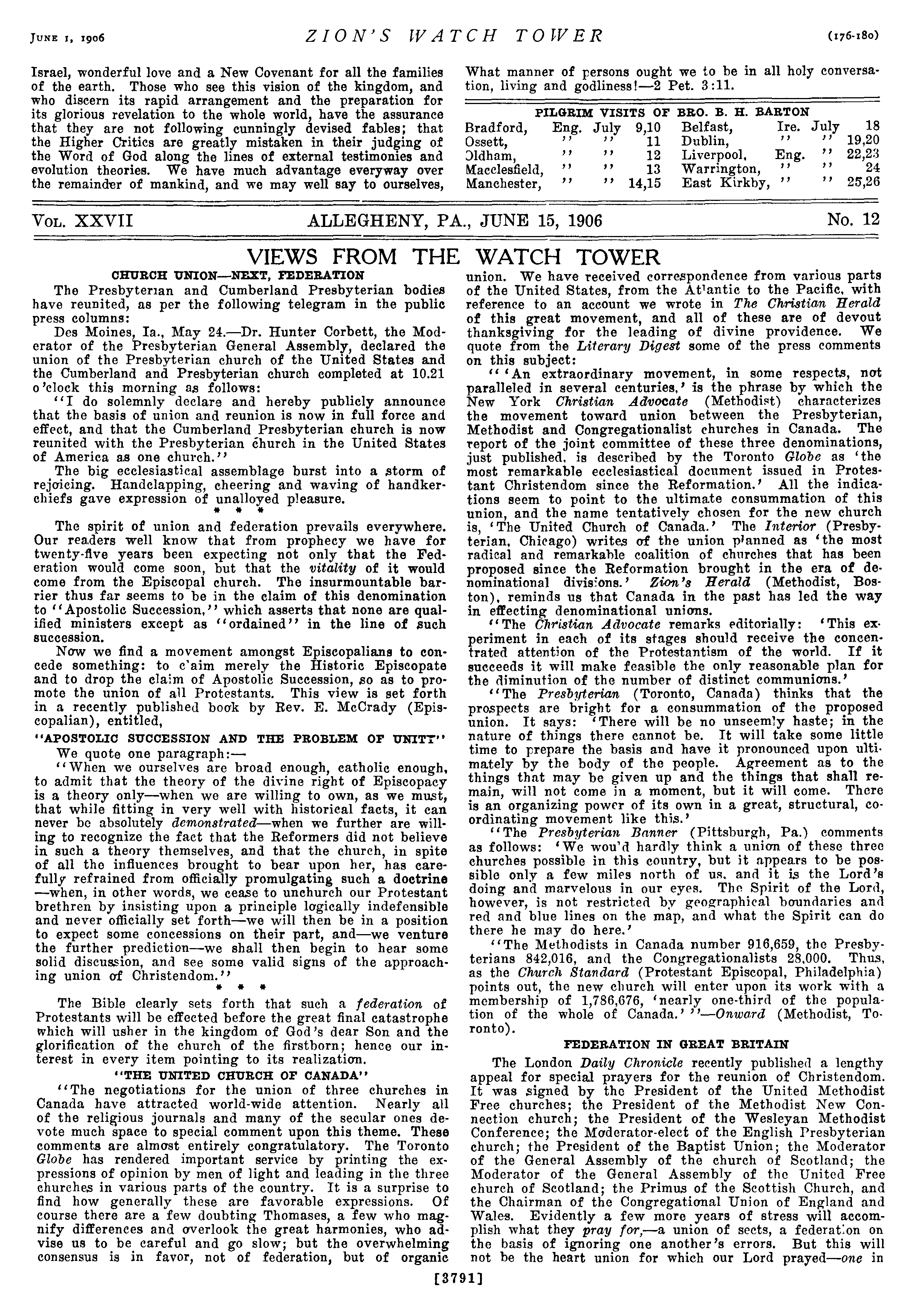
ZION’S JUNE 1, 1906 Israel, wonderful love and a New Covenant for all the families of the earth. Those who see this vision of the kingdom, and who discern its rapid arrangement and the preparation for its glorious revelation to the whole world, have the assurance that they are not following cunningly devised fables; that the Higher Critics are greatly mistaken in their judging of the Word of God along the lines of external testimonies and evolution theories. We have much advantage everyway over the remainder of mankind, and we may well say to ourselves, WATCH TOWER (176-180) What manner of persons ought we to be in all holy conversation, living and godliness!—2 Pet. 3:11. PILGRIM VISITS OF BRO. B. H. BARTON Vou. XXVII Bradford, Eng. July 9,10 Belfast, Ire. July 18 Ossett, 9") Dublin, 179" 19,90 Jldham, ” ” 12 Liverpool, Eng. 7? 22,23 Macclesfield, ’’ ”? 13 Warrington, ’’ ”? 24 Manchester, ’’ 7? 14,15 East Kirkby, ’’ 7? 25,26 ALLEGHENY, PA., JUNE 15, 1906 No. 12 VIEWS FROM THE WATCH TOWER CHURCH UNION—NEXT, FEDERATION The Presbyterian and Cumberland Presbyterian bodies have reunited, as per the following telegram in the public press columns: Des Moines, Ia., May 24.—Dr. Hunter Corbett, the Moderator of the Presbyterian General Assembly, declared the union of the Presbyterian church of the United States and the Cumberland and Presbyterian church completed at 10.21 o’clock this morning as follows: ‘‘T do solemnly declare and hereby publicly announce that the basis of union and reunion is now in full force and effect, and that the Cumberland Presbyterian church is now reunited with the Presbyterian church in the United States of America as one church.’’ The big ecclesiastical assemblage burst into a storm of rejoicing. Handclapping, cheering and waving of handkerchiefs gave expression of unalloyed pleasure. * * * The spirit of union and federation prevails everywhere. Our readers well know that from prophecy we have for twenty-five years been expecting not only that the Federation would come soon, but that the vitality of it would come from the Episcopal church. The insurmountable barrier thus far seems to be in the claim of this denomination to ‘‘ Apostolic Succession,’’ which asserts that none are qualified ministers except as ‘‘ordained’’ in the line of such succession. Now we find a movement amongst Episcopalians to concede something: to c’'aim merely the Historic Episcopate and to drop the elaim of Apostolic Succession, so as to promote the union of all Protestants. This view is set forth in a recently published book by Rev. E. McCrady (Episcopalian), entitled, “APOSTOLIC SUCCESSION AND THE PROBLEM OF UNITY’’ We quote one paragraph:— ‘‘When we ourselves are broad enough, catholic enough, to admit that the theory of the divine right of Episcopacy is a theory only—when we are willing to own, as we must, that while fitting in very well with historical facts, it can never be absolutely demonstrated—when we further are willing to recognize the fact that the Reformers did not believe in such a theory themselves, and that the church, in spite of ali the influences brought to bear upon her, has carefully refrained from officially promulgating such a doctrine —when, in other words, we cease to unchurch our Protestant brethren by insisting upon a principle logically indefensible and never officially set forth—we will then be in a position to expect some concessions on their part, and—we venture the further prediction—we shall then begin to hear some solid discussion, and see some valid signs of the approaching union of Christendom.’’ * * * The Bible clearly sets forth that such a federation of Protestants will be effected before the great final catastrophe which will usher in the kingdom of God’s dear Son and the glorification of the church of the firstborn; hence our interest in every item pointing to its realization. ‘THE UNITED CHURCH OF CANADA”’ ‘‘The negotiations for the union of three churches in Canada have attracted world-wide attention. Nearly all of the religious journals and many of the secular ones devote much space to special comment upon this theme. These comments are almost entirely congratulatory. The Toronto Globe has rendered important service by printing the expressions of opinion by men of light and leading in the three churches in various parts of the country. It is a surprise to find how generally these are favorable expressions. Of course there are a few doubting Thomases, a few who magnify differences and overlook the great harmonies, who advise us to be careful and go slow; but the overwhelming consensus ig in favor, not of federation, but of organic union. We have received correspondence from various parts of the United States, from the Atlantic to the Pacific, with reference to an account we wrote in The Christian Herald of this great movement, and all of these are of devout thanksgiving for the leading of divine providence. We quote from the Literary Digest some of the press comments on this subject: ‘¢¢An extraordinary movement, in some respects, not paralleled in several centuries,’ is the phrase by which the New York Christian Advocate (Methodist) characterizes the movement toward union between the Presbyterian, Methodist and Congregationalist churches in Canada. The report of the joint committee of these three denominations, just published, is described by the Toronto Globe as ‘the most remarkable ecclesiastical document issued in Protestant Christendom since the Reformation.’ All the indications seem to point to the ultimate consummation of this union, and the name tentatively chosen for the new church is, ‘The United Church of Canada.’ The Interior (Presbyterian, Chicago) writes of the union planned as ‘the most radical and remarkable coalition of churches that has been proposed since the Reformation brought in the era of denominational divisions.’ Zion’s Herald (Methodist, Boston), reminds us that Canada in the past has led the way in effecting denominational unions. ‘*The Christian Advocate remarks editorially: ‘This experiment in each of its stages should receive the concentrated attention of the Protestantism of the world. If it succeeds it will make feasible the only reasonable plan for the diminution of the number of distinct communions.’ ‘‘The Presbyterian (Toronto, Canada) thinks that the prospects are bright for a consummation of the proposed union. It says: ‘There will be no unseemly haste; in the nature of things there cannot be. It will take some little time to prepare the basis and have it pronounced upon ulti. mately by the body of the people. Agreement as to the things that may be given up and the things that shall remain, will not come in a moment, but it will come. There is an organizing power of its own in a great, structural, coordinating movement like this.’ ‘‘The Presbyterian Banner (Pittsburgh, Pa.) comments as follows: ‘We wou'd hardly think a union of these three churches possible in this country, but it appears to be possible only a few miles north of us, and it is the Lord’s doing and marvelous in our eyes. The Spirit of the Lord, however, is not restricted by geographical boundaries and red and blue lines on the map, and what the Spirit can do there he may do here.’ ‘‘The Methodists in Canada number 916,659, the Presbyterians 842,016, and the Congregationalists 28,000. Thus, as the Church Standard (Protestant Episcopal, Philadelphia) points out, the new church will enter upon its work with a membership of 1,786,676, ‘nearly one-third of the population of the whole of Canada.’ ’’—Onward (Methodist, Toronto). FEDERATION IN GREAT BRITAIN The London Daily Chronicle recently published a lengthy appeal for special prayers for the reunion of Christendom. It was signed by the President of the United Methodist Free churches; the President of the Methodist New Connection church; the President of the Wesleyan Methodist Conference; the Moderator-elect of the English Presbyterian church; the President of the Baptist Union; the Moderator of the General Assembly of the church of Scotland; the Moderator of the General Assembly of the United Free church of Scotland; the Primus of the Scottish Church, and the Chairman of the Congregational Union of England and Wales. Evidently a few more years of stress will accomplish what they pray for,—a union of sects, a federation on the basis of ignoring one another’s errors. But this will not be the heart union for which our Lord prayed—one in [3791]
To enhance your experience on our website, we use cookies and similar technologies. Some cookies are essential for the core functionality of our site and cannot be declined. You can choose to accept or decline additional cookies. We want to assure you that none of this data will be sold or used for marketing purposes. You can adjust your preferences at any time by accessing the Privacy Settings from the footer of the page. For more information, please refer to our
Privacy Policy
Terms of Use
.


