8
1
8
download/literature/watchtower/1907-14.pdf
watchtower/1907/14/1907-14-1
VOL.
XXVIII
ALLEGHENY,
P
A.,
JULY
15,
1907
VIEWS
FROM
THE
WATCH
TOWER
No.
14
"Tms
ONE
THING
I
DO"
The
Methodist
RevtCw
gives
a
report
of
a
sermon
by
Rev.
C.
E.
Jefferson
as
follows:
,
'N
0
other
man
can
wander
so
easily
from
his
province
as
the
preacher.
The
fences
are
low,
and
if
he
steps
over
them
no
one
but
God
will
speak
to
him
about
his
indiscretion.
Every
man
in
the
community
except
the
preacher
is
bound
with
hoops
of
steel
to
the
task
which
heaven
has
assigned
him.
The
physician
must
practice
medicine
and
keep
close
to
his
patients,
the
lawyer
must
practice
law
and
keep
close
to
his
clients,
the
editor
must
gather
news
and
keep
close
to
his
subscribers,
the
teacher
must
teach
and
keep
close
to
his
pupils,
the
banker
must
keep
close
to
his
money,
the
business
man
must
be
loyal
to
his
business;
but
the
preacher
can
leave
his
work
and
flit
like
a
bee
from
field
to
field,
gathering
nectar
from
a
thQusand
flowers,
and
he
himself
may
think
he
is
making
honey
when
in
fact
he
is
only
buzzing."
The
"buzzing"
preachers
who
are
moved
to
treat
all
manner
of
"magazine"
subjects
because,.
of
the
prevalent
conviction
that
the
preacher
should
be
"a
social
agitator,
a
political
reformer,
a
man
who
stands
before
the
community
as
the
sworn
antagonist
of
every
form
of
social
wrong,"
are
reminded
that
their
day
furnishes
a
social
environment
differ
ent
only
in
matter,
and
not
in
manner,
from
the
day
of
Christ's
preaching.
'
'The
people
of
his
day
wanted
him
to
do
every
thing,"
says
Dr.
Jefferson.
"That
was
their
conception
of
the
Messiah."
Further:
"The
air
was
filled
with
questions,
political,
social,
eco
nomic,
e~clesiastical,
but
he
refused
to
touch
them,
so
eager
was
he
to
say
just
one
more
word
about
God.
Evils
lifted
their
hoary
heads
on
every
side--slavery,
Roman
tyranny,
the
Social
evil,
false
customs,
economic
tragedies-but
he
never
htted
a
hand
to
strike
them.
So
narrow
was
he,
so
blind
was
he!
Men
were
hot
in
their
discussion
of
problems.
No
age
ever
had
more
problems
than
his.
But
to
him
there
was
only
one
fundamental
problem,
and
that
was
the
problem
of
sin
and
he
had
time
for
the
discussion
of
none
other.
The
est~angement
of
the
heart
from
God-that
to
him
was
the
root
of
all
tragedies.
A
will
fixed
in
rebellion
against
the
good
Father-that
was
the
fountain
of
all
the
world's
woes.
All
problems
of
all
kinds
got
their
complications
from
the
estranged
heart,
and
all
tragedies
got
their
blackness
from
the
mind
that
had
become
darkened
by
going
away
from
God,
and
he
had
nothing
to
say
about
secondary
problems
and
sub
ordinate
evils
because
his
eyes
were
fixed
on
the
one
plague
spot
of
humanity-a
will
disobedient
to
the
good.
God..
S.uch
a
line
of
action
on
his
part
was
of
course
dlsappolDtmg.
It
was
even
exasperating.
The
intellectual
people
of
his
day
had
no
use
for
him.
Men
of
acumen
and
large
mental
grasp
smiled
at
the
poor
peasant
telling
people
little
stories
about
God.
Men
of
patriotic
fervor!
alive
to
th?
ne~ds
of
~he
day,
sneered
at
him
because
he
dId
not
fall
m
WIth
theIr
plans
and
adopt
their
panaceas.
To
all
practi~al
men
'Yho
believed
in
grappling
with
problems
and
suggestmg
solutIons
he
~as
a
visionary,
a
fool.
It
did
seem
visionary,
so
much
talkmg
about
God.
"The
German
Strauss
is
offended
because
Jesus
allows
the
life
of
the
family
to
fall
into
the
background,
is
neutr~l
toward
the
state
rejects
property,
and
passes
all
the
psthetIe
intents
of
the
~orld
unnoticed.
John
Stuart
Mill
declares
his
Gospel
is
not
su:ffici~nt
as
a
rule
of
action,.
a~d
must
be
supplemented
by
instructIons
drawn
from
non·Chrl~tIan
source~.
The
Italian
Mazzini
thinks
his
heart
was
all
rIght,
but
hIS
intellect
deficient
because
he
took
no
interest
in
the
great
ideals
of
political
liberty
and
national
progress
which
made
the
nineteenth
century
glorious."
Christ
consciously
and
stedfastly
limited
the
field
of
his
activity
says
Dr.
Jefferson,
and
so
was
able
to
say
at
last,
"I
hav~
finished
the
work
which
thou
gavest
me
to
do."
If
he
carved
out
his
work
with
such
clean-cut
edges,
the
writer
remarks
it
may
be
that
his
example
was
designed
"to
save
us
frorr:
the
tragedy
of
attempting
things
to
which
we
have
not
been
called."
We
read:
"Do
you
not
think
that
the
name
of
God
wou~d
be
more
glorious
in
the
hearts
of
men
today,
and
the
kIngdom
of
heaven
would
have
wider
limits
on
the
earth,
if
all
who
have
been
ordained
to
T
reach
the
Gospel
had
only
been
willing
to
confine
themselves
to
the
one
task
assigned
them'
I
like
to
think
that
a
preacher
should
talk
differently
from
any
other
man
in
the
community;
that
a
sermon
should
be
unlike
any
other
discourse
known
among
men.
I
like
to
think
that
a
Christian
church
should
be
different
in
atmosphere
from
!lny
other
building
built
by
man.
PUblic
worship,
so
I
think,
ought
to
have
a
different
tone
from
the
tone
of
society
or
the
street.
On
going
into
the
house
of
God
one
should
know
at
once
that
it
is
not
a
lecture-hall,
a
reform-club
meeting
place,
a
professor's
class-room,
a
newspaper
office,
the
rendez
vous
of
a
literary
or
musical
society.
There
ought
to
be
in
the
air
a
mystical
something
which
awes
the
heart
and
impels
it
to
look
upward.
There
ought
to
be
something
there
which
makes
one
feel
like
saying,
'This
is
none
other
than
the
house
of
God;
this
is
the
gate
of
heaven.'
And
it
is
the
preacher
who
must
be
foremost
in
creating
this
atmosphere."
The
Monitor
(Rom.
Cath.,
Newark,
N.
J.),
in
commenting
on
the
lament
constantly
appearing
in
Protestant
journals
over
the
dearth
in
church
attendance,
observes
somewhat
similarly:
"Perhaps
the
spiritual
leaders
of
our
separated
brethren
make
a
mistake
in
striving
too
much
after
novelty.
Perhaps
the
people,
especially
the
men
part,
may
prefer
the
teachings
drawn
from
the
everlasting
and
inexhaustible
Gospel
of
Christ;
the
daily
papers
can
supply
all
necessary
comment
and
critic
ism
on
passing
events.
Sincerity
is
a
much
better
heart-mover
than
sensationalism,
and
the
true
preacher
will
impart
to
his
hearers
the
thoughts
and
ideals
and
resolves
that
move
him
self.
'If
you
wish
me
to
weep,
you
yourself
must
shed
tears.'
,
'Two
generations
ago
one
of
the
most
peaceful
and
Chris
tian
parishes
in
Ireland,
and
that
is
saying
a
good
deal,
was
a
village
near
Mitchellstown,
County
Cork.
The
aged
pastor
had
been
in
charge
for
over
half
a
century,
and
he
was
never
known
to
preach
but
the
same
sermon
in
all
that
time.
Every
Sunday,
after
the
Gospel,
he
turned
to
his
people
and
said
solemnly
to
them,
in
the
old
Gaelic,
'Brethren,
avoid
the
evil
and
do
the
good.'
This
fact
is
historical,
and
it
is
also
historical
that
this
parish
was
called
the
parish
of
saints,
where
a
lawyer
would
starve,
a
judge
throw
up
his
position
in
sheer
disgust,
and
a
jail
collapse
through
dry
rot."
SEEKING
COVER
OF
THE
MOUNTAINS
We
have
called
attention
to
the
statement
of
Scripture
that
in
the
day
of
the
Lord
the
rich
and
great
and
might,.
will
foresee
the
impending
trouble
and
seek
protection
from
the
stronger
institutions.
A
poor
translation
says
that
they
will
call
on
the
rocks
and
mountains
to
fall
on
them
to
hide
them,
whereas
the
thought
is
that
they
will
request
of
these
symbolic
rocks,
etc.,
hiding,
covering,
protection
from
the
storm
of
trouble
brewing.
We
have
already
noted
that
Croker,
Astor,
Carnegie
and
other
wealthy
men
sought
the
security
of
Great
Britain
as
greater
than
that
of
the
United
States,
and
removed
their
residences
thither.
We
now
note
a
different
move
by
the
millionaire
J.
Pierrepont
Morgan.
He
is
far-sighted
and
seek~
a
different
rock
or
mountain
to
cover
him.
For
a
long
time
a
Protestant
he
recently
joined
the
Roman
Catholic
Church
in
a
manner
so
public
as
to
advertise
him
a
Catholic
all
the
world
over.
Newspaper
reports
say
that
he
presented
about
one
million
dollars
to
the
Catholic
Church
and
then
received
the
Pope's
public
blessing
and
an
amulet
which
the
pontift
took
from
his
own
neck
and
fastened
about
the
neck
of
Mr.
Morgan.
In
the
case
of
so
astute
a
financier
as
he,
the
public
is
justified
in
supposing
that
he
must
have
associated
financhl
matters
with
the
religious.
It
is
not,
therefore,
far-fetchea
to
suppose
that
the
gentleman
sees
the
trOUble
coming,
and
concludes
that
his
vast
interests
will
be
safest
if
allied
with
the
largest
religious
system
of
Christendom,
and
the
one
whose
millions
most
thoroughly
obey
the
voice
of
the
leaders.
Nor
will
it
surprise
us
if
other
wealthy
men
see
the
situation
in
the
same
light,
and
flee
to
the
same
mountain.
SURPASSING
SKILL
OF
THE
ANCIENTS
"We
are
losing
all
our
secrets
in
this
shabby
age,"
an
architect
said.
"If
we
keep
on
the
time
will
come
when
we'll
be
able
to
do
nothing
well.
I'Take,
for
instance,
steel.
We
claim
to
make
good
steel,
yet
the
blades
the
Saracens
turned
out
hundreds
of
years
ago
would
cut
one
of
our
own
blades
in
two
like
butter.
,
'Take
ink.
Our
modern
ink
fades
in
five
or
ten
years
rust
color,
yet
the
ink
of
mediaeval
manuscripts
is
as
black
and
bright
today
as
it
was
700
years
ago.
,
'Take
dyes.
The
beautifUl
blues
and
reds
and
greens
of
antique
oriental
rugs
have
all
been
lost,
while
in
Egyptian
tombs
we
find
fabrics
dyed
thousands
of
years
ago
that
re
main
today
brighter
and
purer
in
hue
than
any
of
our
modern
fabrics.
"Take
my
specialty,
buildings.
We
can't
build
as
the
ancients
did.
The
secret
of
their
mortar
and
cement
is
lost
[40251
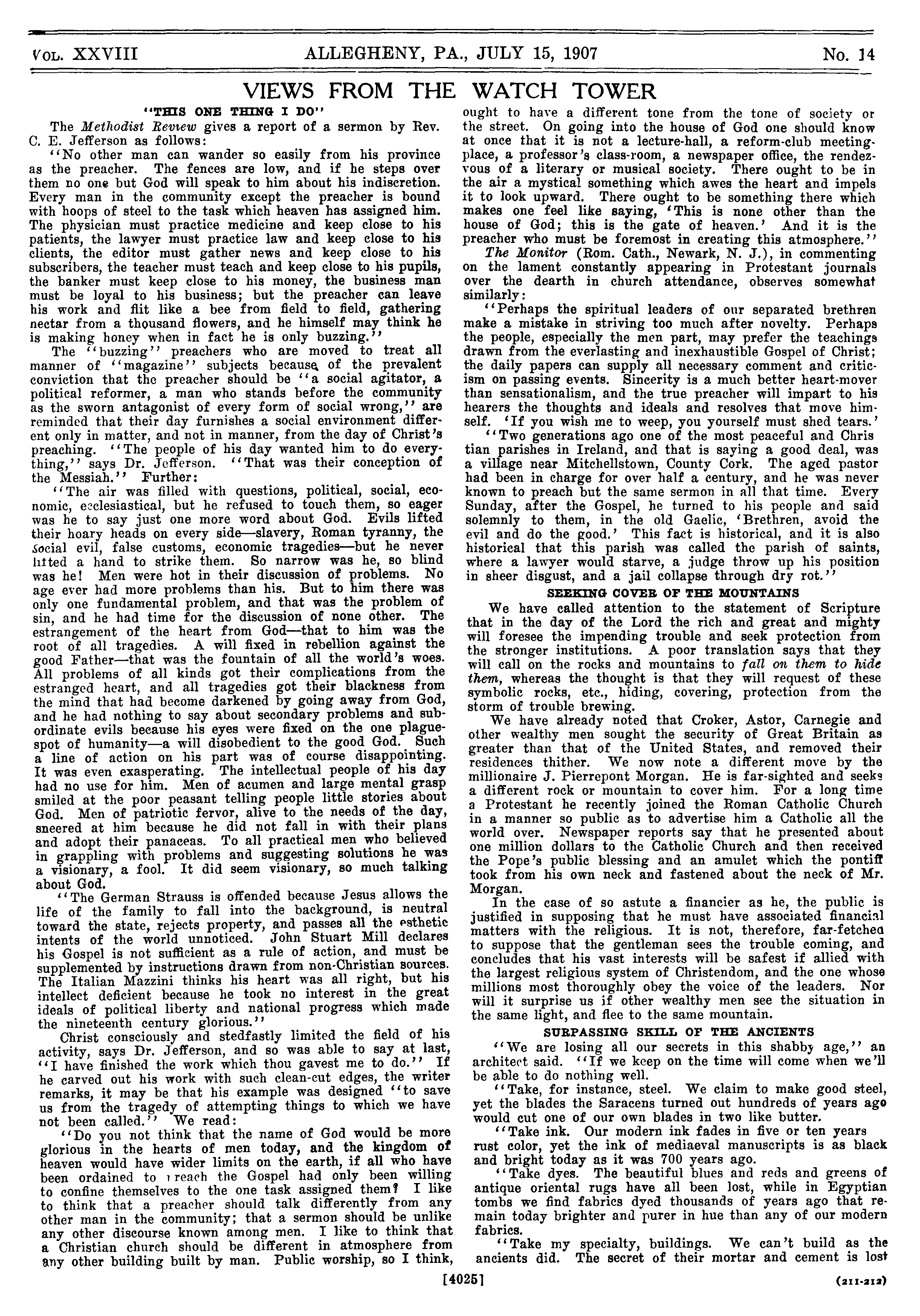
Vov. XXVIII ALLEGHENY, PA., JULY 15, 1907 No. 14 VIEWS FROM THE WATCH TOWER “THIS ONE THING I DO’’ The Methodist Review gives a report of a sermon by Rev. C. E. Jefferson as follows: ‘‘No other man can wander so easily from his province as the preacher. The fences are low, and if he steps over them no one but God will speak to him about his indiscretion. Every man in the community except the preacher is bound with hoops of steel to the task which heaven has assigned him. The physician must practice medicine and keep close to his patients, the lawyer must practice law and keep close to his clients, the editor must gather news and keep close to his subscribers, the teacher must teach and keep close to his pupils, the banker must keep close to his money, the business man must be loyal to his business; but the preacher can leave his work and flit like a bee from field to field, gathering nectar from a thousand flowers, and he himself may think he is making honey when in fact he is only buzzing.’’ The ‘‘buzzing’’ preachers who are moved to treat all manner of ‘‘magazine’’ subjects because of the prevalent conviction that the preacher should be ‘‘a social agitator, a political reformer, a man who stands before the community as the sworn antagonist of every form of social wrong,’’ are reminded that their day furnishes a social environment different only in matter, and not in manner, from the day of Christ’s preaching. ‘‘The people of his day wanted him to do everything,’’ says Dr, Jefferson. ‘‘That was their conception of the Messiah.’’? Further: ‘¢The air was filled with questions, political, social, economic, ecclesiastical, but he refused to touch them, so eager was he to say just one more word about God. Evils lifted their hoary heads on every side—slavery, Roman tyranny, the Social evil, false customs, economie tragedies—but he never htted a hand to strike them. So narrow was he, so blind was he! Men were hot in their discussion of problems. No age ever had more problems than his. But to him there was only one fundamental problem, and that was the problem of sin, and he had time for the discussion of none other. The estrangement of the heart from God—that to him was the root of all tragedies. A will fixed in rebellion against the good Father—that was the fountain of all the world’s woes. All problems of all kinds got their complications from the estranged heart, and all tragedies got their blackness from the mind that had become darkened by going away from God, and he had nothing to say about secondary problems and subordinate evils because his eyes were fixed on the one plaguespot of humanity—a will disobedient to the good God. Such a line of action on his part was of course disappointing. It was even exasperating. The intellectual people of his day had no use for him. Men of acumen and large mental grasp smiled at the poor peasant telling people little stories about God. Men of patriotic fervor, alive to the needs of the day, sneered at him because he did not fall in with their plans and adopt their panaceas. To all practical men who believed in grappling with problems and suggesting solutions he was a visionary, a fool. It did seem visionary, so much talking about God. ‘The German Strauss is offended because Jesus allows the life of the family to fall into the background, is neutral toward the state, rejects property, and passes all the esthetic intents of the world unnoticed. John Stuart Mill declares his Gospel is not sufficient as a rule of action, and must be supplemented by instructions drawn from non-Christian sources. The Italian Mazzini thinks his heart was all right, but his intellect deficient because he took no interest in the great ideals of political liberty and national progress which made the nineteenth century glorious.’’ . Christ consciously and ste@fastly limited the field of his activity, says Dr. Jefferson, and so was able to say at last, ‘‘T have finished the work which thou gavest me to do.’’ If he carved out hig work with such clean-cut edges, the writer remarks, it may be that his example was designed ‘‘to save us from the tragedy of attempting things to which we have not been called.’? We read: “‘Do you not think that the name of God would be more glorious in the hearts of men today, and the kingdom of heaven would have wider limits on the earth, if all who have been ordained to 1reach the Gospel had only been willing to confine themselves to the one task assigned them? I like to think that a preacher should talk differently from any other man in the community; that a sermon should be unlike any other discourse known among men. I like to think that a Christian church should be different in atmosphere from any other building built by man. Public worship, so I think, [4025] ought to have a different tone from the tone of society or the street. On going into the house of God one should know at once that it is not a lecture-hall, a reform-club meetingplace, a professor’s class-room, a newspaper office, the rendezvous of a literary or musical society. There ought to be in the air a mystical something which awes the heart and impels it to look upward. There ought to be something there which makes one feel like saying, ‘This is none other than the house of God; this is the gate of heaven.’ And it is the preacher who must be foremost in creating this atmosphere.’’ The Monitor (Rom. Cath., Newark, N. J.), in commenting on the lament constantly appearing in Protestant journals over the dearth in church attendance, observes somewhat similarly: ‘*Perhaps the spiritual leaders of our separated brethren make a mistake in striving too much after novelty. Perhaps the people, especially the men part, may prefer the teachings drawn from the everlasting and inexhaustible Gospel of Christ; the daily papers can supply all necessary comment and criticism on passing events. Sincerity is a much better heart-mover than sensationalism, and the true preacher will impart to his hearers the thoughts and ideals and resolves that move himself. ‘If you wish me to weep, you yourself must shed tears.’ ‘‘Two generations ago one of the most peaceful and Chris tian parishes in Ireland, and that is saying a good deal, was a village near Mitchellstown, County Cork. The aged pastor had been in charge for over half a century, and he was never known to preach but the same sermon in all] that time. Every Sunday, after the Gospel, he turned to his people and said solemnly to them, in the old Gaelic, ‘Brethren, avoid the evil and do the good.’ This fact is historical, and it is also historical that this parish was called the parish of saints, where a lawyer would starve, a judge throw up his position in sheer disgust, and a jail collapse through dry rot.’’ SEEKING COVER OF THE MOUNTAINS We have called attention to the statement of Scripture that in the day of the Lord the rich and great and mighty will foresee the impending trouble and seek protection from the stronger institutions. A poor translation says that they will call on the rocks and mountains to fall on them to hide them, whereas the thought is that they will request of these symbolic rocks, ete., hiding, covering, protection from the storm of trouble brewing. We have already noted that Croker, Astor, Carnegie and other wealthy men sought the security of Great Britain as greater than that of the United States, and removed their residences thither. We now note a different move by the millionaire J. Pierrepont Morgan. He is far-sighted and seeks a different rock or mountain to cover him. For a long time a Protestant he recently joined the Roman Catholic Church in a manner so public as to advertise him a Catholic all the world over. Newspaper reports say that he presented about one million dollars to the Catholic Church and then received the Pope’s public blessing and an amulet which the pontiff took from his own neck and fastened about the neck of Mr. Morgan. In the case of so astute a financier as he, the public is justified in supposing that he must have associated financial matters with the religious. It is not, therefore, far-fetchea to suppose that the gentleman sees the trouble coming, and concludes that his vast interests will be safest if allied with the largest religious system of Christendom, and the one whose millions most thoroughly obey the voice of the leaders. Nor will it surprise us if other wealthy men see the situation in the same light, and flee to the same mountain. SURPASSING SKILL OF THE ANCIENTS ‘*We are losing all our secrets in this shabby age,’’ an architect said. ‘‘If we keep on the time will come when we’ll be able to do nothing well. ‘«Take, for instance, steel. We claim to make good steel, yet the blades the Saracens turned out hundreds of years ago would cut one of our own blades in two like butter. ‘‘Take ink. Our modern ink fades in five or ten years rust color, yet the ink of mediaeval manuscripts is as black and bright today as it was 700 years ago. ‘«Make dyes. The beautiful blues and reds and greens of antique oriental rugs have all been lost, while in Egyptian tombs we find fabrics dyed thousands of years ago that remain today brighter and purer in hue than any of our modern fabrics. ‘“‘Take my specialty, buildings. We can’t build as the ancients did. The secret of their mortar and cement is lost (211-212)
To enhance your experience on our website, we use cookies and similar technologies. Some cookies are essential for the core functionality of our site and cannot be declined. You can choose to accept or decline additional cookies. We want to assure you that none of this data will be sold or used for marketing purposes. You can adjust your preferences at any time by accessing the Privacy Settings from the footer of the page. For more information, please refer to our
Privacy Policy
Terms of Use
.


