4
1
4
download/literature/watchtower/1910-2.pdf
watchtower/1910/2/1910-2-1
JANUARY
1,
1910
THE
WATCH
TOWER
(14-19)
(3)
Your
argument
is
not
logical.
If
our
Lord
had
finished
his
work
of
sacrifice
he
could
not
give
his
footstep
followers
a
share
therein.
(-!)
The
~criptures
nowhere
say
that
our
Lord
sealed
the
New
Covenant
with
his
blood.
Neither
was
it
necessary
for
him
to
seal
the
New
Covenant
before
he
would
be
its
Mediator.
He
was
thc
Mediator
of
the
New
Covenant
in
the
(Ii
vine
purpose
and
promise
centuries
before
he
became
the
man
Christ-Jesus.
He
was
the
Mediator
of
the
New
Covenant
when
born
in
Bethlehem
in
exactly
the
same
sense
that
he
was
then
the
~avior
of
the
world:
not
because
he
had
sealed
the
New
Covenant
nor
because
he
had
saved
the
world,
but
hecause
he
was
the
one
through
whom
the
world's
salva
tion
and
the
New
Covenant
for
its
blessing
were
eventually
to
be
aceomplished.
Our
Lord
has
not
y('t
saved
the
world,.
nor
has
he
acted
as
the
Mediator
of
the
New
Covenant;
but
he
will
accomplish
both
purposes
during
the
Millennial
age;
and
at
its
con
elusion
the
prophecy
will
be
fulfilled,
"He
Shall
see
of
the
travail
of
hi~
soul
and
shall
be
satisfied."
Our
Lord
was
privilpgpd
to
olfer
his
church
a
share
with
himself
in
his
~rediatorial
kingdom
on
condition
that
she
would
share
in
hi~
pup
of
,mITering
and
self-sacrifice-share
in
his
baptism
illio
his
dp:dh.
~o
doing
she
shall
share
his
reward
of
glory,
!tOil
or
awl
immortality
in
"his
resurrection."
(Phil.
3:
10)
Awl
~haril!g
his
glory
and
throne
as
his
joint-sacrificer
and
joillt-llPir
of
the
promise
she
would
be
with
him
jointly
the
~rediator
hl'twppn
liod
anti
men-the
world-during
the
Mil
1"llIlial
a,gp-thc
work
of
reconciling
the
world,
or
so
many
of
thcm
lUI
may
pro\-e
willing
to
receive
the
blessing
of
re
gl}llera
tion.
\;,
I
'iou
arp
not
right.
There
is
a
difference
between
a
CO\'Pllant
and
th
..
law
of
R
covenant.
God's
law
given
to
TSr.1el
sllIlllllarizHI
was.
"Thou
shalt
love
the
Lord
thy
God
with
all
th.\'
hpari.
with
all
thy
mind,
with
all
thy
being
and
with
all
th\'
strength;
ancl
thou
shalt
love
thy
neighbor
as
thy"elf."
That
law
is
perfect
and
will
be
the
basis
or
law
of
thl'
Npw
COVl'lHlllt..
1\Io.;es
as
a
Mediator
under
his
covenant
p\lrposP(j
to
IH']p
TS1':1pl
to
keep
that
law,
and
God
covenanted
to
~i\·"
them
ptPI'Iml
life.
if
tllPV
would
do
so.
But
they
were
llll:lhip
to
kp,,1'
th'lt
law
perfrctly
in
act
and
thougl~t
and
w"nt.
:111rl
hl'}H'p
thp~·
reapell
its
condemnation
of
death
and
not
its
p1'olTprpd
hlpssings
of
life.
Under
th~lt
covenant
;\rO~l'S
Wll';
privilegpd
to
arrange
sacrifices
an,l
offerings
for
"in.
:1IHI
thlH
~-par
h~'
Vl':11'
to
cle:mse
the
people
for
a
YNlr
at
a
timp
from
tlH'ir
original
eonrlemnation.
But
he
had
no
ml':ln.;
of
ad
Il'lll~'
blotting
out
their
sins
and
no
pow('r
or
ri~ht
il)
:1l·tllnlly
reston'
t1LPm
to
perfection
and
ability
to
kepp
that
law.
Th'
'\pw
CO\-l'nant
will
havp
the
samp
law
exactly.
but
th
..
1\Tl':lintor
llaving
hy
t1lPn
paid
o\'('r
to
JUiitil'f'
the
ransom
pril'P
of
thp
worl,1,
s('l'ured
hy
his
own
sacrificial
death.
will
then
have
full
charge
of
mankind
and
be
fully
empowered
to
deal
mercifully
with
theIr
imperfections
and
to
help
them
step
by
step
out
of
their
sin
and
death
condition
back
to
per
fection,
and
to
cut
otT
the
rcbellious
in
the
second
death.
At
the
close
of
the
:Millennium
he
will
present
the
willing
and
obedient
to
the
Father
actually
perfect.
Thus
it
will
be
seen
that
God's
dealings
with
mankind
under
the
typi('al
Law
Covenant,
and
under
its
anti
type
the
New
Covenant,
is
along
the
lines
of
actual
obedience
to
the
divine
law,
and
not
along
the
lines
of
reckoned
obedience
through
faith.
As
obedience
to
the
old
Law
Covenant
held
the
reward
of
human
perteetion
and
life,
so
the
rewards
of
the
New
LLaw]
Covenant
w111
be
similar-eternal
life
or
eternal
death.
Quite
to
the
contrary
of
both
of
these
arrangements.
the
church
is
now
called
to
a
"heavenly
('aIling"
under
the
Ahra
hamie
Covenant-to
be
members
of
the
bodv
of
Christ,
who,
with
Jesus
her
Head,
will
constitute
tlte
"Mediator
of
the
New
Covenant.
The
church
is
"not
under
law,
but
under
gra('e,"
not
judged
according
to
the
flesh
and
earthly
restitution.
but
judged
according
to
the
heart
and
intention;
and
required
to
sacrifice
restitution
rights
to
the
attainment
of
"the
high
calling"
life
and
glory
on
the
spirit
plane
as
members
of
the
Mediator
of
the
New
Covenant.
(6)
No,
tll<lJt
"New
Commandment"
represcnts
a
higher
law
than
was
given
to
the
Jew
under
the
Law
Covenant,
henee
higher
also
than
will
be
given
to
Israel
and
mankind
under
the
New
Covenant.
The
New
Commandment
men
tioned
by
our
Lord
is
not
the
Father's
commandment
at
all,
but
the
command
of
our
Heacl,
our
Teacher,
to
all
those
who
have
entered
the
school
of
Christ
and
who
are
hoping
to
be
come
"members"
of
the
Anointpd
Onc-memhers
of
the
Mediator,
Prophet,
Priest
and
King"
of
the
new
dispensation.
.Justice
could
not
give
this
new
command:
all
that
Just'lce
could
command
is
expressed
in
the
law
given
to
IsraPl,
namely,
suprpme
love
of
God
and
love
for
the
neigh
hoI'
as
for
one's
self.
This
new
commandment
whil:h
the
Lord
gave
applies
only
to
the
church
of
this
Gospel
age.
In
effect
it
i~
this:
If
you
would
he
my
disciples.
if
you
would
share.
my
throne
and
glory
and
immortality,
you
mu~t
have
my
splnt.
you
must
do
more
than
keep
the
law.
You
must
be
more
than
just.
You
must
be
self-sacrificing.
If
you
would
share
my
glory
I
command
and
dirl"Ct
that
you
lov('
onp
another
as
I
have
loved
you.
(.John
15:
12)
I
havp
loved
yOIl
to
the
extent
of
laying
down
my
life
for
yon
,;a('rifHa
Ily.
Y
ou
mu~t
have
this
samp
spirit
and
paHt
in
your
lot
with
me
in
self-s:lprifice.
or
y.on
rannot
h"
my
eliscipleH,
nor
share
my
glory,
and
asso
ciate
in
my
work
as
the
ME'diator
for
the
hlessing
of
Israel
and
manki"n<!.
Whosol'wr
will
1)('
my
disciple
must
take
up
his
prMS
and
follow
me.
that
whprp
I
am
there
shall
my
dispiple
he.
Surely
no
one
('an
1I0uht
the
~avior'~
mpaning
my"
<lis"ip]e~
fill"t
eli"
with
mp.
Yor,.
XXXI
BROOKLYN,
N.
Y.,
JANUARY
15,
HllO
No.
'2
WHERE
ARE
THE
DEAD}
Our
F·riends,
Our
Neighbors)'
the
Holy,
the
Unholy,
the
Cirilized,
the
Vile?
The
proper
answer
to
this
qneHtion
stands
related
to
our
own
<!PHtiny,
cnlorH
and
influenres
our
theology
and
the
entire
trend
of
our
lives!
The
correct
flllHwpr
givps
strpngth,
confidpnre,
courage
and
assists
towardH
the
spirit
of
a
sound
mind!
"M
t'n
and
brethren,
let
me
freely
sp,eak
to
yo'u
at
the
patriarch
DI/rid,
that
he
is
both
dead
and
buriotl,
alld
his
sepulchre
is
'Irith
1/S
1tnto
this
dny.
For
David
is
not
ascended
into
the
hearens."
(Ads
2
:2!l.
34.)
"fInd
no
rI1/l1l
hath
ascended
up
to
heaven,
but
he
that
came
down
from
heaven,
even
the
Son
Of
man."-John
3:
13.
For
a
man
to
r!ee!al'l'
himself
uninterested
in
this
SUbject
reHpert
to
the
intelligence
and
thought
of
our
,lay
and
of
past
would
be
to
pro<'1aim
himself
idiotic-thoughtless.
If
the
renturies
to
make
general
inljuiries
on
the
subje,·t
and
have
ordinary
affairs
of
this
present
life,
food,
raiment,
finance,
hdore
our
minds
the
most
profoun,l
thoughts
of
the
most
politil's,
etp..
which
pon('prn
us
but
for
a
few
years,
are
a
stute
thinkers
of
our
racp.
\Ye
('al1llOt,
howe\'er,
go
into
dl'pmpd
worthy
of
t.hought.
study.
how
much
more
concern
this
matt,pr
plaboratl'lv
and
givp
lengthy
(l'lOtations.
\\'e
must
should
Wl'
have
in
r('sppet
to
the
eternal
future
of
ourselves
l'ontent
ourselves
with
brief,
synoptipal
<1nswprs,
which
will
and
nl'ighborR
ami
mankind
in
general?
be
stated
kin(lly
and
truthfully,
and
with
a
desirE'
not
to
Of
COllrsp.
so
important
a
question
has
had
the
most
pro-
offE'nd
anybody,
'however
much
\~'e
may
disagree
with
his
eon-
fnllll<l
study,
eHr
since
the
reign
of
Sin
and
Death
began
six
l'lusions.
\Ve
reco).,YJlize
thp
right
of
evpry
llIan
to
uo
his
own
thousan(l
ypars
ngo.
By
thi~
time
the
subject
should
be
thinking
and
to
reac·h
his
own
conl'111sions,
whl'ther
these
agrpe
thread
hare.
Thl'
entire
world
should
be
so
thoroughly
in-
with
our
eonpeptions
or
not.
forml'd
rpspPl·tmg
this
question
that
there
would
be
nothing"
\Ve
begin
our
examination
by
asking
our
agnostic
friends.
npw
to
say
and
n0body
curiou~
to
hear.
But
the
large
who
boast
of
their
untrammeled
frel'dom
of
thought,
\Vhat
l1\llliplll'es
of
.int,~I.ligpnt
..
thoughtful
peo.ple
which
come
to
say
you.
"Frpe-thinkers,"
in
rE'ply
to
our
query,
Where
are
hear,
and
whIch
Itstpn
WIth
breatnless
mterest
to
what
we
the
<lead!
Their
answer
iR.
"\Ve
do
not
know.
\Ve
would
have
to
say.
imply
that
after
all
the
study
the
subject
has
llk('
to
believe
in
a
future
lifl',
but
we
have
no
proof
of
it.
had,
but
fpw
arp
thoroughly
satisfied
with
their
conclusions.
Lacking
the
evidl'nres
our
l'OJlPlusion
is
that
man
dies
as
does
THE
AGNOSTIC
ANSWERS
THE
QUESTION
the
brute
beast.
If
our
conclusion
di~appoints
your
expecta-
Bl'fore
presenting
what
we
claim
is
the
Scriptural
and
tion'!
in
respel't
to
having
joy
for
the
saints,
it
certainly
only
satisfactory
answer
to
our
query,
we
think
it
but
proper
should
be
comforting
to
all
as
respects
the
vast
majority
of
[4549]
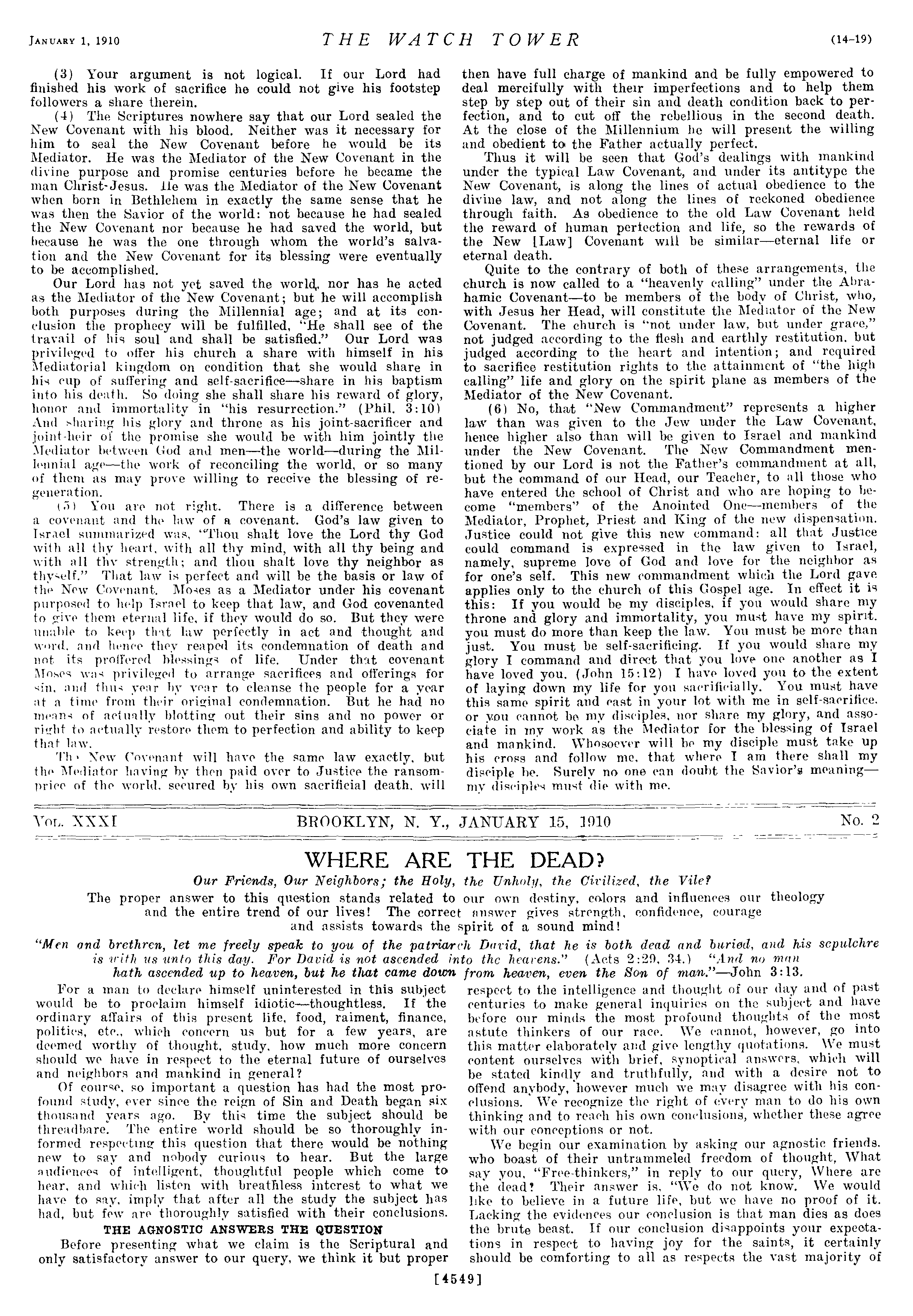
January 1, 1910 (3) Your argument is not logical. If our Lord had finished his work of sacrifice he could not give his footstep followers a share therein, (4) The Scriptures nowhere say that our Lord sealed the New Covenant with his blood. Neither was it necessary for him to seal the New Covenant before he would be its Mediator. He was the Mediator of the New Covenant in the divine purpose and promise centuries before he became the man Christ-Jesus. Je was the Mediator of the New Covenant when born in Bethlehem in exactly the same sense that he was then the Savior of the world: not because he had sealed the New Covenant nor because he had saved the world, but because he was the one through whom the world’s salvation and the New Covenant for its blessing were eventually to be accomplished. Our Lord has not yet saved the world, nor has he acted as the Mediator of the New Covenant; but he will accomplish both purposes during the Millennial age; and at its conclusion the prophecy will be fulfilled, “He shall see of the travail of his soul and shall be satisfied.” Our Lord was privileged to offer his church a share with himself in his Mediatorial kingdom on condition that she would share in his cup of suffering and self-sacrifice—share in his baptism into his death. So doing she shall share his reward of glory, honor and immortality in “his resurrection.” (Phil, 3:10) And sharing his glory and throne as his joint-sacrificer and joint-heir of the promise she would be with him jointly the Mediator between God and men—the world—during the Millennial age—the work of reconciling the world, or so many of them as may prove willing to receive the blessing of regeneration. (5) You are not right. There is a difference between a covenant and the law of a covenant. God’s law given to Israel summarized was, ‘“Vhou shalt love the Lord thy God with all thy heart, with all thy mind, with all thy being and with all thy strength; and thou shalt love thy neighbor as thyself.” That law is perfect and will be the basis or law of the New Covenant. Moses as a Mediator under his covenant purposed to help Israel to keep that law, and God covenanted to give them eternal life, if they would do so. But they were unable to Keep that law perfectly in act and thought and word, and hence they reaped its condemnation of death and not its proffered blessings of life. Under that covenant Moses was privileged to arrange sacrifices and offerings for sin, and thus vear hy vear to cleanse the people for a year at a time from their original condemnation. But he had no means of actually blotting out their sins and no power or right to actually restore them to perfection and ability to keep that law. Th» New Covenant will have the same law exactly, but the Mediator having by then paid over to Justice the ransomprice of the world, secured by his own sacrificial death. will THE WATCH TOWER (14-19) then have full charge of mankind and be fully empowered to deal mercifully with their imperfections and to help them step by step out of their sin and death condition back to perfection, and to cut off the rebellious in the second death. At the close of the Millennium he will present the willing and obedient to the Father actually perfect. Thus it will be seen that God’s dealings with mankind under the typical Law Covenant, and under its antitype the New Covenant, is along the lines of actual obedience to the divine law, and not along the lines of reckoned obedience through faith. As obedience to the old Law Covenant held the reward of human pertection and life, so the rewards of the New [Law] Covenant will be similar—eternal life or eternal death. Quite to the contrary of both of these arrangements, the church is now called to a “heavenly calling” under the Abrahamic Covenant—to be members of the body of Christ, who, with Jesus her Head, will constitute the Mediator of the New Covenant. The church is “not under law, but under grace,” not judged according to the flesh and earthly restitution, but judged according to the heart and intention; and required to sacrifice restitution rights to the attainment of “the high calling” life and glory on the spirit plane as members of the Mediator of the New Covenant. (6) No, that “New Commandment” represents a higher law than was given to the Jew under the Law Covenant, hence higher also than will be given to Israel and mankind under the New Covenant. The New Commandment mentioned by our Lord is not the Father’s commandment at all, but the command of our Head, our Teacher, to all those who have entered the school of Christ and who are hoping to hecome “members” of the Anointed One~—-members of the Mediator, Prophet, Priest and King of the new dispensation. Justice could not give this new command: all that Justice could command is expressed in the law given to Israel, namely, supreme Jove of God and love for the neighbor as for one’s self. This new commandment which the Lord gave applies only to the church of this Gospel age. In effect it is this: If you would be my disciples, if you would share my throne and glory and immortality, you must have my spirit. you must do more than keep the law. You must be more than just. You must be self-sacrificing. If you would share my glory I command and direct that you love one another as I have loved you. (John 15:12) I have loved you to the extent of laying down my life for you sacrificially. You must have this same spirit and east in your lot with me in self-sacrifice. or vou cannot be my disciples, nor share my glory, and_associate in my work ag the Mediator for the blessing of Israel and mankind. Whosoever will be my disciple must take up his cross and follow me, that where I am there shall my disciple he. Surely no one can doubt the Savior’s meaning— my disciptes must die with me. Vou. XNXAI BROOKLYN, N. Y., JANUARY 15, 1910 - No. 2 WHERE ARE THE DEAD? Our Friends, Our Neighbors; the Holy, the Unholy, the Civilized, the Vile? The proper answer to this question stands related to our own destiny, colors and influences our theology and the entire trend of our lives! The correct answer gives strength, confidence, courage and assists towards the spirit of a sound mind! “Men and brethren, let me freely speak to you of the patriarch Duvid, that he is both dead and buried, and his scpulchre is with us unto this day. For David is not ascended into the heavens.” (Acts 2:29, 34.) “And no man hath ascended up to heaven, but he that came down from heaven, even the Son of man.’—John 3:13. For a man to declare himself uninterested in this subject would be to proclaim himself idiotic—thoughtless. If the ordinary affairs of this present life, food, raiment, finance, politics, ete., which concern us but for a few years, are deemed worthy of thought, study, how much more concern should we have in respect to the eternal future of ourselves and neighbors and mankind in general? Of course, so important a question has had the most profound study, ever since the reign of Sin and Death began six thousand years ago. By this time the subject should be threadbare. The entire world should be so thoroughly informed respecting this question that there would be nothing new to say and nobody curious to hear. But the large audiences of intelligent, thoughtful people which come to hear, and which listen with breathless interest to what we have to say, imply that after all the study the subject has had, but few are thoroughly satisfied with their conclusions. THE AGNOSTIC ANSWERS THE QUESTION Before presenting what we claim is the Scriptural and only satisfactory answer to our query, we think it but proper respect to the intelligence and thought of our day and of past centuries to make general inquiries on the subject and have before our minds the most profound thoughts of the most astute thinkers of our race. We cannot, however, go into this matter elaborately and give lengthy quotations. We must content ourselves with brief, synoptieal answers, which will be stated kindly and truthfully, and with a desire not to offend anybody, however much we may disagree with his conclusions. We recognize the right of every man to do his own thinking and to reach his own conclusions, whether these agree with our coneeptions or not. We begin our examination by asking our agnostic friends. who boast of their untrammeled freedom of thought, What say you, “Free-thinkers,” in reply to our query, Where are the dead? Their answer is, “We do not know. We would like to believe in a future life, but we have no proof of it. Lacking the evidences our conclusion is that man dies as does the brute beast. If our conclusion disappoints your expectations in respect to having joy for the saints, it certainly should be comforting to all as respects the vast majority of [4549]
To enhance your experience on our website, we use cookies and similar technologies. Some cookies are essential for the core functionality of our site and cannot be declined. You can choose to accept or decline additional cookies. We want to assure you that none of this data will be sold or used for marketing purposes. You can adjust your preferences at any time by accessing the Privacy Settings from the footer of the page. For more information, please refer to our
Privacy Policy
Terms of Use
.


