9
1
9
download/literature/watchtower/1912-3.pdf
watchtower/1912/3/1912-3-1
JANUARY
15,
1912
THE
WATCH
TOWER
(39-43)
some
time
with
gooll
effect.
Even
Sister
Smith
has
been
giving
the
work
a
trial
with
marked
success.
Such
is
the
wonderful
effect
of
zeal
and
shows
how
the
Lord
can
use
weak
means
to
great
ends.-l
Cor.
1
:27,28.
You
can
imagine
the
joy
that
this
bring"
to
our
hearts.
I
know
it
will
bring
joy
to
yours
also.
Yours
in
faith
and
love,
R.
G.
S:\UTlI.-England.
DEARLY
BI,;r,OVEIl
BROTHER
A1\"D
PAioiTOR:-
('hristian
love
and
greetings!
It
has
been
the
privilege
of
Si~tcr
Louise
Jolly
and
my"elf
to
spend
the
past
few
days
col
portcuring
some
of
the
offices
of
Plainfield.
The
dear
Lord
strpngthl'ne,l
us
HO
wonderfully
for
this
service
and
granted
us
~uch
fine
experiences
that
I
felt
constrained
to
write
you.
Having
naturally
too
mu('h
caution.
I
have
very
few
times
colporteur
cd
the
bUHiness
sel'fion
of
towns
for
fear
of
intruding.
How('\'er.
here
ff'w
ga
ve
the
excuse
of
being
too
busy,
and
when
they
Jid
they
im'ited
us
to
call
again.
Tho"e
who
purchased
:"TUDIER
thanked
us
manv
times
for
calling,
as
did
also
several
\\
ho
dill
not
purr'ha~e.
it
is
such
a
satisfaction
to
present
the
Message
to
those
who
are
in
the
forefront
of
this
great
battle
for
existcnce
and
who
seem
to
appreciate
any
literature
treating
the
~mbject
of
present-day
conditions
.
.-\.
dear
si~ter
said
to
me
at
the
Put-in-Bay
Convention,
"Don't
neglect
thl'
bu~iuesH
~e('tion
of
your
town'.
The
Lord
has
some
preclUuH
graill~
of
wheat
among
the
bu~y
bu~iness
n)('n."
Shf'
gave
her
e:o-.perience
as
having'
bel'n
so
timid
tInlt
before
she
could
undertake
that
branch
of
servicp,
she
would
have
to
have
spC'eial
prayC'r
of
eac'h
member
of
tll('
class
in
her
behalf.
"~ow:'
she
says,
"I
would
not
take
anything
for
my
experiC'nce
in
the
business
sC'etions."
Again
I
,lesire
to
express
my
gratitude
to
the
great
Chief
Shepherd.
and
incidentally
to
you,
an
appointe'll
Pastor.
for
the~e
soul-rl'freHhing.
life-giving
waterR
of
Truth.
and
His
gn'at
conuC's('en~ion.
in
using
to
any
extent
an
eart!IPn
vesse!
whi,'h
seemed
of
no
use
at
all.
Prav
for
me,
dear
Broth,'r,
that
I
lIlav
continue
to
be
"a
broken
an'd
('Inptied
ve~sC'l
for
the
Master's
use
made
n1('et,"
now
and
in
the
glorious
fuhln·.
Yours
in
our
glorious
hope,
~I.
::\1.
SPRI:"IGE2.
CURE
FOR
APPENDICITIS
It
is
known
that
only
about
three
out
of
everyone
hundred
"]H'raLl'd
upon
tor
aprendiciti~
really
have
a
diseased
apppIHlix
needing
removaL
Y\'e
give
below
a
simple
cure
for
appenlli
citi~
symptoms.
'lllC
pain
in
the
appenuix
region
is
caused
by
the
biting
of
worms
near
the
junction
of
the
transverse
colon
with
the
small
inte"tines,
low
down
on
the
right
side
of
the
abrlomen.
Thi~
remeuy
is
recommcnued
also
for
typhoid
fever,
which
is
also
a
worm
disease.
Tlw
Ill('(li,'ine
i~
tiantonine:
dOHp,
:l
grains,
an
hour
before
hreakfast;
repeated
for
four
IllorJling~,
or
until
all
the
Rymptoms
disappear.
Then
one
UORe
per
month
for
three
months
to
eradi,'ate
all
germ~.
This
recipe
is
of
incalculable
vahlC'.
~ot
only
will
it
save
the
surgeon's
and
hORpital
fees
of
l)('rhapH
$~OO,
but
it
savC's
weeks
of
ill
health,
inconvenience,
convale'i('enl'e
anu
loss
of
salary.
YOL.
XXXll
BROOKLYN,
N.
Y.,
FEBRUARY
1,
1912
THE
BABE
OF
BETHLEHEM
No.
:;
"For
UII
to
you
is
born
this
day
in
the
city
of
David
a
Savior,
which
is
Christ,
the
Lord.
And
this
shall
be
a
sign
unto
you:
Ye
shall
find
the
babe
wrapped
in
swaddling
olothes
and
lying
in
a
manger."-Luke
2:
11,
12.
WHY
WAS
THIS
BABE
EXPECTED?
tomb.
They
rC'ali2e,1
that
wItat
they
npp"e,l
\\as
some
~:'Vlor
\\
hy
\\en'
all
nIPll
in
expectation
of
lllm
at
the
time
of
hI'>
to
l'OI11C'
awl
dl'!Ivpr
thl'lll
from
thl'
po\wr
of
sin,
to
,]eliVl'r
birth
~
\\'hat
w;:~
to
be
peculiar
about
him
to
lead
lsrad
to
thl'm
from
the
death
ppnalty
of
~in-a
~avior
who
woul,l
!·w.
p'\]"',,t
hi~
hirth
'!
The
answer
to
this
question
is
that
God
in
of
her
word~.
a
Lifp-givl'r.
Thpy
wpre
dying
and
needed
k,d
madl'
a
cntain
promise
l'enturies
before
and
the
promise
nC'w
life.
This
i~
till'
meaning
of
th!'
wonl
~a\'ior
in
thC'
h:lil
JlO'
h"l'n
fulfille(L
This
promise
contained
the
thought
language
used
by
our
L,)f(]
:Ind
the
apostlps.
They
were
t!l:lt
a
holy
('hi!d
\vould
be
born.
and
that
in
some
way.
not
hoping
and
expecting
that
(;0,1
would
spnll
a
Lifp-giver.
pxplanll"!
in
the
promise.
this
l'hil,l
would
bring
the
blessing
It
was
on
this
a(','ount
th:lt
tlt,'y
Wl're
so
gre;ttly
coneerncd
t
h"
worl,]
needp,!.
Thnpfore
evC'ry
mother
amongst
the
regarding
the
promisp
ma,le
to
Ahraham-"In
thl'l'
and
1Il
I
~rar'litl'~
was
\'Pry
solicitous
that
she
might
be
the
mothC'r
thy
Swd
shall
all
tl1"
famili,'s
of
til('
parlh
1w
hlp,sl'd"-they
of
a
")11
rather
than
a
daughter,
that
ppf('hance
she
might
shall
be
grantC',]
a
rC'leaHe
from
sin
:Ind
dl'ath.
In
no
othl'r
hr'
tltp
mothpr
of
thi~
promispd
chi
It!.
Thus
the
matter
went
way
('auld
mankind
hp
hll'~~e,l.
It
would
h"
impo~Hibh'
to
OJl
for
ye~lr~
until.
tinally.
the
ehild
wa~
boru.
bless
mankind
excl'pt
h~'
rl'h'asing
thplll
from
~ill
ami
,\Path.
Th,·
promisp
Iml'k
of
the
expcl'tation
was
that
wbich
Gm!
Hl'n('p.
thp
~{'fipj
l1l'pS
tl'll
u~
of
(;o,l's
sympathy:
that
God
ma,!,'
to
~\brahalll,
saving.
"In
thee
an,l
in
thy
spell
sball
all
looked
<lown
fmm
Iti~
holy
habitation.
:1n,1
1)('bl'ld
our
sorrow.
til"
familiC'R
of
the
earth
be
ble~sC',l."
From
t,h:lt
time
forward
allli
hpard,
figuratiYl'!y,
'''thl'
groaning
of
th"
pri~onl'r<'--
.\hr,llwm
hl'g-all
to
look
for
the
promi'ed
~eed-tilE'
promi~"ri
humanity-all
O'roanin"
anu
tr:1yailirl"
ll\lll"r
this
p"nalty
ot
,'bil<l.
HC'
looked
tirst
of
all
to
his
own
children,
and
was
Jpath-~omp
with
f"w~a"IH's
and
pail~~.
and
,am"
\\
ith
riwre
tin;lll~'
infornwd
that
it
would
not
be
onC'
of
his
children
a,'hp"
am]
pains;
Rnnw
with
fl'w
sorrows.
an,]
Homl'
With
(bred.
but
that
throug-h
their
l'llildrpn,
at
some
remote
date,
greatpr
sorrows.
hut
all
groaning
and
travailing
in
pain.
thi~
('bil,]
<hoult!
1]('
horn-the
~eeu
of
Abraham.
From
t1lat
But.
(;o,!'s
sympa
thy
wa~
man
i
tp~tr',l:
and
\\
e
]'('a
d
t
ba
t.
time
onwarrl,
all
tlIP
I~raelites
were
waiting
for
the
birth
of
"Hp
look,',l
down
an,l
hl'lH'ld
fh:lt.
th,'r"
was
no
l'y"
to
pity
and
the
('bild
tbat
should
bring
the
blessing.
no
arm
to
saye"
and
with
"hi~
own
arm
ll('
brought
~aIYa-
But
why
was
a
l\lessiah
necessary?
\Vhy
wait
at
all
for
tion."
This
is
what
was
promi8pd
to
Ahraham-'-that
onl'
th,·
birth
of
thp
cbild?
Thl'
answC'r
to
thb
question
is
that
should
pomp
from
his
postprit.\,
wbo
wouJ.I
1)('
thl'
~:tvior
of
sin
harl
('ome
into
thC'
world;
that
God
had
placed
our
first
thp
\\01'1,1:
:11111
bppan~c
thi~
promiH"
wa~
m;u)p
to
Ahraham
parent~-holy.
pure
awl
free
from
sin-in
thl'
glorious
con,li-
amI
to
hi~
~epd,
thl'Y
\\'l'
1'('
markpd
out
a~
Hl'l'aratp
frOll!
-Ill
tion~
of
tIle
Gartlen
of
E,len
with
eyery
favorable
prospect
and
other
natiolls
and
]'l'oplp8.
To
th!'
.rpwi~h
nation
alol}('
Ill'-
l,\'prla~ting
life
at
their
command
if
tlll'Y
C'ontinued
in
har-
10nO'e,1
this
grpat
honor-that
thr01l"h
th"rn
Hboul,]
"om"
tbi~
mOllY
with
(iod.
But
hy
rea'OlI
of
their
disohedien('e
thpy
s;ll;ation.
IJl'nl'e,
from
that
time
~ollward
tbl'
.J"w~
spok"
l'~WIC'
under
divine
displeasure
and
sentpnee
of
death.
This
of
thpmsplyp~
aR
(iod'~
p"oplC',
thp
peoplC'
\\hom
Ciod
h:ld
spnt"nl'p
of
dl'ath
has
brought
in
it~
wake
aches,
pains,
sor-
promi~C'd
to
hI
PHS.
and
throug-h
whom
lw
woul,l
hring
a
hl,'s~'
ro\\s,
tC',us,
sighing.
crying
and
death-all
of
these
experi-
jn~
to
all
othl'rs.
Tb"rp!ore.
all
othC'r
peoplp
W('l'C'
,,,til,',!
l'1J('p~
as
tlIP
rC'sult
of
sin.
bC'ath"lI
(or
natIOns.
whi,'h
thp
worrl
nll'an~
I.
Isra"l
\\;l~
Onr
hC'aYC'nly
Father
said
to
our
first
parents-anu
this
thus
Rpparatl'd
becau~e
(jo,l's
poyplJant
wa~
\\
ith
them,
;1I1l]
\y;IS
thp
first
intimation
that
he
gave
them
of
a
deli\'('ran('e-
not
with
tllP
others.
But
(io,!'s
('O\'pnant
with
IHr:w!
wa~
for
that
"The
~l'(',l
of
the
woman
shall
bruise
the
serpent's
head."
thp
hlC'ssing
of
all
thC'
othprs:
"Tn
thy
s('('<1
Hhall
all
U1C'
Thl'
Ol'rpl'nt
in
thi~
expression
mean,
Satan-all
the
powers
familips
of
the
earth
be
hles,<'(!.·'
~ow:
we
have
the
"w1lv"
of
l'yil.
"ypr~'thin_!!
a,1\'('r8P
to
humanity,
everything
adverse
to
of
thi~
wondC'rful
habC"s
h{'ing
horn.
.
thl'
bl,'s~illgs
whil'h
(iod
had
given
them,
and
which
they
had
HOW
WAS
THIS
BABE
PECULIAR-HOLY
HARMLESS
ln~t
by
rli~oh('(lipl]('e.
But
the
promise
wa~
vaguC'
ami
the,\'
UNDEFILED?"
Iln(lerstood
litt)p
about
the
"seC'd
of
the
woman"
an,l
"hruis-
ITow
enuld
he
bC'
a
Savior?
1n
what
wav
could
he
hI'
II1g
the
~erp!'nt.'s
IH'ad."
It
merely
meant
in
an
allegorical
,lifferent
from
any
othpr
hal>C'?
\Yhy
not
u~e
somp
oth!'r
way
It
great
vietory
ovC'r
sin
and
Satan.
without
explaining
hab"
as
thp
one
through
whom
salvation
~hould
C'omC'?
TI1l'
how
it
Rhoulu
('0
!II
e.
answpr
of
thC'
Bibl('
i~
that
salvation
pould
not
C'om('
to
man-
So
mankin(l
('ontil11lPd
to
die;
they
contillu,'d
to
have
aehf'S
kind
lInl('s~
thpre
should
he
a
Ratisfadion
of
.iu~ti('e
on
aecount
and
pain'
an,l
sorrows;
thp,\'
('ontinned
going
duwn
to
the
of
original
sin.
That
must
he
the
first
consideration.
The
[4963]
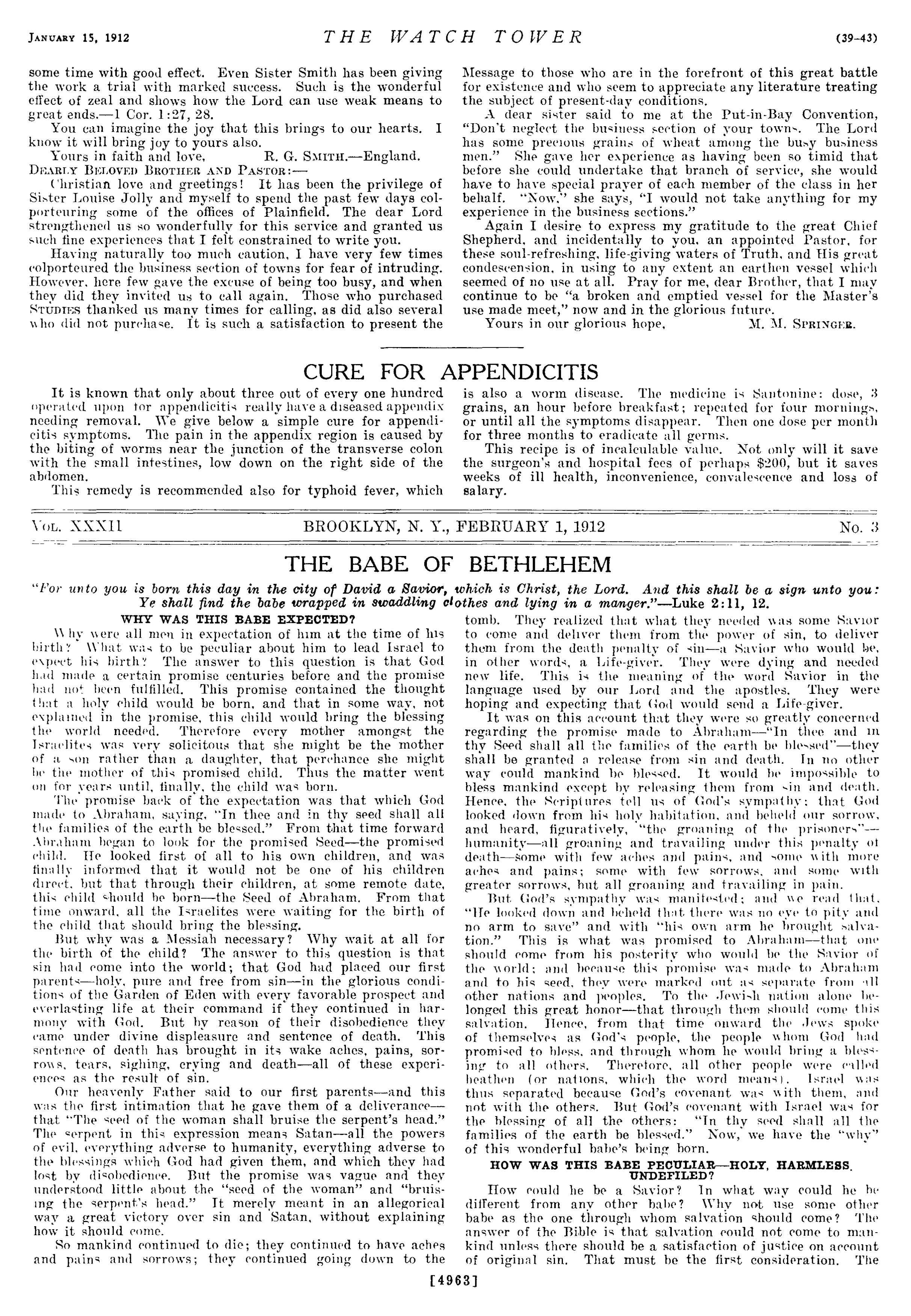
THE January 15, 1912 some time with good effect. Even Sister Smith has been giving the work a trial with marked success. Such is the wonderful effect of zeal and shows how the Lord can use weak means to great ends.—1 Cor. 1:27, 28, You can imagine the joy that this brings to our hearts. I know it will bring joy to yours also, Yours in faith and love, R. G. Smiru.—England. Dearty BELOVED BrotuerR AND Pasror:— Christian love and greetings! It has been the privilege of Sister Louise Jolly and myself to spend the past few days colporteuring some of the offices of Plainfield. The dear Lord strengthened us so wonderfully for this service and granted us such fine experiences that I felt constrained to write you. Having naturally too much caution, I have very few times colporteured the business section of towns for fear of intruding. However, here few gave the excuse of being too busy, and when they did they invited us to call again, Those who purchased Stuptes thanked us many times for calling, as did also several who did not purchase. It is such a satisfaction to present the WATCH TOWER (39-43) Message to those who are in the forefront of this great battle for existence and who scem to appreciate any literature treating the subject of present-day conditions. A dear sister said to me at the Put-in-Bay Convention, “Don't neglect the business section of your towns. The Lord has some precious grains of wheat among the busy business men.” She gave her experience as having been so timid that before she could undertake that branch of service, she would have to have special prayer of each member of the class in her behalf. “Now.” she says, “I would not take anything for my experience in the business sections.” Again I desire to express my gratitude to the great Chief Shepherd, and incidentally to you. an appointed Pastor, for these soul-refreshing, life-giving waters of Truth, and His great condescension, in using to any extent an earthen vessel which seemed of no use at all. Pray for me, dear Brother, that I may continue to be “a broken and emptied vessel for the Master’s use made meet,” now and in the glorious future. Yours in our glorious hope, M. M. Sprinere. CURE FOR APPENDICITIS It is known that only about three out of every one hundred operated upon tor appendicitis really have a diseased appendix needing removal. We give below a simple cure for appendicitis symptoms. The pain in the appendix region is eaused by the biting of worms near the junction of the transverse colon with the small intestines, low down on the right side of the abdomen, This remedy is recommended also for typhoid fever, which Vou. XXXIL BROOKLYN, N. Y., FEBRUARY 1, 1912 No. 3 is also a worm disease. The medicine is Santonine: dose, 3 grains, an hour before breakfast; repeated for four mornings, or until all the symptoms disappear. Then one dose per month for three months to eradicate all germs. This recipe is of incalculable value. Not only will it save the surgeon’s and hospital fees of perhaps $200, but it saves weeks of ill health, inconvenience, convalescence and loss of salary. THE BABE OF BETHLEHEM “For unto you is born this day in the city of David a Savior, which is Christ, the Lord. And this shall be a sign unto you: Ye shall find the babe wrapped in swaddling clothes and lying in a manger.”—Luke 2:11, 12. WHY WAS THIS BABE EXPECTED? Why were all men in expectation of him at the time of his birth’ What was to be peculiar about him to lead Israel to expect his birth’ The answer to this question is that God had made a certain promise centuries before and the promise had not been fulfilled. This promise contained the thought that a holy child would be born, and that in some way, not explamed in the promise, this child would bring the blessing the world needed. Therefore every mother amongst the Israclites was very solicitous that she might be the mother of a son rather than a daughter, that perchance she might be the mother of this promised child. Thus the matter went on for vears until, finally, the child was born. The promise back of the expectation was that which God made to Abraham, saving, “In thee and in thy seed shall all the families of the earth be blessed.” From that time forward Abreham began to look for the promised Seed—the promised child. He looked first of all to hig own children, and was finally informed that it would not be one of his children direct, but that through their children, at some remote date, this child should be born—the Seed of Abraham. From that time onward, all the Israelites were waiting for the birth of the child that should bring the blessing. But why was a Messiah necessary? Why wait at all for the birth of the child? The answer to this question is that sin had eome into the world; that God had placed our first parents—holy, pure and free from sin—in the glorious conditions of the Garden of Eden with every favorable prospect and everlasting life at their command if they continued in harmony with God. But hy reason of their disobedience they came under divine displeasure and sentence of death. ‘This sentence of death has brought in its wake aches, pains, sorrows, tears, sighing, crying and death—all of these experiences as the result of sin. Onur heavenly Father said to our first parents—and this wis the first intimation that he gave them of a deliverance— that “The seed of the woman shall bruise the serpent’s head.” The serpent in this expression means Satan—all the powers of evil, everything adverse to humanity, evervthing adverse to the blessings which God had given them, and which they had lost by disobedience. But the promise was vague and they understood little about the “seed of the woman” and “bruising the serpent’s head.” Jt merely meant in an allegorical way a great victory over sin and Satan, without explaining how it should come. So mankind continued to die; they continued to have aches and pains and sorrows; they continued going down to the tomb. They realized that what they needed was some Savior to come and deliver them from the power of sin, to deliver them from the death penalty of sin—a Savior who would be, in other words, a Life-giver. They were dying and needed new life. This is the meaning of the word Savior in the language used by our Lord and the apostles. They were hoping and expecting that God would send a Life-giver, It was on this account that they were so greatly concerned regarding the promise made to Abraham-—‘“In thee and in thy Seed shall all the families of the earth be blessed”—they shall be granted a release from xin and death. In no other way could mankind be blessed. It would be impossible to bless mankind except by releasing them from sin and death. Hence. the Scriptures tell us of God’s sympathy: that God looked down from his holy habitation, and beheld our sorrow, and heard, figuratively, “the groaning of the prisoners’-— humanity—all groaning and travailing under this penalty of death—some with few aches and pains, and some with more avhes and pains; some with few sorrows, and some with greater sorrows, but all groaning and travailing in pain. But God’s sympathy was manifested; and we read that. “He looked down and beheld that there was no eye to pity and no arm to save” and with “his own arm he brought salvation.” This is what was promised to Abraham—that one should come from his posterity who would be the Savior of the world; and heeause this promise was made to Abraham and to his seed, they were marked out as separate from all other nations and peoples, To the Jewish nation alone belonged this great honor—that through them should come this salvation. Henee, from that time onward the Jews spoke of themselves as God's people, the people whom God had promised to bless, and through whom he would bring a blessing to all others, Therefore, all other people were called heathen (or nations, which the word means). Israel was thus separated because Ged’s covenant was with them, and not with the others. But God’s covenant with Israel was for the blessing of all the others: “In thy seed shall all the families of the earth be blessed.” Now, we have the “why” of this wonderful bahe’s being horn. HOW WAS THIS BABE PECULIAR—HOLY, HARMLESS, UNDEFILED? How could he be a Savior? In what way could he he different from anv other babe?) Why not use some other babe as the one through whom salvation should come? ‘The answer of the Bible is that salvation could not come to mankind unless there should be a satisfaction of justice on account of original sin. That must be the first consideration. The [4963]
To enhance your experience on our website, we use cookies and similar technologies. Some cookies are essential for the core functionality of our site and cannot be declined. You can choose to accept or decline additional cookies. We want to assure you that none of this data will be sold or used for marketing purposes. You can adjust your preferences at any time by accessing the Privacy Settings from the footer of the page. For more information, please refer to our
Privacy Policy
Terms of Use
.


