8
1
8
download/literature/watchtower/1916-16.pdf
watchtower/1916/16/1916-16-1
YOLo
XXXVII
BROOKLYN,
N.
Y.,
AGGUST
15,
1916
CONFESSION
OF
SIN
ESSENTIAL
TO
FORGIVENESS
"If
we
confess
our
sins,
he
is
faithful
and
just
to
forgive
us
our
sins
and
to
cleanse
us
from
aU
unrighteousness."-l
John
1
:9.
No.
16
The
Apostle
John
i~
not
hNe
addressing
thC'
world
of
un
believers,
unju:,tified
persons,
"sinners"
in
th~
ordinary
sense
of
the
word.
On
the
contrary,
he
is
addrpssing
the
justified
and
sanctified
In
Christ
Jesus;
and
he
rla~ses
himself
,,-itll
thesC',
using
the
plural
pronoun
"we."
The
frequent
mistake
of
applying
this
and
similar
passages
to
sinners
in
general
has
bpen
injurious
in
two
important
particulars:
First.
It
has
been
injurious
to
the
unregcnerate,
in
that
it
has
givcn
some
the
impression
that
there
is
no
difference
between
thp
church
and
the
world;
and
that
all
alike
have
accpss
to
God
in
prayer
and
for
the
forgiveness
of
daily
tres
pa
<;Sf's.
It
hiB
thus
hindered
some
from
re:l1izing
the
necessity
of
faith
in
the
atoncment,
an(l
from
definitely
entering
into
eovenant
relationship
with
the
Lord
under
the
terms
of
the
grace
eovenant---4-he
covenant
of
sacrifice.
(Psalm
50:
5)
On
the
eontrary,
all
should
be
informed
of
the
fact
that
re
pentance
and
a
positive
acceptance
of
Christ
as
their
personal
Sa
vior
a
I
e
absolutely
necessary
before
they
can
be
"accepted
in
the
Belovpd,"
and
be
treated
as
"sons
of
God,"
and
enjoy
the
privileges
of
this
relationship-prayer,
fellowship
wILh
God,
divine
care,
or
providential
oversight
of
their
affair!!
and
interests,
and
the
favor
of
forgiveness
of
daily
trespasses
through
the
merit
of
the
great
High
Priest,
Jesus
lnlrist
the
Righteous.
Sp('ond.
This
oversight
has
had
an
injurious
effect
upon
some
Christians,
who
have
gone
to
the
extreme
of
claiming
that
tllPy
can
never
commit
sin,
after
their
past
sins
have
been
graciously
forgiven
by
the
Lord,
and
after
they
have
entered
into
covenant
relationship.
Hence
we
have
the
very
wrong
vicws
and
teachings
of
so-called
"perfectionists"
who
(']aim.
not
merely
that
they
are
reckonedly
perfect
now,
but
that
tllPy
are
aetually
perfect
in
all
theIr
thoughts,
words
and
dp{'ds-DECI;;rVlNG
TJIEMSELVI<;S
and
laying
themselves
lia
ble
to
many
grievous
errors,
as
the
Apostle
declares
in
connec
tion
with
our
text.
BASIS
OF
TRUE
FELLOWSHIP
The
Apostle
John
in
writing
this
Epistle
clearly
states
llis
ouject,
saying,
"These
things
write
we
unto
you,
that
your
joy
may
be
full."
It
is
a
noteworthy
fact
that
the
vast
ma
jority
of
Christians
never
experience
the
fulness
of
joy,
peace
and
bles..;ing
that
they
might
possess.
Too
many
are
content
with
simply
diluted
first
principles
of
the
doctrine
of
Christ.
Thprefore,
as
the
Apostle
Paul
declares,
such
are
merely
"baul's
in
Christ."
(1
Corinthians
3:
I,
2;
Hebrews
5:
12-14)
Of
poune,
they
have
a
blessing
in
any
relationship
to
the
Lord.
but
they
have
not
the
fulness
of
joy
which
would
be
theirs
if
they
pro!-!:re'i;;l'd
in
!-!:race
ancl
in
knowledge
to
the
full
~tawre
of
a
man
in
Christ.
The
object
of
the
Apostle's
writing
thpm
was
to
stir
up
the
pure
minds
of
believers
to
an
appreciation
and
enjoyment
of
their
privil€'ges,
that
thereby
tIH'."
might
grow
an(l
develop.
'fhp
Apo-.;tle
follows
the
example
of
our
Lord
Jesus
in
symllohzing
truth
and
righteousness
as
light,
and
sin
and
every
evil
a~
~o
llluch
of
opposing
darkness.
God
himself
thus
considerpil
woulll
ue
the
very
perfection
of
Light--"in
him
is
no
darkne-~,"
no
sin,
no
imperfection.
\Vith
this
thought
before
the
mind.
the
Apostlp
points
out
tllat
any
growth
of
fellow
..;hip
with
God
to
whi('h
we
may
aspire
must
be
along
the
lines
of
go()(lne-.;s.
purity,
and
that
it
woulll
be
sin
for
us
to
say
to
other..;
or
to
imagine
in
our
own
hearts
that
we
are
walking
with
(;011
and
having
fcllowship
with
him,
if
our
course
of
life
is
dark,
a
sinful
onp.
Such
are
merely
deceiving
them
sPIns
and
others.
They
are
not
deceiving
God,
and
they
are
not
)!ptting
the
blessings
enjoyed
by
those
who
"walk
in
the
li!-!:ht."·
-
.
;\roreowr.
to
Ihp
p'(tpnt
that
we
walk
in
the
light
and
in
harmony
and
fpllowshqJ
with
God,
we
shall
find
ourselves
in
f('llow-hip
with
all
othprs
who
are
like-minded.
So
then,
if
WP
do
not
"love
the
brethren
whom
\ve
have
seen,"
so
as
to
he
ahle
to
havp
fellow"hip
and
spiritual
pleasure
with
them,
it
woul(l
bp
an
indication
that
we
are
not
wholly
in
harmony
and
fpllowship
with
God.
But
who
arc
the
"brethren"?
Our
Lord
tells
us
that
not
all
who
profp~s
Ilis
name
arc
true
hn'thren.
He
says,
"Not
everv
onp
that
saith
Lord,
Lord.
"hall
enter
into
the
kingdom
of
I;pavpn
[bp
rpcogui~pd
a..;
his
hrdhren
and
joint-heirs],
but
Ill'
that
dopth
thp
will
of
mv
Fatlwr
which
is
in
heaven."
\Ve
thus
see
that
it
is
bv
our
dpeds.
and
not
merely
bv
our
professions,
that
\\
e
a
It'
a'cceptell
of
the
Lord.
Again:
he'
says,
"Who
are
my
brellJrPIl?
...
VNily.
I
say
unto
you,
he
that
doeth
the
will
of
my
Father,
the
same
is
my
brother."-J\lat
thew
7:21;
12:48-50.
\Ve
are
not,
therefore.
to
anticipate
"fellowship"
with
all
who
name
the
name
of
Christ
as
a
proof
of
fellowship
with
the
Father,
and
that
we
are
in
the
light.
'Ve
are
merely
to
anticipate
this
true
fellowship
with
those
who
are
earnestly
seeking
to
do
the
Father's
will
to
serve
his
cause
and
expmplify
the
instructions
of
his
Word,
in
their
deeds
as
well
as
in
their
professions.
Between
all
such
there
mu.,t
he.
whl'ther
hidden
or
open,
a
bond
of
fellowship
and
union.
That
bond
is
the
one
faith
and
one
baptism
into
the
one
Lord.
SHORTCOMINGS
AND
FAULTS
ARE
SINS
But
while
this
fellowship
bdween
us
and
our
Lord
and
all
who
have
his
spirit
is
based
upon
our
walking
in
the
light,
our
following
in
his
footsteps
to
the
extent
of
our
ability,
nevertheless
it
does
not
imply
absol
ute
freedom
from
the
im
perfections
of
sin.
Although
under
our
gr:Jee
covenant
ar
rangement
nothing
is
charged
up
to
us
as
sin
except
in
pro
portion
as
it
has
been
wilfully
done,
nevertheless,
bpcau.,e
of
the
manifold
temptations
and
the
weaknesses
of
our
flesh,
the
result
of
inherited
predisposition
toward
sin,
it
is
impossible
for
us
to
a
void
shortcomings
and
faults.
These
may
proper
Iy
be
termed
sins,
as
in
our
text;
for
"sin
is
a
transgression
of
the
Law,"
however
unintentional
it
may
be.
But
the
divine
arrangement
under
the
grace
covenant.
on
behalf
(ff
the
Lord's
people,
is
that
these
unintentional
faults
and
shortcomings
need
not
be
ehargpd
up
against
us
as
sins;
but
may
instead
be
cleansed
away
upon
our
application
to
the
great
High
Priest,
through
the
merit
of
the
precious
blood.
Thus
it
is
that
the
blood
of
Jesus
Christ
our
Lord
cleanseth
us
from
all
sin-keeps
us
clean
from
sin,
if
we
continually
make
application
for
forgiveness,
because
of
realization
ot
imperfections
of
our
flesh.
AN
INSIDIOUS
SNARE
OF
THE
ADVERSARY
Further
on
in
this
Epistle,
the
Apostle
uses
the
word
"sin"
in
a
different
senSe
from
the
above,
saying,
H\Vhosoever
:vbid
eth
in
him
sinneth
not;
whosoever
sinneth
hath
not
seen
him
nor
[even]
known
him
....
He
that
committeth
sin
is
of
tde
devil.
...
Whosoever
is
begotten
of
God
doth
not
commit
sin;
for
his
seed
remaineth
in
him,
and
he
cannot
sin,
because
he
is
begotten
of
God."
Again
he
says:
"\v
e
know
that
who
soever
is
begotten
of
God
sinneth
not;
but
he
that
is
be
gotten
of
God
keepeth
himself,
and
that
wicked
one
toueheth
him
not."-l
.J
ohn
3:
6-9;
5:
18.
In
these
passages
the
Apostle
uses
the
word
"sin"
in
its
full
or
absolute
sense,
meaning
wilful
sin,
deliberate
sin,
in
tentional
sin-not
merely
shortcomings
and
faults,
due
largely
or
wholly
to
the
imperfections
of
the
flesh,
inherited
from
our
ancestors.
No
one,
the
Apostle
assures
us,
who
has
been
be
gotten
of
the
spirit
of
the
Lord,
the
spirit
of
holiness
and
truth,
could
have
any
sympathy
with
sin
so
as
to
wilfully,
knowingly
and
intentionally
engage
therein.
All
who
so
love
sin
and
wilfully
do
it
and
approve
it
after
they
have
a
knowl
edge
of
the
truth,
are
children
of
darkness,
who
love
darkness
and
who
thus
show
that
they
have
the
spirit,
or
disposition
of
Satan.
INJUSTICE
TO
THE
BRETHREN
INEXCUSABLE
At
first
thought,
many
may
be
inclined
to
say,
"'Yell,
1
am
in
no
danger
of
that
sin;
for
I
am
sure
that
I
would
not
commit
sin
wilfully,
intentionally,
designedly."
But
let
us
notice,
dear
friends,
that
there
is
a
way
in
which
sins
may
come
upon
us
without
being
at
the
time
a
wilful
sin,
but
which
later
might
become
wilful
sin.
For
instance,
any
trans
gression
committed,
either
in
total
ignorance
or
with
onlv
a
partial
acquiescence
of
our
wills,
might
become
a
full,
wiltul,
deliberate
sin
afterward,
if
we
should
come
to
a
clear
knowl
edge
of
the
truth
respecting
the
subject,
and
fail
to
rppent
of
it
to
the
Lord
and
to
undo
so
far
as
is
in
our
power
the
wrong
toward
our
fellow-creatures.
To
consent
to
a
sin
clearly
and
fully
understood
simply
because
at
the
time
of
its
committal
we
were
in
ignorance,
and
to
refuse
to
make
amends
for
it,
and
thus
endorse
the
sin
intelligently,
would
appear
to
make
of
it
a
will-ful
sin.
With
this
view
of
the
matter,
the
children
of
God
cannot
afford
to
sanction
in
their
own
minds
even
the
slightest
in
justiee
or
untruth
toward
each
other,
or
toward
any.
The
pssence
of
this
thought
is
f01lnd
in
our
Lord's
command:
"If
thou
comest
to
the
altar
[if
we
have
anything
to
ofTer
to
the
Lord,
either
of
service
or
of
worship
or
of
thanks],
and
(243-244)
[5938]
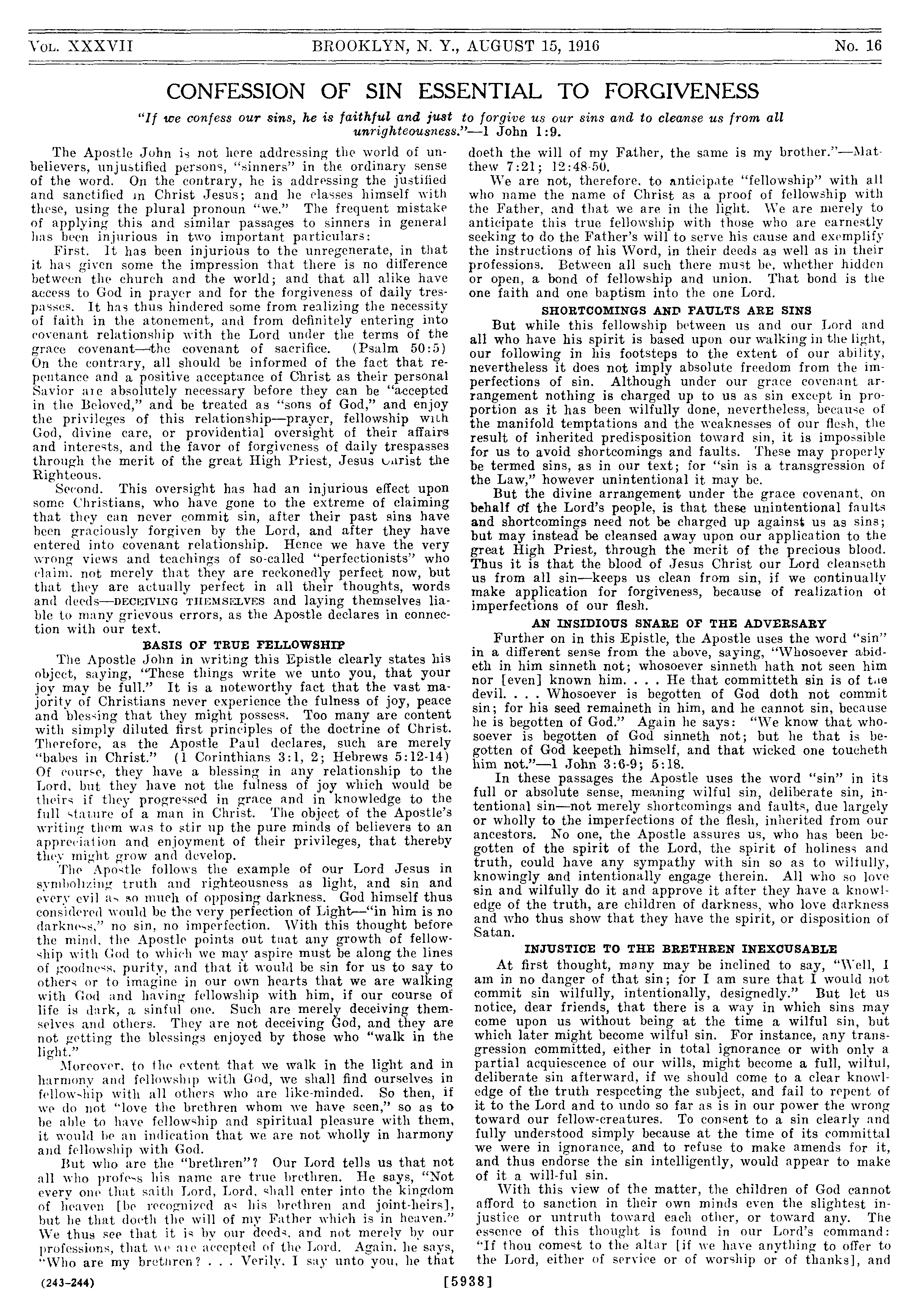
Vou. XXXVIT CONFESSION OF SIN BROOKLYN, N. Y., AUGUST 15, 1916 No. 16 ESSENTIAL TO FORGIVENESS “If we confess our sins, he is faithful and just to forgive us our sins and to cleanse us from all unrighteousness.”—} John 1:9. The Apostle John is not here addressing the world of unbelievers, unjustified persons, “sinners” in the ordinary sense of the word. On the contrary, he is addressing the justified and sanctified in Christ Jesus; and he classes himself with these, using the plural pronoun “we.” The frequent mistake of applying this and similar passages to sinners in general has been injurious in two important particulars: First. It has been injurious to the unregenerate, in that it has given some the impression that there is no difference between the church and the world; and that all alike have access to God in prayer and for the forgiveness of daily trespasses. It has thus hindered some from realizing the necessity of faith in the atonement, and from definitely entering into covenant relationship with the Lord under the terms of the grace covenant—the covenant of sacrifice. (Psalm 50:5) On the contrary, all should be informed of the fact that repentance and a positive acceptance of Christ as their personal Savior are absolutely necessary before they can he ‘‘accepted in the Beloved,” and be treated as “sons of God,” and enjoy the privileges of this relationship—prayer, fellowship with God, divine care, or providential oversight of their affairs and interests, and the favor of forgiveness of daily trespasses through the merit of the great High Priest, Jesus Uurist the Righteous. Second. This oversight has had an injurious effect upon some Christians, who have gone to the extreme of claiming that they can never commit sin, after their past sins have been graciously forgiven by the Lord, and after they have entered into covenant relationship. Hence we have the very wrong views and teachings of so-called “perfectionists”’ who claim, not merely that they are reckonedly perfect now, but that they are actually perfect in all their thoughts, words and deeds—DECEIVING THEMSELVES and laying themselves liable to many grievous errors, as the Apostle declares in connection with our text. BASIS OF TRUE FELLOWSHIP The Apostle John in writing this Epistle clearly states his object, saying, “These things write we unto you, that your joy may be full.” It is a noteworthy fact that the vast majority of Christians never experience the fulness of joy, peace and blessing that they might possess. Too many are content with simply diluted first principles of the doctrine of Christ. Therefore, as the Apostle Paul declares, such are merely “babes in Christ.” (1 Corinthians 3:1, 2; Hebrews 5:12-14) Of course, they have a blessing in any relationship to the Lord, but they have not the fulness of joy which would be theirs if they progressed in grace and in knowledge to the full stature of a man in Christ. The object of the Apostle’s writing them was to stir up the pure minds of believers to an appreciation and enjoyment of their privileges, that thereby they might grow and develop. The Apostle follows the example of our Lord Jesus in symbolizing truth and righteousness ag light, and sin and every evil a} so much of opposing darkness. God himself thus considered would be the very perfection of Light—“in him is no darkness,” no sin, no imperfection. With this thought before the mind, the Apostle points out tuat any growth of fellowship with God to which we may aspire must be along the lines of goodness, purity, and that it would be sin for us to say to others or to imagine in our own hearts that we are walking with God and having fellowship with him, if our course of life ig dark, a sinful one. Such are merely deceiving themselves and others. They are not deceiving God, and they are not getting the blessings enjoyed by those who “walk in the light.” Moreover, to the extent that we walk in the light and in harmony and fellowship with God, we shall find ourselves in fellowship with all others who are like-minded. So then, if we do not “love the brethren whom we have seen,’ so as to be able to have fellowship and spiritual pleasure with them, it would be an indication that we are not wholly in harmony and fellowship with God. But who are the “brethren”? Our Lord tells us that not all who profess his name are true brethren. He says, “Not every one that saith Lord, Lord, shall enter into the kingdom of heaven [be reeognized as his brethren and joint-heirs], but be that docth the will of my Father which is in heaven.” We thus see that it is by our deeds, and not merely by our professions, that we are aceepted of the Lord. Again, he says, “Who are my brethren? ... Verily, I say unto you, he that (243-244) doeth the will of my Father, the same is my brother.”—Matthew 7:21; 12:48-50, We are not, therefore. to anticipate “fellowship” with all who name the name of Christ as a proof of fellowship with the Father, and that we are in the light. We are merely to anticipate this true fellowship with those who are earnestly seeking to do the Father’s will to serve his cause and exemplify the instructions of his Word, in their deeds ag well as in their professions. Between all such there must be, whether hidden or open, a bond of fellowship and union. That bond is the one faith and one baptism into the one Lord. SHORTCOMINGS AND FAULTS ARE SINS But while this fellowship between us and our Lord and all who have his spirit is based upon our walking in the light, our following in his footsteps to the extent of our ability, nevertheless it does not imply absolute freedom from the imperfections of sin. Although under our grace covenant arrangement nothing is charged up to us as sin except in proportion as it has been wilfully done, nevertheless, because of the manifold temptations and the weaknesses of our flesh, the result of inherited predisposition toward sin, it is impossible for us to avoid shortcomings and faults. These may properly be termed sins, as in our text; for “sin is a transgression of the Law,” however unintentional it may be. But the divine arrangement under the grace covenant, on behalf of the Lord’s people, is that these unintentional faults and shortcomings need not be charged up against us as sins; but may instead be cleansed away upon our application to the great High Priest, through the merit of the precious blood. Thus it is that the blood of Jesus Christ our Lord cleanseth us from all sin—keeps us clean from sin, if we continually make application for forgiveness, because of realization of imperfections of our flesh, AN INSIDIOUS SNARE OF THE ADVERSARY Further on in this Epistle, the Apostle uses the word “sin” in a different sense from the above, saying, ““Whosoever abideth in him sinneth not; whosoever sinneth hath not seen him nor [even] known him... . He that committeth sin is of tue devil. .. . Whosoever is begotten of God doth not commit sin; for his seed remaineth in him, and he cannot sin, because he is begotten of God.” Again he says: “We know that whosoever is begotten of God sinneth not; but he that is begotten of God keepeth himself, and that wicked one toucheth him not.”—1 John 3:6-9; 5:18. In these passages the Apostle uses the word “sin” in its full or absolute sense, meaning wilful sin, deliberate sin, intentiona] sin—not merely shortcomings and faults, due largely or wholly to the imperfections of the flesh, inherited from our ancestors, No one, the Apostle assures us, who has been begotten of the spirit of the Lord, the spirit of holiness and truth, could have any sympathy with sin so as to wilfully, knowingly and intentionally engage therein. All who so love sin and wilfully do it and approve it after they have a know!edge of the truth, are children of darkness, who love darkness and who thus show that they have the spirit, or disposition of Satan. INJUSTICE TO THE BRETHREN INEXCUSABLE At first thought, many may be inclined to say, “Well, I am in no danger of that sin; for I am sure that I would not commit sin wilfully, intentionally, designedly.” But let us notice, dear friends, that there is a way in which sins may come upon us without being at the time a wilful sin, but which later might become wilful sin. For instance, any transgression committed, either in total ignorance or with only a partial acquiescence of our wills, might become a full, wiltul, deliberate sin afterward, if we should come to a clear knowledge of the truth respecting the subject, and fail to repent of it to the Lord and to undo so far as is in our power the wrong toward our fellow-creatures. To consent to a sin clearly and fully understood simply because at the time of its committal we were in ignorance, and to refuse to make amends for it, and thus endorse the sin intelligently, would appear to make of it a will-ful sin. With this view of the matter, the children of God cannot afford to sanetion in their own minds even the slightest injustice or untruth toward each other, or toward any. The essence of this thought is found in our Lord’s command: “If thou comest to the altar [if we have anything to offer to the Lord, either of service or of worship or of thanks], and [5938]
To enhance your experience on our website, we use cookies and similar technologies. Some cookies are essential for the core functionality of our site and cannot be declined. You can choose to accept or decline additional cookies. We want to assure you that none of this data will be sold or used for marketing purposes. You can adjust your preferences at any time by accessing the Privacy Settings from the footer of the page. For more information, please refer to our
Privacy Policy
Terms of Use
.


