8
1
8
download/literature/watchtower/1919-12.pdf
watchtower/1919/12/1919-12-1
Jl!Nl
1,
1919
THE
WATCH
TOWER
079-180)
opinion,
which
was
written
by
Judge
Henry
G.
Ward
....
Re·
ferring
to
the
treatment
of
the
witnesses,
Mrs.
Campbell,
Mrs.
Huuging~
ami
HUdgings,
ihe
decision
says:
"
'\\
e
think
that
the
attitude
of
the
court
in
regard
to
the
testimoJlv
of
these
three
witnesses
and
the
action
it
took
in
the
prcs;'nce
of
the
jury
in
the
ease
of
the
witness
William
F.
Hudgings
was
most
prejudicial
to
the
defendants.
It
was
very
likely
to
intimidate
wItnesses
subsequently
called,
to
pre·
judice
the
jurors
against
the
defendants
and
to
make
them
think
that
the
court
was
satisfied
of
the
defendants'
guilt.
Wh1Lt
It
judge
may
say
to
the
contrary
on
such
an
occasion
may
not
necessarily
prevent
such
consequences.'''
YOLo
XL
PJTTSRCRGH,
PA.,
JCNE
15,
1919
GOD'S
COVENANTS
AND
BLESSINGS
"Let
them
cur.~e,
but
lJless
thou."-Pswlm
10-9:28.
Ko.
1~
Clear
understanding
of
every
feature
of
God's
plan,
while
desirable,
is
not
necessarily
essential
to
our
blessing
there
under.
:Most
of
us
belie\-ed
in
the
precious
blood
of
Christ
>lnd
Wl're
justified
frt>ely
thereby
from
all
things
when
we
did
not
at
all
underst:md
the
philosophy
of
the
atonement--even
as
the
majority
of
Christian
people
do
not
understand
it
now.
While
increasing
knowledge
did
not
bring
increasing
justifi.
eation,
it
did
brin~
increased
appreciation,
devotion
and
love,
togethl'r
with
~reater
opportunities
for
harmony
and
co-oper
ation
with
God's
purposes,
as
those
purposes
were
better
un
der~lood.
Likewi,e
a
clear
appreciation
of
God's
covenants
is
im
portant
and
valuable
to
the
Christian.
In
the
knowledge
of
these
he
possesses
the
key
to
the
understanding
of
the
entire
plan
of
God.
That
which
we
believe
the
Lord
has
allowed
us
to
see
more
distinctly
than
most
Christians
is
manifestly
our
duty
and
privilege
to
lay
before
the
household
of
faith.
The
Apostle's
statement
that
God
"will
have
all
men
to
be
saved
and
to
come
to
a
knowledge
of
the
truth,"
together
with
the
inspired
allusion
to
God's
disposition
quoted
at
the
head
of
this
column,
shows
us
that
the
heavenly
Father
pre
fers
to
,bless,
rather
than
to
curse.
But
for
the
maintenance
of
justice,
the
stabilizing
attribute
of
God's
character,
he
will
curse,
or
remove
the
blessings
already
possessed
or
re
move
the
opportunity
for
additional
blessings,
j.f
favors
al
ready
shown
are
unappreciated
and
unused.
Adam,
God's
:perfect
earthly
image,
was
fairly
engulfed
in
divine
blessings.
He
was
perfect
socially,
mentally,
mor
ally,
and
physically;
more
than
this
he
had
a
perfect
en
vironment
and
perfect
dominion.
He
was
the
climax
of
all
•
Tehovah's
wonderful
creative
work
on
earth
and
was
included
in
the
general
statement
of
approval:
"And
God
saw
every
thing
that
he
had
made,
and,
,behold
it
was
very
good."
Thus
"God
blessed
them"
by
making
every
arrangement
for
their
well-being
and
happiness.
ROllE
TIBS
BlWKJlN
But
man
disobeyed
God
and
so
severed
the
bond
of
fellow
ship
and
communion
between
them,
the
tacit
agreement
be·
tween
man
and
his
Maker
to
render
mutual
love
and
appre
ciation.
God's
blessing
or
Javor
was
withdrawn,
and
since
only
"in
his
favor
is
life"
(Psalm
30:5),
the
curse
or
dis
favor
of
,Jehovah
rested
upon
Adam.
(Genesis
3:
19)
What
now!
Could
nothing
in
the
sha-pe
of
divine
blessing
be
looked
fOJ'IWard
to
as
the
disobedient
pair
were
driven
from
their
home
in
Eden
1
Yes,
there
was
a
glimmer
O!f
hope
given
in
the
curse
upon
the
serpent:
"it
[the
seed
of
Eve]
shall
bruise
thy
head."
(Genesis
3:
15
)
It
must
have
been
humiliating
to
Adam,
who
should
have
been
the
head,
to
have
his
only
ray
of
hope
expressed
in
God's
communication
to
the
serpent,
and
that
ill
a
promise
where
his
own
name
was
not
even
men
tioned;
but
the
realization
of
that
fact
could
not
have
been
half
as
humiliating
as
the
consciousness
of
the
utter
ingrati
tude
with
which
he
had
treated
the
benign
providenccs
of
his
Maker.
Adam's
failure
to
keep
God's
law
had
cut
himself
and
his
race
off
from
divine
favor
and
placed
them
under
divine
sen·
tence;
and
nothing
that
man
could
do
would
restore
that
fa
vor.
The
initiative
toward
reconciliation
must
come
from
God,
if
at
all;
and
God's
covenants
are
his
sta.tements
of
his
proposition
for
a
reconciliation,
and
indicate
how,
with
whom,
and
by
whom
it
shall
be
accomplished.
COVENANT.
AJi
ABBANGBKENT
0&
CONT:&ACT
Before
taking
up
a
review
of
God's
three
most
prominent
('ovenants
we
will
perhaps
do
well
to
bring
clearly
to
mind
the
meanings
of
the
important
terms
used,
especially
the
words
of
Covpnant
and
Mediator.
The
word
in
the
Greek
which
is
tramlated
covenant
or
testament
is
diatheekee
and
is
derived
from
dia,
thoroughly,
and
theh-o,
to
place.
From
this
we
get
the
thought
of
disposi
tion,
arrangement,
bequeet,
testament,
or
covenant.
Professor
Youn!!'
!lives
"arrangement,
covenant";
Strong's
Concordance
gives
"disposition,
i.
e.,
(specifically)
It
contract
(es]Jf'ci
a
lly
a
devisory
will)."
The
English
word
covenant
is
probably
well
un,lerstoOO,
but
a
few
citations
will
not
be
out
of
plaee:
Covenant;
an
agreement
entered
into
by
two
or
more
par·
ties.
A
written
agreement
between
parties
under
seal.
Stand
M'd
Dictionary.
Covenant;
A
written
contract
under
seal;
"covenant"
is
frequent
in
religious
usage,
as
"contract"
is
in
law
and
busi
npss.
Fernald
Synonyms.
Covenant;
A
covenant
is
usually
a
national
and
public
transaction;
a
solemn
engagement
on
the
one
hand
and
faith
in
that
engagement
on
the
other,
enter
into
the
nature
of
a
covenant.
Orabb's
S1f7IOnymes.
Covenant;
A
mutual
contract
or
agreement
of
two
or
more
persons
to
do
or
to
refrain
from
doing
some
act.
In
general
(larw)
,
an
agreement
under
a
seal.
In
Biblical
usage,
the
free
promise
of
God,
generally,
though
not
always,
expressly
accompanied
'by
the
requirement
of
fulfillment
of
certain
con·
ditions
on
the
part
of
man.
Oentury
DictiotULry.
A
contract
or
covenant
may
be
unilateral,
i.
e.
onesided,
or
bilateral,
i.
e.
two-sided.
A
covenant
may
be
conditional,
or
unconditional.
Where
a
covenant
is
conditional
each
con
tracting
party
is
bound
to
fulfill
certain
conditions,
and
a
mediator
is
appointed
to
~ee
that
each
keeps
his
covenant.
Where
a
covenant
is
unconditional,
no
mediator
is
necessary.
Mediator;
(Greek
meseetees)
middleman.
Young'8
Oon
cordance.
Mediator;
a
go-between,
i.
e.
(simply)
an
intemunciator,
(by
implication
l
a
reconciler.
Str<mg's
Ooncordance.
The
Greek
word
means
simply
a
betweener,
but
is
used
in
the
Scriptures
for
one
who
interposes
between
parties
at
vari
ance
in
order
to
reconcile
them
or
to
see
that
justice
is
done
to
both
parties
.
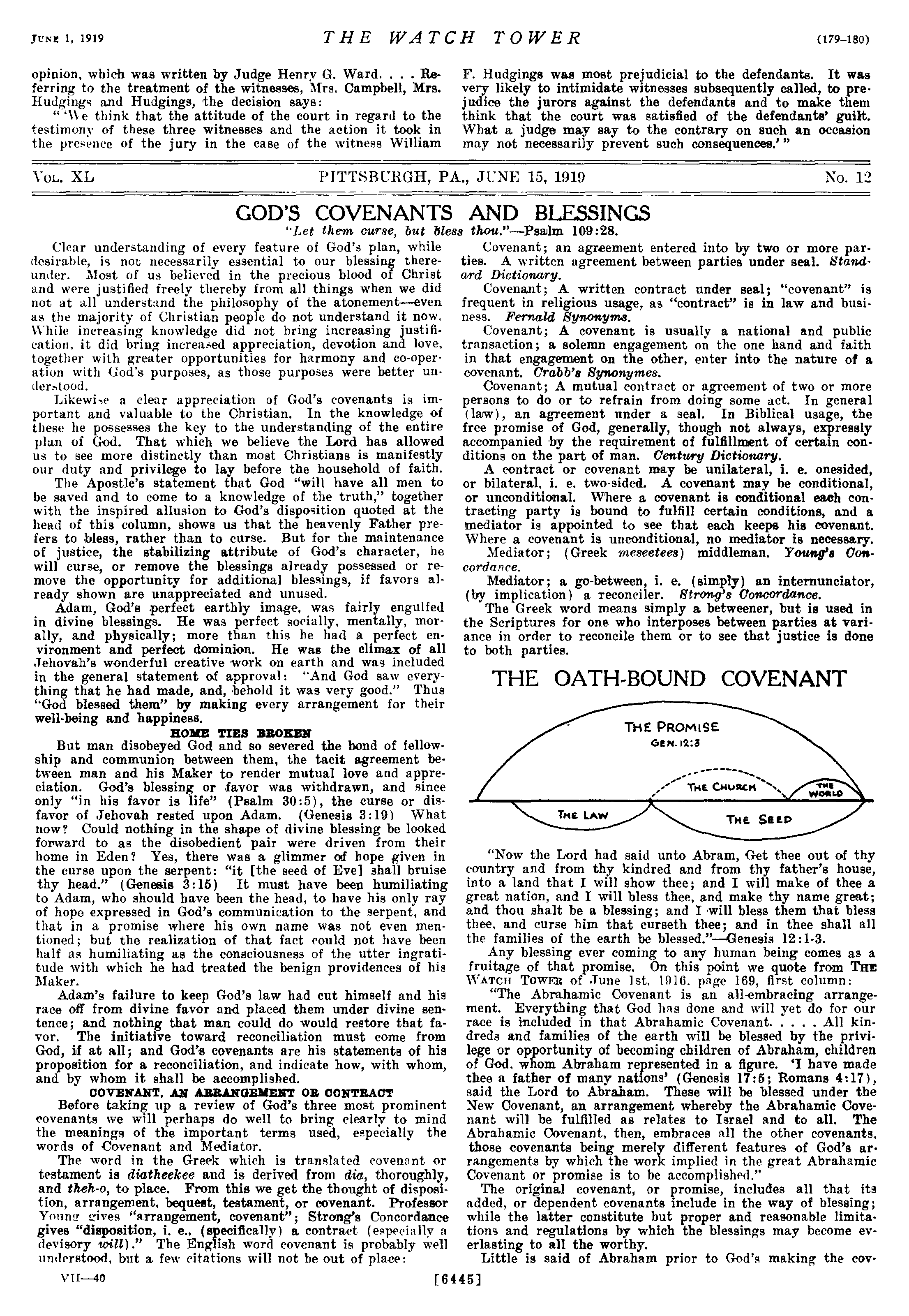
THE
OATH~BOUND
COVENANT
THE
PROMISE
GEN.I'.l.:"
~,~
...
-----
..........
,'--~
THE.
CMuALI1
~~'"
,
,
"Now
the
Lord
had
said
unto
Abram,
f'.-et
thee
out
of
thy
conntry
and
from
thy
kindred
and
from
thy
father's
house,
into
a
land
that
I
will
show
thee;
and
I
will
make
of
thee
a
great
nation,
and
I
will
bless
thee,
and
make
thy
name
great;
and
thou
shalt
be
a
blessing;
and
I
will
bless
them
that
bless
thee,
and
curse
him
that
eurseth
thee;
and
in
thee
shall
all
the
families
of
the
earth
be
blessed."--Genesis
12:
1-3.
Any
blessing
ever
coming
to
any
human
being
comes
as
a
fruitage
of
that
promise.
On
this
point
we
quote
from
THE
"'ATCII
TowP.R
of
.Tune
1st,
Hl16.
png-e
169,
first
column:
"The
Abrahamic
Covenant
is
an
all-embracing
arrange
ment.
Everything
that
God
has
done
and
will
yet
do
for
our
race
is
included
in
that
Abrahamic
Covenant
.....
All
kin·
dreds
and
families
of
the
earth
will
be
blessed
by
the
privi·
lege
or
opportunity
of
becoming
children
of
Abraham,
children
of
God.
wliom
Abraham
r~resented
in
a
figure.
'I
have
made
thee
a
father
of
many
nations'
(Genesis
17:
5;
Rom1Lns
4:
17)
,
said
the
Lord
to
Abraham.
These
will
be
blessed
under
the
~ew
Oovenant,
an
arrangement
whereby
the
Abrahamic
Cove
nant
will
be
fulfilled
as
relates
to
Israel
and
to
all.
The
Abrahamic
Covenant,
then,
embraces
all
the
other
covenants,
those
covenants
being
merely
different
features
of
God's
ar
ra.ngements
by
which
the
work
implied
in
the
great
Abrahamic
Covenant
or
promise
is
to
be
aceomplishl'd,"
The
original
covenant,
or
promise,
includes
all
that
its
added,
or
dependent
covenants
include
in
the
way
of
blessing;
while
the
latter
constitute
hut
proper
and
reasonable
lim
ita·
tioll'l
and
regulations
by
which
the
blessings
may
become
ev·
erlasting
to
all
the
worthy.
Little
is
said
of
Abraham
prior
to
C'rlld's
making
the
cov·
VTI-40
[6445]
Jung 1, 1919 opinion, which was written by Judge Henry G. Ward... . Referring to the treatment of the witnesses, Mrs. Campbell, Mrs. Hudgings and Hudgings, the decision says: “We think that the attitude of the court in regard to the testimony of these three witnesses and the action it took in the presence of the jury in the case of the witness William THE WATCH TOWER (179-180) F. Hudgings was most prejudicial to the defendants. It was very likely to intimidate witnesses subsequently called, to prejudice the jurors against the defendants and to make them think that the court was satisfied of the defendants’ guilt. What a judge may say to the contrary on such an occasion may not necessarily prevent such consequences.’ ” Vou. XL PITTSBURGH, PA., JUNE 15, 1919 GOD’S COVENANTS AND BLESSINGS No. 12 “Let them curse, but bless thou.”—Psalm 109:28. Clear understanding of every feature of God’s plan, while desirable, is not necessarily essential to our blessing thereunder. Most of us believed in the precious blood of Christ and were justified freely thereby from all things when we did not at all understand the philosophy of the atonement—-even as the majority of Christian people do not understand it now. While increasing knowledge did not bring increasing justification, it did bring increased appreciation, devotion and love, together with greater opportunities for harmony and co-operation with God’s purposes, as those purposes were better understood. Likewise a clear appreciation of God’s covenants is important and valuable to the Christian, In the knowledge of these he possesses the key to the understanding of the entire plan of God. That which we believe the Lord has allowed us to see more distinctly than most Christians is manifestly our duty and privilege to lay before the household of faith. The Apostle’s statement that God “will have all men to be saved and to come to a knowledge of the truth,” together with the inspired allusion to God’s disposition quoted at the head of this column, shows us that the heavenly Father prefers to bless, rather than to curse. But for the maintenance of justice, the stabilizing attribute of God’s character, he will curse, or remove the blessings already possessed or remove the opportunity for additional] blessings, if favors already shown are unappreciated and unused. Adam, God’s perfect earthly image, was fairly engulfed in divine blessings. He was perfect socially, mentally, morally, and physically; more than this he had a_ perfect environment and perfect dominion. He was the climax of all Jehovah’s wonderful creative work on earth and was included in the genera] statement of approval: ‘And God saw everything that he had made, and, behold it was very good.” Thus “God blessed them” by making every arrangement for their well-being and happiness. HOME TIES BROKEN But man disobeyed God and so severed the bond of fellowship and communion between them, the tacit agreement between man and his Maker to render mutual love and appreciation. Ged’s blessing or favor was withdrawn, and since only “in his favor is life’? (Psalm 30:5), the curse or disfavor of Jehovah rested upon Adam. (Genesis 3:19) What now? Could nothing in the shape of divine blessing be looked forward to as the disobedient pair were driven from their home in Eden? Yes, there was a glimmer of hope given in the curse upon the serpent: “it [the seed of Eve] shall bruise thy head.” (Genesis 3:15) It must have been humiliating to Adam, who should have been the head, to have his only ray of hope expressed in God’s communication to the serpent, and that in a promise where his own name was not even mentioned; but the realization of that fact could not have been half as humiliating as the consciousness of the utter ingratitude with which he had treated the benign providences of his Maker. Adam’s failure to keep God’s law had cut himself and his race off from divine favor and placed them under divine sentence; and nothing that man could do would restore that favor. The initiative toward reconciliation must come from God, if at all; and God’s covenants are his statements of his proposition for a reconciliation, and indicate how, with whom, and by whom it shall be accomplished. COVENANT, AN ARRANGEMENT OR CONTRACT Before taking up a review of God’s three most prominent covenants we will perhaps do well to bring clearly to mind the meanings of the important terms used, especially the words of Covenant and Mediator. The word in the Greek which is translated covenant or testament is diatheekee and is derived from dia, thoroughly, and theh-o, to place. From this we get the thought of disposition, arrangement, bequest, testament, or covenant. Professor Young gives “arrangement, covenant”; Strong’s Concordance gives “disposition, i. e., (specifically) a contract (especially a devisory will).” The English word covenant is probably well understood, but a few citations will not be out of place: VII—40 Covenant; an agreement entered into by two or more parties. A written agreement between parties under seal. Standard Dictionary. Covenant; A written contract under seal; ‘covenant’? is frequent in religious usage, as “contract” is in law and business. Fernald Synonyms, Covenant; A covenant is usually a national and public transaction; a solemn engagement on the one hand and faith in that engagement on the other, enter into the nature of a covenant. Crabb’s Synonymes. Covenant; A mutual contract or agreement of two or more persons to do or to refrain from doing some act. In general (law), an agreement under a seal. In Biblical usage, the free promise of God, generally, though not always, expressly accompanied by the requirement of fulfillment of certain conditions on the part of man. Century Dictionary. A contract or covenant may be unilateral, i. e. onesided, or bilateral, i. e. two-sided. A covenant may be conditional, or unconditional. Where a covenant is conditional each contracting party is bound to fulfill certain conditions, and a mediator is appointed to see that each keeps his covenant. Where a covenant is unconditional, no mediator is necessary. Mediator; (Greek meseetees) middleman. Young's Concordance. Mediator; a go-between, i. e. (simply) an internunciator, (by implication) a reconciler. Strong’s Concordence. The Greek word means simply a betweener, but is used in the Scriptures for one who interposes between parties at variance in order to reconcile them or to see that justice is done to both parties. THE OATH-BOUND COVENANT THE PROMISE GEN. 12:3 or a, Pa ~/., “ Tre CHURCH ~ “Now the Lord had said unto Abram, Get thee out of thy country and from thy kindred and from thy father’s house, into a land that I will show thee; and I will make of thee a great nation, and I will bless thee, and make thy name great; and thou shalt be a blessing; and I will bless them that bless thee, and curse him that curseth thee; and in thee shall all the families of the earth be blessed.”-—-Genesis 12:1-3. Any blessing ever coming to any human being comes as a fruitage of that promise. On this point we quote from THE Watcn Towrr of June Ist, 1916. page 169, first column: “The Abrahamic Covenant is an all-embracing arrangement. Everything that God has done and will yet do for our race ig included in that Abrahamic Covenant. .... All kindreds and families of the earth will be blessed by the privilege or opportunity of becoming children of Abraham, children of God, whom Abraham represented in a figure. ‘I have made thee a father of many nations’ (Genesis 17:5; Romans 4:17), said the Lord to Abraham. These will be blessed under the New Covenant, an arrangement whereby the Abrahamic Covenant will be fulfilled as relates to Israel and to all. The Abrahamic Covenant, then, embraces all the other covenants, those covenants being merely different features of God’s arrangements by which the work implied in the great Abrahamic Covenant or promise is to be accomplished.” The original covenant, or promise, includes all that ita added, or dependent covenants include in the way of blessing; while the latter constitute but proper and reasonable limitations and regulations by which the blessings may become everlasting to all the worthy. Little is said of Abraham prior to God’s making the cov [6445]
To enhance your experience on our website, we use cookies and similar technologies. Some cookies are essential for the core functionality of our site and cannot be declined. You can choose to accept or decline additional cookies. We want to assure you that none of this data will be sold or used for marketing purposes. You can adjust your preferences at any time by accessing the Privacy Settings from the footer of the page. For more information, please refer to our
Privacy Policy
Terms of Use
.


