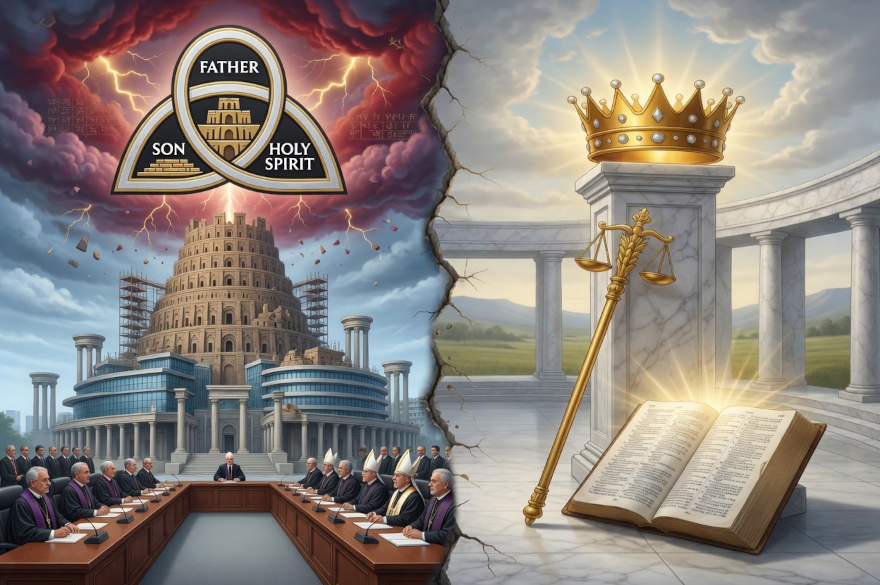
The "Trinity" Opposed to God's Kingdom
Publication date: August 11, 2026
The trinity doctrine is not found in the Holy Scriptures. From Plato to the Council of Nicaea, from Jesus' own words to the apostles' testimony, the Bible consistently shows that Jehovah alone is the Most High God, Jesus is his subordinate Son, and the holy spirit is God's active force — not a triune Godhead.
A Pagan Doctrine, Not a Biblical One
Moses declared:
The Lord our God is one Lord. Deuteronomy 6:4
4Hear, O Israel: The Lord our God is one Lord:
From Moses to Malachi, the prophets never taught a trinity. The heathen nations did — the Babylonians, Assyrians, Greeks, Chinese, and Hindus — but Jehovah's chosen people did not. The prophets warned against adopting these
doctrines of devils, inspired by wicked demons opposed to the one living and true God.
The Greek word
triás, meaning triad, was coined by the pagan philosopher Plato in the fifth century B.C.E. It does not appear anywhere in the Greek Scriptures. Theophilus of Antioch introduced it into Christian writings around C.E. 180, and Tertullian translated it into Latin as
trinitas near the end of the second century. The doctrine does not date from apostolic times but from almost a century later — late enough for the apostasy Paul warned about to take hold.
2 Thessalonians 2:3-12
3Let no man deceive you by any means: for that day shall not come, except there come a falling away first, and that man of sin be revealed, the son of perdition;
4Who opposeth and exalteth himself above all that is called God, or that is worshipped; so that he as God sitteth in the temple of God, shewing himself that he is God.
5Remember ye not, that, when I was yet with you, I told you these things?
6And now ye know what withholdeth that he might be revealed in his time.
7For the mystery of iniquity doth already work: only he who now letteth will let, until he be taken out of the way.
8And then shall that Wicked be revealed, whom the Lord shall consume with the spirit of his mouth, and shall destroy with the brightness of his coming:
9Even him, whose coming is after the working of Satan with all power and signs and lying wonders,
10And with all deceivableness of unrighteousness in them that perish; because they received not the love of the truth, that they might be saved.
11And for this cause God shall send them strong delusion, that they should believe a lie:
12That they all might be damned who believed not the truth, but had pleasure in unrighteousness.
In C.E. 325, the unbaptized Emperor Constantine presided over the Council of Nicaea — not the bishop of Rome. By imperial decree, he banned Arius for opposing trinitarianism and enforced the Nicene Creed by the sword as the rule of belief for the Roman Empire. As the
Watchtower of March 1, 1948 argued, this was not a Bible-based decision but a political one, imposed by imperial power.
The Kingdom Establishment Disproves Co-Equality
In establishing God's Kingdom, Jehovah puts his Son on the throne — which proves subordination, not equality.
Psalms 45:6,7
6Thy throne, O God, is for ever and ever: the sceptre of thy kingdom is a right sceptre.
7Thou lovest righteousness, and hatest wickedness: therefore God, thy God, hath anointed thee with the oil of gladness above thy fellows.
, quoted at
Hebrews 1:8,9
8But unto the Son he saith, Thy throne, O God, is for ever and ever: a sceptre of righteousness is the sceptre of thy kingdom.
9Thou hast loved righteousness, and hated iniquity; therefore God, even thy God, hath anointed thee with the oil of gladness above thy fellows.
, shows Jehovah conferring royal blessings on Christ. Paul's rule applies:
that which is less, is blessed by the better. Hebrews 7:7
7And without all contradiction the less is blessed of the better.
Christ sits at God's right hand
Psalms 110:1
1The Lord said unto my Lord, Sit thou at my right hand, until I make thine enemies thy footstool.
, not in the central position. Unlike Satan, Jesus never tried to make himself
like the Most High.
Philippians 2:5-7
5Let this mind be in you, which was also in Christ Jesus:
6Who, being in the form of God, thought it not robbery to be equal with God:
7But made himself of no reputation, and took upon him the form of a servant, and was made in the likeness of men:
At the end of his reign, Christ
delivers up the kingdom to the Father, that is Jehovah God. He subjects himself to the One who put all things under him.
1 Corinteni 15:24-28
24Then cometh the end, when he shall have delivered up the kingdom to God, even the Father; when he shall have put down all rule and all authority and power.
25For he must reign, till he hath put all enemies under his feet.
26The last enemy that shall be destroyed is death.
27For he hath put all things under his feet. But when he saith all things are put under him, it is manifest that he is excepted, which did put all things under him.
28And when all things shall be subdued unto him, then shall the Son also himself be subject unto him that put all things under him, that God may be all in all.
He makes an exception of Jehovah God — showing that trinitarian co-equality is a religious falsehood. This is not subjection merely as to his human nature, because
flesh and blood cannot possess the kingdom of God. 1 Corinteni 15:50
50Now this I say, brethren, that flesh and blood cannot inherit the kingdom of God; neither doth corruption inherit incorruption.
No Holy Ghost on the Throne
In every vision of God's throne in Revelation, Jehovah sits on the throne and Jesus stands in the midst — but no
holy ghost is ever seen at God's left hand. The great multitude cries
Salvation to our God and to the Lamb Revelation 7:9-10
9After this I beheld, and, lo, a great multitude, which no man could number, of all nations, and kindreds, and people, and tongues, stood before the throne, and before the Lamb, clothed with white robes, and palms in their hands;
10And cried with a loud voice, saying, Salvation to our God which sitteth upon the throne, and unto the Lamb.
— no mention of a holy ghost. Stephen saw Jesus at God's right hand but no holy ghost.
Acts 7:55-56
55But he, being full of the Holy Ghost, looked up stedfastly into heaven, and saw the glory of God, and Jesus standing on the right hand of God,
56And said, Behold, I see the heavens opened, and the Son of man standing on the right hand of God.
Daniel's vision likewise reveals no holy ghost.
Daniel 7:9-14
9I beheld till the thrones were cast down, and the Ancient of days did sit, whose garment was white as snow, and the hair of his head like the pure wool: his throne was like the fiery flame, and his wheels as burning fire.
10A fiery stream issued and came forth from before him: thousand thousands ministered unto him, and ten thousand times ten thousand stood before him: the judgment was set, and the books were opened.
11I beheld then because of the voice of the great words which the horn spake: I beheld even till the beast was slain, and his body destroyed, and given to the burning flame.
12As concerning the rest of the beasts, they had their dominion taken away: yet their lives were prolonged for a season and time.
13I saw in the night visions, and, behold, one like the Son of man came with the clouds of heaven, and came to the Ancient of days, and they brought him near before him.
14And there was given him dominion, and glory, and a kingdom, that all people, nations, and languages, should serve him: his dominion is an everlasting dominion, which shall not pass away, and his kingdom that which shall not be destroyed.
Jehovah God alone is the
Pantokrator — the Almighty One. Jesus is never called Almighty. Jehovah bestows power on his Son.
Matthew 28:18
18And Jesus came and spake unto them, saying, All power is given unto me in heaven and in earth.
The holy spirit is not a
third person but the impersonal, invisible active force proceeding from Jehovah. At Pentecost, Peter said Jesus
received from the Father the promise of the Holy Spirit and poured it forth. Acts 2:32-33
32This Jesus hath God raised up, whereof we all are witnesses.
33Therefore being by the right hand of God exalted, and having received of the Father the promise of the Holy Ghost, he hath shed forth this, which ye now see and hear.
The Sender Is Greater Than the Sent
Jesus always confessed himself as the one sent by God. In his final prayer he said:
this is life eternal, that they might know thee the only true God, and Jesus Christ whom thou hast sent. John 17:3
3And this is life eternal, that they might know thee the only true God, and Jesus Christ, whom thou hast sent.
He was God's Apostle — his Sent One — and thus inferior to the Sender.
Jesus said:
The servant is not greater than his lord; neither he that is sent greater than he that sent him. John 13:16
16Verily, verily, I say unto you, The servant is not greater than his lord; neither he that is sent greater than he that sent him.
The holy spirit is likewise proved not co-equal, because it is sent by both God and Christ.
John 14:26
26But the Comforter, which is the Holy Ghost, whom the Father will send in my name, he shall teach you all things, and bring all things to your remembrance, whatsoever I have said unto you.
John 15:26
26But when the Comforter is come, whom I will send unto you from the Father, even the Spirit of truth, which proceedeth from the Father, he shall testify of me:
It has never had human nature, so the trinitarian argument that it is subject
only as to human nature is impossible.
Jesus declared himself a servant of God, not a co-equal person. Old Testament prophecies called him God's servant.
Isaiah 42:1-4
1Behold my servant, whom I uphold; mine elect, in whom my soul delighteth; I have put my spirit upon him: he shall bring forth judgment to the Gentiles.
2He shall not cry, nor lift up, nor cause his voice to be heard in the street.
3A bruised reed shall he not break, and the smoking flax shall he not quench: he shall bring forth judgment unto truth.
4He shall not fail nor be discouraged, till he have set judgment in the earth: and the isles shall wait for his law.
Isaiah 52:13
13Behold, my servant shall deal prudently, he shall be exalted and extolled, and be very high.
Isaiah 53:11
11He shall see of the travail of his soul, and shall be satisfied: by his knowledge shall my righteous servant justify many; for he shall bear their iniquities.
The disciples prayed about
thy holy servant Jesus.
Acts 4:26-28
26The kings of the earth stood up, and the rulers were gathered together against the Lord, and against his Christ.
27For of a truth against thy holy child Jesus, whom thou hast anointed, both Herod, and Pontius Pilate, with the Gentiles, and the people of Israel, were gathered together,
28For to do whatsoever thy hand and thy counsel determined before to be done.
Peter called him God's
Servant Jesus.
Acts 3:13,26
13The God of Abraham, and of Isaac, and of Jacob, the God of our fathers, hath glorified his Son Jesus; whom ye delivered up, and denied him in the presence of Pilate, when he was determined to let him go.
26Unto you first God, having raised up his Son Jesus, sent him to bless you, in turning away every one of you from his iniquities.
As a servant, Jesus tried to please his heavenly Father, not himself. He said:
I do always those things that please him. John 8:28-29
28Then said Jesus unto them, When ye have lifted up the Son of man, then shall ye know that I am he, and that I do nothing of myself; but as my Father hath taught me, I speak these things.
29And he that sent me is with me: the Father hath not left me alone; for I do always those things that please him.
If he were co-equal in a trinity, he would be inferior to nothing and free to please himself. But Paul wrote:
Christ pleased not himself. Romans 15:1-3
1We then that are strong ought to bear the infirmities of the weak, and not to please ourselves.
2Let every one of us please his neighbour for his good to edification.
3For even Christ pleased not himself; but, as it is written, The reproaches of them that reproached thee fell on me.
The One whose reproaches he bore was separate and distinct from Jesus.
Jesus stated the Father's superiority directly:
My Father is greater than all John 10:29
29My Father, which gave them me, is greater than all; and no man is able to pluck them out of my Father’s hand.
and
my Father is greater than I John 14:28
28Ye have heard how I said unto you, I go away, and come again unto you. If ye loved me, ye would rejoice, because I said, I go unto the Father: for my Father is greater than I.
. This was not merely about his flesh. When Jesus said
Before Abraham was, I am John 8:58
58Jesus said unto them, Verily, verily, I say unto you, Before Abraham was, I am.
, he meant his person. If
I meant his flesh, then Jesus' flesh existed in heaven before he became man — which is absurd.
Jesus Has a God
Jesus refused Satan's temptation, saying:
Thou shalt worship the Lord thy God, and him only shalt thou serve. Matthew 4:8-10
8Again, the devil taketh him up into an exceeding high mountain, and sheweth him all the kingdoms of the world, and the glory of them;
9And saith unto him, All these things will I give thee, if thou wilt fall down and worship me.
10Then saith Jesus unto him, Get thee hence, Satan: for it is written, Thou shalt worship the Lord thy God, and him only shalt thou serve.
On the torture stake he cried:
My God, my God, why hast thou forsaken me? Matthew 27:46
46And about the ninth hour Jesus cried with a loud voice, saying, Eli, Eli, lama sabachthani? that is to say, My God, my God, why hast thou forsaken me?
After his resurrection he said:
I ascend unto my Father, and your Father; and to my God, and your God. John 20:17
17Jesus saith unto her, Touch me not; for I am not yet ascended to my Father: but go to my brethren, and say unto them, I ascend unto my Father, and your Father; and to my God, and your God.
Thomas exclaimed
My Lord and my God John 20:28
28And Thomas answered and said unto him, My Lord and my God.
, but John explains this was written so readers
might believe that Jesus is the Christ, the Son of God John 20:31
31But these are written, that ye might believe that Jesus is the Christ, the Son of God; and that believing ye might have life through his name.
— not that Jesus is Jehovah God. As High Priest forever after the order of Melchizedek, Christ worships Jehovah as his personal God forever.
Hebrews 5:4-6
4And no man taketh this honour unto himself, but he that is called of God, as was Aaron.
5So also Christ glorified not himself to be made an high priest; but he that said unto him, Thou art my Son, to day have I begotten thee.
6As he saith also in another place, Thou art a priest for ever after the order of Melchisedec.
The apostles consistently confirm this. Peter writes:
Blessed be the God and Father of our Lord Jesus Christ 1 Peter 1:3
3Blessed be the God and Father of our Lord Jesus Christ, which according to his abundant mercy hath begotten us again unto a lively hope by the resurrection of Jesus Christ from the dead,
. Paul writes:
the God of our Lord Jesus Christ, the Father of glory Ephesians 1:3,17
3Blessed be the God and Father of our Lord Jesus Christ, who hath blessed us with all spiritual blessings in heavenly places in Christ:
17That the God of our Lord Jesus Christ, the Father of glory, may give unto you the spirit of wisdom and revelation in the knowledge of him:
. John writes that Jesus
made us to be a kingdom, to be priests unto his God and Father Revelation 1:6
6And hath made us kings and priests unto God and his Father; to him be glory and dominion for ever and ever. Amen.
. All three apostles identify Jehovah as the God of Jesus Christ.
One in Purpose, Not in Substance
Trinitarians appeal to
John 10:30
30I and my Father are one.
:
I and the Father are one. But Jesus did not say
one God. He meant oneness of purpose and work, not substance. The parable of the Good Shepherd never mentions the holy spirit — so at most it speaks of a duality, not a trinity. Jehovah is the great Shepherd; Jesus is the Lamb of God.
Paul illustrated this oneness at
1 Corinteni 3:5-9
5Who then is Paul, and who is Apollos, but ministers by whom ye believed, even as the Lord gave to every man?
6I have planted, Apollos watered; but God gave the increase.
7So then neither is he that planteth any thing, neither he that watereth; but God that giveth the increase.
8Now he that planteth and he that watereth are one: and every man shall receive his own reward according to his own labour.
9For we are labourers together with God: ye are God’s husbandry, ye are God’s building.
:
he that planteth and he that watereth are one. Paul and Apollos were one — not in substance or person, but in God's work. Jesus confirmed this in his prayer:
that they all may be one, as thou, Father, in me, and I in thee John 17:20-23
20Neither pray I for these alone, but for them also which shall believe on me through their word;
21That they all may be one; as thou, Father, art in me, and I in thee, that they also may be one in us: that the world may believe that thou hast sent me.
22And the glory which thou gavest me I have given them; that they may be one, even as we are one:
23I in them, and thou in me, that they may be made perfect in one; and that the world may know that thou hast sent me, and hast loved them, as thou hast loved me.
. If this oneness meant consubstantiality, then Jesus was praying for disciples to become part of a multi-person Godhead — reducing the trinity to absurdity.
The Forged Text and the Mistranslation
Trinitarians rely on
1 John 5:7
7For there are three that bear record in heaven, the Father, the Word, and the Holy Ghost: and these three are one.
— the so-called
Comma Johanneum. But those words do not appear in the oldest Greek manuscripts: the Vatican MS 1209, the Sinaitic MS (both 4th century), and the Alexandrine MS (5th century). They appear in no Greek manuscript earlier than the 15th century. Even Jerome's Latin Vulgate did not contain them. They are a
forgery and an uninspired interpolation. Catholic Jesuit editors admit that
nearly all critics agree they were not in John's original text — but Roman Catholic editors are not permitted to remove them without Vatican action.
The other key trinitarian text,
John 1:1
1In the beginning was the Word, and the Word was with God, and the Word was God.
, actually disproves the trinity. John uses the definite article
ho when referring to God (
the Word was with the God) but omits it when referring to the Word (
the Word was a god). This shows two separate individuals. The proper translation, per Archbishop Newcome, reads:
The Word was in the beginning, and the Word was with God, and the Word was a god. Also, John 1:1 mentions only God and the Word — no holy spirit.
The Only Begotten Son
The Word, who became Jesus Christ, was God's first creation. In Revelation, Jesus said:
I am the Amen, the faithful and true witness, who is the beginning of the creation of God. Revelation 3:14
14And unto the angel of the church of the Laodiceans write; These things saith the Amen, the faithful and true witness, the beginning of the creation of God;
Paul confirms: the Son is
the firstborn of every creature and
all other things were created by him, and for him. Colossians 1:15-17
15Who is the image of the invisible God, the firstborn of every creature:
16For by him were all things created, that are in heaven, and that are in earth, visible and invisible, whether they be thrones, or dominions, or principalities, or powers: all things were created by him, and for him:
17And he is before all things, and by him all things consist.
Jehovah God created his Son first, without the colaboring of any other person — directly by himself alone. No other creature enjoyed this distinction. After creating his only begotten Son, Jehovah used him as colaborer in making all other creations.
John 3:16,18
16For God so loved the world, that he gave his only begotten Son, that whosoever believeth in him should not perish, but have everlasting life.
18He that believeth on him is not condemned: but he that believeth not is condemned already, because he hath not believed in the name of the only begotten Son of God.
John 1:14,18
14And the Word was made flesh, and dwelt among us, (and we beheld his glory, the glory as of the only begotten of the Father,) full of grace and truth.
18No man hath seen God at any time; the only begotten Son, which is in the bosom of the Father, he hath declared him.
Why It Matters Now
The so called "Christian" religions claim trinitarian belief but together with the nations they march toward Armageddon in combined opposition to God's Kingdom. The question of supremacy must be openly settled:
Is Jehovah supreme as the Most High God? As the psalmist declared:
thou, whose name alone is JEHOVAH, art the most high over all the earth. Psalms 83:18
18That men may know that thou, whose name alone is Jehovah, art the most high over all the earth.
Belief in the trinity will not save the nations. No three-in-one god exists to come to their rescue. The trinity is an unscriptural pagan doctrine invented by demons who bring reproach upon God's name and most high position. The Holy Scriptures — from Moses to Malachi, from the apostles to John — nowhere teach it.
There Is Hope
Since Christ came into the Kingdom in 1914, he has poured out holy spirit on the faithful remnant.
Joel 2:28-29
28And it shall come to pass afterward, that I will pour out my spirit upon all flesh; and your sons and your daughters shall prophesy, your old men shall dream dreams, your young men shall see visions:
29And also upon the servants and upon the handmaids in those days will I pour out my spirit.
By this spirit's illuminating power, those who search the Scriptures see Jehovah God, Jesus Christ, and the holy spirit in their right relationship — not as a triune God. The truth is liberating:
Sanctify them through thy truth: thy word is truth. John 17:17
17Sanctify them through thy truth: thy word is truth.
The trinity is opposed to God's Kingdom. It denies Jehovah's supremacy, diminishes Christ's subordination, and misrepresents the holy spirit. But the Bible's testimony is clear. Will you trust the traditions of men — enforced by imperial sword at Nicaea — or will you search the Scriptures as the Bereans did?
Acts 17:11
11These were more noble than those in Thessalonica, in that they received the word with all readiness of mind, and searched the scriptures daily, whether those things were so.
The answer determines your relationship with the only true God, Jehovah, and his sent one, Jesus Christ.